
Elliott’s Lovegrass (Eragrostis elliottii)
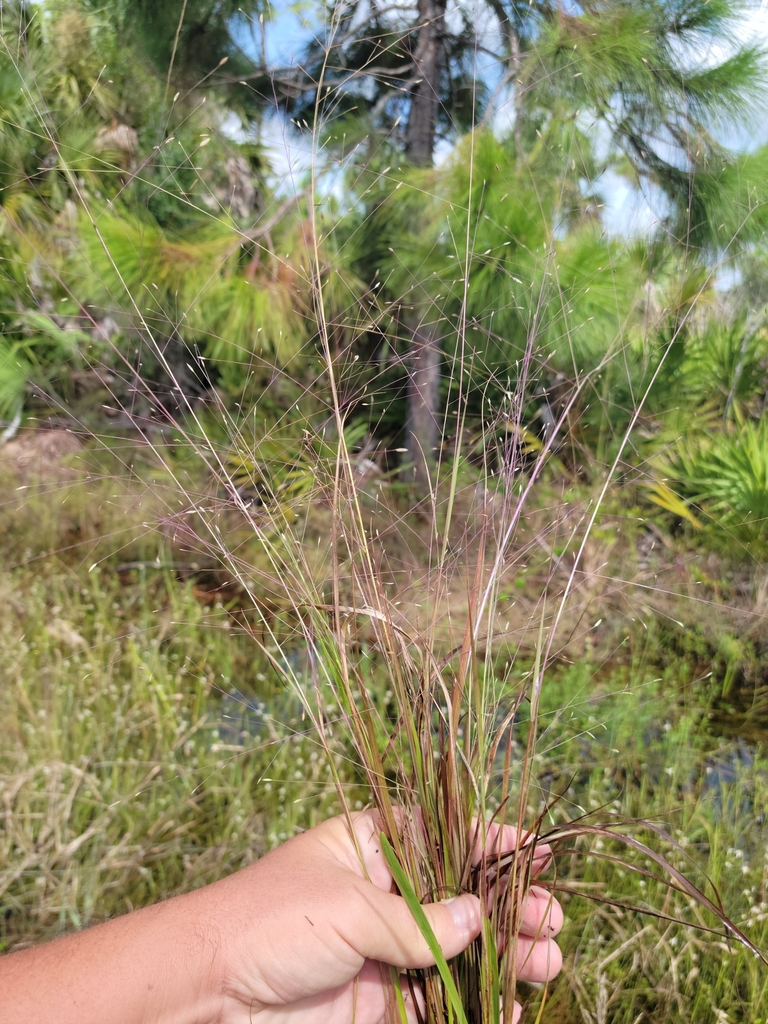
Eragrostis elliottii, Elliott’s Lovegrass, is a fine-textured native bunchgrass of the southeastern Coastal Plain. USDA PLANTS lists it under the common name field lovegrass. It forms a loose, fountain-shaped clump of narrow blue-green to gray-green leaves 1 to 2 feet tall, and from late summer into fall it sends up very open, cloud-like panicles of tiny silvery spikelets that can bring the total height to about 2½ to 3 feet. In the slightest breeze the whole plant shimmers, which is why it has become popular in Florida landscapes, especially the nursery selection ‘Wind Dancer’.
It belongs to the grass family (Poaceae) and to Eragrostis, the lovegrasses, a large genus that also includes the native purple lovegrass and the African grain crop teff. The species name honors Stephen Elliott (1771–1830), a South Carolina banker, legislator and botanist whose Sketch of the Botany of South-Carolina and Georgia first described the plant under another name. Sereno Watson renamed it in his honor in 1883.
In the wild, Elliott’s lovegrass grows in pine flatwoods, savannas, sandhills, coastal dunes and swales, and the edges of marshes and ponds, on moist to dry sandy soils. It is native from North Carolina and Missouri south to Florida and Texas, and also in Puerto Rico, the U.S. Virgin Islands, the Caribbean and parts of Latin America. This guide covers how to identify it, where it grows, and how to use it in gardens and restorations.
Identification
Elliott’s lovegrass is easiest to identify in flower, when its wide, airy panicles stand out against the low, blue-green clump. Several other lovegrasses and similar grasses grow in the same places, so look closely at the leaves, spikelets and growth form.
Growth Form
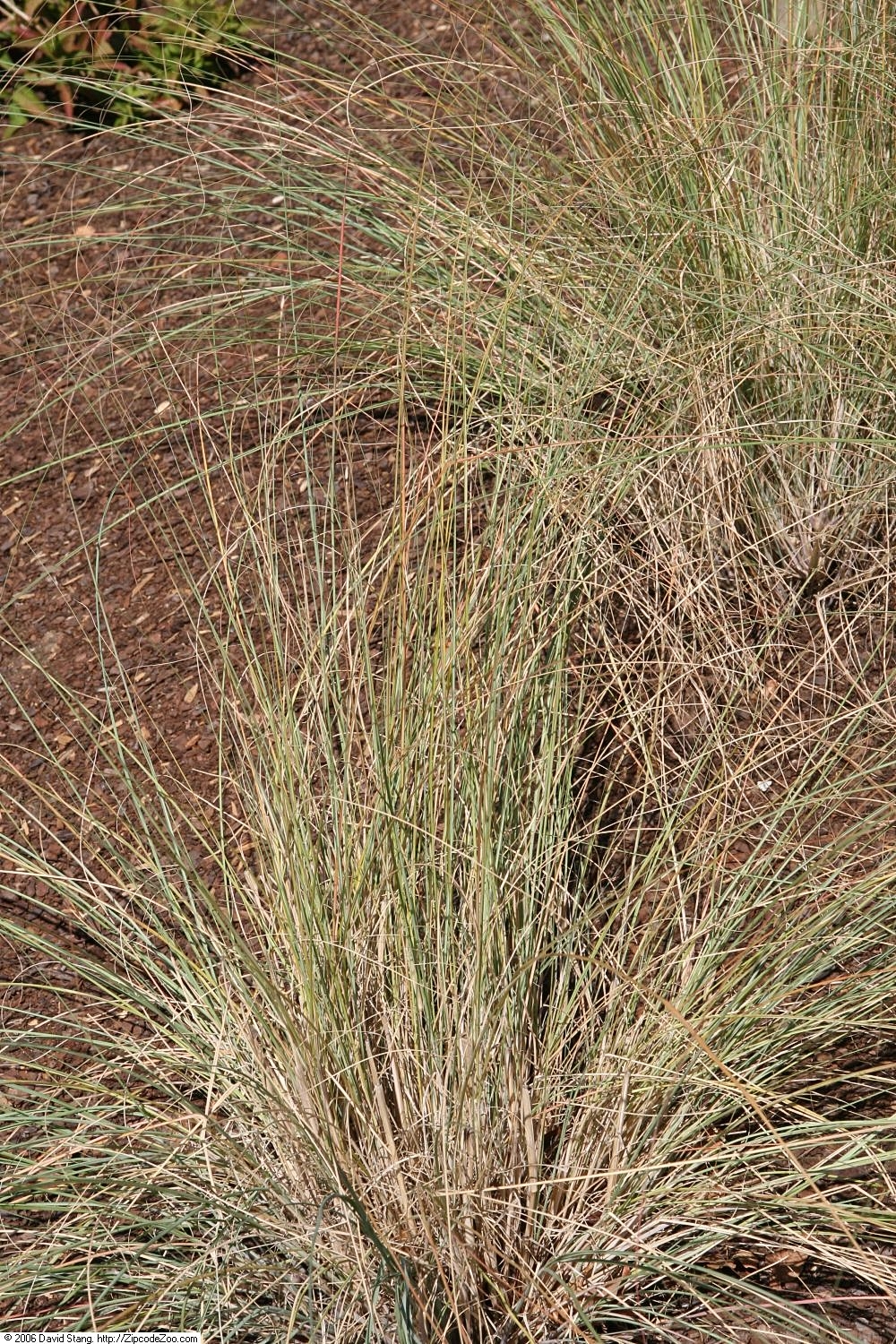
It is a warm-season perennial bunchgrass that grows in a dense tuft without runners. The stems (culms) are slender, 1 to 3 feet tall, and often lean outward, so mature clumps take on a vase or fountain shape. Old clumps can be 2 feet or more across.
Leaves
The leaf blades are long and narrow, about ⅛ to ¼ inch wide, flat or rolled inward, and a distinctive blue-green to gray-green. The leaf sheaths are smooth and often pale. In Florida and along the Gulf Coast the foliage remains partly green through mild winters. Farther north it turns tan.
Flowers & Panicles
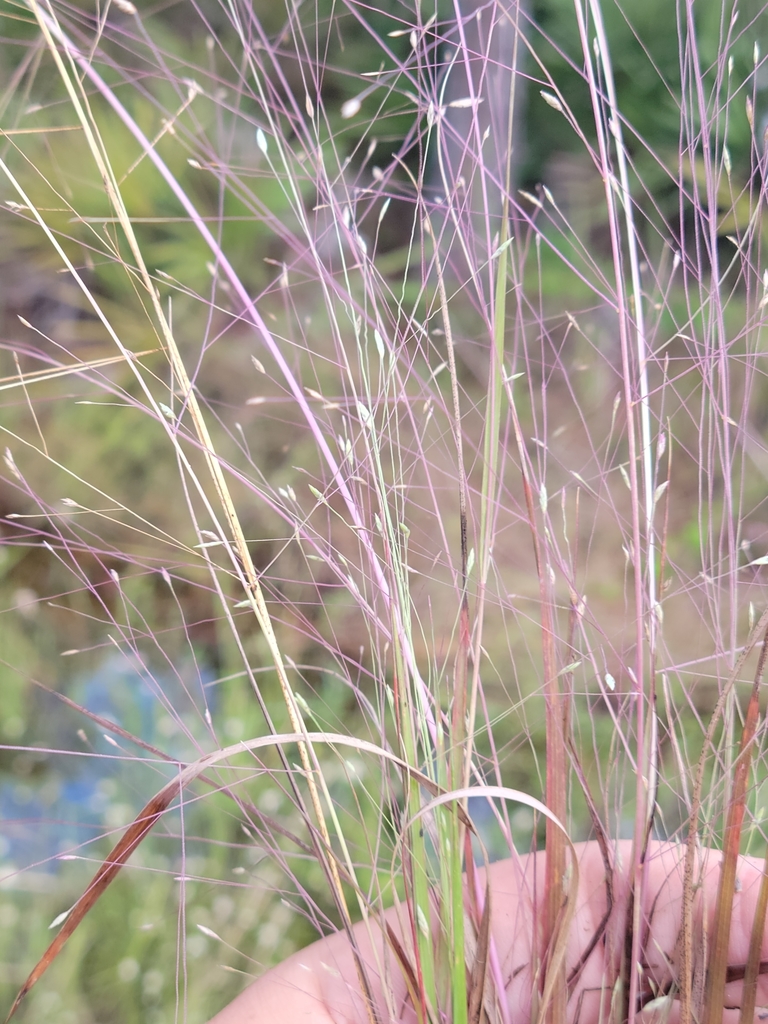
The flowering head is a large, very open panicle, often a foot or more long and nearly as wide, with hair-fine branches that spread widely. The individual spikelets are tiny, flattened and many-flowered, silvery gray to pale green and often tinged purple. The Lady Bird Johnson Wildflower Center gives a bloom time of August to October, but in south Florida plants may flower over much of the year. As the seed ripens the panicle often breaks loose and tumbles in the wind.
Similar Species
Purple lovegrass (Eragrostis spectabilis) has hairier, greener leaves and a denser, distinctly reddish-purple cloud of panicles, and it usually grows on drier, more open ground. Gulf muhly (Muhlenbergia capillaris) has a similar airy look but bright pink to purple flowers and wiry green leaves. The non-native weeping lovegrass (Eragrostis curvula), widely planted for erosion control, has long, arching, bright green leaves and narrower panicles.
Quick Facts
| Scientific Name | Eragrostis elliottii (syn. Poa nitida Elliott) |
| Family | Poaceae (grass family) |
| Plant Type | Warm-season perennial bunchgrass |
| Mature Height | 1–2 ft foliage; 2–3 ft in flower |
| Mature Spread | 1½–3 ft |
| Growth Rate | Moderate to fast |
| Sun Exposure | Full sun to light shade |
| Water Needs | Low to moderate; tolerates both seasonal wetness and drought |
| Soil Type | Sandy soils, from moist flatwoods to dry dunes |
| Soil pH | Acidic to slightly alkaline (about 5.0–7.5) |
| Bloom Time | August–October (much of the year in south Florida) |
| Flower Color | Silvery gray to pale green, often tinged purple |
| Fall Color | Tan to straw; partly evergreen in mild winters |
| Fruit | Tiny grain (caryopsis) |
| Deer Resistant | Yes; rarely browsed |
| USDA Hardiness Zones | 7–11 |
Native Range
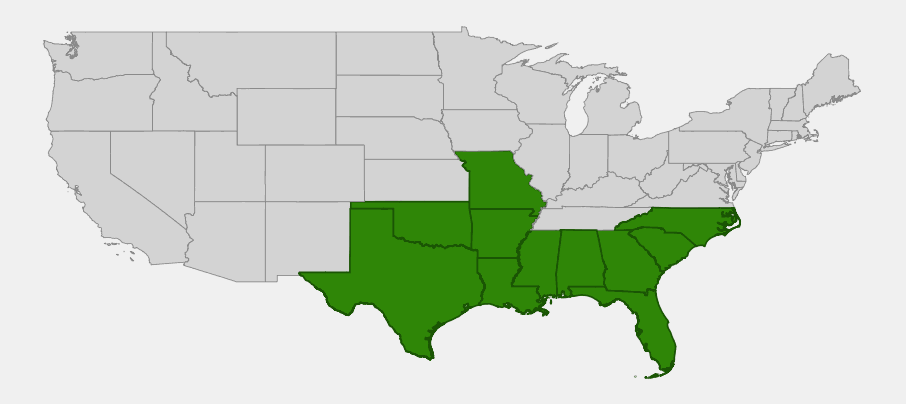
USDA PLANTS and the Lady Bird Johnson Wildflower Center record Elliott’s lovegrass as native in eleven states: Alabama, Arkansas, Florida, Georgia, Louisiana, Mississippi, Missouri, North Carolina, Oklahoma, South Carolina and Texas. USDA also lists it as native in Puerto Rico and the U.S. Virgin Islands, which are not drawn on the map. Outside the United States it occurs in the Bahamas and the Greater Antilles and in parts of Mexico, Central America and South America.
It is overwhelmingly a Coastal Plain grass. It is most common in Florida, south Georgia and along the Gulf Coast, where it grows in wet and mesic pine flatwoods, savannas, wet prairies, coastal dunes and interdunal swales, and along the margins of ponds, marshes and cypress domes. Farther inland and north, in Arkansas, Oklahoma and Missouri, it is much less common and is usually found on sandy, seasonally wet ground. In Florida, the Atlas of Florida Plants records it as native across most of the state, from the Panhandle to south Florida.
The National Wetland Plant List rates it as a facultative wetland species (FACW) in the Southeast, meaning it usually grows in wetlands but also occurs on drier sites. In practice it is a good indicator of the wet-to-dry transition zone in flatwoods and around depressions, where water stands for part of the year.
📋 Regional plant lists featuring Elliott’s Lovegrass: North & South Florida · Alabama, Georgia & Mississippi · North & South Carolina · Arkansas, Louisiana, Eastern Oklahoma & Eastern Texas · Illinois, Iowa & Missouri
Growing & Care Guide
Elliott’s lovegrass is one of the easiest native grasses to grow in the Southeast. It is widely available from Florida native nurseries, both as the wild type and as ‘Wind Dancer’, a selection with especially blue foliage and arching habit. It is adaptable, tough and fast to establish, and it can self-sow modestly in open ground.
Light
Full sun gives the densest, bluest clumps and the most flowers. It tolerates light or partial shade, such as under scattered pines, but in deeper shade it becomes floppy and sparse.
Soil & Water
It grows in almost any sandy soil, from seasonally wet flatwoods to dry, well-drained beds, and it tolerates moderate salt spray. Water new plants regularly for the first few weeks. Once established it rarely needs irrigation except during long droughts. It does not need fertilizer, and rich soils tend to make it floppy.
Planting Tips
Plant plugs or 1-gallon plants 18 to 24 inches apart for a massed effect, or in groups of three or more in mixed borders. It looks best where it can be backlit by the morning or evening sun, which lights up the panicles. Elliott’s lovegrass is also a good choice for rain gardens and swales, planted along the upper edges where water does not stand for long.
Pruning & Maintenance
Cut clumps back to 3 to 4 inches in late winter, before new growth begins, to remove old stems and seed heads. In fire-maintained natural areas, prescribed burning does the same job. Old clumps can be divided every few years if the centers thin out. Expect a few seedlings in bare soil nearby; pull extras or move them while young.
Propagation
Grow it from seed sown on the surface of a moist, sandy mix in spring or early summer; the tiny seeds need light and warm temperatures to germinate. Established clumps can also be divided in spring.
Landscape Uses
- Mass plantings and meadows: a soft, fine-textured matrix grass for sunny native gardens
- Coastal landscapes: tolerates sandy soils, wind and moderate salt spray
- Rain gardens and swales: grows along the edges of seasonally wet areas
- Flatwoods and savanna restoration: a native groundcover grass within its range
- Borders and containers: ‘Wind Dancer’ gives blue-gray foliage and movement in mixed plantings
Wildlife & Ecological Value
Native bunchgrasses such as Elliott’s lovegrass form the structural backbone of southeastern flatwoods and savannas. Their clumps leave open spaces between them where wildflowers, insects and ground-nesting animals live.
For Pollinators
Like other grasses it is wind-pollinated and offers no nectar. Its value to insects is mostly as shelter: the dense base of each clump protects overwintering beetles, spiders and other invertebrates, and native grasses in general support grass-feeding caterpillars of skippers and moths.
For Birds
Its small grains are eaten by sparrows, common ground doves, northern bobwhite and other seed-eating birds, especially in fall and winter. The clumps give cover to ground-foraging birds, and old leaves and stems are used as nesting material.
For Mammals
Small mammals such as cotton rats and mice use the clumps for cover and eat the seeds. It is not a major forage grass for deer or livestock.
Ecosystem Role
In pine flatwoods and savannas it is one of the many bunchgrasses that carry the frequent low-intensity fires these ecosystems depend on, and it resprouts quickly from its base after burning. Its deep, fibrous roots help hold sandy soil and slow runoff on dunes, swales and roadsides.
Cultural & Historical Uses
Stephen Elliott first described this grass as Poa nitida in his Sketch of the Botany of South-Carolina and Georgia (1816–1824), one of the earliest regional floras of the American South. That name had already been used for a different plant, so the American botanist Sereno Watson gave it a new name, Eragrostis elliottii, honoring Elliott, in 1883.
The genus name Eragrostis is usually explained as a combination of the Greek eros (love) and agrostis (a kind of grass), the origin of the common name lovegrass. The genus includes teff (Eragrostis tef), the tiny-seeded grain of Ethiopia, as well as several introduced pasture and erosion-control grasses.
For most of its history Elliott’s lovegrass was simply a background grass of flatwoods and roadsides. In recent decades Florida’s native plant nurseries have made it one of the most popular native ornamental grasses in the state, and ‘Wind Dancer’ is now widely used in residential and commercial landscapes as a native substitute for non-native ornamental grasses.
Frequently Asked Questions
Is Elliott’s lovegrass the same as field lovegrass?
Yes. USDA PLANTS lists Eragrostis elliottii under the common name “field lovegrass,” while Florida nurseries and field guides more often call it Elliott’s lovegrass. Both names refer to the same native grass.
What is ‘Wind Dancer’ lovegrass?
‘Wind Dancer’ is a nursery selection of Elliott’s lovegrass chosen for its blue-gray foliage and graceful, arching form. It is the same native species, propagated from selected plants.
Does Elliott’s lovegrass spread aggressively?
No. It is a clumping bunchgrass with no runners. It may produce some seedlings in bare, sunny soil, but these are easy to remove and rarely become a problem in mulched beds.
Can Elliott’s lovegrass grow in wet soil?
Yes, within limits. It grows naturally in seasonally wet flatwoods and around ponds, and it is rated a facultative wetland plant. It does best where the soil drains between wet periods rather than where water stands for months.
Is Elliott’s lovegrass evergreen?
In south and central Florida it often stays partly green through winter. Farther north it goes dormant and turns tan in cold weather. Cut it back in late winter to make room for fresh growth.

Looking for a nursery that carries Elliott’s Lovegrass?
Browse our native plant nursery directory: Alabama & Arkansas · Florida & Georgia · Louisiana, Mississippi & Missouri · North Carolina & Oklahoma · South Carolina & Texas