
Shoreline Seapurslane (Sesuvium portulacastrum)
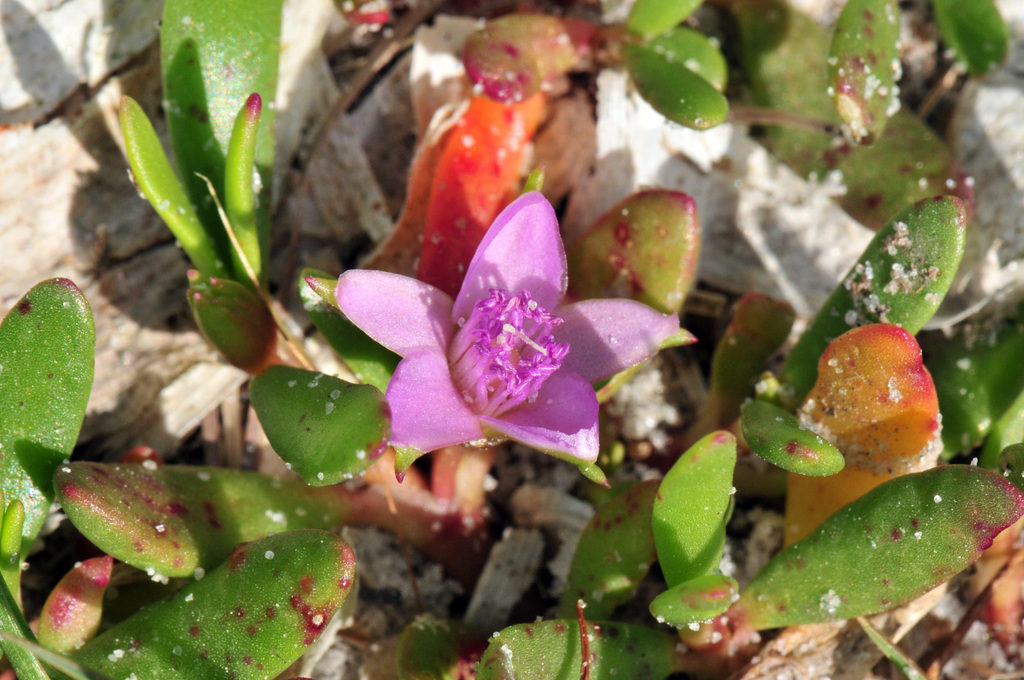
Sesuvium portulacastrum, the Shoreline Seapurslane (also called sea purslane), is a creeping, succulent groundcover of beaches, salt flats and marsh edges. Its smooth, often red stems run across sand and mud and root as they go, and they carry pairs of thick, glossy, finger-like leaves. Small pink, star-shaped flowers open among the leaves through most of the year in warm climates. It belongs to the fig-marigold or ice plant family (Aizoaceae), not to the true purslane family, despite its name.
Shoreline seapurslane is one of the most widespread coastal plants in the world, found on tropical and subtropical shores around the globe. In the United States it grows along the Atlantic coast from North Carolina to Florida and around the Gulf of Mexico to Texas. USDA PLANTS also lists it as native in Hawaii, where it is called ʻākulikuli, and in Puerto Rico and the U.S. Virgin Islands.
For gardeners near the coast it is one of the toughest native groundcovers available. It tolerates salt spray, salty soil, periodic tidal flooding, heat and drought, and it spreads quickly to hold sand in place. This guide covers how to identify it, where it grows, how to use it in coastal landscapes and shoreline restoration, and how it supports shoreline wildlife.
Identification
Shoreline seapurslane is easy to recognize on the beach: a sprawling succulent with opposite, fleshy leaves and pink star-shaped flowers. It can be confused with a few other low, salty-soil succulents.
Stems & Habit
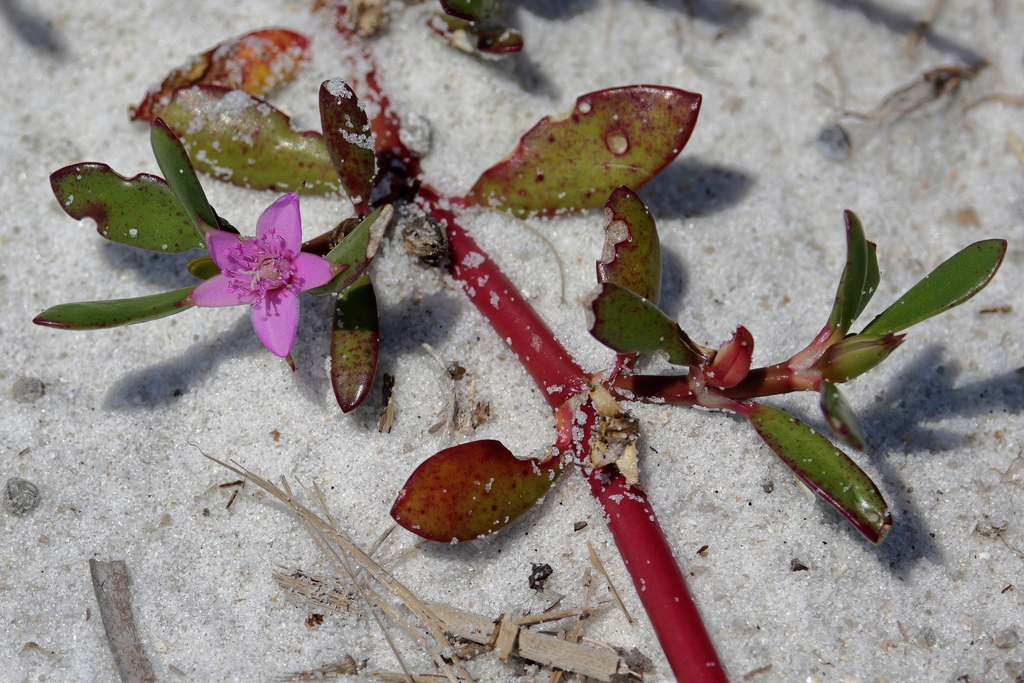
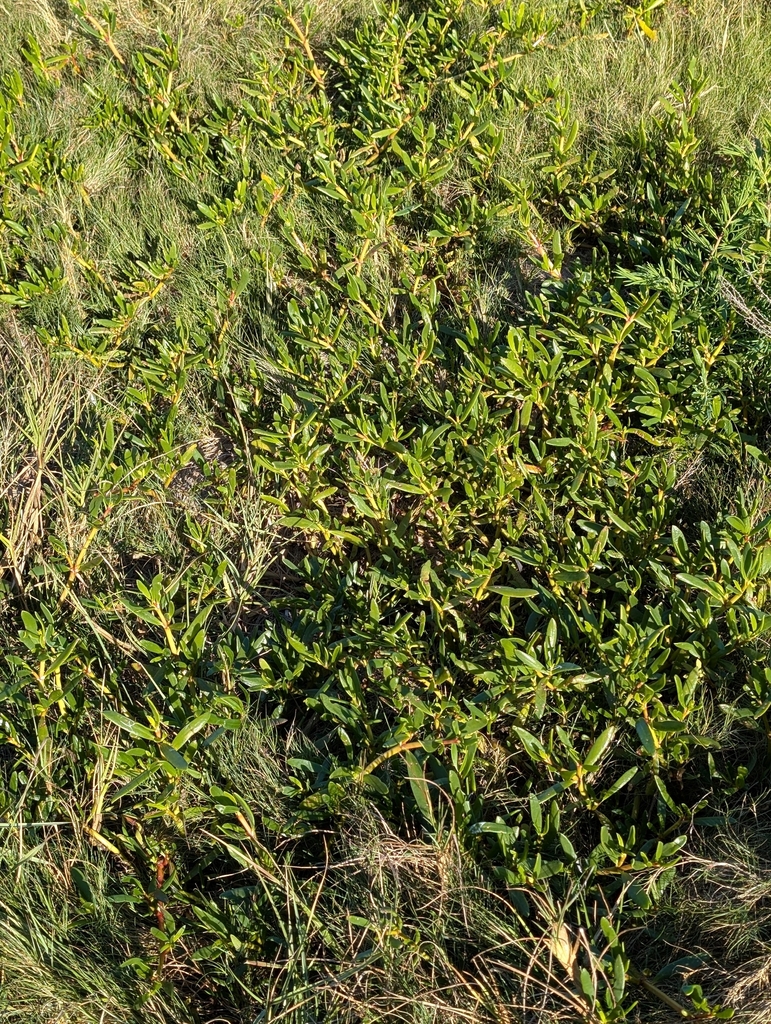
It is a perennial with smooth, fleshy, branching stems that lie flat on the ground and root at the joints. Single stems can run several feet, and plants form mats up to about 6 feet across. The stems are green to bright red, often redder in sun, drought or cool weather. The mat is usually only 4 to 12 inches high.
Leaves
The leaves are opposite, thick and succulent, linear to narrowly spoon-shaped, mostly ¾ to 2½ inches long. They are smooth and shiny, bright green to yellow-green, often blushed red. They hold salty water, which helps the plant survive salt and drought. The bases of each leaf pair clasp the stem.
Flowers
The flowers grow singly in the leaf axils on short stalks. Each is about ½ to 1 inch across, with five pointed, star-like lobes that are pink to purple inside and green outside. They are actually colored sepals; the plant has no true petals. A cluster of many pink stamens sits in the center. Each flower opens for only part of a day, usually in sun. In Florida and other warm areas it can flower in any month.
Annual seapurslane (Sesuvium maritimum) is a smaller, upright annual with stalkless flowers. Common purslane (Portulaca oleracea), a weed in another family, has alternate leaves and yellow flowers.
Fruit & Seeds
The fruit is a small capsule enclosed by the persistent sepals. When ripe, its top comes off like a lid, revealing several smooth, shiny black seeds. Seeds and stem fragments both spread the plant, and stem pieces carried by tides can root on new shores.
Quick Facts
| Scientific Name | Sesuvium portulacastrum (L.) L. (syn. Portulaca portulacastrum) |
| Family | Aizoaceae (fig-marigold or ice plant family) |
| Plant Type | Succulent perennial groundcover |
| Mature Height | 4–12 in |
| Mature Spread | 3–6 ft per plant; spreads by rooting stems |
| Growth Rate | Fast |
| Sun Exposure | Full sun |
| Water Needs | Low to high; tolerates drought and periodic tidal flooding |
| Soil Type | Sand, shell, sandy mud and salty soils |
| Soil pH | Neutral to alkaline (about 6.5–8.5) |
| Bloom Time | Year-round in warm areas; mainly spring–fall farther north |
| Flower Color | Pink to purple |
| Fall Color | Stems and leaves often turn red in cool or dry weather |
| Fruit | Small capsule that opens by a lid; shiny black seeds |
| Deer Resistant | Mostly; salty foliage is seldom browsed |
| USDA Hardiness Zones | 8–11 |
Native Range
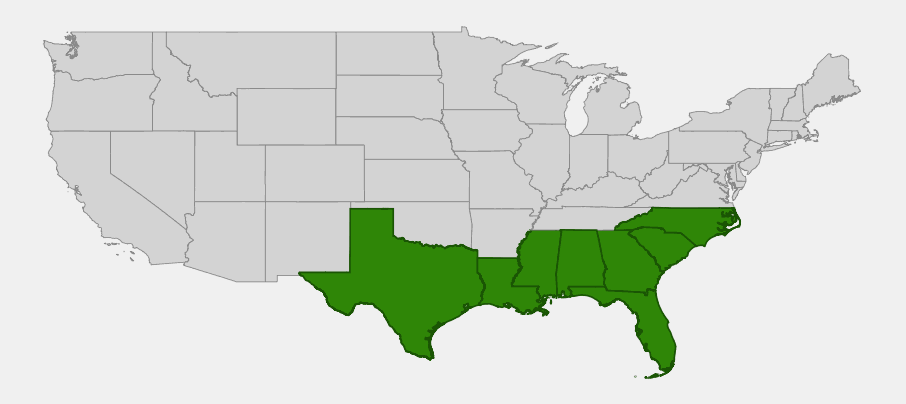
Shoreline seapurslane is pantropical: it grows on warm coasts of the Americas, Africa, Asia, Australia and the Pacific islands. In the continental United States, USDA PLANTS and the Lady Bird Johnson Wildflower Center record it from coastal North Carolina, South Carolina, Georgia, Florida, Alabama, Mississippi, Louisiana and Texas. USDA also lists it as native in Hawaii, Puerto Rico and the U.S. Virgin Islands. (The Wildflower Center’s state list also includes Pennsylvania, well outside its coastal range; that record is not shown on the map.)
In Florida it grows on all coasts, from the Panhandle through the Keys. It is a plant of the zone just above the tide line and of salty, open ground nearby: upper beaches and foredunes, sand and shell flats, salt pans, the edges of salt marshes and mangroves, and the shores of brackish lagoons. It also turns up inland of the beach on salty road shoulders and dredge spoil.
Because both seeds and stem pieces float and survive in seawater, ocean currents have spread it widely. On many shores it is one of the first plants to colonize newly deposited sand or bare ground after a storm, helping to start the build-up of dunes.
📋 Regional plant lists featuring Shoreline Seapurslane: North & South Florida · Alabama, Georgia & Mississippi · North & South Carolina · Arkansas, Louisiana, Eastern Oklahoma & Eastern Texas · South & West Texas · Hawaii
Growing & Care Guide
Shoreline seapurslane is easy to grow wherever winters are mild and the site is sunny. Native nurseries in Florida and along the Gulf Coast sell it, and it is often used in dune and shoreline restoration. It is grown most easily from cuttings.
Light
Give it full sun. It tolerates light shade, but it grows thin and flowers less without several hours of direct sun.
Soil & Water
It thrives in sand, shell and salty soils, and it tolerates salt spray, tidal flooding and long dry spells. In ordinary garden soil it grows well too, as long as drainage is decent. Water new plantings for a few weeks; once rooted, it rarely needs irrigation. Overwatering in rich soil can cause rot. No fertilizer is needed.
Planting Tips
Plant rooted cuttings or plugs 12 to 18 inches apart in spring or summer, when warm weather speeds rooting. On dunes and shorelines, set them above the normal high-tide line and let them spread. It is useful along seawalls, on salt-burned lawn edges and in hot, salty spots near the beach where other groundcovers fail. In zone 8 a hard freeze may kill the tops, and plants regrow from surviving stems.
Pruning & Maintenance
Little care is needed. Trim stems that grow onto paths. It does not tolerate foot traffic well. In mixed beach plantings it fills gaps between taller dune grasses and shrubs.
Propagation
Stem cuttings root very easily: push a 4- to 6-inch piece into moist sand, or lay a stem on the ground and pin it down. Rooting often begins within a week or two in warm weather. It can also be grown from seed sown on the surface of moist sand, but cuttings are faster.
Landscape Uses
- Dune and beach restoration: a fast, salt-tolerant groundcover that traps sand and stabilizes the upper beach
- Living shorelines: for the upper edge of marsh plantings along bays and lagoons
- Coastal groundcover: for sunny, salty spots near seawalls, docks and beach houses
- Rock and succulent gardens: a native succulent for hot, dry sites in mild-winter areas
- Containers: spills attractively over the edges of pots in coastal gardens
Wildlife & Ecological Value
On many beaches, shoreline seapurslane is part of a small but important community of plants that live just above the tide line.
For Pollinators
The flowers are visited by small native bees, flies and other insects, especially on warm, sunny days when they open. Because it blooms in almost every month in warm areas, it provides a steady small nectar and pollen source near the beach.
For Birds
Shorebirds and other birds forage among the mats for insects, small crabs and other invertebrates that shelter there.
For Mammals
Small mammals, such as beach mice, use coastal vegetation for cover and food. The salty foliage is rarely eaten by deer.
Ecosystem Role
Its creeping, rooting stems trap blowing sand and hold sediment, so it is one of the plants that helps start embryo dunes on new beaches and stabilizes salt flats and marsh edges. Its mats also shade the sand, providing cooler, moister cover for crabs, insects and other small animals.
Cultural & Historical Uses
Linnaeus first named this plant Portulaca portulacastrum in 1753 and later moved it to Sesuvium, which explains the “(L.) L.” after its name. The species name means “like Portulaca,” the purslane genus, because of its fleshy leaves and creeping stems.
In Hawaii, where it is native, it is called ʻākulikuli and is widely used in coastal landscaping. In other parts of the world, the salty, crunchy leaves and stems have been eaten raw, pickled or cooked as a vegetable. Anyone foraging should be certain of identification and avoid plants growing on polluted shores.
Researchers have studied shoreline seapurslane for its ability to tolerate high salt levels and to take up salts and some heavy metals from soil, and it is used in coastal restoration in many countries. In the Southeast it is a standard plant in dune and living shoreline projects.
Frequently Asked Questions
Is shoreline seapurslane edible?
The leaves and stems are edible and salty and have been eaten in several parts of the world, raw, pickled or cooked. Only eat it if you are sure of identification, and avoid plants from polluted shores or roadsides.
Is sea purslane related to common purslane?
Not closely. Shoreline seapurslane belongs to the ice plant family (Aizoaceae), while common purslane (Portulaca oleracea) belongs to the purslane family (Portulacaceae). They look somewhat similar because both are fleshy, creeping plants.
Can shoreline seapurslane survive salt water?
Yes. It tolerates salt spray, salty soil and occasional flooding by seawater, which is why it grows just above the tide line on beaches and in salt flats.
Is it native to Hawaii?
Yes. USDA PLANTS lists it as native to Hawaii, where it is known as ʻākulikuli, as well as to Puerto Rico, the U.S. Virgin Islands and the Atlantic and Gulf coasts.
How do I propagate shoreline seapurslane?
From stem cuttings. Push a piece of stem into moist sand, and it usually roots within a couple of weeks in warm weather.

Looking for a nursery that carries Shoreline Seapurslane?
Browse our native plant nursery directory: Alabama · Florida & Georgia · Louisiana & Mississippi · North Carolina · South Carolina & Texas