
Woolly Pawpaw (Asimina incana)
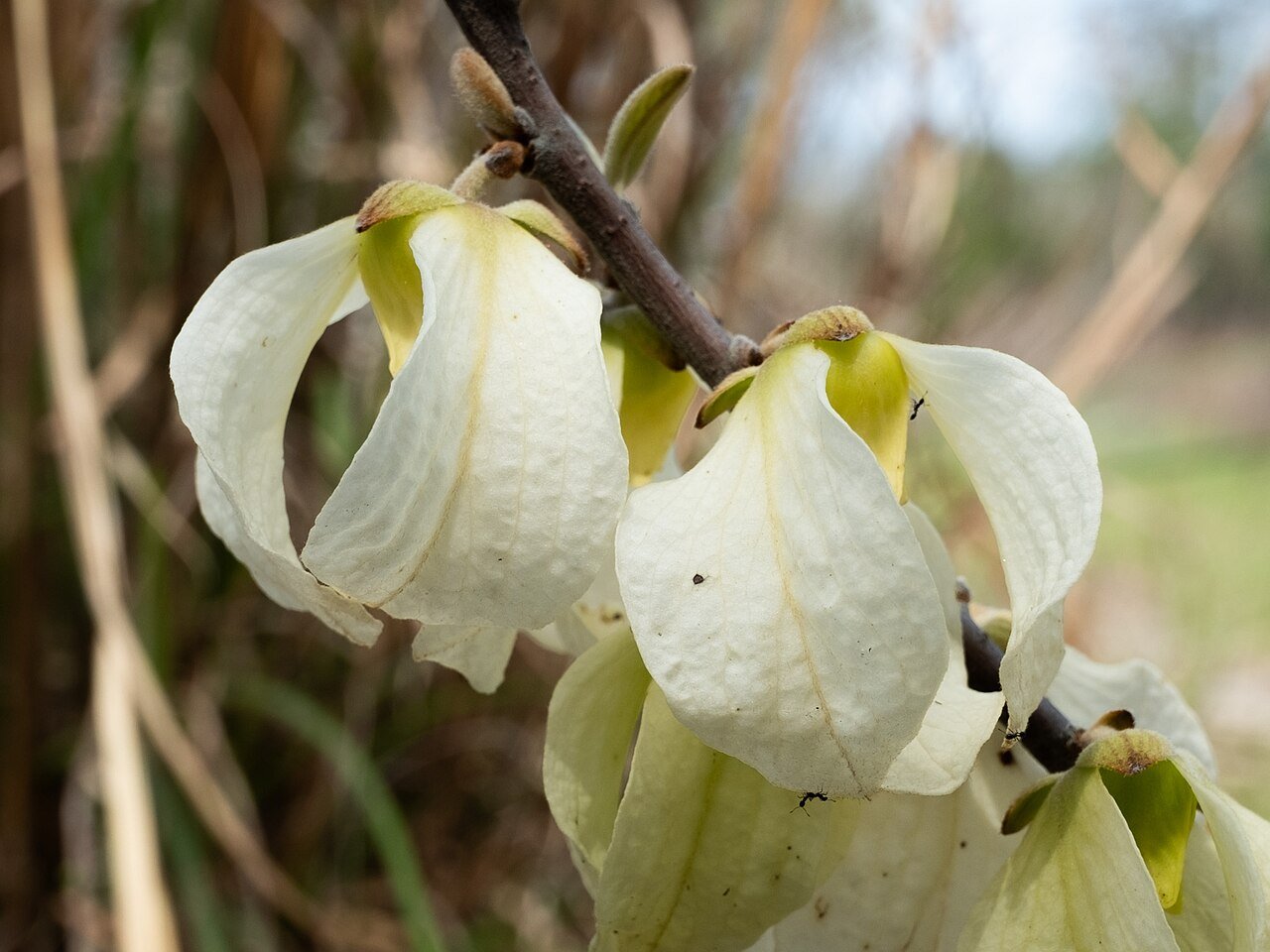
Asimina incana, known as Woolly Pawpaw or polecat bush, is a small deciduous shrub of the dry, sandy pinelands of Florida and southern Georgia. In early spring, often before its leaves have fully expanded, it covers its bare branches with large, nodding, creamy white flowers that are among the showiest of any shrub in the sandhills. Later in the season it produces oblong, green to yellowish fruits that are a smaller relative of the familiar pawpaw. It belongs to the custard-apple family (Annonaceae), a mostly tropical family that reaches its northern limit in the eastern United States.
The name “woolly” refers to the dense covering of soft, gray to rusty hairs on its new shoots, young leaves and flower buds, which is what the species name incana (gray, hoary) also means. It was formerly called Asimina speciosa and Pityothamnus incanus, names still found in older references.
Woolly pawpaw is a fire-adapted plant of longleaf pine sandhills and flatwoods. It is a larval host for the zebra swallowtail butterfly and the pawpaw sphinx moth, and its fruits feed wildlife. For gardeners it is a rewarding, if slow and somewhat finicky, choice for dry, sunny sites in Florida and coastal Georgia.
Identification
Woolly pawpaw is one of several small, shrubby pawpaws native to the Southeast. Its hairy new growth, broad leathery leaves and very large, early white flowers distinguish it from most of its relatives.
Growth Habit
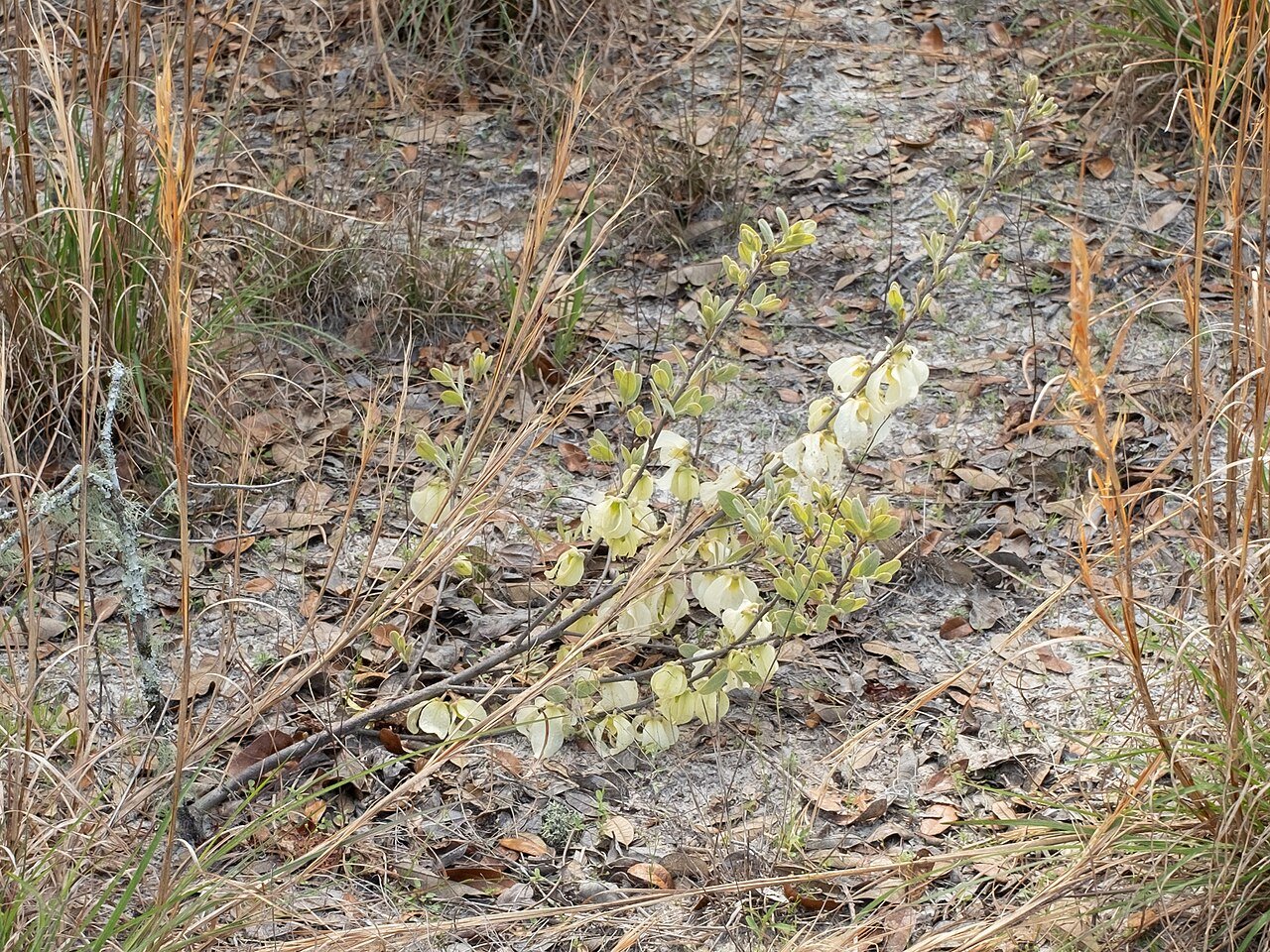
Woolly pawpaw is a low, often sprawling deciduous shrub, usually 2 to 5 feet tall and occasionally taller. It grows from a deep, woody taproot and typically has one to several arching stems. After a fire or cutting, it resprouts from the root crown, so plants in frequently burned sandhills are often small and multi-stemmed.
Leaves
The leaves are alternate, simple, oblong to oval, about 2 to 3½ inches long, thick and leathery with smooth edges and a rounded or blunt tip. New leaves are densely covered in soft gray or rusty hairs, and they keep some hairiness on the underside all season. The foliage has a faintly unpleasant smell when crushed, which may explain the old name “polecat bush”. Leaves turn yellow before dropping in fall.
Flowers
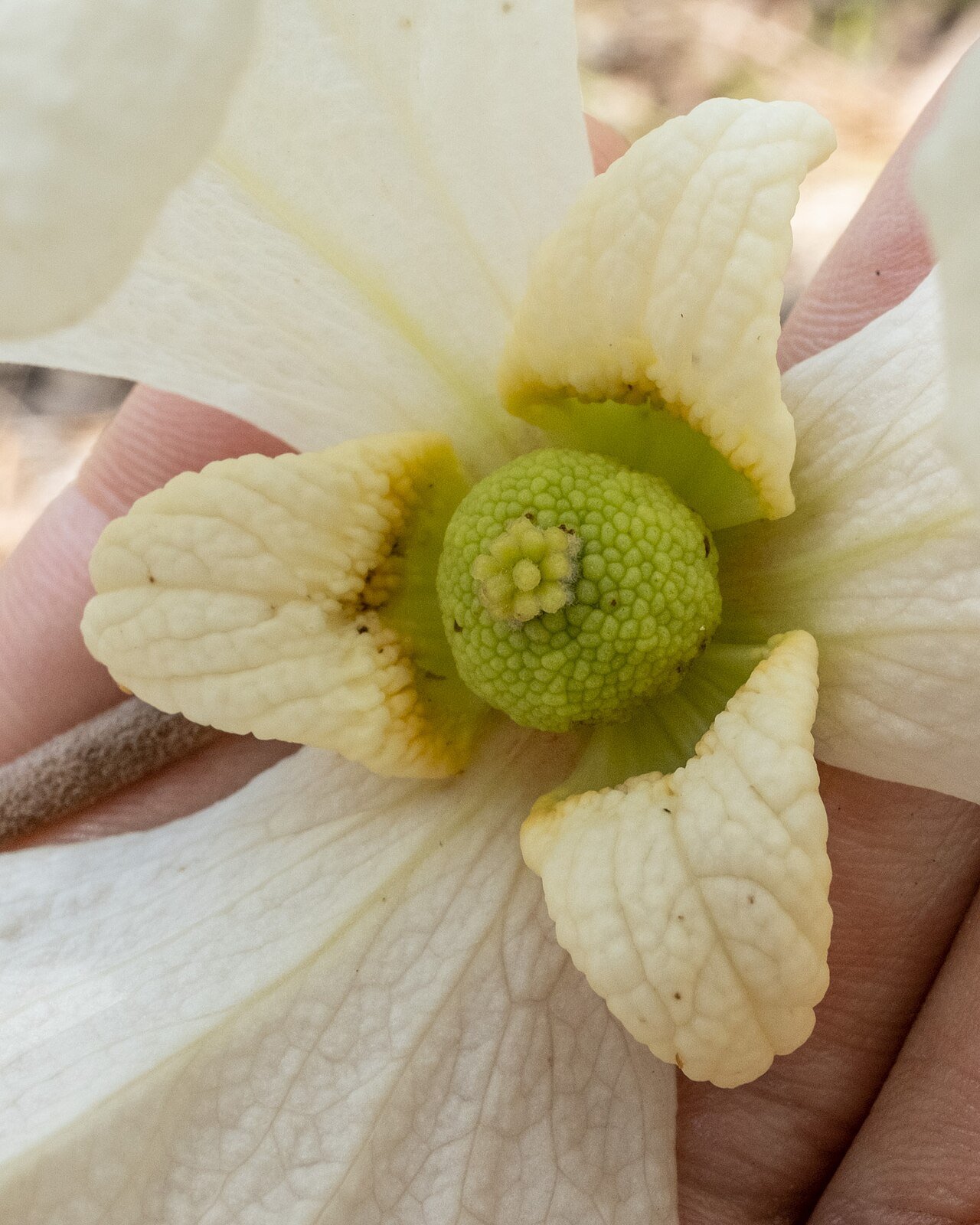
Flowers appear from March to May (rarely into June), mostly on the previous year’s wood, before or as the new leaves emerge. They hang from short, hairy stalks, one to several per node. Each flower has three large, creamy white outer petals, 1½ to 3 inches long and slightly cupped, and three much shorter, thick inner petals that are ridged and often yellowish at the base. At the center is a green, ball-shaped cluster of stamens with several pistils at its tip.
Fruit & Seeds
The fruit is a fleshy, oblong berry about 2 to 3 inches long that ripens from green to yellowish green in summer. The yellow pulp is soft and edible, with a flavor similar to that of its larger relative, the common pawpaw. Each fruit contains several large, flattened, brown seeds.
Similar Species
Bigflower pawpaw (Asimina obovata) of Florida scrub has similarly large white flowers, but its leaves are broader at the tip, less hairy when mature, and usually emerge before the flowers. Netted pawpaw (A. reticulata) has narrow, net-veined leaves and smaller flowers. The common pawpaw (A. triloba) is a small tree of moist forests with maroon flowers.
Quick Facts
| Scientific Name | Asimina incana (syn. Asimina speciosa, Pityothamnus incanus) |
| Family | Annonaceae (custard-apple family) |
| Plant Type | Deciduous shrub |
| Mature Height | 2–5 ft (occasionally to 6 ft) |
| Mature Spread | 3–5 ft |
| Growth Rate | Slow |
| Sun Exposure | Full sun to partial shade |
| Water Needs | Low; very drought tolerant once established |
| Soil Type | Deep, well-drained sand |
| Soil pH | Acidic to neutral |
| Bloom Time | March–May (rarely June) |
| Flower Color | Creamy white with yellowish inner petals |
| Fall Color | Yellow |
| Fruit | Oblong green to yellow-green berry, 2–3 in, edible |
| Deer Resistant | Moderately; foliage is seldom browsed heavily |
| USDA Hardiness Zones | 8–9 |
Native Range
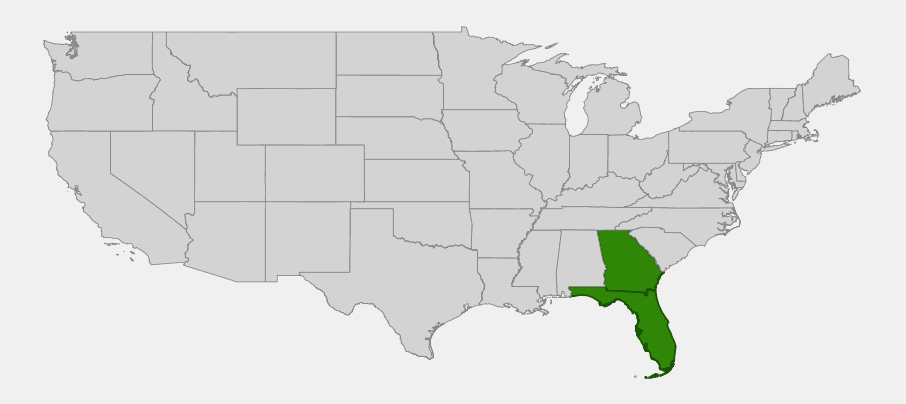
Woolly pawpaw has a small native range in the southeastern Coastal Plain. USDA PLANTS and the Lady Bird Johnson Wildflower Center record it only from Florida and Georgia. In Florida it grows through much of the northern and central peninsula, and in Georgia it reaches the southeastern Coastal Plain.
It is a plant of dry, sandy uplands. Typical habitats are longleaf pine and turkey oak sandhills, upland oak and pine woodlands, flatwoods and scrubby flatwoods. It also persists on old fields, pastures and roadsides with deep sand, where it often survives as resprouts from old taproots. Its deep root system allows it to reach moisture far below the dry surface sand.
Like many sandhill plants, woolly pawpaw depends on regular low-intensity fire. Fire clears away competing shrubs and leaf litter, and woolly pawpaw responds by resprouting and flowering heavily. Where fire has been excluded for decades, it gradually declines under thickening oaks and shrubs.
📋 Regional plant lists featuring Woolly Pawpaw: North & South Florida · Alabama, Georgia & Mississippi
Growing & Care Guide
Woolly pawpaw is a natural fit for dry, sunny, sandy gardens in Florida and coastal Georgia, but it has a reputation for being slow and hard to establish. Its long taproot resents disturbance, so success depends mainly on planting small, container-grown plants and leaving them alone. Look for it at native plant nurseries and Florida Native Plant Society plant sales, and never dig plants from the wild; they almost never survive.
Light
Full sun to light shade. Plants in full sun are more compact and flower more heavily; in deep shade they become sparse and rarely bloom.
Soil & Water
Plant in deep, well-drained, acidic to neutral sand. It does not tolerate poorly drained or wet soils, and it has little tolerance of salt spray. Water regularly during the first growing season, then let it fend for itself; established plants survive long droughts thanks to their deep roots. Avoid fertilizer and rich amended soil.
Planting Tips
Start with small, container-grown plants, ideally grown in tall pots that encourage a long taproot. Disturb the root ball as little as possible and plant it at the same depth it grew in the pot. Plant in fall or winter, when the shrub is dormant and rainfall is more reliable in most of its range. Mark young plants, since they are deciduous and easy to overlook in winter.
Pruning & Maintenance
Little pruning is needed. Remove dead stems in late winter. In naturalistic plantings, old plants can be rejuvenated by cutting them to the ground in winter, imitating the effect of fire; they resprout vigorously from the root. Leave caterpillars alone; zebra swallowtail larvae rarely do lasting harm.
Propagation
Woolly pawpaw is grown from seed. Collect ripe fruit in summer, clean the seeds and sow them fresh; do not let them dry out. Seeds germinate slowly, often after several months, and seedlings first put their energy into the taproot. Grow them in deep containers and transplant them while small. Cuttings and division are rarely successful.
Landscape Uses
- Sandhill and pineland gardens: pairs naturally with wiregrass, gopher apple and other dry-upland natives
- Butterfly gardens: a larval host for the zebra swallowtail
- Wildlife gardens: fruit feeds birds and small mammals; flowers attract beetles and other pollinators
- Habitat restoration: in sandhill and flatwoods restorations within its native range
- Edible landscaping: the small fruits are edible, though fruiting is irregular
Wildlife & Ecological Value
Woolly pawpaw is an important plant in the dry upland pine forests of Florida and Georgia, supporting specialist insects and providing fruit in summer.
For Pollinators
The flowers are pollinated mainly by beetles and flies, which are drawn to their scent and crawl among the inner petals. Like other pawpaws, the flowers are protogynous: the pistils are receptive before the flower sheds its own pollen, which encourages cross-pollination between plants.
For Butterflies & Moths
Woolly pawpaw is a larval host for the zebra swallowtail (Eurytides marcellus), whose caterpillars feed only on pawpaws, and for the pawpaw sphinx moth (Dolba hyloeus). Zebra swallowtails are often seen flying low through sandhills in early spring, searching for young pawpaw leaves on which to lay eggs.
For Birds
Birds eat the ripe fruit, though much of the crop is taken by mammals. The shrubs provide low cover in open pinelands.
For Mammals
Raccoons, opossums, foxes and other small mammals eat the fruit. The leaves are not a preferred deer food.
Ecosystem Role
Woolly pawpaw is part of the diverse shrub and herb layer of longleaf pine sandhills. Its ability to resprout after fire and its deep taproot help it persist through frequent burns and drought, and its flowers and fruits feed insects and wildlife at times of year when few other resources are available.
Cultural & Historical Uses
William Bartram, traveling through Florida in the 1770s, admired a shrubby pawpaw with large white flowers in the sandy pinelands, and the species was later named from his description. Its scientific name has changed several times. It has been placed in the genus Pityothamnus and has been known as Asimina speciosa, and the name Asimina incana was adopted in the twentieth century based on Bartram’s earliest name for it.
The genus name Asimina comes from asiminier, the French colonial name for the pawpaw, which in turn was adapted from a Native American name for the fruit. The fruits of the small shrubby pawpaws were eaten by Indigenous peoples and early settlers in the Southeast, though they are smaller and less abundant than those of the common pawpaw.
Today woolly pawpaw is valued mostly by native plant gardeners and butterfly enthusiasts in Florida, and it is regularly offered at native nurseries and Florida Native Plant Society plant sales.
Frequently Asked Questions
Is woolly pawpaw fruit edible?
Yes. The ripe yellowish pulp is soft and sweet, with a flavor similar to the common pawpaw. Fruits are small and plants fruit irregularly, so it is more of a wild treat than a crop. Eat only fully ripe fruit, and avoid the seeds and skin.
Why is woolly pawpaw hard to transplant?
It forms a long, deep taproot early in life. Digging an established plant almost always damages the root, and the plant usually dies. Start with small container-grown plants and plant them carefully.
Does woolly pawpaw attract butterflies?
Yes. It is a larval host for the zebra swallowtail, a striking black-and-white butterfly whose caterpillars feed only on pawpaws, and for the pawpaw sphinx moth.
Why is it called polecat bush?
The crushed leaves and some flowers have a faintly unpleasant odor, which earned it the old name polecat bush. The smell is noticeable only up close.
Where does woolly pawpaw grow?
It is native only to Florida and southeastern Georgia, where it grows in dry sandhills, pine flatwoods and scrubby flatwoods. In gardens it suits deep, well-drained sand in zones 8 and 9.

Looking for a nursery that carries Woolly Pawpaw?
Browse our native plant nursery directory: Florida & Georgia