
Rose Pogonia (Pogonia ophioglossoides)
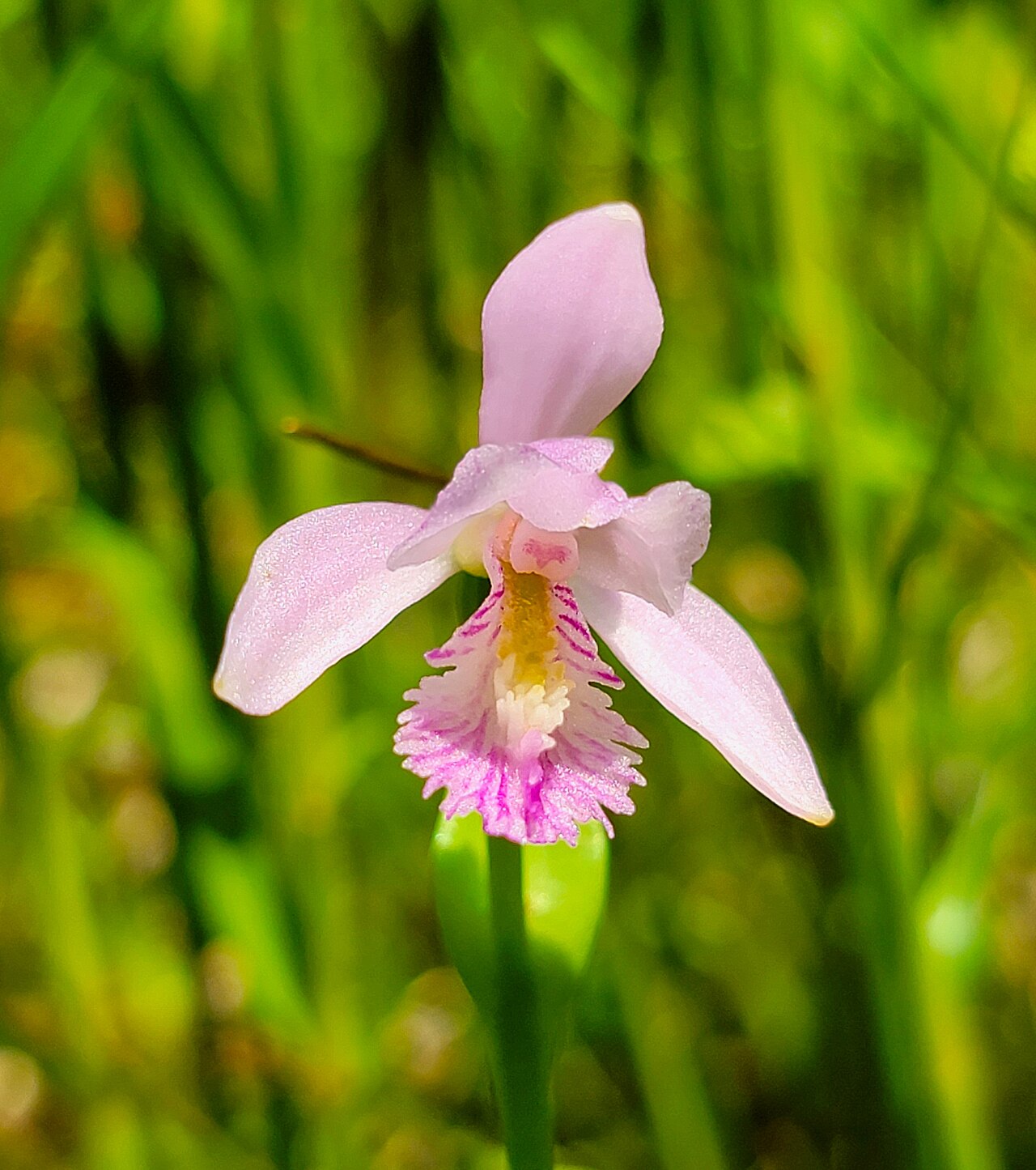
Pogonia ophioglossoides, known as Rose Pogonia or snakemouth orchid, is a small, fragrant native orchid of bogs, fens, wet meadows and wet pine savannas in eastern North America. A single slender stem, usually 8 to 16 inches tall, carries one leaf near its middle and, at the top, usually one rose-pink flower about 1 to 2 inches long. The flower’s lip is fringed and bearded with fleshy yellow and white bristles, which gave the plant both its genus name (Greek pogon, beard) and the common name snakemouth.
Rose pogonia is the only member of its genus in North America, and it has a very wide range, from Newfoundland and Ontario south to Florida and eastern Texas. Across much of that range it is still locally common in good habitat, sometimes forming colonies of dozens or hundreds of stems that spread from the roots. In many places, though, it has declined as wetlands have been drained, developed, or overgrown by shrubs after fire was removed.
In Florida, rose pogonia is listed as a Threatened species under Florida’s state endangered and threatened plant list, as shown in the Atlas of Florida Plants. Florida law prohibits collecting state-listed plants from another person’s land without the owner’s permission. Gardeners who want to grow it should buy only nursery-propagated plants from reputable native orchid growers and never collect plants from the wild. This guide covers identification, range, responsible cultivation and the plant’s role in wetland ecosystems.
Identification
Rose pogonia is easy to recognize in flower. Its single nodding pink flower with a fringed, bearded lip, held above one small leaf, is distinctive among the bog orchids it grows with.
Roots & Stems
Rose pogonia grows from a cluster of slender, fleshy roots rather than a corm or bulb. The roots run through moss and peat and can produce new shoots at intervals, so one plant can gradually form a colony. Each flowering stem is slender, smooth and green, usually about 8 to 16 inches tall, but it ranges from about 3 inches to more than 2 feet depending on conditions.
Leaves
There is a single, stalkless leaf attached about halfway up the stem, lance-shaped to elliptic, up to about 4 inches long and 1¼ inches wide, smooth and somewhat fleshy. A small, leaf-like bract sits just below the flower. Non-flowering plants often produce a single long-stalked leaf from the root.
Flowers
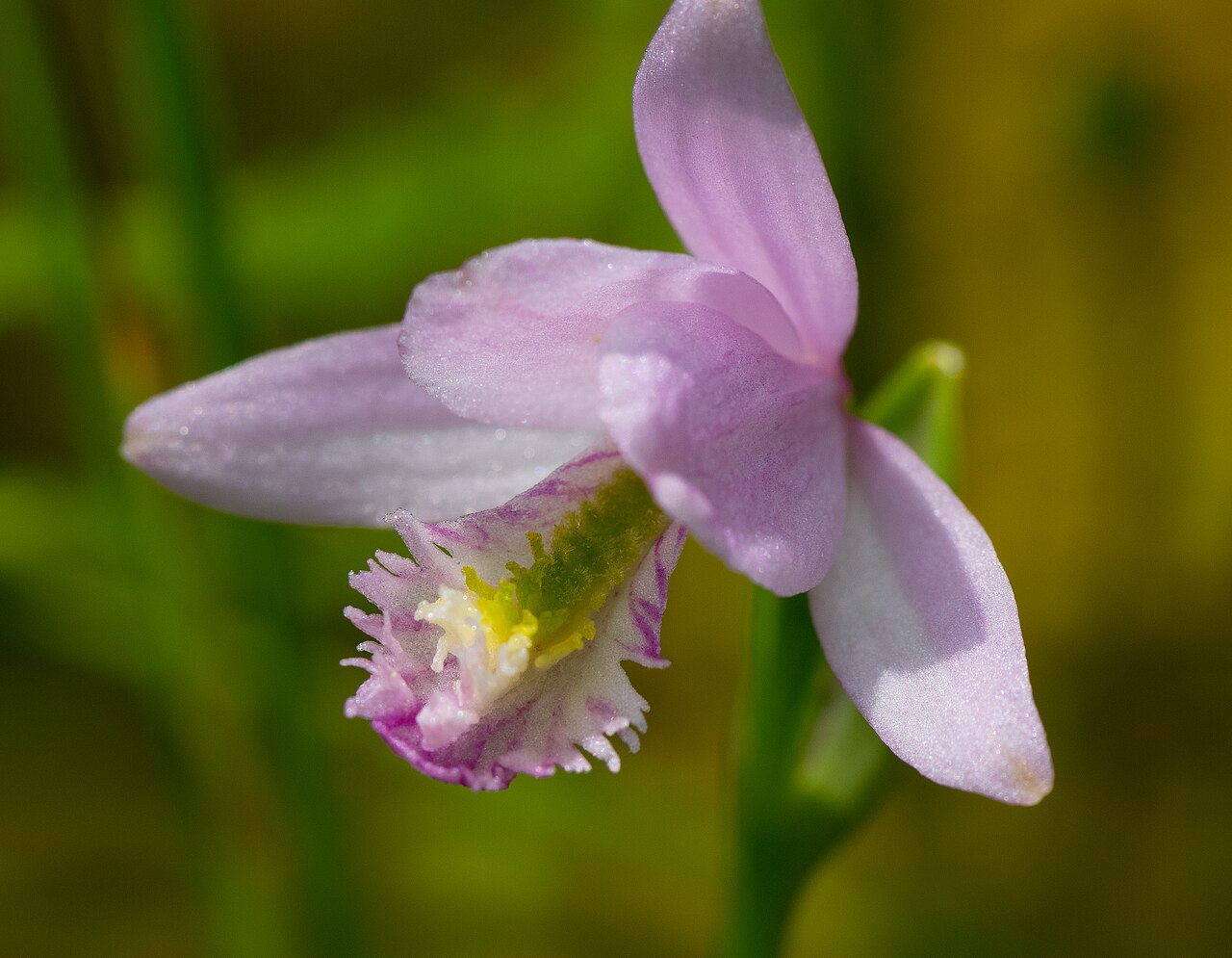
Usually one flower (rarely two or three) opens at the top of the stem. It is pale to deep rose-pink, occasionally white, and about 1 to 2 inches long. The three sepals and two petals are oblong and point forward or upward, forming a loose hood over the lip and column. The lip is spoon-shaped, fringed along its edge, and veined with darker pink, with a central “beard” of fleshy yellow, white and pink bristles. The flowers have a light, pleasant fragrance that many people compare to raspberries. Colonies bloom over several weeks because individual plants open at different times: in Florida and the Gulf Coast mainly in spring, and farther north from late May through July or into August.
Fruit & Seeds
A pollinated flower forms an upright, ribbed capsule about ¾ inch (2 cm) long. When ripe it splits and releases thousands of tiny, dust-like seeds carried by wind. Like all orchid seeds, they need a compatible soil fungus to germinate.
Quick Facts
| Scientific Name | Pogonia ophioglossoides (L.) Ker Gawl. (syn. Arethusa ophioglossoides) |
| Family | Orchidaceae (orchid family) |
| Plant Type | Terrestrial orchid; herbaceous perennial from fleshy roots |
| Mature Height | 8–16 in typical (about 3 in to over 2 ft) |
| Mature Spread | 2–4 in per stem; spreads slowly by root shoots into colonies |
| Growth Rate | Slow |
| Sun Exposure | Full sun to light shade |
| Water Needs | High; constantly moist to saturated soil |
| Soil Type | Sphagnum peat, wet sand or peaty sand; also fen soils |
| Soil pH | About 4.0–6.5 (acidic bogs; some neutral fens) |
| Bloom Time | Spring in Florida and the Gulf Coast; late May–August farther north |
| Flower Color | Rose-pink to pale pink; rarely white |
| Fall Color | None; above-ground parts die back |
| Fruit | Upright ribbed capsule with dust-like seeds |
| Deer Resistant | No; deer sometimes eat the stems and flowers |
| USDA Hardiness Zones | 3–9 |
Native Range
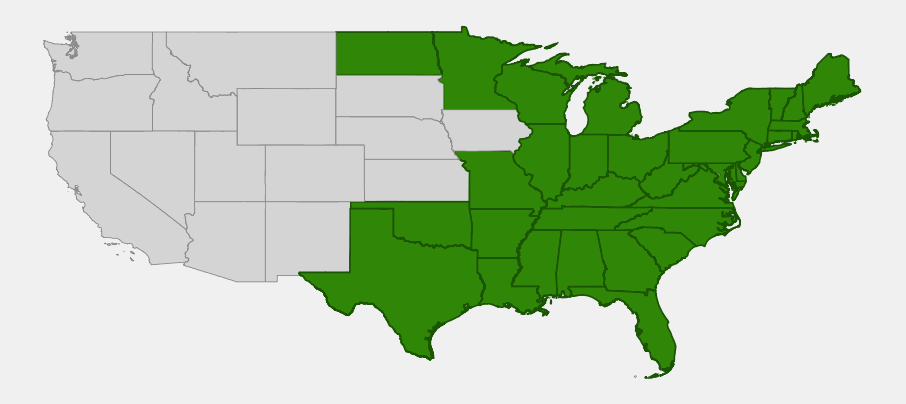
Rose pogonia has one of the widest ranges of any eastern North American orchid. USDA PLANTS and the Lady Bird Johnson Wildflower Center record it from 33 states and the District of Columbia: throughout New England and the Mid-Atlantic, west through the Great Lakes states to Minnesota and North Dakota, south through the Appalachians and the Ohio Valley, and along the whole Atlantic and Gulf Coastal Plain from New Jersey to Florida and eastern Texas, with outlying sites in Arkansas, Missouri and Oklahoma. In Canada it grows in Ontario, Quebec, New Brunswick, Nova Scotia, Prince Edward Island and Newfoundland and Labrador, and it also reaches Saint Pierre and Miquelon.
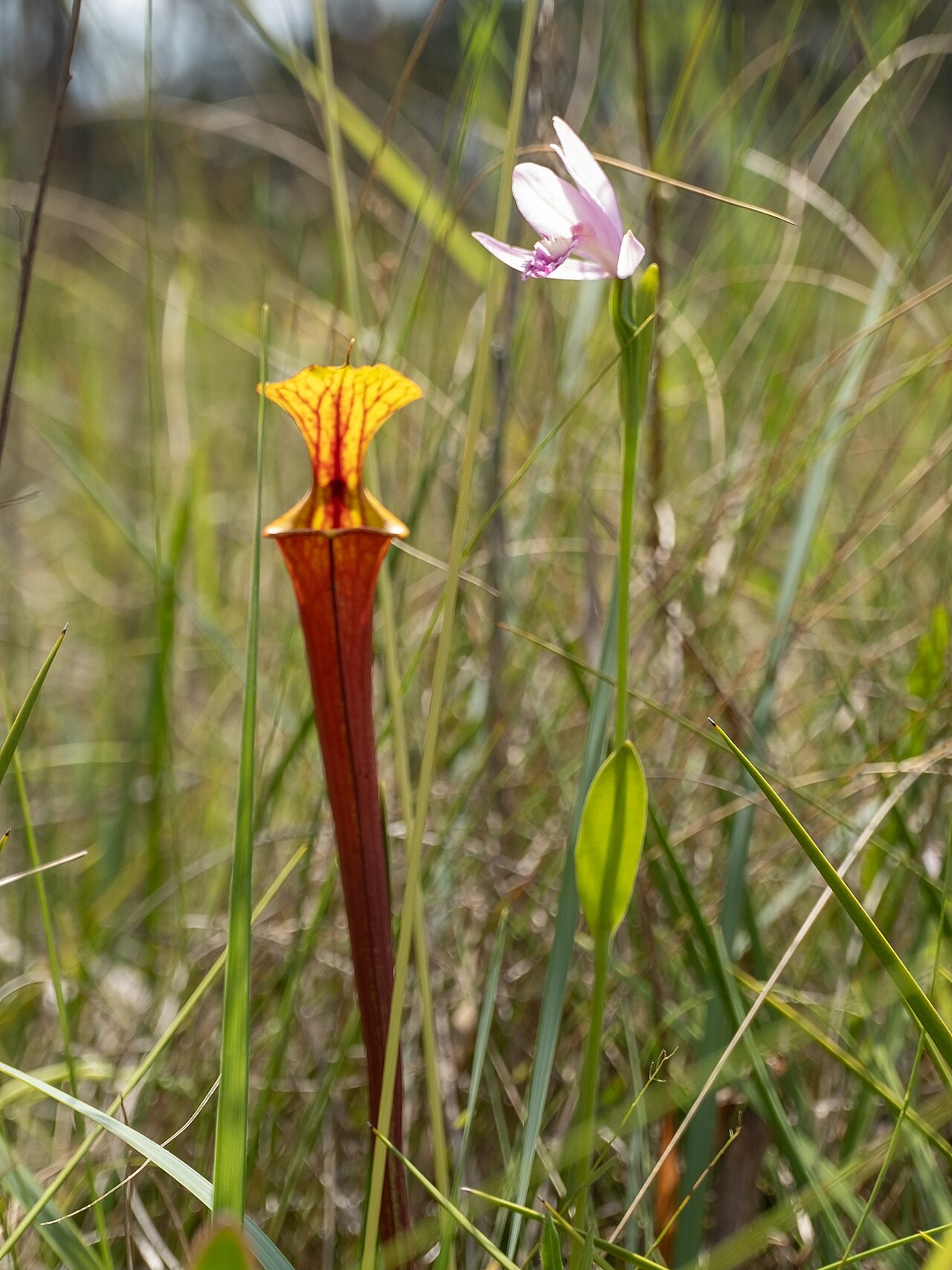
Its habitats change with latitude. In the North it is mostly a plant of open fens, sphagnum bogs, floating mats around bog lakes and wet meadows. On the Coastal Plain of the South, including Florida, it is mainly found in wet pine savannas and flatwoods, seepage bogs, pitcher plant bogs and the edges of ponds and wet ditches. It is typically found alongside grass pink (Calopogon tuberosus) and, in the North, dragon’s mouth (Arethusa bulbosa).
In Florida, rose pogonia is listed as Threatened by the state, according to the Atlas of Florida Plants. Much of its Florida habitat, including seepage bogs and wet savannas, has been lost to drainage, development and fire suppression. It is also listed as rare or protected in several other states at the edges of its range. Collecting from the wild is a real threat to small populations, so please buy only propagated plants.
📋 Regional plant lists featuring Rose Pogonia: North & South Florida · Alabama, Georgia & Mississippi · North & South Carolina · Maryland, Virginia & West Virginia · Kentucky & Tennessee · Arkansas, Louisiana, Eastern Oklahoma & Eastern Texas · Illinois, Iowa & Missouri · Ohio & Indiana · North Dakota, South Dakota & Western Minnesota · Michigan, Wisconsin & Eastern Minnesota · New York, Pennsylvania & Northern New Jersey · Delaware, Southern New Jersey & Long Island · Connecticut, Massachusetts & Rhode Island · New Hampshire, Maine & Vermont
Growing & Care Guide
Rose pogonia can be grown in a well-built bog garden, and it is one of the more forgiving native orchids once established. It must come from a reliable source. Because it is state-listed as Threatened in Florida and declining in many areas, never dig or collect it from the wild. Buy plants raised from seed in lab culture, or divisions from cultivated stock, from reputable native orchid nurseries.
Light
Give it full sun or very light shade. In the wild it disappears as shrubs and trees shade a bog. In a garden bog, place it where taller plants will not overtop it.
Soil & Water
Use a low-nutrient, acidic mix such as two parts sphagnum peat (or live sphagnum) to one part coarse, lime-free sand, in a lined bog garden or large container without drainage holes. Keep the medium constantly wet, with the water table just below the surface during the growing season. Water with rainwater or other low-mineral water if possible, and never fertilize.
Planting Tips
Plant in early spring or while dormant in fall, setting the roots horizontally about an inch below the surface of moist peat or living sphagnum. Plant among low companions such as pitcher plants, sundews and grass pink, which share its needs. Mark the spot, as the plants die back completely in late summer.
Pruning & Maintenance
Keep the bog wet and open. Remove aggressive grasses, sedges and woody seedlings that would shade it. Healthy plants spread by root shoots, and a living sphagnum surface helps them do so. Old stems can be cut back after the capsules have split.
Propagation
In cultivation, established colonies can be divided while dormant by separating rooted shoots. Seed requires sterile lab culture or a compatible fungus and is best left to specialist growers. Do not propagate from wild-collected plants.
Landscape Uses
- Bog gardens: a classic companion for pitcher plants, sundews and grass pink
- Wetland and savanna restoration: in fire-managed bogs and wet savannas within its native range, using propagated stock
- Container bogs: a large, lined tub kept wet can host a small colony
- Native orchid collections: one of the more reliable hardy bog orchids for experienced growers
- Pond margins: in sunny, wet, nutrient-poor peat along the water’s edge
Wildlife & Ecological Value
Rose pogonia is a good indicator of a healthy, open wetland with natural water levels and few nutrients. Where it flowers abundantly, the bog or savanna is usually in good condition.
For Pollinators
Rose pogonia is pollinated mainly by bumblebees, including species such as Bombus borealis and Bombus fervidus. The flower is deceptive: its bristly yellow beard looks like a rich supply of pollen, but it offers no nectar. A bee landing on the lip pushes forward under the column and picks up pollen on its back as it backs out. Because bees learn to avoid the flowers, rose pogonia relies on a steady supply of inexperienced bees and often blooms alongside other deceptive orchids such as grass pink.
For Birds
The plant has no direct food value for birds. The wetlands where it grows, though, are important habitat for many birds, from sedge wrens and swamp sparrows in northern bogs to Henslow’s sparrows and other grassland birds in southern savannas.
For Mammals
Deer sometimes graze the stems and flowers in bogs and meadows. The plant is otherwise of little importance to mammals.
Ecosystem Role
Like all orchids, rose pogonia depends on mycorrhizal fungi to germinate and to grow as a young plant. In the South it is adapted to frequent fire, which keeps savannas and bogs open; plants survive underground and often flower well after burns. Drainage, development, fire suppression and collecting are the main threats to its populations.
Cultural & Historical Uses
Linnaeus described the plant in 1753 as Arethusa ophioglossoides, and John Bellenden Ker Gawler moved it to Pogonia in 1816. The species name means “like Ophioglossum,” the adder’s-tongue fern, probably because the single leaf resembles the fern’s leaf. “Adder’s mouth” and “snakemouth” both come from the open, fringed lip, which some people imagined as an open snake’s mouth.
Rose pogonia has long been admired by naturalists in New England and the Great Lakes, where it blooms in June and July in the same bogs as grass pink and pitcher plants. It remains a favorite of wildflower photographers and bog walkers.
Today it is a familiar species in native orchid conservation. Several specialist nurseries propagate it, and it is used in bog restoration projects. Buying propagated plants, protecting wetlands, and restoring fire to southern savannas are the best ways to help it survive.
Frequently Asked Questions
Is rose pogonia protected in Florida?
Yes. It is listed as a Threatened plant in Florida (state listing shown in the Atlas of Florida Plants). Do not collect it from the wild. Buy only nursery-propagated plants from reputable native orchid growers.
Can I grow rose pogonia in my garden?
Yes, if you can provide a sunny, constantly wet, acidic bog garden. It is one of the easier native orchids to keep once established, and healthy plants spread slowly by root shoots. Start with propagated plants, not wild-collected ones.
Why is it called snakemouth orchid?
The fringed, open lip of the flower reminded early naturalists of an open snake’s mouth. The scientific name refers to the adder’s-tongue fern (Ophioglossum), whose leaf the single orchid leaf resembles.
Does rose pogonia have a scent?
Yes. The flowers have a light, sweet fragrance that many people describe as similar to raspberries.
When does rose pogonia bloom?
In Florida and along the Gulf Coast it blooms in spring. Farther north it flowers from late May through July, sometimes into August. Colonies bloom for several weeks because individual plants open at different times.

Looking for a nursery that carries Rose Pogonia?
Browse our native plant nursery directory: Alabama & Arkansas · Connecticut, Delaware, Florida & Georgia · Illinois & Indiana · Kentucky, Louisiana, Maine, Maryland, Massachusetts, Michigan, Minnesota, Mississippi & Missouri · New Hampshire, New Jersey, New York, North Carolina, North Dakota, Ohio & Oklahoma · Pennsylvania, Rhode Island, South Carolina, Tennessee, Texas, Vermont & Virginia · West Virginia & Wisconsin