
Sawgrass (Cladium jamaicense)
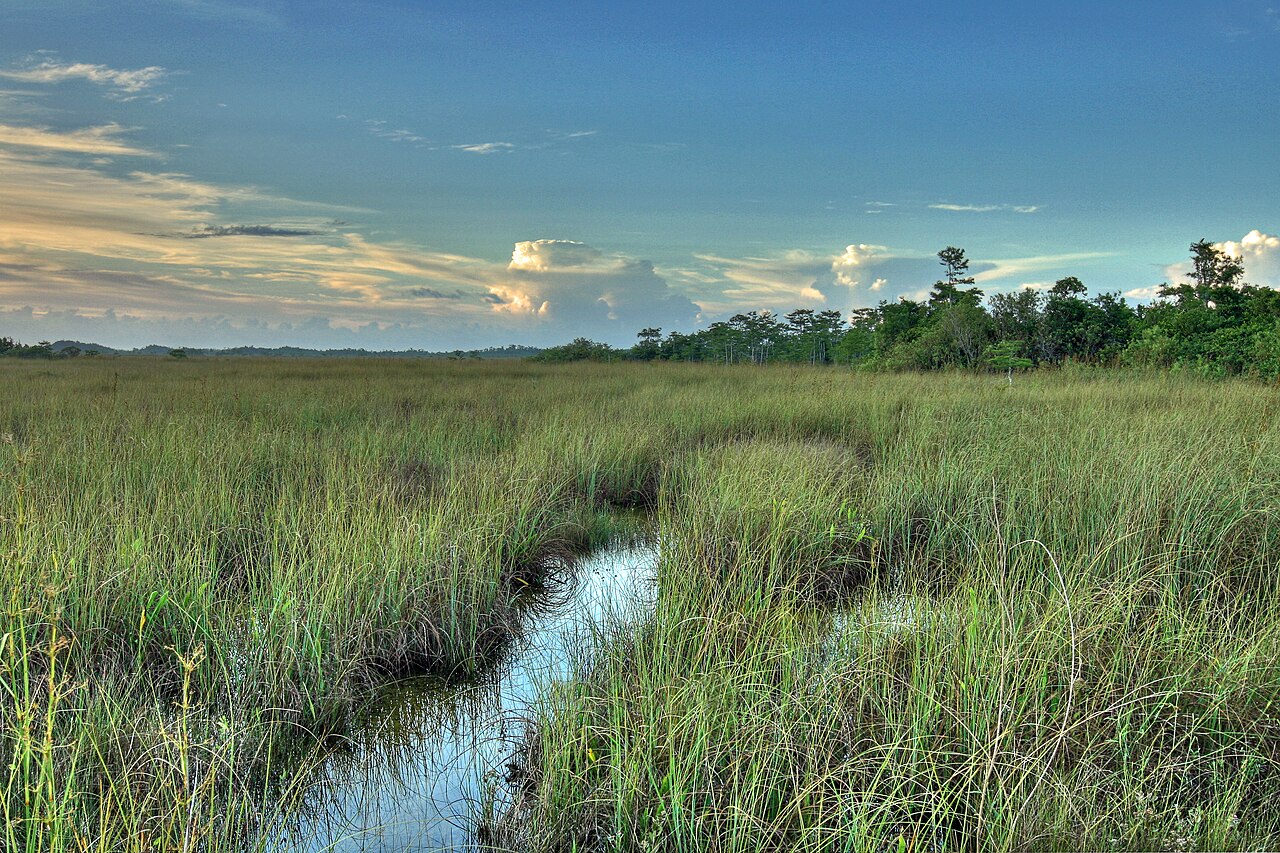
Cladium jamaicense, Sawgrass or Jamaica swamp sawgrass, is not a grass at all. It is a tall, tough, rhizomatous sedge whose leaf edges and midribs carry rows of small, hard, forward-pointing teeth that will slice skin like a serrated blade. It is the defining plant of the Florida Everglades, where it covers hundreds of square miles in unbroken stands, and it grows along wet margins from Virginia around the Gulf to Texas and New Mexico, as well as in Hawaii and Puerto Rico.
Gardeners, restoration crews and the Atlas of Florida Plants call it Cladium jamaicense. USDA PLANTS treats it as a subspecies of a widespread Old World plant, Cladium mariscus ssp. jamaicense, under the symbol CLMAJ. Both names are in current use and refer to the same plant; the question is whether the American material is distinct enough from European great fen-sedge to stand as its own species. In Hawaii the same plant is called ‘uki.
Sawgrass is a plant of low nutrients, standing water and fire. It grows where phosphorus is scarce, tolerates months of flooding and months of drought in the same year, and recovers from marsh fires that kill most of its competitors. Those traits make it a superb restoration plant and a genuinely difficult garden plant. This guide covers how to recognize it, where it grows, what it does for wildlife, and how to use it safely in a large wet landscape.
Identification
At a distance sawgrass reads as a coarse, dull green to tawny grass 4 to 8 feet tall. Up close nothing else looks like it: run a finger very lightly along the leaf edge, in the direction the teeth point, and you will feel why it is called sawgrass. Better still, look without touching.
Habit & Rhizomes
Sawgrass grows from stout, woody, horizontal rhizomes that creep through peat or marl just below the surface. Each rhizome sends up fans of leaves and, in some years, a flowering stem. Over time a single plant builds a dense colony that excludes almost everything else, which is why sawgrass marshes look so uniform. Plants usually stand 3 to 6 feet tall, and in deep, fertile peat in the northern Everglades they can reach 9 or 10 feet. The rhizomes store enough starch to regrow the entire top of the plant after fire or a hard freeze.
Leaves
Leaves are long, narrow, flat to V-shaped in cross-section, keeled, and arranged in three ranks. They are 1/4 to 3/4 inch wide and can be 3 to 6 feet long, arching over at the tip. The margins and the underside of the midrib carry rows of stiff, forward-pointing teeth large enough to see with a hand lens and sharp enough to cut skin, clothing and airboat tires. The teeth point toward the leaf tip, so a hand sliding up the leaf is cut and a hand sliding down is not. Color is olive to yellow-green, drying to straw and tan. Leaves are evergreen in frost-free areas.
Flowers
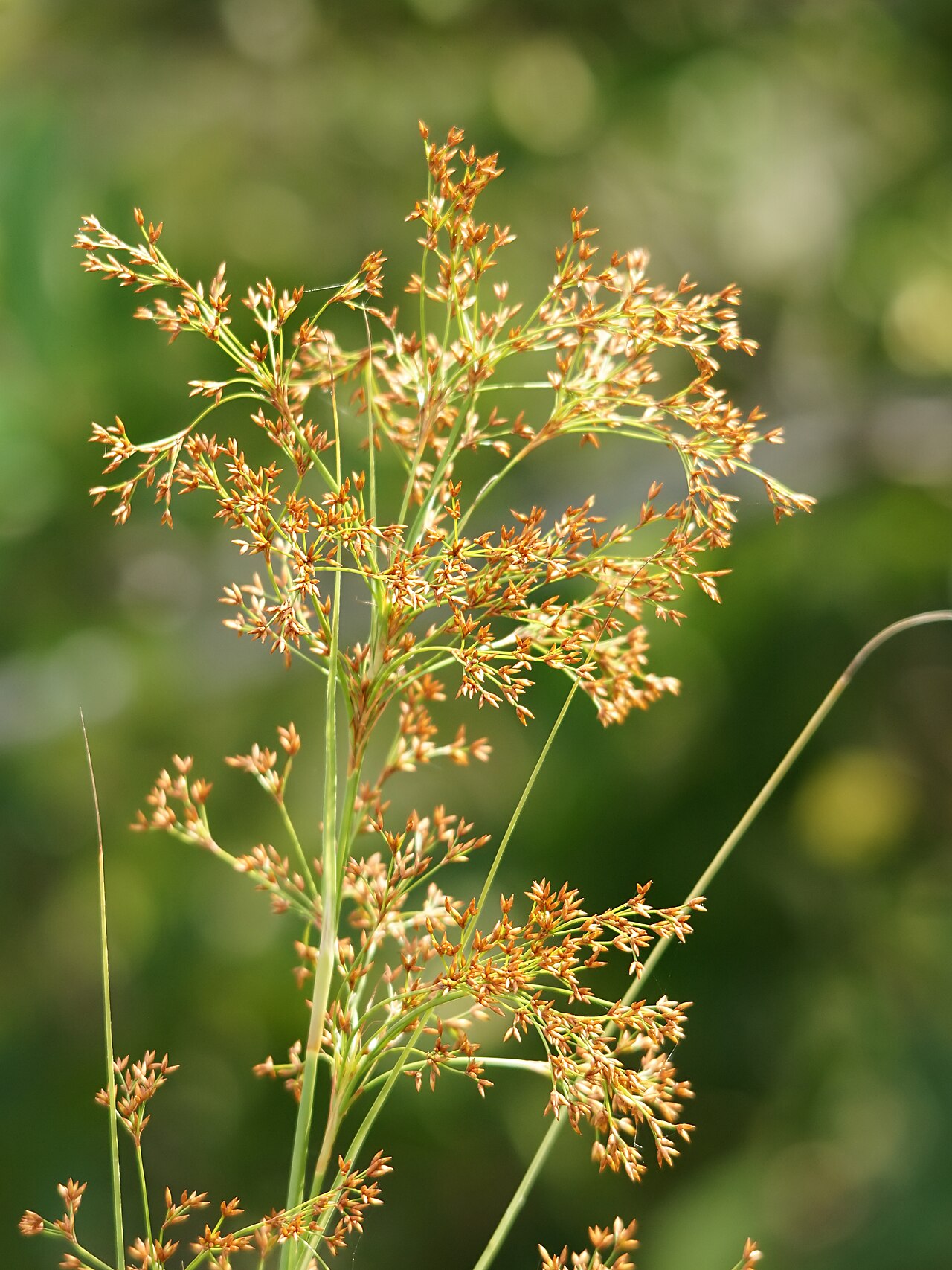
Sawgrass is wind-pollinated and has no showy flowers. The flowering stem rises above the leaves and carries a tall, repeatedly branched cluster, often a foot or two long, of hundreds of tiny brown spikelets. Each spikelet is about an eighth of an inch long with a few overlapping scales and typically one fertile flower. The display is the overall bronze haze above the marsh rather than any individual flower. In Florida, flowering runs roughly from spring into fall, and stands flower heavily in some years and barely at all in others, often in response to fire and water levels.
Fruit & Seeds
The fruit is a small, hard, shiny, pointed achene about an eighth of an inch long, greenish turning brown. It floats, and most dispersal happens on moving water. Seedlings are surprisingly uncommon in established marsh; sawgrass spreads mainly by rhizome, and seed matters most for colonizing newly flooded or newly burned ground. The dry flowering stems persist through the winter and are an attractive feature in a large planting.
Quick Facts
| Scientific Name | Cladium jamaicense (USDA treats it as Cladium mariscus ssp. jamaicense, symbol CLMAJ) |
| Family | Cyperaceae (sedge family) |
| Plant Type | Evergreen rhizomatous perennial sedge |
| Mature Height | 3–6 ft typically; to 9–10 ft in deep fertile peat |
| Mature Spread | Spreads indefinitely by rhizomes; forms solid colonies |
| Growth Rate | Moderate to fast once established |
| Sun Exposure | Full sun to part shade |
| Water Needs | High; seasonal standing water to permanently saturated soil |
| Soil Type | Peat, marl, muck, sand; tolerates limestone and very low-nutrient soils |
| Soil pH | About 5.5–8.5; thrives on alkaline marl and limestone |
| Bloom Time | Spring through fall; flowering varies year to year |
| Flower Color | Brown; wind-pollinated and not showy |
| Fall Color | Olive green aging to straw and tan; evergreen in frost-free areas |
| Fruit | Small, hard, shiny brown achene that floats |
| Deer Resistant | Yes; the sawtoothed leaves are almost never browsed |
| USDA Hardiness Zones | 7–11 |
Native Range
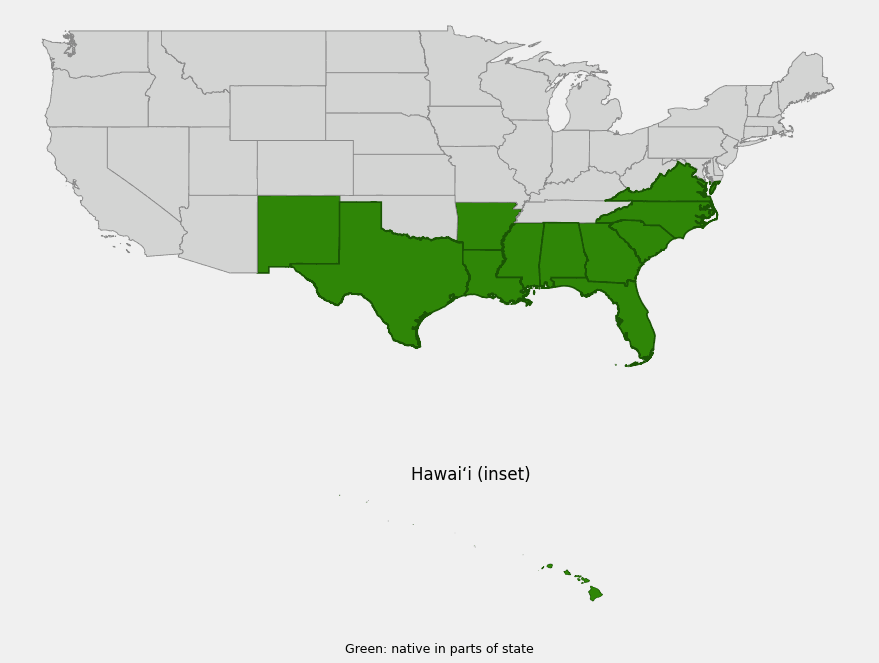
USDA PLANTS lists sawgrass as native in the lower 48 states, Hawaii and Puerto Rico, and records it from Alabama, Arkansas, Florida, Georgia, Louisiana, Mississippi, New Mexico, North Carolina, South Carolina, Texas and Virginia. It is overwhelmingly a Coastal Plain plant: the interior records in Arkansas, New Mexico and west Texas are scattered spring-fed marshes, cienegas and limestone seeps rather than continuous habitat. It also grows through the West Indies, Mexico, Central and South America and across the Pacific, and the species as a whole is one of the most widely distributed wetland sedges in the world.
In Florida it occurs in nearly every county, but the Everglades is where it becomes a landscape. The historic “river of grass” was a sheet of shallow water a few inches to a few feet deep moving slowly south across a nearly flat limestone plain, and sawgrass was the plant that could live in it: low phosphorus, seasonal flooding, periodic fire. Sawgrass ridges alternate with deeper open sloughs in a pattern that developed over thousands of years and that current Everglades restoration is trying to rebuild.
Elsewhere it grows in freshwater and slightly brackish marshes, wet prairies, the upper edges of tidal marshes, pond and lake margins, interdunal swales, limestone seeps and cienegas. In Hawaii, ‘uki grows in bogs and wet shrubland on several islands, including the high rainfall areas of Kaua‘i and Maui. It tolerates brief brackish conditions but does not grow in salt marsh proper.
📋 Regional plant lists featuring Sawgrass: North & South Florida · Alabama, Georgia & Mississippi · North & South Carolina · Maryland, Virginia & West Virginia · Arkansas, Louisiana, Eastern Oklahoma & Eastern Texas · South & West Texas · Arizona & New Mexico · Hawaii
Growing & Care Guide
Sawgrass is a restoration plant and a large-scale landscape plant, not a border perennial. It needs wet ground, room to spread, and distance from anywhere people walk, because the leaves genuinely cut. Given those three things it is close to indestructible.
Light
Full sun is best and gives the densest, most upright growth. It tolerates part shade at the edge of a cypress stand or hammock, where it grows thinner and taller. It will not persist in deep shade.
Soil & Water
Sawgrass wants saturated soil or shallow standing water for at least part of the year, and it handles water a few inches to about two feet deep in the growing season. It also survives a dry season with the soil surface cracked, which is normal in Everglades marsh. Soil type hardly matters: peat, muck, marl, sand and raw limestone all work. What does matter is nutrients. Sawgrass is adapted to extremely low phosphorus, and where fertilizer-rich runoff enters a marsh, cattails outcompete and replace it. Never fertilize sawgrass, and keep lawn runoff out of a sawgrass planting.
Planting Tips
Plant plugs or containerized divisions in spring at the start of the wet season, spaced 3 to 6 feet apart, and expect them to close ranks within two or three years. Site it at the back of a pond or in a stormwater basin, not within arm’s reach of a path, dock or play area. Wear leather gloves, long sleeves and eye protection when handling plants: the teeth cut hands, forearms and corneas. Keep it well away from where children play. In small gardens it is nearly always the wrong plant; use Sand Cordgrass or a muhly grass instead.
Pruning & Maintenance
Maintenance is mostly about containment. The rhizomes advance steadily, so a sawgrass stand needs either a hard edge such as open water or deep shade, or periodic cutting back at the margins. Where fire is not an option, stands can be mown or cut to about a foot in late winter every few years to remove accumulated dead leaves; use a tractor-mounted mower or a brush cutter with full protective gear, not a string trimmer by hand. In managed natural areas, prescribed fire does the same job better and faster.
Propagation
Divide rhizomes in late winter or early spring, taking a chunk with several shoots and plenty of root, and keep the divisions wet until they establish. Seed can be collected when the achenes turn brown and hard, and it germinates best after a period of cold, wet storage, sown on saturated soil in warm conditions; germination rates are typically modest. Nurseries in Florida and the Gulf States grow it in quantity for wetland mitigation work, so buying plugs is usually easier than raising your own.
Landscape Uses
- Wetland restoration: the core species of Everglades and Coastal Plain freshwater marsh restoration
- Stormwater and treatment wetlands: tolerates fluctuating water levels and stabilizes peat and muck soils
- Large pond and lake margins: a tall evergreen screen at the water’s edge on acreage, kept away from paths
- Erosion control: dense rhizome mats hold shoreline soils against wave action and seasonal drawdown
- Wildlife habitat plantings: nesting and roosting cover for marsh birds and shelter for alligators and wading birds
Wildlife & Ecological Value
Very little eats sawgrass, which is exactly why it matters. Its value is structural: it builds the physical habitat that an entire marsh ecosystem lives in.
For Pollinators
Sawgrass is wind-pollinated and offers no nectar, so it has no direct pollinator value. The stands do shelter enormous numbers of insects, including the grasshoppers, spiders, dragonflies and aquatic invertebrates that feed marsh birds and fish, and the flowering stems are used as perches by dragonflies hunting over open water.
For Birds
Sawgrass stands are nesting and roosting habitat for marsh birds, including king rails, least bitterns, boat-tailed grackles and red-winged blackbirds. Seeds are eaten by some ducks and marsh sparrows, though they are not a major food. The ecological importance is greater: the ridge-and-slough pattern of sawgrass stands and open water creates the shallow feeding areas that white ibis, wood storks, great egrets and roseate spoonbills depend on as the dry season concentrates fish.
For Mammals
Marsh rabbits, cotton rats and round-tailed muskrats live in and under sawgrass stands and feed on the tender bases and rhizomes rather than the toothed leaves. Deer avoid it. The dense cover is important to small mammals as refuge from fire and flood, and the raised peat of sawgrass ridges provides dry ground during high water.
Ecosystem Role
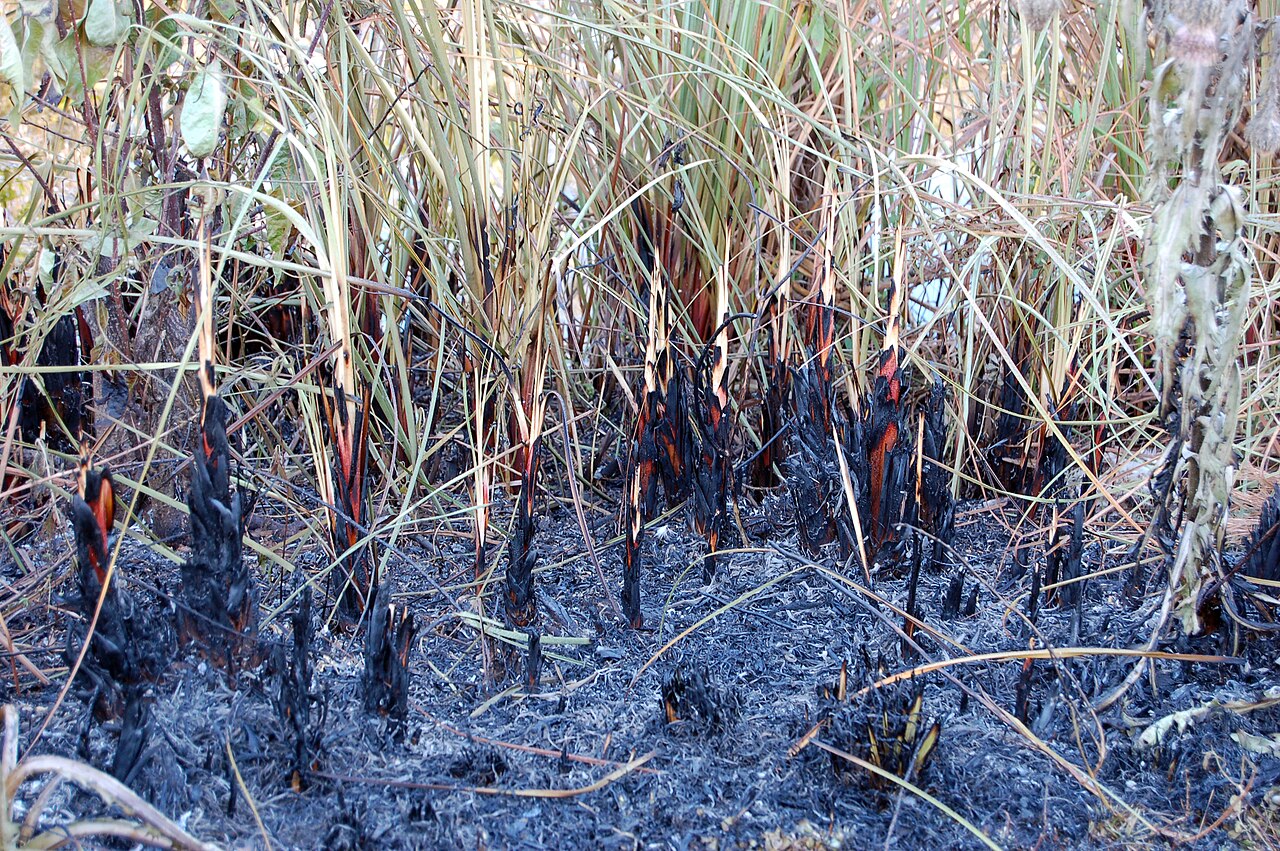
Sawgrass builds the Everglades. Its dead leaves and roots accumulate faster than they decay in saturated, low-oxygen conditions, and over thousands of years that process created the peat soils of the system. It is adapted to a specific fire regime: fast-moving surface fires every few years burn the leaves without harming the rhizomes in wet peat, and the stands resprout within weeks. Deep peat fires in drought years, by contrast, kill the rhizomes and can convert a sawgrass ridge into open slough. Sawgrass is also the standard indicator of unenriched water. When phosphorus levels rise, cattail replaces it, and that shift is one of the main measures used to track Everglades water quality.
Cultural & Historical Uses
Sawgrass has been the backdrop of human life in south Florida for thousands of years. The Calusa and later the Seminole and Miccosukee travelled the marsh by canoe along sloughs and gator trails because walking through sawgrass is nearly impossible, and tree islands within the sawgrass were the places people lived, farmed and buried their dead. The same leaves that cut skin were put to use as cutting tools and in thatch and cordage, and the name “river of grass” comes from Marjory Stoneman Douglas’s 1947 book, which more than anything else changed how Americans thought about the Everglades.
The scientific naming reflects a long argument. Linnaeus described the Old World plant as Schoenus mariscus in 1753; Crantz published Cladium jamaicense for Jamaican material in 1766. Some botanists, including the treatment USDA PLANTS follows, consider the New World plant a subspecies of the Old World one, Cladium mariscus ssp. jamaicense. Florida botanists, the Atlas of Florida Plants, and nearly every restoration contract use Cladium jamaicense. In Hawaii the plant is ‘uki, and Hawaiians used it for thatch.
Today sawgrass is at the center of the largest ecosystem restoration project ever attempted. Drainage canals, agricultural runoff and altered water deliveries have shrunk the sawgrass marsh to about half its historic area, flattened the ridge-and-slough pattern, and let cattail take over nutrient-enriched areas. The Comprehensive Everglades Restoration Plan is, in large part, an attempt to restore the water depths, flow patterns and low nutrient levels that sawgrass needs. The plant itself is in no danger. What is at risk is the particular arrangement of sawgrass ridges, open sloughs and tree islands that supports everything else.
Frequently Asked Questions
Is sawgrass really a grass?
No. It is a sedge, in the family Cyperaceae. Sedges typically have solid, often triangular stems and leaves in three ranks, while grasses have hollow, round, jointed stems and leaves in two ranks. The common name comes from the overall look and from the sawtoothed leaf edges.
Can sawgrass actually cut you?
Yes. The leaf margins and midrib carry rows of hard, forward-pointing teeth that slice skin, clothing and even inflatable boats. The cuts are shallow but numerous, and they sting in salt or dirty water. Wear leather gloves, long sleeves and eye protection around it, and never let it grow next to a path or play area.
What is the difference between Cladium jamaicense and Cladium mariscus?
They are either two species or two subspecies of one, depending on the treatment. Cladium mariscus is the Old World great fen-sedge. USDA PLANTS calls the American plant C. mariscus ssp. jamaicense; the Atlas of Florida Plants, Florida botanists and the nursery trade call it Cladium jamaicense. They are the same plant under two naming conventions.
Why is cattail replacing sawgrass in the Everglades?
Sawgrass is adapted to extremely low phosphorus. When fertilizer-rich water enters the marsh, cattail, which responds strongly to added nutrients, grows faster and shades sawgrass out. The sawgrass-to-cattail shift is one of the main indicators used to measure water quality problems in the Everglades.
Should I plant sawgrass in my garden?
Only on acreage, at the edge of a pond or in a restoration planting, and never near a path or seating area. It spreads aggressively by rhizome and the leaves cut. For a tall native clumping grass in a normal Florida yard, Sand Cordgrass or muhly grass is a far better choice.

Looking for a nursery that carries Sawgrass?
Browse our native plant nursery directory: Alabama & Arkansas · Florida, Georgia & Hawaii · Louisiana & Mississippi · New Mexico & North Carolina · South Carolina, Texas & Virginia