
Alligator Flag (Thalia geniculata)
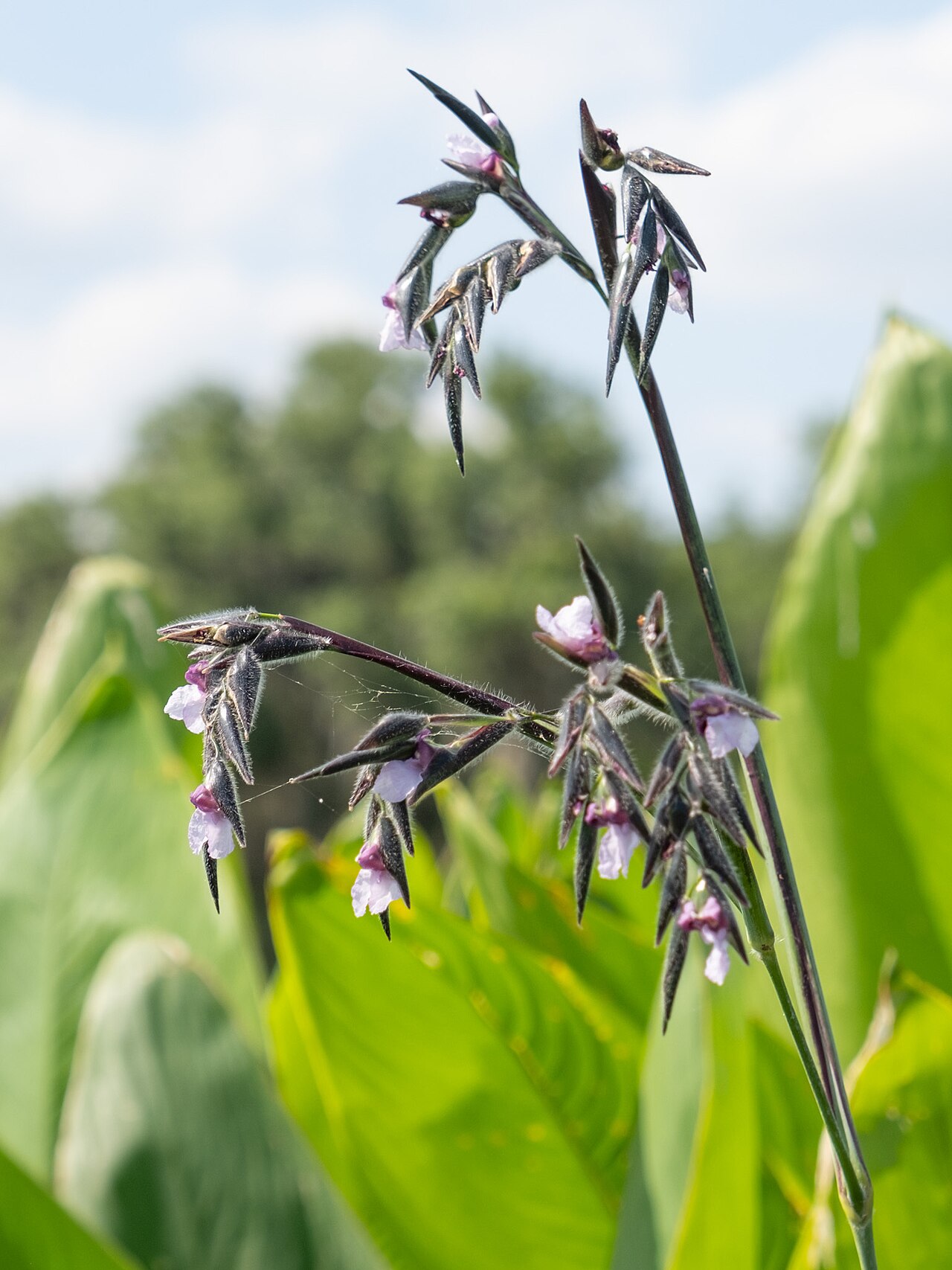
Thalia geniculata, the Alligator Flag, is a giant emergent wetland plant of the Gulf Coast and Florida. It is also called fireflag, bent alligator-flag (the USDA name) and arrowroot. From creeping underground rhizomes it raises paddle-shaped leaves on stalks up to 3 feet long, and in summer and fall its flower stalks tower 6 to 10 feet over the marsh, ending in drooping, zigzag branches of small purple flowers.
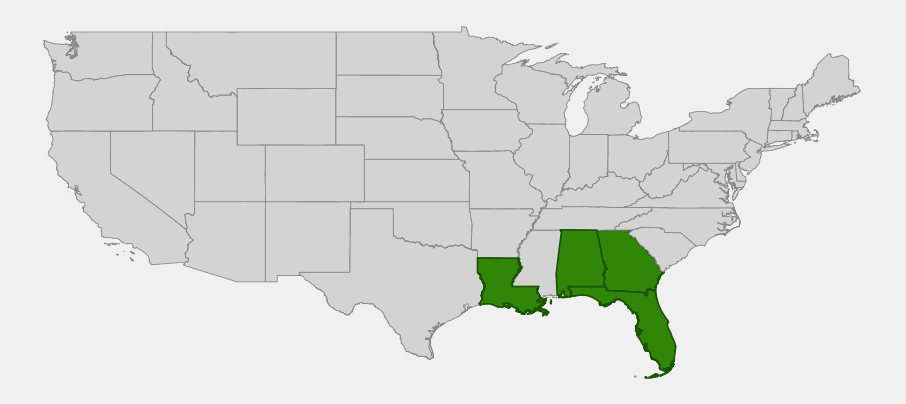
It belongs to the prayer-plant or arrowroot family (Marantaceae), a mostly tropical family that also includes calatheas and the houseplant prayer plants. In the United States it grows wild in Florida, southern Georgia, Alabama and Louisiana, and it is also native to Puerto Rico, the U.S. Virgin Islands, Mexico, Central and South America and tropical Africa.
For water gardens and large ponds in warm climates, alligator flag is one of the most dramatic native plants available. It gives a tropical look, grows in standing water, and feeds bees and the caterpillars of the Brazilian skipper. It is a big, spreading plant, though, so it suits large ponds, lake edges and stormwater basins better than small tubs.
Identification
Alligator flag is easy to recognize by its size, its large banana-like leaves and especially its flower stalks, whose branches hang down and bend back and forth at every node. The closely related powdery thalia (Thalia dealbata) is the main look-alike.
Leaves
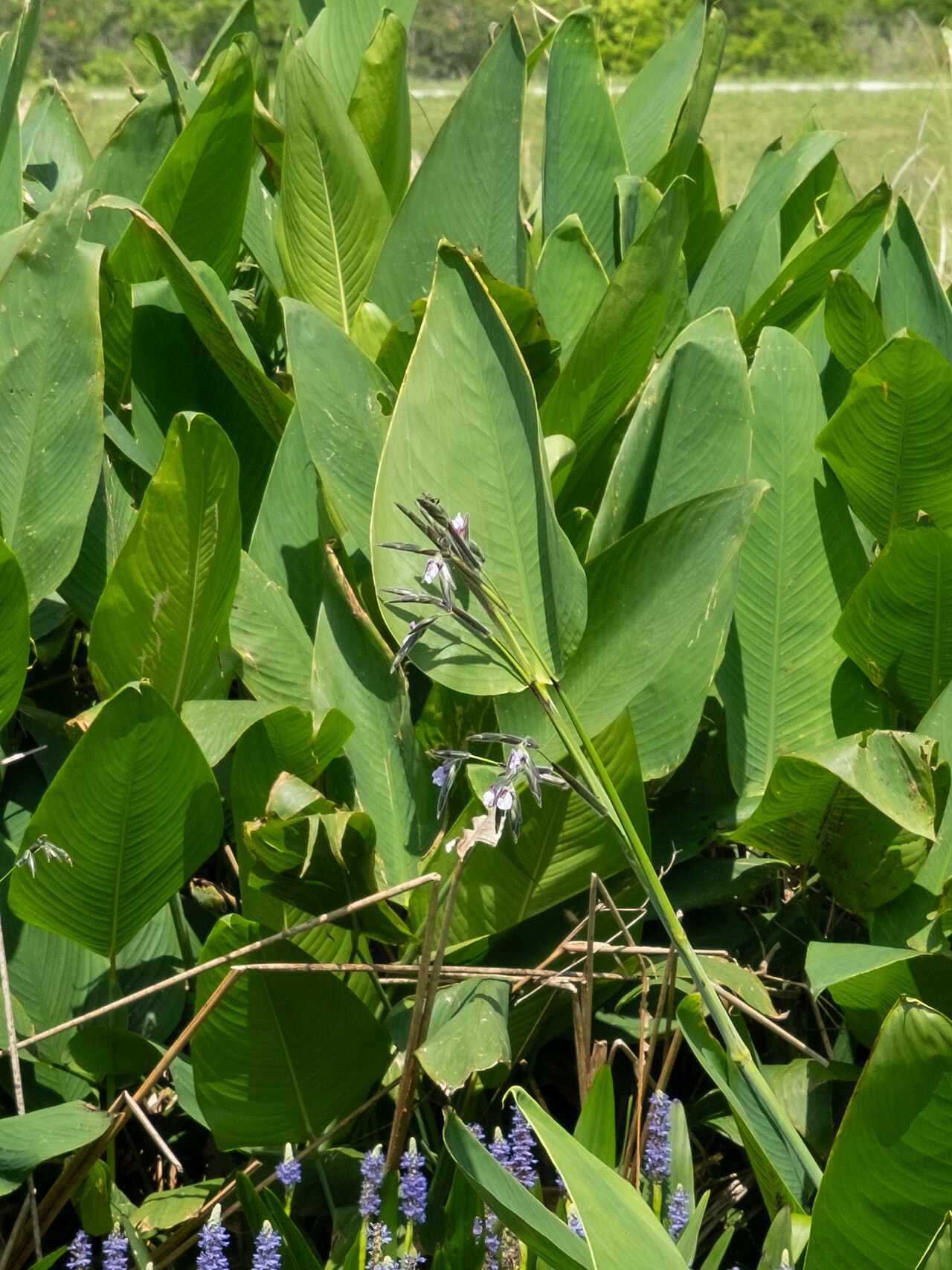
The leaves rise from the rhizome in clumps. Each has a long, sheathing stalk up to about 3 feet long and an oval to lance-shaped blade 1 to 2 feet long and about half as wide, with a prominent midrib and fine parallel veins. The leaves are bright to light green and not powdery. Some forms sold in the trade have red-tinged leaf stalks (sometimes labeled forma ruminoides).
Flower Stalks
From summer into fall, tall leafless stalks rise above the leaves, often reaching 6 to 10 feet. They branch at the top into a loose, open panicle whose slender branches droop and zigzag sharply; the name geniculata means “bent like a knee.” Each zigzag holds a pair of narrow, often hairy bracts.
Flowers
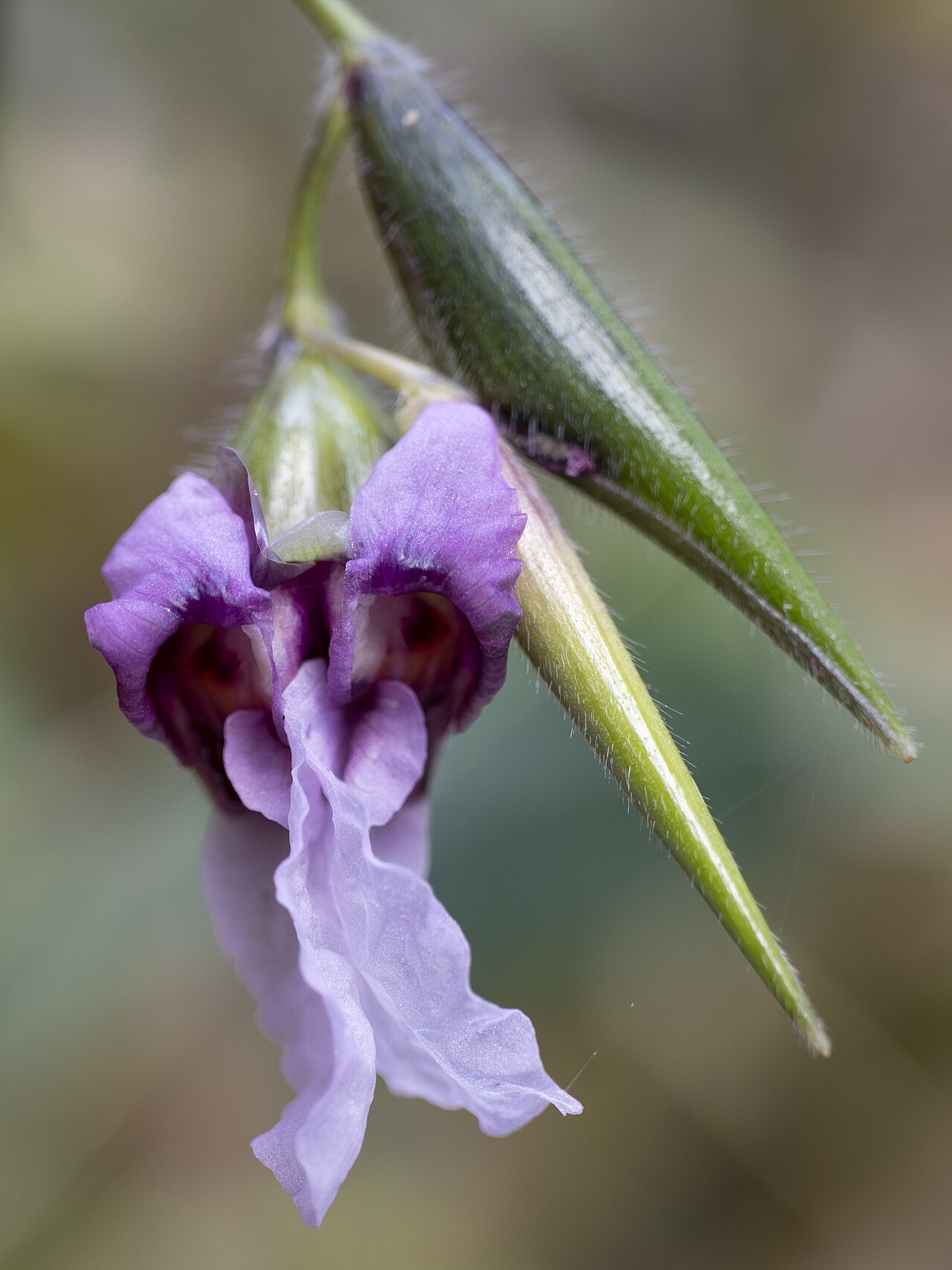
The flowers are small, about ¾ inch long, and come in pairs. They are irregular and orchid-like, pale lavender to deep purple with a white or pale lip. Like other members of the family, each flower has a spring-loaded style that snaps when a visiting bee trips it, dusting the bee with pollen. Flowering in Florida runs mainly from late spring into fall.
Fruit
After flowering, each flower produces a small, rounded capsule containing a single hard seed. The seed heads remain on the drooping branches for a while before falling into the water.
Alligator Flag vs. Powdery Thalia
Powdery thalia (Thalia dealbata) has a wider, more northern range across the Southeast and the lower Mississippi Valley, including north Florida. It is shorter, its leaves and stems are covered with a white, powdery bloom, and its flower clusters are compact and upright rather than drooping and zigzag. Alligator flag has green, non-powdery leaves and arching, zigzag flower branches.
Quick Facts
| Scientific Name | Thalia geniculata (syn. Thalia trichocalyx) |
| Family | Marantaceae (prayer-plant or arrowroot family) |
| Plant Type | Emergent aquatic herbaceous perennial |
| Mature Height | 6–10 ft in flower (leaves 4–6 ft) |
| Mature Spread | 3–6 ft per clump; spreads by rhizomes |
| Growth Rate | Fast |
| Sun Exposure | Full sun to part shade |
| Water Needs | High; saturated soil or standing water to about 2 ft deep |
| Soil Type | Mucky, peaty or sandy wetland soils |
| Soil pH | About 5.5–7.5 |
| Bloom Time | May–November (mainly summer and fall) |
| Flower Color | Purple to lavender with white |
| Fall Color | None; leaves brown with frost |
| Fruit | Small one-seeded capsules |
| Deer Resistant | Unknown |
| USDA Hardiness Zones | 8b–11 |
Native Range
In the continental United States, alligator flag grows in Florida, southern Georgia, Alabama and Louisiana. It is common throughout much of the Florida peninsula and the Everglades and less common in the Panhandle and along the Gulf Coast to Louisiana. It is also native to Puerto Rico and the U.S. Virgin Islands, and its wider range covers the West Indies, Mexico, Central America, most of South America and much of tropical Africa.
It grows in freshwater wetlands with shallow, slow-moving or still water: marshes, sloughs, cypress and hardwood swamps, pond and lake margins, canals and roadside ditches. In the Everglades it is famous for growing around alligator holes and in the deeper water of tree islands and sloughs, where its tall leaves stand out above the sawgrass.
Alligator flag is not state-listed in Florida and is secure across its range. Where it is common, it is easy to grow and widely sold by Florida native and aquatic nurseries.
📋 Regional plant lists featuring Alligator Flag: North & South Florida · Alabama, Georgia & Mississippi · Arkansas, Louisiana, Eastern Oklahoma & Eastern Texas
Growing & Care Guide
Alligator flag is easy to grow wherever it has wet feet and warm summers. Give it space and water, and it will provide a striking vertical accent and summer-long flowers.
Light
It flowers best in full sun to light shade. In deeper shade it still grows but produces fewer flower stalks.
Soil & Water
Plant it in mucky or sandy soil that stays saturated, or in standing water up to about 2 feet deep; it is happiest in 6 to 12 inches of water. It will not tolerate drying out for long. In containers, use heavy garden soil or aquatic planting mix rather than light potting soil, which floats.
Planting Tips
Use it at the edge of a large pond, lake or stormwater pond, or in a big container sunk in a water garden. It spreads by rhizomes and forms large clumps, so keep it out of small ponds unless it is confined to a pot. Combine it with pickerelweed, duck potato and swamp lilies for a native marsh look. Avoid planting it right beside docks or paths where the 8-foot stalks may lean into the way.
Pruning & Maintenance
Remove brown leaves and spent flower stalks as needed. Frost kills the leaves to the ground in north and central Florida, but the rhizomes resprout in spring; cut back the frozen foliage once new growth starts. Divide clumps every few years if they outgrow their space.
Propagation
The easiest method is division of the rhizomes in spring. It can also be grown from seed sown in wet soil, but seed can be slow and uneven to germinate.
Landscape Uses
- Large ponds and lake edges: a bold, tropical-looking native accent in shallow water
- Stormwater ponds and constructed wetlands: its dense clumps take up nutrients and stabilize banks
- Water gardens: in large containers that limit its spread
- Wildlife gardens: nectar for bees and a host plant for the Brazilian skipper
Wildlife & Ecological Value
Stands of alligator flag are small worlds of their own, giving shelter and food to insects, frogs, birds and the animals that live in alligator holes.
For Pollinators
The flowers are pollinated mainly by bees. When a bee pushes into a flower it releases the spring-loaded style, which snaps and deposits pollen on the bee. Alligator flag is also a larval host plant for the Brazilian skipper (Calpodes ethlius), whose caterpillars roll the large leaves into shelters.
For Birds
Wading birds such as herons, egrets and limpkins hunt among the stems, and small marsh birds use the dense clumps for cover. The tall flower stalks also serve as perches for marsh birds.
For Mammals
It is of limited food value to mammals but provides cover at the water’s edge for marsh rabbits and other small animals.
Ecosystem Role
In the Everglades, alligators dig and keep open holes in the marsh that hold water through the dry season. Alligator flag commonly grows around these holes, so its tall leaves “flag” their location, which is the origin of the common name. These refuges keep fish, turtles, snails and wading birds alive through drought. The plant’s dense root mats also hold soil and filter water along shorelines.
Cultural & Historical Uses
The genus Thalia was named by Linnaeus for Johann Thal, a 16th-century German physician and botanist who wrote one of the first regional floras, of the Harz Mountains. The species was first illustrated by the French botanist Charles Plumier, who drew it in the Caribbean and published it in 1703.
The common name alligator flag comes from the Everglades, where the plant marks alligator holes, deep pockets of water that alligators keep open.
Alligator flag is grown as an ornamental in tropical and subtropical water gardens around the world, including botanic gardens in Asia and Europe, where it is often labeled simply as “Thalia.” Its other common names, fireflag and arrowroot, are shared loosely with other members of the family.
Frequently Asked Questions
How tall does alligator flag get?
The leaves usually stand 4 to 6 feet tall, and the flower stalks reach 6 to 10 feet, making it one of the tallest native marsh plants in Florida.
What is the difference between alligator flag and powdery thalia?
Powdery thalia (Thalia dealbata) is shorter, has leaves and stems covered with white powder, and holds its flowers in compact, upright clusters. Alligator flag has green, non-powdery leaves and drooping, zigzag flower branches, and in the U.S. grows mainly in Florida and along the Gulf Coast.
Is alligator flag invasive?
No. It is native to Florida and the Gulf Coast. It does spread by rhizomes and can fill a small pond, so plant it in a container or give it room.
Can alligator flag survive frost?
The leaves are killed by frost, but the rhizomes survive light freezes and resprout in spring. It is reliable in zones 9–11 and can survive in protected spots in zone 8b.
How deep can I plant alligator flag?
It grows best in 6 to 12 inches of water and tolerates up to about 2 feet. It also grows in soil that stays saturated.

Looking for a nursery that carries Alligator Flag?
Browse our native plant nursery directory: Alabama · Florida & Georgia · Louisiana