
Downy Rattlesnake Plantain (Goodyera pubescens)
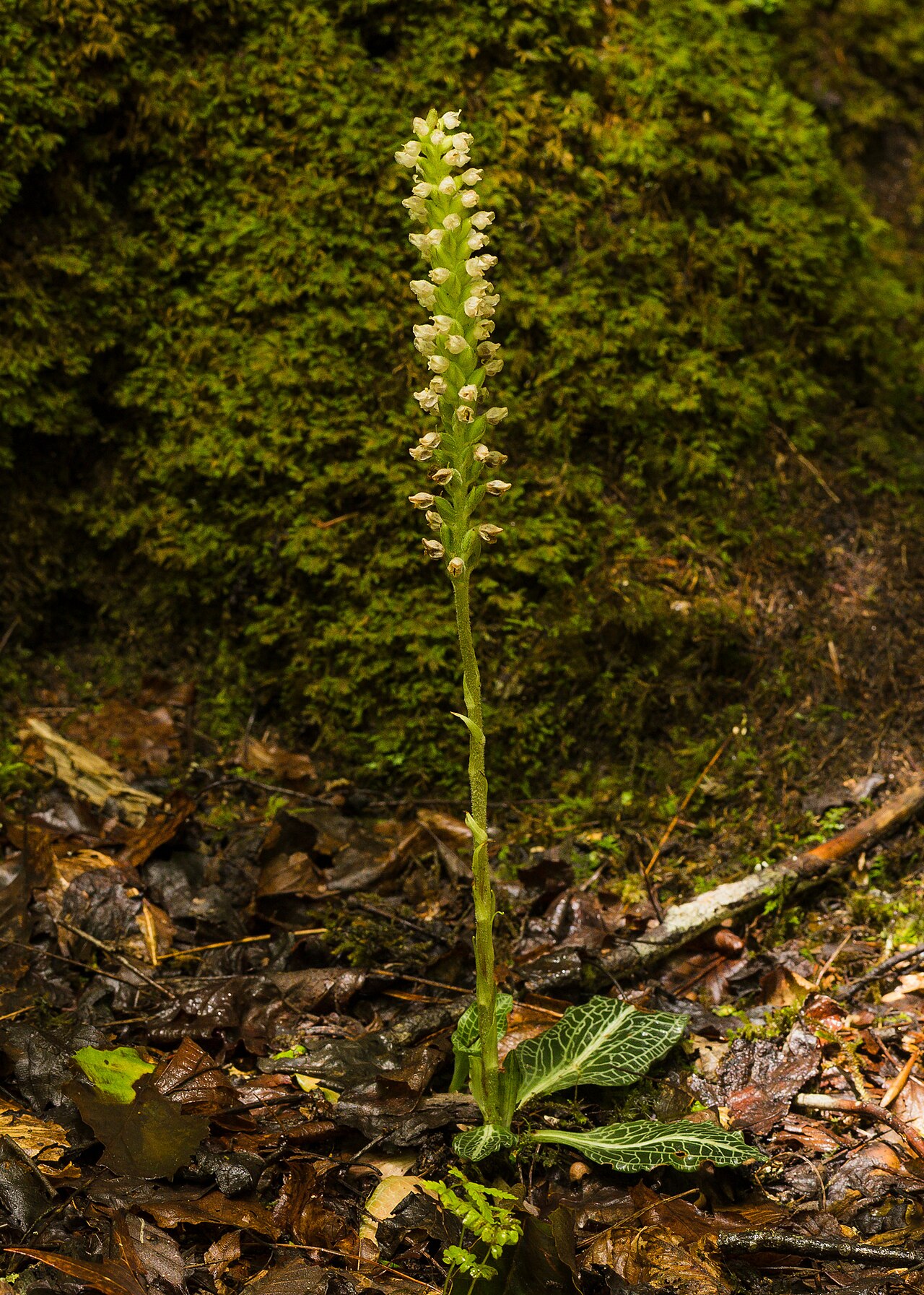
Goodyera pubescens, known as Downy Rattlesnake Plantain, is the most common native orchid in many eastern forests, and one of the most beautiful in leaf. It forms low, evergreen rosettes of oval, blue-green leaves laced with a fine network of silvery-white veins and a broad white stripe down the middle. In midsummer each mature rosette sends up a densely hairy stalk 8 to 16 inches tall, crowded with dozens of small, rounded white flowers. It belongs to the orchid family (Orchidaceae) and grows in dry to moist deciduous and mixed woods, often under oaks, pines and hemlocks.
The common name comes from the leaves. Their checkered pattern reminded early settlers of snakeskin, and under the old “doctrine of signatures” the plant was used as a remedy for snakebite. “Plantain” refers to the flat rosette of leaves, which looks a little like the unrelated lawn weed plantain. “Downy” describes the soft, glandular hairs that cover the flower stalk and buds.
Downy rattlesnake plantain is a woodland plant that depends on soil fungi throughout its life, and it does not transplant from the wild. Digging it for terrariums and shade gardens has eliminated it from many accessible woods. This guide covers how to identify it, where it grows, what it needs, and why it is best enjoyed in place or grown only from responsibly propagated stock.
Identification
In most of the year you will see only the evergreen leaf rosettes, often in small colonies on a wooded slope. The leaf pattern is distinctive, but several related rattlesnake plantains grow in the same region, so check the leaf pattern and the flower spike.
Leaves
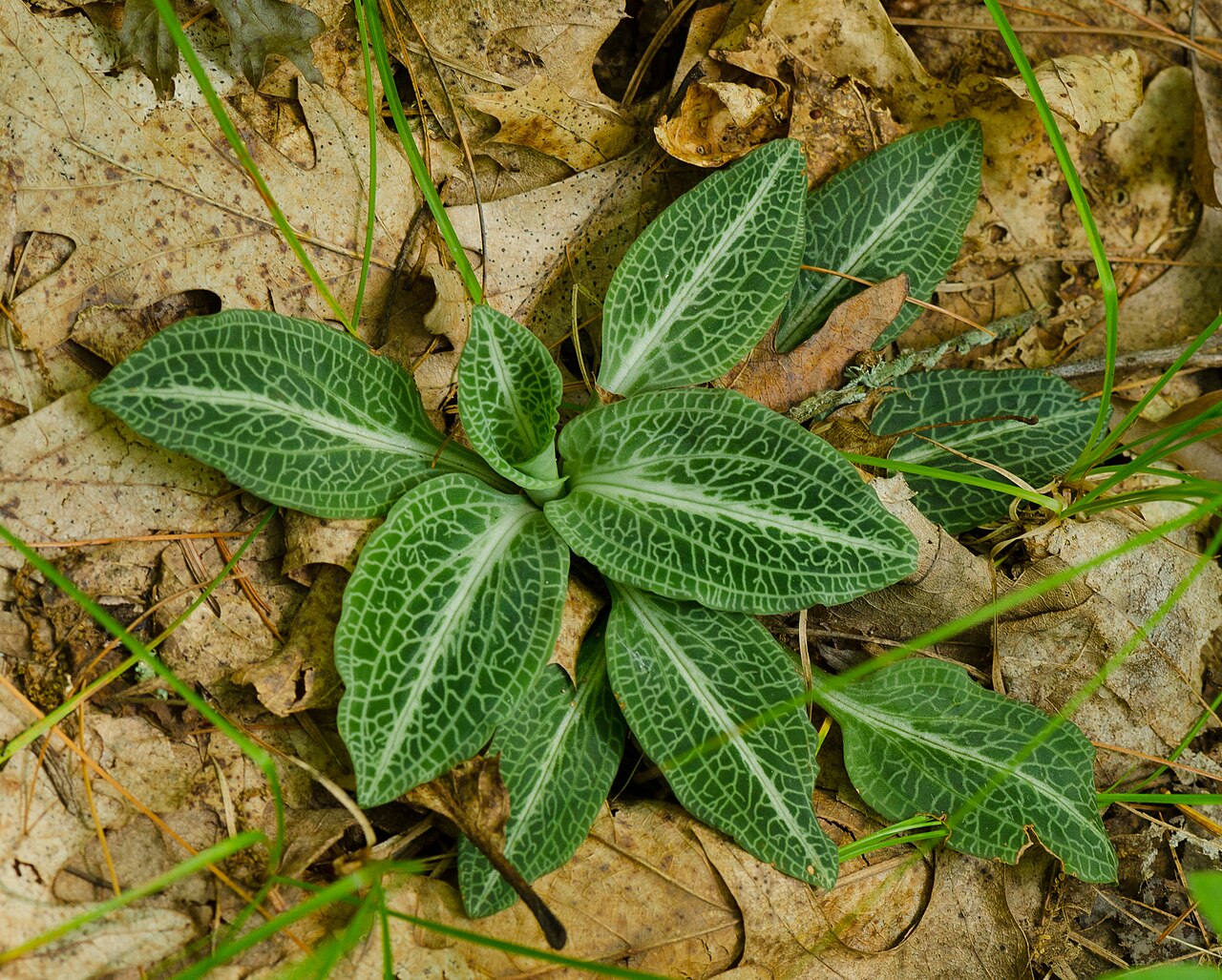
Each rosette has three to eight oval to egg-shaped leaves, 1 to 3½ inches long, lying flat or slightly raised above the leaf litter. They are thick, dark blue-green, and covered by a bold network of white veins with a broad white band down the midrib. The leaves stay green through the winter, which makes the plant easy to spot on snow-free days.
Stems & Growth Habit
Rosettes arise from short, creeping rhizomes just under the leaf litter. Over time a single plant branches and forms a loose colony of several rosettes. A rosette flowers only once, after several years of growth, and is then replaced by side shoots from the rhizome.
Flowers
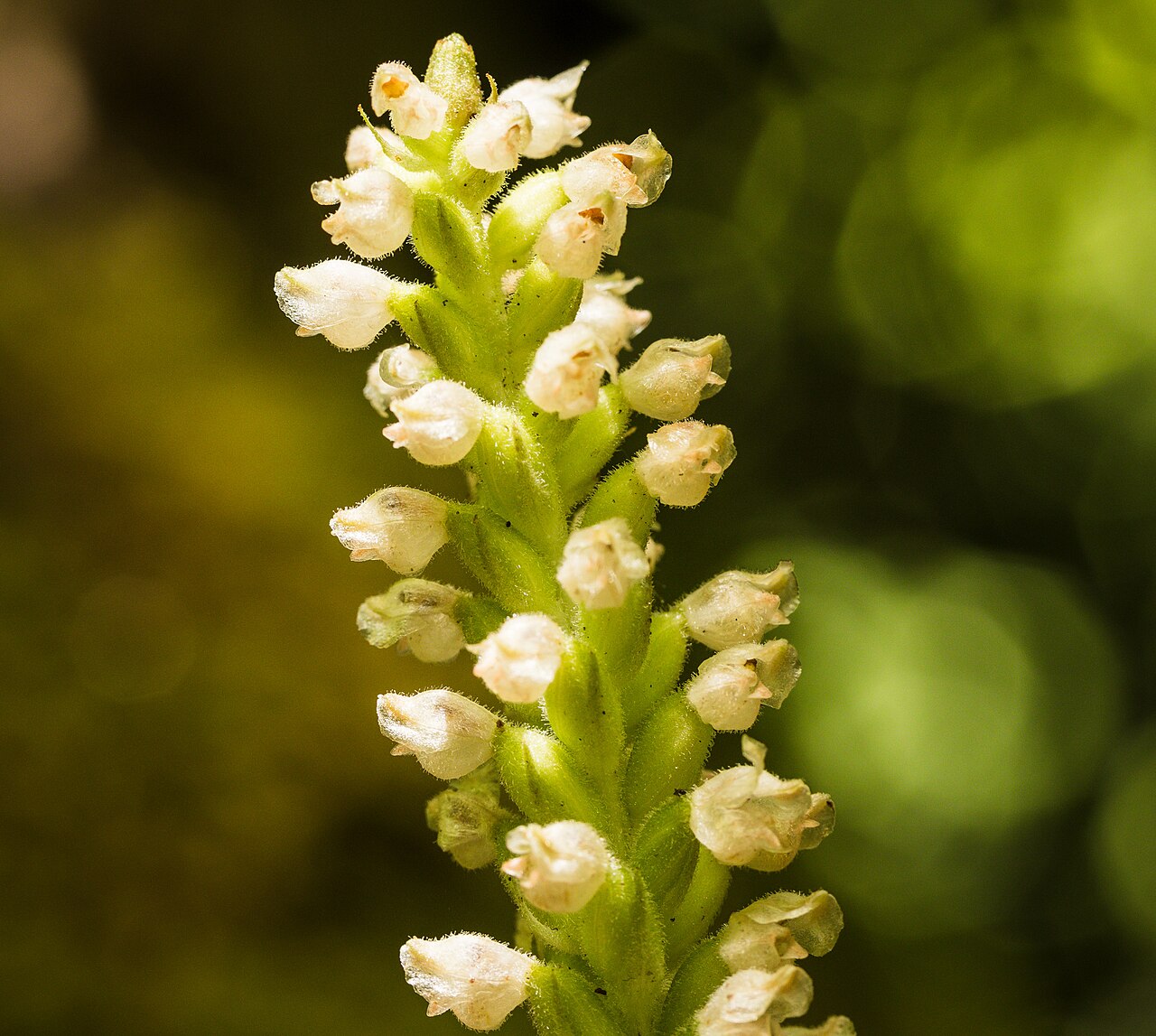
In July and August (June to September depending on location) a stout, densely hairy stalk rises 8 to 16 inches, occasionally up to about 18 inches, with a few small scale-like bracts. The upper part is a dense, cylindrical spike of 20 to 80 or more flowers arranged all around the stem. Each flower is white to greenish-white, about ¼ inch long, and rounded, with a hood formed by the upper sepal and petals over a pouch-shaped lip that ends in a short, down-turned beak. The outside of the flowers and ovaries is also hairy.
Fruit & Seeds
Pollinated flowers form small, upright, ellipsoid capsules that turn brown in fall and split to release thousands of dust-fine seeds. Dry stalks with empty capsules often stand into winter above the green rosettes.
Look-alikes
Checkered rattlesnake plantain (Goodyera tesselata), of the northern forests, has paler leaves with a fainter, more mottled pattern and no bold white midstripe, and a looser, more one-sided flower spike. Lesser rattlesnake plantain (G. repens) is much smaller, with leaves under an inch long and flowers on one side of the stalk. Western rattlesnake plantain (G. oblongifolia) grows mostly in the West and the far north and has narrower leaves, usually with only a white midstripe.
Quick Facts
| Scientific Name | Goodyera pubescens (syn. Peramium pubescens, Epipactis pubescens) |
| Family | Orchidaceae (orchid family) |
| Plant Type | Evergreen terrestrial orchid; herbaceous perennial from rhizomes |
| Mature Height | 2–4 in in leaf; 8–16 in in flower |
| Mature Spread | 4–6 in per rosette; slowly forms small colonies |
| Growth Rate | Slow |
| Sun Exposure | Part shade to full shade |
| Water Needs | Low to medium; dry to moist, well-drained woodland soil |
| Soil Type | Acidic, humus-rich forest soil, loam or sandy loam with leaf litter |
| Soil pH | About 4.5–6.5 (acidic) |
| Bloom Time | July–August (June–September) |
| Flower Color | White to greenish-white |
| Fall Color | None; the white-veined leaves are evergreen |
| Fruit | Small upright capsule with dust-like seeds |
| Deer Resistant | Moderate; deer occasionally browse flower stalks |
| USDA Hardiness Zones | 3–9 |
Native Range
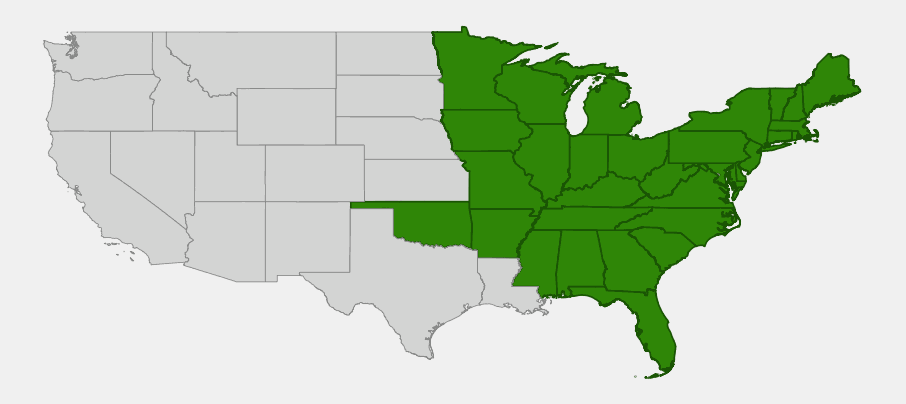
Downy rattlesnake plantain grows across most of eastern North America. USDA PLANTS records it as native in 31 states, from Maine and the Great Lakes south to Florida, the Gulf states and Oklahoma, and west to Minnesota, Iowa, Missouri and Arkansas. In Canada it grows in southern Ontario and Quebec and in New Brunswick and Nova Scotia.
It is most abundant in the Appalachian Mountains and the Piedmont, where it can be one of the commonest plants on dry, wooded ridges and slopes under oak, pine and hemlock. It is also widespread in the Ozarks, the Cumberland Plateau and the woods of the Great Lakes region. Toward the edges of its range, in the western Midwest, Oklahoma, the Gulf Coastal Plain and northern Florida, it becomes scattered and local, and it may be considered rare or protected under state law in some of those states.
Unlike many orchids, it does not need wetlands or rich soil. It grows in leaf litter and humus over well-drained, acidic, often rocky or sandy soils, on slopes, ravine sides, stream terraces and old woodlands. Its colonies are long-lived and are often found again in the same spot year after year.
📋 Regional plant lists featuring Downy Rattlesnake Plantain: New York, Pennsylvania & Northern New Jersey · Ohio & Indiana · Michigan, Wisconsin & Eastern Minnesota · Kentucky & Tennessee · Connecticut, Massachusetts & Rhode Island · New Hampshire, Maine & Vermont · Maryland, Virginia & West Virginia · Delaware, Southern New Jersey & Long Island · Illinois, Iowa & Missouri · Alabama, Georgia & Mississippi · North & South Florida
Growing & Care Guide
Downy rattlesnake plantain is admired by gardeners for its foliage, but it is not an ordinary garden perennial. Like all native orchids, it depends on soil fungi for germination and for much of its nutrition, and plants dug from the wild almost always decline and die. Never dig it from the wild. The best way to enjoy it is to protect the woodland where it already grows. If you want to grow it, buy only plants that a nursery has propagated (some specialist orchid growers raise it from seed or divisions) and give it conditions that closely match a dry, acidic forest floor.
Light
Give it light to full shade, such as the dappled shade under oaks, pines or hemlocks. It tolerates deep shade better than most woodland plants but does not do well in direct afternoon sun.
Soil & Water
It needs loose, acidic, well-drained soil rich in decaying leaves or pine needles. Avoid heavy clay, compacted soil, lime and fertilizer. Water during prolonged summer droughts in its first years, but never keep it soggy; in the wild it often grows on dry, rocky or sandy slopes. Leave a natural layer of leaf litter or pine needles around the rosettes.
Planting Tips
Plant nursery-propagated rosettes in spring or early fall, setting the rhizome just below the surface so the rosette sits at soil level. Disturb the surrounding soil as little as possible and plant near trees and shrubs that suggest its natural habitat, such as oaks, pines, mountain laurel or blueberries. Even with care, transplanted plants can take several years to settle in, and some do not.
Pruning & Maintenance
No pruning is needed. Keep leaf litter in place, avoid raking and foot traffic near the plants, and pull out invasive groundcovers such as English ivy, Japanese stiltgrass and vinca, which smother the rosettes. In areas with heavy deer pressure, the flower stalks may need protection.
Propagation
In nature it spreads slowly by branching rhizomes and by wind-borne seed that germinates only with a compatible mycorrhizal fungus. In cultivation, established colonies can be divided carefully in spring, keeping a section of rhizome and roots with each rosette. Seed propagation is done in sterile laboratory culture by specialist growers. Never collect plants or seed capsules from the wild without permission; in some states it is legally protected.
Landscape Uses
- Woodland gardens: an evergreen accent for dry, acidic shade, where its patterned leaves stand out all winter
- Protecting existing colonies: the best way to enjoy it: keep woods, leaf litter and fungi intact where it already grows
- Nature study and photography: one of the easiest native orchids to find and watch through the seasons
- Native orchid collections: for experienced growers using nursery-propagated plants
- Woodland restoration: as an indicator of intact, undisturbed forest soil rather than a planted species
Wildlife & Ecological Value
Downy rattlesnake plantain is a small plant, but it is a good indicator of healthy, undisturbed forest floors, where the soil fungi it relies on are still intact.
For Pollinators
Bumblebees are the main pollinators. A bee probing the narrow opening of the pouch-shaped lip for nectar picks up the sticky pollen masses (pollinia) on its tongue and carries them to the next flower. Flowers open from the bottom of the spike upward over several weeks in midsummer.
For Birds
The plant has little direct food value for birds. It grows in the forest-floor community used by ground-nesting woodland birds such as ovenbirds and wood thrushes.
For Mammals
Deer and rabbits occasionally bite off flower stalks or leaves, especially in winter when the green rosettes stand out. Heavy deer browsing can keep plants from flowering.
Ecosystem Role
Like all orchids, downy rattlesnake plantain has dust-like seeds with almost no stored food, and the seedlings depend completely on a mycorrhizal fungus for their first years. Adult plants have green leaves and make their own food, but their roots continue to host mycorrhizal fungi. This dependence on soil fungi is why the plant does not survive being dug up and why it is a sign of long-undisturbed woodland soil.
Cultural & Historical Uses
The genus Goodyera honors John Goodyer (1592–1664), an English botanist who translated classical Greek herbals and contributed to an expanded edition of John Gerard’s famous Herball. The species name pubescens means “downy,” for the hairy flower stalk. Older American books call it Peramium pubescens or Epipactis pubescens.
The white-netted leaves reminded early observers of snakeskin, and under the doctrine of signatures, the old idea that a plant’s appearance shows its medical use, rattlesnake plantain was recommended for snakebite. Several Native American peoples and colonial herbalists used the leaves medicinally, but there is no evidence that it is effective, and the plant is too slow-growing and vulnerable to collect.
In the twentieth century the attractive rosettes were often dug for terrariums, dish gardens and woodland plantings. Most of those plants died, and the practice depleted colonies near towns and trails. Conservation groups and native plant societies now ask people to admire this orchid where it grows, and it is protected by state plant laws in some states at the edge of its range.
Frequently Asked Questions
Can I dig downy rattlesnake plantain from the woods for my garden?
No. It relies on specific soil fungi and almost always declines after being dug, and collecting harms wild populations; in some states it is illegal without permission. Buy nursery-propagated plants, or better yet protect a colony where it already grows.
Is downy rattlesnake plantain rare?
In much of the Appalachians, Piedmont and Northeast it is one of the most common native orchids. It is less common at the western and southern edges of its range and has disappeared from many heavily disturbed or over-collected woods.
Why is it called rattlesnake plantain?
The white network of veins on the leaves resembles snakeskin, and the plant was once used as a supposed remedy for snakebite. “Plantain” refers to its flat leaf rosette. It is not related to the lawn weed plantain or to the banana-like plantain.
When does downy rattlesnake plantain bloom?
Mostly in July and August, with some plants flowering from late June into September. The leaves are evergreen, so the plant can be recognized in every season.
Is it the same as checkered rattlesnake plantain?
No. Checkered rattlesnake plantain (Goodyera tesselata) is a more northern species with a fainter leaf pattern and no bold white midstripe. Downy rattlesnake plantain has the sharpest, most contrasting white net of veins of the eastern species.

Looking for a nursery that carries Downy Rattlesnake Plantain?
Browse our native plant nursery directory: Alabama & Arkansas · Connecticut, Delaware, Florida & Georgia · Illinois, Indiana & Iowa · Kentucky, Maine, Maryland, Massachusetts, Michigan, Minnesota, Mississippi & Missouri · New Hampshire, New Jersey, New York, North Carolina, Ohio & Oklahoma · Pennsylvania, Rhode Island, South Carolina, Tennessee, Vermont & Virginia · West Virginia & Wisconsin