
Western Wallflower (Erysimum capitatum)
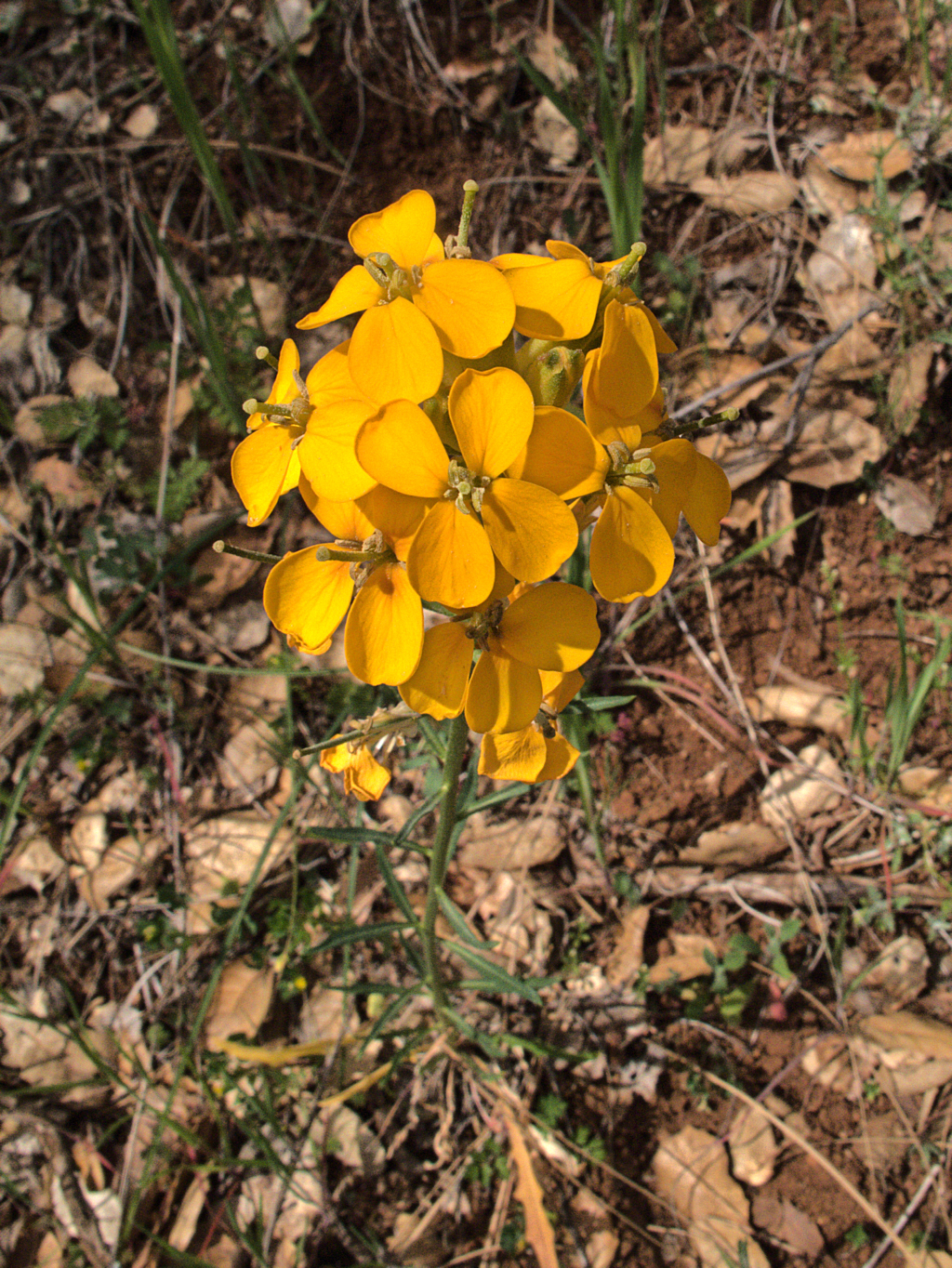
Erysimum capitatum, known as Western Wallflower and listed by USDA as sanddune wallflower, is a showy native member of the mustard family (Brassicaceae). It forms a rosette of narrow, grayish-green leaves and then sends up one or a few stiff stems topped with a dense, rounded head of four-petaled flowers. Depending on the population, they are lemon yellow, golden, bright orange or, more rarely, cream or brick red, and they are sweetly fragrant. It is a biennial or short-lived perennial that blooms from early spring at low elevations to midsummer in the high mountains.
Few native wildflowers cover as much ground. Western wallflower grows from coastal dunes and chaparral in California to sagebrush steppe, pinyon-juniper woodland, ponderosa pine forest and alpine scree above 12,000 feet. Isolated populations also occur on rocky bluffs and sand prairies east to Ohio, Tennessee and Virginia. Plants from these different places vary so much in size, flower color and habit that botanists have described many varieties, a few of them rare and federally protected.
For gardeners in the West, western wallflower is one of the easiest and brightest spring flowers to grow from seed in dry, sunny ground. It attracts bees, butterflies and moths, and its bloom carries the classic clove-like scent of the garden wallflowers it is related to. This guide covers identification, native range, growing tips and its role in wildlife habitats.
Identification
Western wallflower is easy to recognize as a wallflower: a stiff, usually unbranched stem crowned by a crowded, rounded head of four-petaled flowers, with long, narrow seed pods developing below. Separating it from the related plains wallflower (Erysimum asperum) and other Erysimum species takes a closer look at the fruits.
Rosette & Stems
In its first year the plant forms a low rosette of narrow leaves. Flowering stems usually appear in the second year, though some plants bloom the first year and long-lived forms bloom for several seasons. Stems are erect, 6 inches to about 3 feet tall depending on site and variety, and covered with fine, flattened, two- or three-branched hairs that give them a rough feel. High-elevation plants can be nearly stemless, with flower clusters sitting just above the leaves.
Leaves
Basal leaves are narrowly lance-shaped to linear, 1 to 5 inches long, with smooth or few-toothed margins, and grayish green from their dense, tiny hairs. Stem leaves are smaller and alternate, getting shorter up the stem. The leaves often wither by the time the fruits are ripe.
Flowers
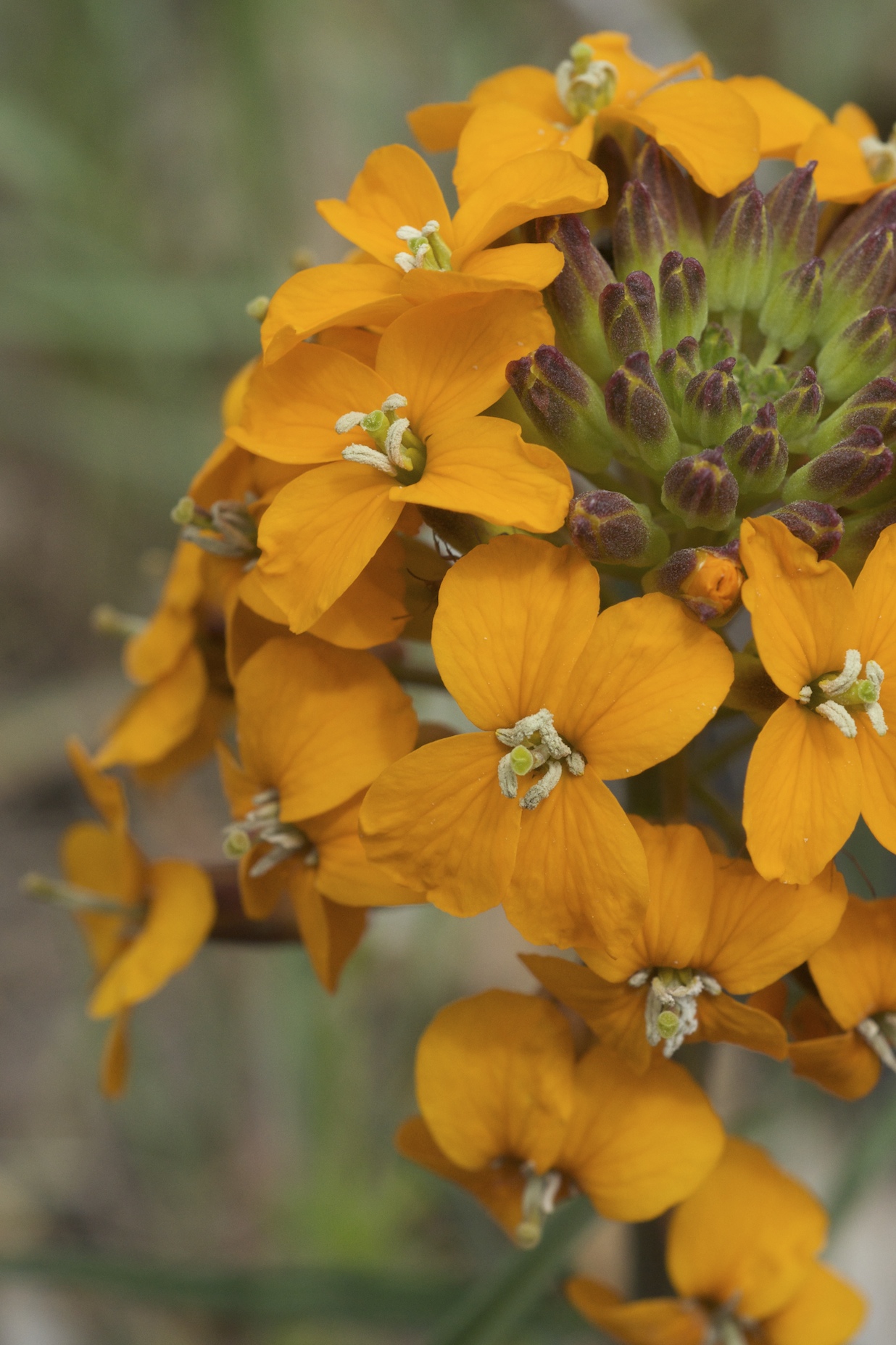
The flowers are crowded into a rounded or flat-topped head (the “capitatum” of the name) that stretches into a longer spike as it keeps blooming. Each flower is about ¾ to 1 inch across, with four broad, rounded petals in the shape of a cross and six stamens, as is typical for the mustard family. Color ranges from pale yellow to bright orange: orange forms are common in California and parts of the Southwest, while yellow forms dominate in the Rocky Mountains, the Great Basin and the East. The flowers are fragrant, especially in the evening.
Fruit & Seeds
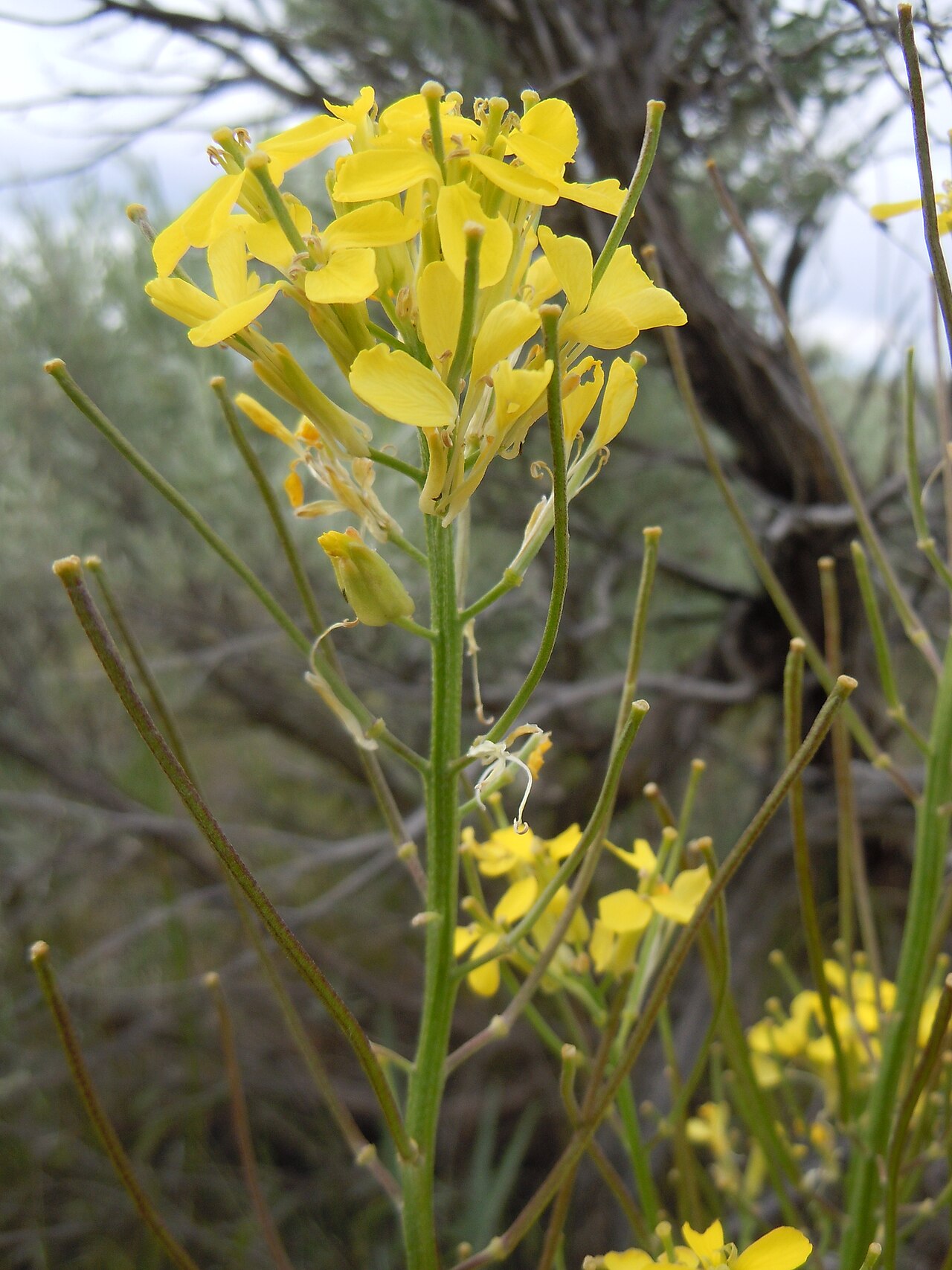
Fruits are long, narrow, four-angled pods (siliques) 2 to 4 inches long, held upright or angled upward, close to the stem. In plains wallflower, by contrast, the pods tend to spread out sideways. Each pod splits lengthwise when dry and releases a row of small, flattened, brown seeds. Old stems with empty pods often stand through winter.
Quick Facts
| Scientific Name | Erysimum capitatum (incl. E. arkansanum) |
| Family | Brassicaceae (mustard family) |
| Plant Type | Biennial or short-lived perennial herb |
| Mature Height | 6–36 in (often 1–2 ft) |
| Mature Spread | 6–12 in |
| Growth Rate | Fast |
| Sun Exposure | Full sun to light shade |
| Water Needs | Low; drought tolerant once established |
| Soil Type | Well-drained sand, gravel, rocky or loamy soil |
| Soil pH | About 6.0–8.0 |
| Bloom Time | March–May at low elevations; June–August in the mountains |
| Flower Color | Yellow to orange; occasionally cream or reddish |
| Fall Color | None; grayish-green winter rosettes |
| Fruit | Long, narrow, upright pod (silique) |
| Deer Resistant | Moderately; occasionally browsed |
| USDA Hardiness Zones | 3–9 |
Native Range
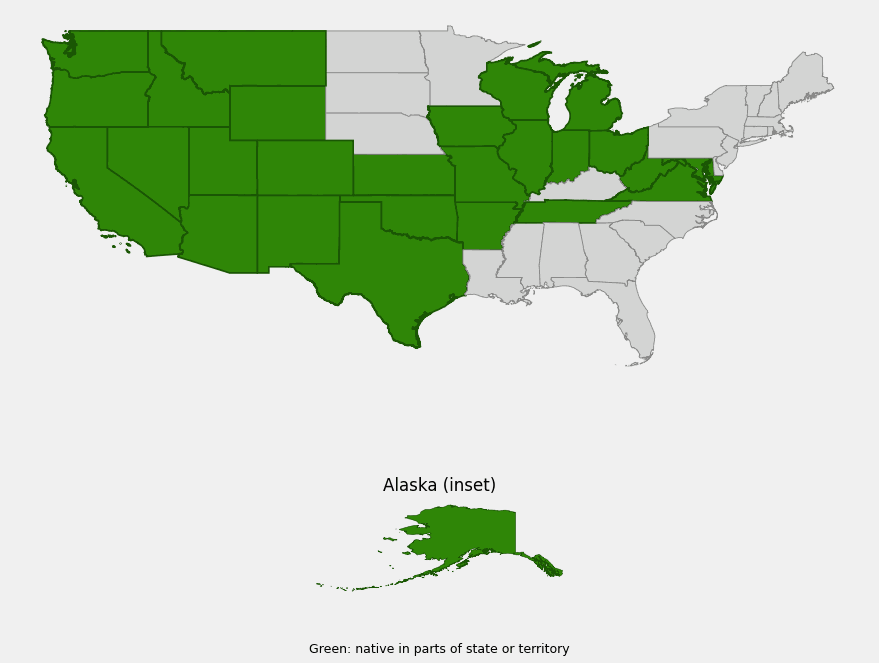
Western wallflower is native across most of the western United States, and the Lady Bird Johnson Wildflower Center describes its range as running from Virginia and Ohio to southwestern Canada, south to Tennessee, Texas and California, and “much more common westward.” USDA PLANTS records it from 27 states, including Alaska. It grows in every state of the Pacific Coast, Great Basin, Rocky Mountains and desert Southwest, and in Kansas, Oklahoma and Texas on the southern plains.
East of the plains the species is scattered and often rare. These populations, once called Erysimum arkansanum and still known as the eastern or Ozark form of var. capitatum, grow on sand prairies, dunes, rocky bluffs, cliffs and shale barrens in Arkansas, Missouri, Iowa, Illinois, Indiana, Ohio, Michigan, Wisconsin, Tennessee, Virginia, West Virginia and Maryland. Several of these states list it as a plant of conservation concern.
In the West, it is found from sea level to well above 12,000 feet. Coastal California has distinctive varieties of dunes and bluffs, including the Contra Costa wallflower (var. angustatum) of the Antioch Dunes, which is federally listed as endangered. Other named varieties include var. purshii of the interior West and var. perenne, a long-lived high-mountain form.
📋 Regional plant lists featuring Western Wallflower: Idaho, Eastern Oregon & Eastern Washington · Ohio & Indiana · Montana & Wyoming · Michigan, Wisconsin & Eastern Minnesota · Kentucky & Tennessee · Nebraska, Kansas & Eastern Colorado · Utah & Western Colorado · Maryland, Virginia & West Virginia · Arizona & New Mexico · Illinois, Iowa & Missouri · Alaska
Growing & Care Guide
Western wallflower is a fast, rewarding plant for dry, sunny gardens in the West, and it can be grown farther east in well-drained rock gardens and sand. It is usually grown from seed. Since individual plants are short-lived, think of it as a self-sowing colony rather than a permanent perennial.
Light
Full sun gives the most compact plants and the heaviest bloom. In hot, low-elevation gardens it tolerates light afternoon shade, and plants from forest openings can handle partial shade.
Soil & Water
Sharp drainage matters more than soil type. Sandy, gravelly and rocky soils are ideal, and it also grows in lean loam that does not stay wet. Once established, it needs little or no supplemental water in most of the West, and too much summer water or heavy clay leads to rot and short-lived, floppy plants. Avoid fertilizer.
Planting Tips
Sow seed outdoors in fall or very early spring, barely covering it. In mild climates, fall-sown seed germinates with the rains and forms rosettes over winter that bloom the following spring. Container-grown seedlings can be planted in spring or fall, spaced about 8 to 12 inches apart. Plant in drifts or among bunchgrasses and other dry-land wildflowers for the best effect.
Pruning & Maintenance
Little care is needed. Deadheading the first flush of flowers can extend bloom and sometimes lengthens the life of perennial forms, but leave some stems to ripen seed if you want volunteers. Cut old stalks down once the pods have split. Keep competing weeds and heavy mulch away from the rosettes.
Propagation
Seed is the easiest method; it needs no special treatment, though a few weeks of cold, moist stratification can improve spring germination. Collect pods when they turn tan and begin to split. Perennial forms can also be grown from cuttings of non-flowering shoots in late spring. Because the species varies so much from region to region, use seed of local origin for restoration work.
Landscape Uses
- Xeriscapes and dry gardens: bright spring color with little water
- Rock gardens and gravel beds: compact high-elevation forms are especially suited
- Pollinator gardens: early-season nectar for bees, butterflies and moths
- Wildflower and meadow seed mixes: establishes quickly and reseeds in open ground
- Habitat restoration: sagebrush, foothill, dune and post-fire sites, using local seed
Wildlife & Ecological Value
Western wallflower is often one of the first bright flowers on dry western hillsides in spring, and it feeds a wide range of insects at a time when nectar can be scarce.
For Pollinators
The fragrant flowers attract native bees, including bumble bees, mason bees and small sweat bees, as well as butterflies, bee flies, beetles and day-flying moths. The evening scent also draws night-flying moths. As a mustard-family plant, it is a potential larval host for whites, marbles and orangetips, butterflies whose caterpillars feed on the flowers and young pods of native mustards.
For Birds
The small seeds are eaten by finches, sparrows and other seed-eating birds after the pods split. In sagebrush and grassland settings it contributes to the diverse forb layer that supports the insects that young grassland and sagebrush birds depend on.
For Mammals
Deer, elk, pronghorn and small mammals occasionally browse the rosettes and flowering stems, but the plant is not a major forage species. The pungent compounds common to the mustard family make it less palatable than many other wildflowers.
Ecosystem Role
Western wallflower is a pioneer of open, disturbed ground. It is among the wildflowers that bloom heavily on burned slopes in the first years after a fire, as in the post-fire Douglas-fir forests of Montana, and it colonizes rock slides, sand and road cuts. On coastal dunes its rosettes help hold shifting sand, and the rare dune varieties are indicators of intact dune systems.
Cultural & Historical Uses
The genus name Erysimum is an ancient Greek plant name, usually linked to a word meaning “to help,” a reference to the medicinal reputation of European wallflowers and their relatives. The species was first described by William Jackson Hooker in 1830 as Cheiranthus capitatus, from specimens the Scottish plant explorer David Douglas collected in the Pacific Northwest. Its name capitatum means “headed,” for the crowded flower clusters.
Several Native American peoples used western wallflower medicinally. Ethnobotanical records describe a variety of medicinal uses among peoples of the West and Southwest. Because the mustard family contains compounds that can be irritating in quantity, these uses are of historical interest only, not recommendations.
Today western wallflower is a staple of native seed mixes and xeriscape plantings across the West, and the Contra Costa wallflower has become a focus of dune restoration at the Antioch Dunes National Wildlife Refuge in California.
Frequently Asked Questions
Is western wallflower a perennial?
It is usually a biennial or short-lived perennial. Most plants form a rosette the first year, bloom the second, and then decline after setting seed, but some forms persist for several years. Letting it reseed keeps it in the garden.
What is the difference between western wallflower and plains wallflower?
The two look very similar. Western wallflower usually holds its long seed pods upward, close to the stem, while plains wallflower (Erysimum asperum) tends to spread its pods out to the sides. Some botanists combine them, and older references may use either name.
Why are some western wallflowers orange and others yellow?
Flower color varies from population to population. Orange forms are common in California and parts of the Southwest, and yellow forms are typical of the Rocky Mountains, Great Basin and eastern populations. Both are the same species.
Is western wallflower related to garden wallflowers?
Yes. Garden wallflowers, once placed in Cheiranthus, are now included in Erysimum too. Western wallflower has a similar scent and form, and it is a good native alternative for dry gardens.
How do I grow western wallflower from seed?
Scatter seed on bare, well-drained soil in fall or early spring and barely cover it. Seed sprouts readily, and plants usually bloom the following spring. Keep the site sunny and dry, and leave a few seed heads to ripen so the plants can self-sow.

Looking for a nursery that carries Western Wallflower?
Browse our native plant nursery directory: Alaska, Arizona & Arkansas · California · Colorado · Idaho, Illinois, Indiana, Iowa & Kansas · Maryland, Michigan, Missouri & Montana · Nevada, New Mexico, Ohio & Oklahoma · Oregon · Tennessee, Texas, Utah & Virginia · Washington · West Virginia, Wisconsin & Wyoming