
Wide leek (Allium tricoccum)
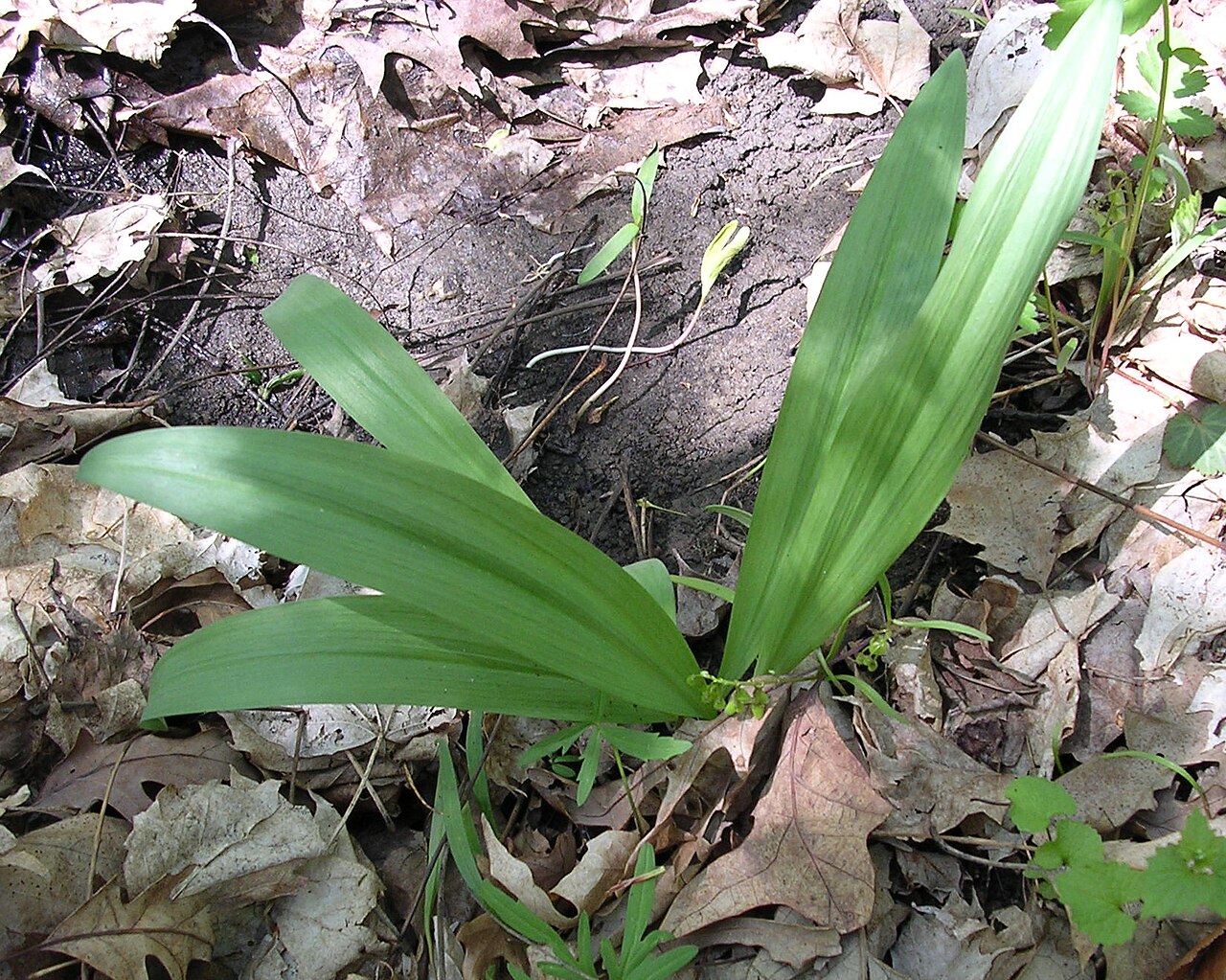
Allium tricoccum, known as Wide leek, ramp (the USDA common name) or wild leek, is a native wild onion of rich, moist deciduous forests in eastern North America. In early spring, before the trees leaf out, it sends up two or three broad, smooth, bright green leaves from a slender bulb, often carpeting the forest floor in dense colonies. By early summer the leaves have withered, and a bare stalk rises to carry a round cluster of creamy white flowers, followed by shiny black seeds.
Ramps have a strong, garlicky-onion flavor and have been gathered as a spring food for centuries, first by Native American peoples and later by settlers, especially in the Appalachians. In recent decades they have become a fashionable restaurant ingredient, and commercial digging has put heavy pressure on wild populations. Ramps grow very slowly: a plant can take five years or more to grow from seed to a harvestable size, and patches that are dug out can take many years to recover.
This guide covers how to identify wide leek, how to tell it from poisonous lookalikes, where it grows, how to grow it from seed or nursery stock, and how to harvest it sustainably. If you forage, take only a single leaf from each plant and leave the bulbs in the ground, or better yet, grow your own.
Identification
Ramps are easiest to identify by their combination of broad, smooth leaves, a reddish or white leaf stalk and a strong onion or garlic smell when a leaf is crushed. Safety note: several poisonous plants grow in the same woods and can look similar, especially lily-of-the-valley (Convallaria majalis) and false hellebore (Veratrum viride). Both are toxic if eaten, and false hellebore can be dangerous even in small amounts. Never eat a plant unless you are certain of its identity.
Bulb & Roots
Each plant grows from a narrow, egg-shaped bulb about ½ to 1 inch thick, covered in a thin, papery or fibrous coat. Bulbs often grow in clusters, and new bulbs form beside old ones, slowly creating dense colonies. The bulbs sit a few inches deep in loose forest soil.
Leaves
Two or three leaves appear in early spring, often in March or April. They are flat, smooth, elliptic to lance-shaped, 4 to 12 inches long and 1 to 3 inches wide, with a narrowed base that tapers into a stalk. The stalk and lower leaf sheath are often reddish-purple, though in the narrow-leaved form, var. burdickii (sometimes treated as a separate species, Allium burdickii), they are white and the leaves are narrower. The leaves wither by late spring or early summer as the forest canopy closes overhead.
Flowers
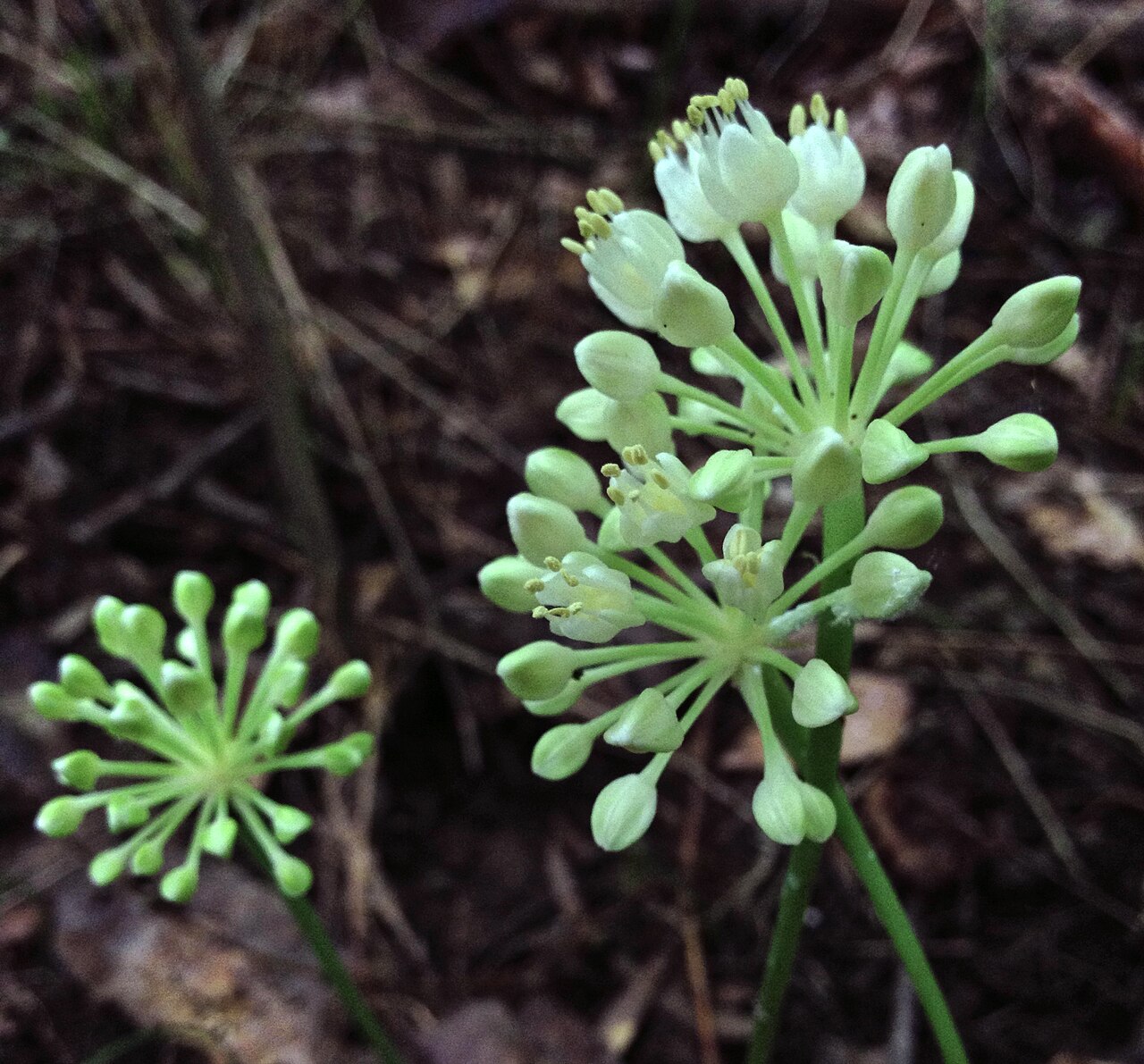
In June or July a leafless stalk 6 to 16 inches tall rises from the bulb, topped by a papery sheath that splits to reveal a rounded umbel of 20 to 50 small, creamy white to pale greenish flowers. Each flower has six tepals and six stamens. Because the leaves are gone by flowering time, many people never connect the summer flowers with the spring ramps.
Fruit & Seeds
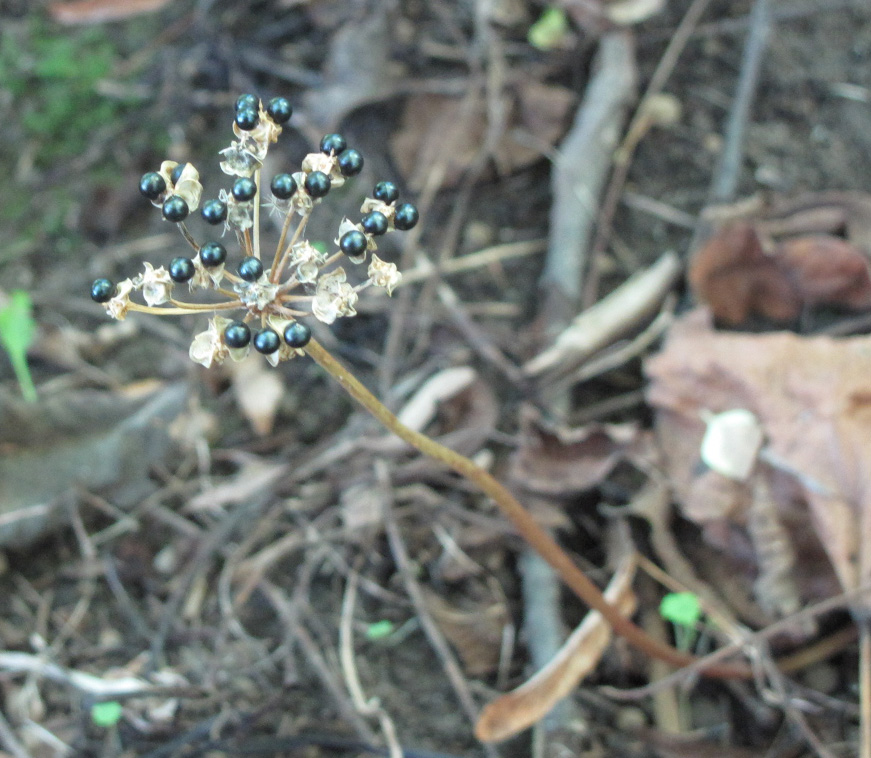
The flowers ripen into three-lobed capsules, each typically holding one to three round, shiny black seeds about ⅛ inch across. The species name tricoccum refers to this three-parted fruit. The seed heads often persist into fall. Seeds have a complex dormancy and may take six to eighteen months to germinate.
Poisonous Lookalikes
Lily-of-the-valley has similar broad leaves but no onion smell, and its leaves usually come up rolled together around a single stem. False hellebore has strongly pleated, ribbed leaves that clasp a stout central stalk, again without an onion smell. Young leaves of other spring plants can also be confused with ramps. Crush a leaf and smell it, but remember that the odor can linger on your hands and give a false result from the next leaf you test. If in doubt, leave it alone.
Quick Facts
| Scientific Name | Allium tricoccum (syn. Validallium tricoccum) |
| Family | Amaryllidaceae (amaryllis and onion family) |
| Plant Type | Bulbous herbaceous perennial; spring ephemeral leaves |
| Mature Height | Leaves 6–12 in; flower stalks 6–16 in |
| Mature Spread | 3–6 in per plant; forms dense colonies |
| Growth Rate | Slow (5–7 years from seed to harvest size) |
| Sun Exposure | Partial to full shade (sun in early spring before leaf-out) |
| Water Needs | Medium to high; consistently moist soil |
| Soil Type | Rich, moist, well-drained forest loam high in organic matter |
| Soil pH | About 5.5–7.0 |
| Bloom Time | June–July (after the leaves have withered) |
| Flower Color | Creamy white to pale greenish white |
| Fall Color | None; leaves die back by early summer |
| Fruit | Three-lobed capsule with shiny black seeds |
| Deer Resistant | Yes; the onion-flavored foliage is seldom browsed |
| USDA Hardiness Zones | 3–7 |
Native Range
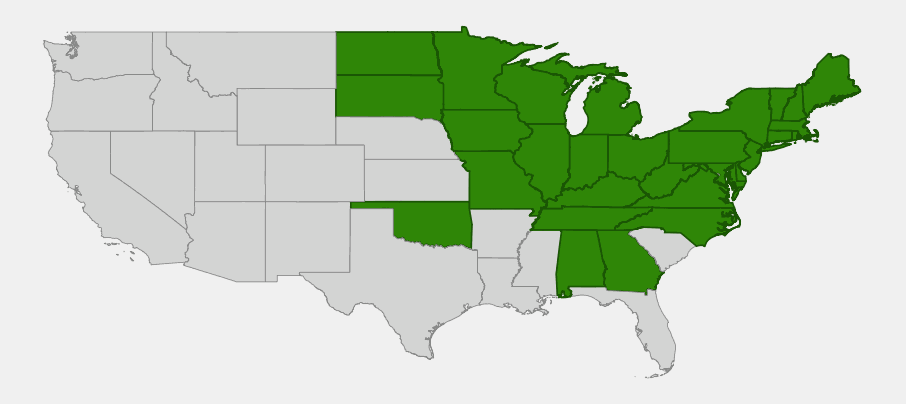
Wide leek is native to the deciduous forests of eastern and north-central North America. USDA PLANTS records it as native in 29 states: across New England and New York, south through New Jersey, Pennsylvania, Delaware and Maryland, through Virginia, West Virginia, Kentucky, Tennessee and North Carolina in the Appalachians to Georgia and Alabama, and west through Ohio, Indiana, Illinois, Michigan, Wisconsin, Minnesota, Iowa and Missouri to the Dakotas and Oklahoma. In Canada it grows from Manitoba east through Ontario and Quebec to New Brunswick and Nova Scotia.
Ramps are most abundant in rich, moist hardwood forests of the Appalachian Mountains, the Great Lakes region, and the Northeast, where they can form colonies covering acres of forest floor. In the southern part of the range they grow mainly at higher elevations in the mountains, often in cove forests. Toward the western edge of the range in the Dakotas, Iowa, Missouri and Oklahoma they become scattered and local, restricted to moist wooded ravines and river bottoms.
They grow best in moist, rich, well-drained soils under maple, beech, basswood, buckeye, tulip tree and other hardwoods, often on north-facing slopes, in cove forests, and along shaded streams and floodplain terraces. They share their habitat with other spring wildflowers such as trout lily, Dutchman’s breeches, trillium and blue cohosh.
📋 Regional plant lists featuring Wide leek: New York, Pennsylvania & Northern New Jersey · Ohio & Indiana · Michigan, Wisconsin & Eastern Minnesota · Kentucky & Tennessee · Connecticut, Massachusetts & Rhode Island · New Hampshire, Maine & Vermont · Maryland, Virginia & West Virginia · Delaware, Southern New Jersey & Long Island · Illinois, Iowa & Missouri · Alabama, Georgia & Mississippi
Growing & Care Guide
Growing your own ramps is one of the best ways to enjoy them without harming wild populations. They are easy to grow in a shady, moist woodland garden, though slow to establish. Start with seed or nursery-grown bulbs from a reputable source rather than digging plants from the wild.
Light
Ramps need spring sun and summer shade, the same pattern found under deciduous trees. Plant them under hardwoods where they get light in early spring before the canopy closes. Evergreen shade or full summer sun is not suitable.
Soil & Water
They grow best in deep, loose, moist soil rich in organic matter, like a natural forest floor. Add leaf mold or compost to heavy or sandy soils. Keep the soil evenly moist in spring. Ramps tolerate some summer dryness while dormant, but they do not do well in compacted or waterlogged soils. Mulch with shredded leaves each fall.
Planting Tips
Plant bulbs in early spring as they begin to leaf out, or in fall, setting them about 3 inches deep and 4 to 6 inches apart. Plant seeds in late summer or fall about ½ inch deep, mark the spot and be patient: seeds often take until the second spring to sprout. Plants from seed may need five years or more to reach a size worth harvesting.
Pruning & Maintenance
Little maintenance is needed. Let the leaves die back naturally so the bulbs can store energy. Leave the flower stalks to ripen seed, which will slowly expand the patch. Control competing weeds and invasive plants such as garlic mustard, which favors the same habitat.
Propagation & Sustainable Harvest
Ramps can be divided in early spring or fall by separating clusters of bulbs, or grown from fresh seed. If you harvest from your own patch or a wild one where it is allowed, take just one leaf from each plant, cutting it above ground, and leave the bulb to grow. If you dig bulbs at all, take only a small share of a patch and do not return to it for several years. Some parks and jurisdictions restrict or prohibit ramp harvesting, so check local rules before you forage.
Landscape Uses
- Woodland gardens: an attractive spring ground cover under hardwoods
- Edible native gardens: a perennial wild onion for shade, harvested leaf by leaf
- Forest restoration: replanting ramps in suitable woods where they have been overharvested
- Spring ephemeral plantings: combines well with trout lily, trillium, bloodroot and wild ginger
- Forest farming: grown in managed woodlots as a sustainable crop
Wildlife & Ecological Value
Wide leek is part of the spring ephemeral community of eastern hardwood forests, completing much of its yearly growth before the trees leaf out.
For Pollinators
The summer flowers are visited by small bees, including sweat bees, as well as flies and other insects. Because the flowers appear in June and July, after most woodland wildflowers have finished, they provide a source of nectar and pollen in shady woods at a time when little else is in bloom.
For Birds
Ramps have little direct food value for birds, though some ground-feeding birds may eat the seeds. Rich hardwood forests that support ramps also support many forest songbirds.
For Mammals
The strong onion flavor discourages most browsing, and deer generally avoid ramps. Small mammals may eat seeds or occasionally dig bulbs.
Ecosystem Role
Ramps take up nutrients from the soil in early spring when the forest floor is warming and few other plants are active. Their dense colonies help hold soil on slopes and stream banks. Because they spread slowly and recover slowly from harvest, healthy ramp colonies are an indicator of a stable, old forest floor.
Cultural & Historical Uses
Ramps were an important spring food for many Native American peoples of the eastern woodlands, who gathered the leaves and bulbs as one of the first fresh greens after winter and used them in medicine. The name of the city of Chicago is widely believed to come from a Miami-Illinois word, shikaakwa, for this plant, which once grew abundantly in the area.
In the Appalachian Mountains, ramps have long been a celebrated spring tradition. Communities across West Virginia and neighboring states hold ramp suppers and festivals each spring, and ramps were once valued as a spring tonic. The English name “ramp” comes from “ramson”, an old name for the related European wild garlic, Allium ursinum.
Today ramps are sought after by chefs and food lovers, which has increased harvesting pressure. Many foragers, conservation groups and nurseries now promote leaf-only harvest, cultivation from seed and forest farming as ways to enjoy ramps while protecting wild populations. Buying ramps that are cultivated or harvested leaf-only helps support these efforts.
Frequently Asked Questions
Are ramps and wide leek the same plant?
Yes. Allium tricoccum is called ramp (the USDA common name), wide leek, wild leek and ramps. A narrower-leaved form, var. burdickii, is sometimes treated as a separate species.
How can I harvest ramps sustainably?
Take only one leaf from each plant, cut it above ground and leave the bulb in place. Avoid digging bulbs, never harvest the same patch heavily year after year, and check local rules, since some areas restrict or ban harvesting. Growing your own from seed or nursery stock is the most sustainable option.
What plants could be confused with ramps?
Lily-of-the-valley and false hellebore are poisonous plants that can look similar in spring. Neither has an onion or garlic smell. False hellebore has pleated leaves on a stout stem. Never eat a wild plant unless you are certain of its identity.
Can I grow ramps from seed?
Yes, but it takes patience. Seeds sown in late summer or fall usually sprout in the second spring, and plants take five years or more to reach harvest size. Planting nursery-grown bulbs gives faster results.
Why do ramp leaves disappear in summer?
Ramps are spring ephemerals. They grow leaves in early spring while the forest floor is sunny, then let the leaves die back as the canopy closes. The bulb stays dormant underground except for the summer flower stalk.

Looking for a nursery that carries Wide leek?
Browse our native plant nursery directory: Alabama · Connecticut, Delaware & Georgia · Illinois, Indiana & Iowa · Kentucky, Maine, Maryland, Massachusetts, Michigan, Minnesota & Missouri · New Hampshire, New Jersey, New York, North Carolina, North Dakota, Ohio & Oklahoma · Pennsylvania, Rhode Island, South Dakota, Tennessee, Vermont & Virginia · West Virginia & Wisconsin