
Two-Leaved Toothwort (Cardamine diphylla)
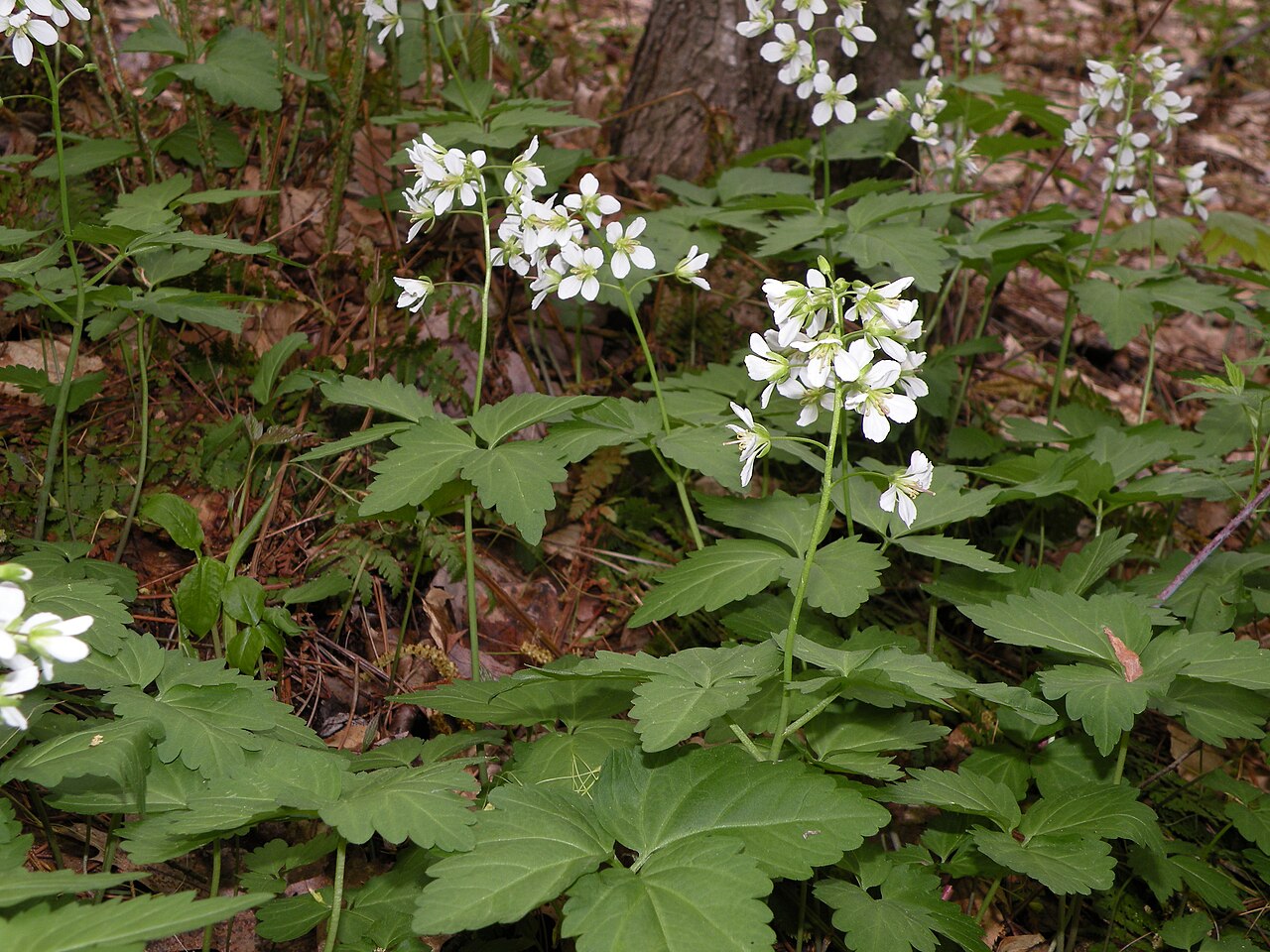
Cardamine diphylla, known as Two-Leaved Toothwort, broadleaf toothwort or crinkleroot (the name USDA PLANTS uses), is a spring wildflower of rich eastern deciduous forests. It belongs to the mustard family (Brassicaceae) and grows 8 to 16 inches tall from a long, fleshy rhizome. In April and May each flowering stem carries a single pair of broad, three-part leaves and a loose cluster of white to pale pink, four-petaled flowers.
Unlike many spring ephemerals, two-leaved toothwort does not disappear when the trees leaf out. Its long-stalked basal leaves often stay green through summer and sometimes into winter, so a patch remains as a low, leafy groundcover after the flowers are gone. The plant spreads slowly by its branching rhizomes and can form large, dense colonies on moist wooded slopes and stream terraces.
Toothwort has a long history as a wild food. Its crisp rhizome tastes sharply peppery, like a mild horseradish or radish. It is also an important host plant for the West Virginia white butterfly, a declining native butterfly of eastern hardwood forests. This guide covers how to identify it, where it grows, how to grow it in a shade garden, and why it matters to woodland wildlife.
Identification
Two-leaved toothwort is easiest to recognize by its stem leaves: almost always two, nearly opposite, and each divided into three broad, toothed leaflets. That detail separates it from its close relative cut-leaved toothwort, which has a whorl of three deeply cut, narrow-lobed leaves.
Rhizome & Stems
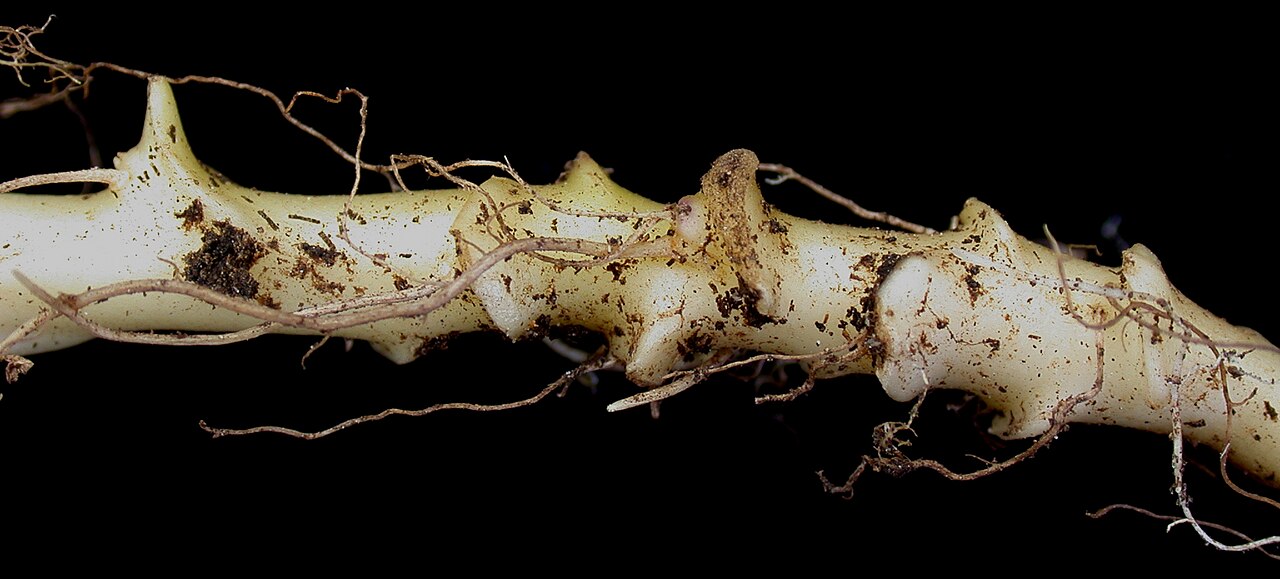
The plant grows from a whitish, fleshy rhizome that runs horizontally just below the leaf litter. It is about ¼ to ½ inch thick, often branched, and constricted at intervals into knobby, tooth-like segments. These segments explain the common names toothwort and crinkleroot, and the old genus name Dentaria (Latin dens, tooth). The flowering stems are smooth, unbranched and usually 8 to 16 inches tall.
Leaves
Each flowering stem carries two leaves (occasionally three) placed close together, nearly opposite, partway up the stem; diphylla means “two-leaved.” Each leaf is divided into three broad, oval to diamond-shaped leaflets, 1½ to 3 inches long, with coarse, rounded teeth along the margins. Separate long-stalked basal leaves of the same shape rise from the rhizome. They are often larger than the stem leaves, and they persist long after flowering.
Flowers
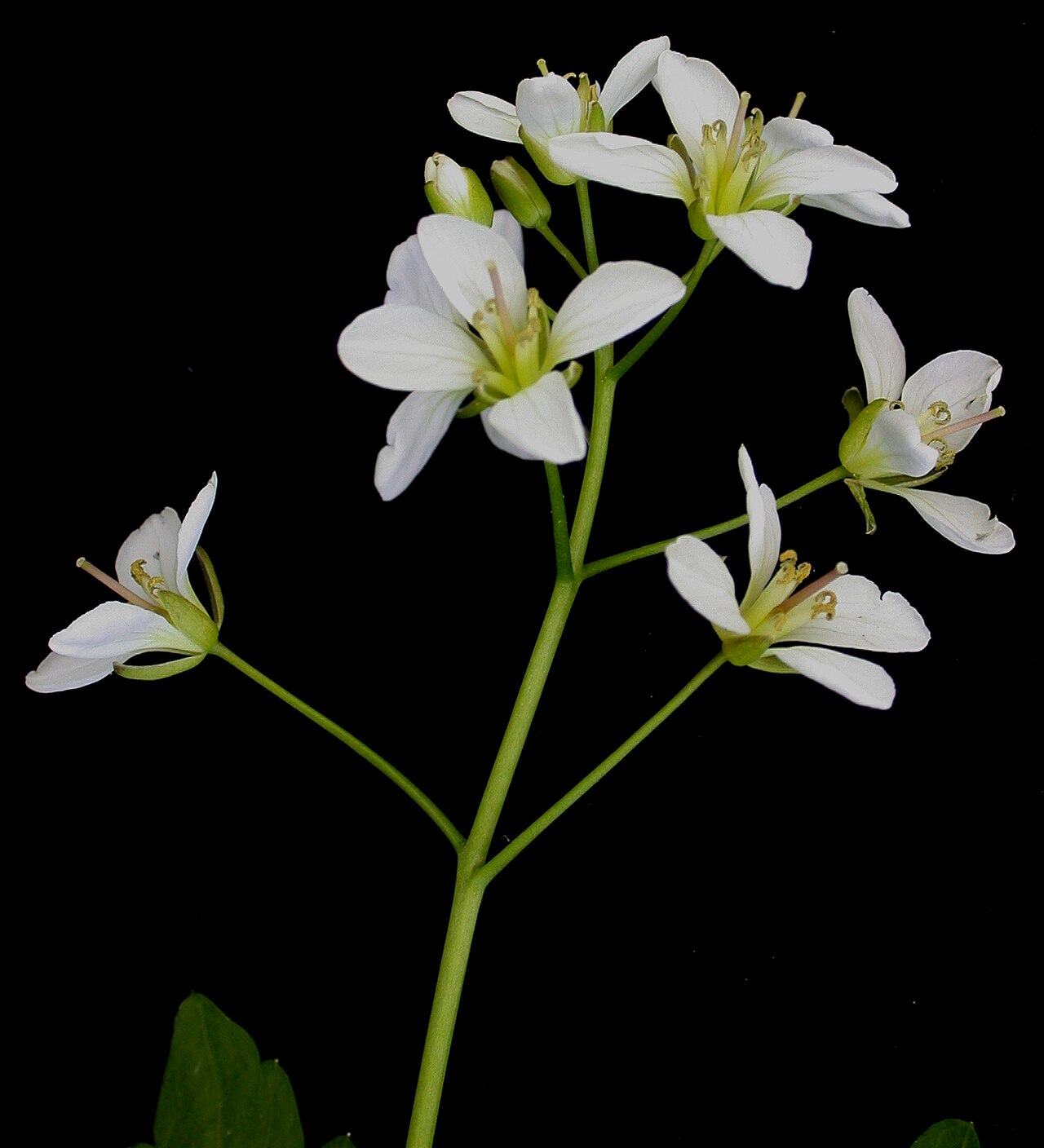
The flowers form a loose cluster (raceme) at the top of the stem, with 5 to 15 blooms opening over two or three weeks. Each flower is about ½ to ¾ inch across, with four white petals (sometimes tinged pale pink or lavender as they age) and six stamens, four long and two short, as in other mustards. The buds are often pinkish and nod before opening. Bloom time is mostly April into May, a little earlier in the South and later in Canada.
Fruit & Seeds
Pollinated flowers develop into slender, upright pods (siliques) about 1 inch long, which split open from the base to release small seeds. In many populations few pods mature, and the plant spreads much more by its rhizomes than by seed. Large colonies can be one plant or a few clones.
Similar Species
Cut-leaved toothwort (Cardamine concatenata) has three stem leaves in a whorl, each cut into narrow, deeply toothed segments, and it goes fully dormant by early summer. Slender toothwort (C. angustata) has narrower leaflets and smaller basal leaves. Spring beauty and rue anemone flower at the same time but have five or more petals.
Quick Facts
| Scientific Name | Cardamine diphylla (syn. Dentaria diphylla) |
| Family | Brassicaceae (mustard family) |
| Plant Type | Herbaceous perennial woodland wildflower; spreads by rhizomes |
| Mature Height | 8–16 in |
| Mature Spread | 6–12 in per plant; forms colonies over time |
| Growth Rate | Slow to moderate |
| Sun Exposure | Partial shade to full shade (under deciduous trees) |
| Water Needs | Moderate; prefers evenly moist soil |
| Soil Type | Rich, humus-rich loam; moist woodland soil with leaf litter |
| Soil pH | About 5.0–7.0 (acidic to near neutral) |
| Bloom Time | April–May |
| Flower Color | White, sometimes tinged pale pink or lavender |
| Fall Color | None; basal leaves often stay green into fall |
| Fruit | Slender upright pod (silique) about 1 in long |
| Deer Resistant | Moderate; occasionally browsed |
| USDA Hardiness Zones | 3–8 |
Native Range
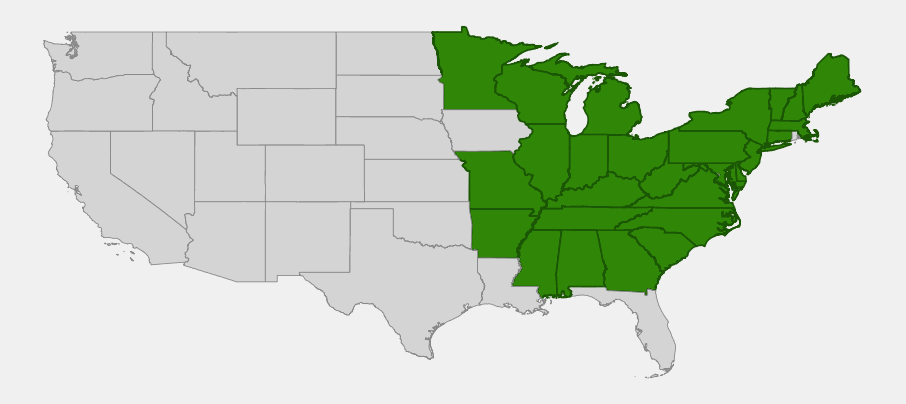
Two-leaved toothwort is a plant of the eastern deciduous forest. USDA PLANTS records it as native in 27 states, from Maine, Vermont and New Hampshire west through the Great Lakes states to Wisconsin and Minnesota and south through the Appalachians to Georgia, Alabama and Mississippi. In Canada it grows in southern Ontario, southern Quebec, New Brunswick, Nova Scotia and Prince Edward Island.
It is most common in the Appalachian Mountains and the hill country of the Northeast and Great Lakes, where it often forms extensive carpets on moist slopes, in ravines and on rich stream terraces. In the Southeast it is mostly a plant of the mountains and Piedmont, becoming scarce on the Coastal Plain. At the western edge of its range in Minnesota, Missouri and Arkansas it is local and uncommon, and those records are outlying populations.
It typically grows in rich, moist hardwood forests of sugar maple, beech, basswood, oak and tulip poplar, especially on north- and east-facing slopes and in coves. Lady Bird Johnson Wildflower Center notes that it does not tolerate the deep shade cast by evergreen trees.
📋 Regional plant lists featuring Two-Leaved Toothwort: New York, Pennsylvania & Northern New Jersey · Ohio & Indiana · Michigan, Wisconsin & Eastern Minnesota · Kentucky & Tennessee · Connecticut, Massachusetts & Rhode Island · New Hampshire, Maine & Vermont · Maryland, Virginia & West Virginia · Delaware, Southern New Jersey & Long Island · Illinois, Iowa & Missouri · Alabama, Georgia & Mississippi · North & South Carolina · Arkansas, Louisiana, Eastern Oklahoma & Eastern Texas
Growing & Care Guide
Two-leaved toothwort is a rewarding plant for a shady woodland garden. It is slow to start, but once settled it spreads into a low, leafy groundcover that flowers each spring and stays green after the true spring ephemerals have vanished. Buy nursery-propagated plants or rhizome divisions rather than digging them from the wild.
Light
Plant it under deciduous trees, where it gets bright light in early spring before leaf-out and shade for the rest of the year. Partial to full shade is ideal. It does poorly under dense conifers and in hot, open sun.
Soil & Water
Give it moist, loose, humus-rich soil with plenty of leaf litter, like a natural forest floor. Slightly acidic to near-neutral soil suits it best. Keep the soil evenly moist in spring. It tolerates some drying in late summer, but the basal leaves will brown and go dormant early in long dry spells.
Planting Tips
Plant potted plants or rhizome pieces in early spring or fall. Lay rhizome sections horizontally about 1 to 2 inches deep and 6 to 12 inches apart, then cover with soil and a light layer of shredded leaves. Mark the planting, since the plant may be slow to appear in its first spring.
Pruning & Maintenance
Toothwort needs very little care. Leave fallen leaves in place as a natural mulch and avoid digging around established patches. Watch for garlic mustard (Alliaria petiolata), an invasive mustard that crowds toothwort out of woodlands and harms the butterflies that depend on it. Pull it before it sets seed.
Propagation
The easiest way to propagate toothwort is to divide the rhizomes after flowering or in early fall. Each piece with a bud or node can grow into a new plant. Seed is produced irregularly. Sow fresh seed outdoors in a shady, moist bed, where it needs a cold winter before it germinates, and expect seedlings to take several years to flower.
Landscape Uses
- Woodland gardens: a spring-blooming groundcover under deciduous trees, with leaves that stay after flowering
- Butterfly gardens in shade: a host plant for West Virginia white and mustard white caterpillars
- Forest restoration: rich, moist hardwood slopes and ravines within its native range
- Companion planting: pairs well with ferns, trilliums, bellworts, wild ginger and other spring wildflowers
- Shady slopes: its spreading rhizomes help knit the leaf litter and soil together
Wildlife & Ecological Value
Two-leaved toothwort is one of the first wildflowers to bloom in many eastern woods, and it supports both early pollinators and a specialist butterfly.
For Pollinators
The flowers produce nectar and pollen for early-season insects, including small bees, bumblebee queens emerging from hibernation, bee flies and early butterflies. Bloom time overlaps with many other spring wildflowers, so it helps sustain the first wave of pollinators of the year.
For Birds
Birds make little direct use of the plant, but its colonies are part of the forest floor where ground-nesting and ground-foraging birds such as ovenbirds and wood thrushes find insects.
For Mammals
Deer occasionally browse the foliage, and small mammals may eat the rhizomes. It is not usually a preferred deer food, but heavy browsing in overpopulated deer herds can reduce flowering.
Ecosystem Role
Toothworts are the main caterpillar food plants of the West Virginia white (Pieris virginiensis), a butterfly of rich eastern hardwood forests, and they are also used by the mustard white (Pieris oleracea). The West Virginia white has declined in many areas. One reason is invasive garlic mustard: females often lay eggs on it, but its chemistry is toxic to the caterpillars, and few survive. Protecting native toothwort colonies and removing garlic mustard both help this butterfly.
Cultural & Historical Uses
André Michaux described this plant in 1803 as Dentaria diphylla, and older field guides still use that name. Alphonso Wood moved it to Cardamine in the nineteenth century, a placement most botanists now follow because DNA studies show the toothworts belong within the larger genus of bittercresses.
The peppery rhizome has long been eaten. Ethnobotanical records describe several Indigenous peoples of the Northeast eating the raw or cooked rhizome and using it as a medicine for colds and other complaints. Early settlers also used it as a condiment, grating or chopping the fresh root and mixing it with vinegar or salt like horseradish, and nineteenth-century writers knew it as “pepper root.”
Modern foragers still prize toothwort, but taking the rhizome kills or damages the plant, and colonies grow back slowly. If you want to taste it, grow your own from nursery stock and harvest only a few pieces from a well-established patch. In the wild, enjoy it as one of the most reliable signs that spring has arrived in an eastern forest.
Frequently Asked Questions
How do I tell two-leaved toothwort from cut-leaved toothwort?
Count and look at the stem leaves. Two-leaved toothwort usually has two leaves, each with three broad, toothed leaflets. Cut-leaved toothwort has three leaves in a whorl, each cut into narrow, deeply toothed lobes. Two-leaved toothwort also keeps its basal leaves after flowering, while cut-leaved toothwort goes completely dormant.
Is two-leaved toothwort edible?
Yes, the rhizome has a sharp, peppery taste similar to horseradish and has a long history of use as food. Harvesting kills or damages plants, though, so never dig from wild populations. Grow it yourself if you want to try it.
Why is it called crinkleroot?
The pale rhizome is wrinkled and constricted into knobby segments. USDA PLANTS uses crinkleroot as its common name, and the names toothwort and pepper root also come from the rhizome.
Is toothwort a host plant for butterflies?
Yes. It is a key larval food plant for the West Virginia white and the mustard white. These butterflies need native toothworts and are harmed when invasive garlic mustard takes their place.
Will it spread in my garden?
Slowly. In rich, moist, shady soil it spreads by rhizomes into patches that can eventually cover several square feet. It is never aggressive and is easy to share by dividing the rhizomes.

Looking for a nursery that carries Two-Leaved Toothwort?
Browse our native plant nursery directory: Alabama & Arkansas · Connecticut, Delaware & Georgia · Illinois & Indiana · Kentucky, Maine, Maryland, Massachusetts, Michigan, Minnesota, Mississippi & Missouri · New Hampshire, New Jersey, New York, North Carolina & Ohio · Pennsylvania, South Carolina, Tennessee, Vermont & Virginia · West Virginia & Wisconsin