
Mountain Woodsorrel (Oxalis montana)
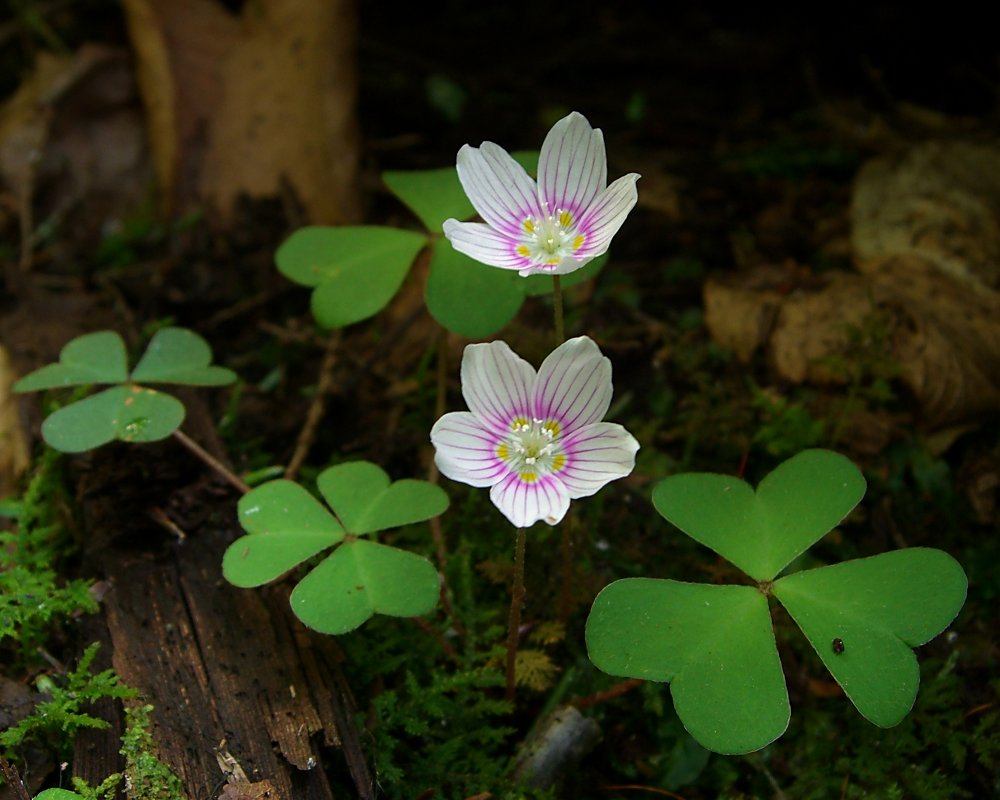
Oxalis montana, the Mountain Woodsorrel, is a small, delicate wildflower of cool, moist northern and mountain forests. Its shamrock-like leaves, each with three heart-shaped leaflets, form soft green carpets on mossy ground, logs and stream banks, and from late spring into summer it opens white flowers finely striped with pink. It is also called white wood sorrel, common wood sorrel and northern wood sorrel.
Mountain woodsorrel is the North American counterpart of the Eurasian wood sorrel, Oxalis acetosella, and some botanists treat it as a subspecies of that plant. It is a plant of spruce-fir, hemlock and northern hardwood forests, and in the South it is found only at high elevations in the Appalachians, where the climate resembles that of New England and Canada.
Like other woodsorrels, its leaves fold down at night and in bright sun, and it produces two kinds of flowers: showy ones that open in spring and early summer, and small closed ones later in the season that pollinate themselves. It is a beautiful but fussy plant that needs cool summers and constant moisture, so it is best enjoyed in the woods or grown only where those conditions exist.
Identification
Mountain woodsorrel is easy to recognize when in flower. Its white, pink-veined flowers separate it from the yellow-flowered woodsorrels and from violet woodsorrel.
Leaves
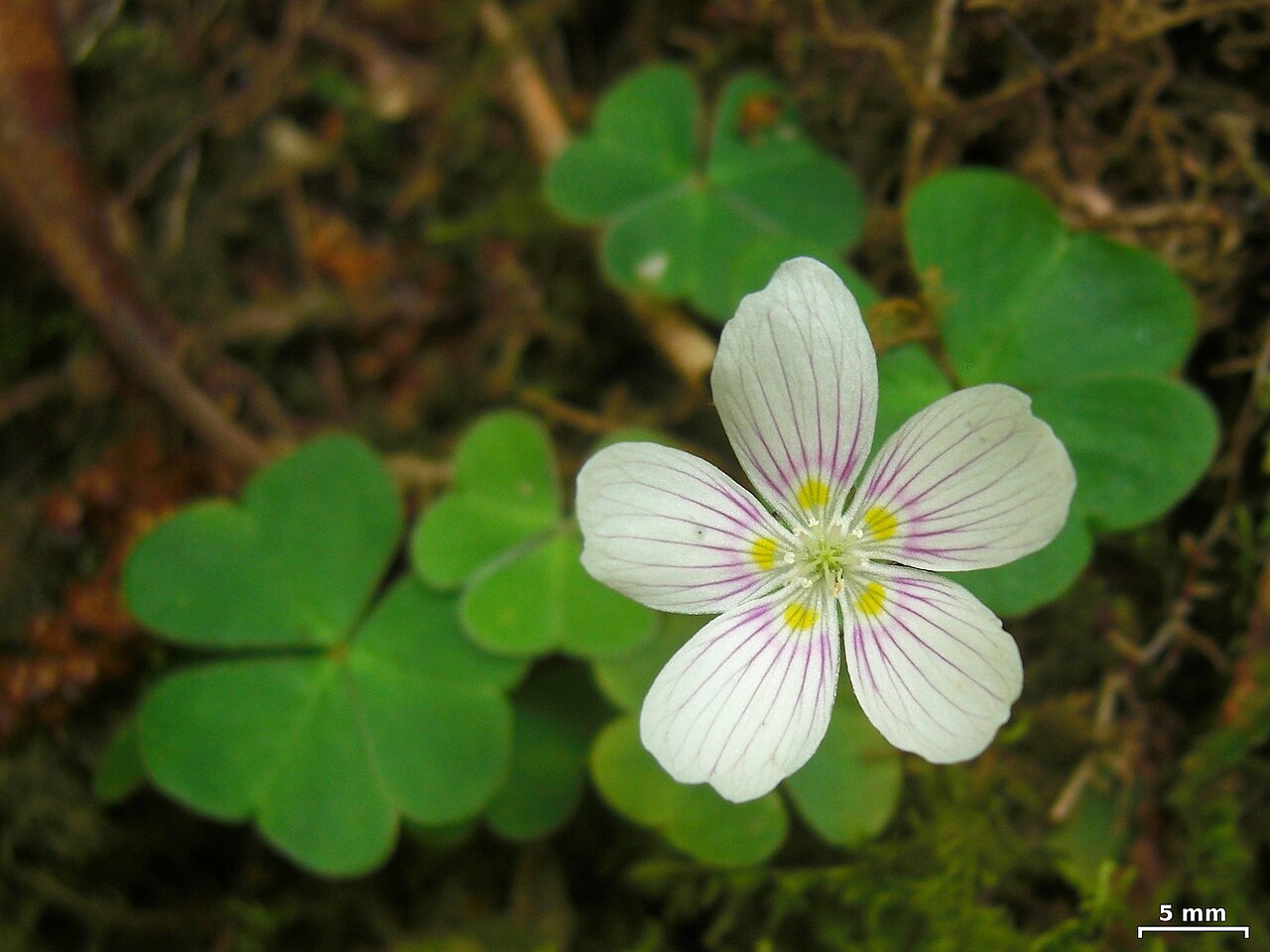
All the leaves rise directly from a slender, creeping underground stem. Each leaf has a long, often reddish, hairy stalk 2 to 6 inches tall and three heart-shaped leaflets, each about 1/2 to 1 inch wide and notched at the tip. The leaflets are bright green, thin and slightly hairy. They fold down along the midrib at night, in cold weather and in strong sun.
Flowers
From May to July, or into August in the North, single flowers rise on slender stalks to about the height of the leaves. Each flower is about 3/4 inch across, with five white petals that are notched at the tip and marked with fine pink or rose veins, plus a small yellow spot at the base of each petal. Occasionally the whole flower is pale pink. Later in the summer the plant also makes small flowers that never open, on short curved stalks near the base, and these pollinate themselves.
Fruit & Seeds
The fruit is a small, egg-shaped capsule. When ripe it bursts open and flings its seeds a short distance, a trait shared by many woodsorrels.
Similar Species
The yellow-flowered woodsorrels, such as yellow wood sorrel, have yellow flowers and grow in sunny, disturbed ground. Violet woodsorrel has clustered pink-violet flowers and grows in drier, open woods. Clovers have leaflets that are not heart-shaped and flowers in dense round heads.
Quick Facts
| Scientific Name | Oxalis montana (syn. Oxalis acetosella subsp. montana) |
| Common Names | Mountain woodsorrel (USDA), white wood sorrel, common wood sorrel, northern wood sorrel |
| Family | Oxalidaceae (wood sorrel family) |
| Plant Type | Low herbaceous perennial wildflower |
| Mature Height | 2–6 in |
| Mature Spread | Spreads slowly by rhizomes to form patches |
| Growth Rate | Slow to moderate in suitable cool, moist sites |
| Sun Exposure | Part shade to full shade |
| Water Needs | Medium to high; constantly moist soil |
| Soil Type | Cool, humus-rich, mossy or peaty forest soil |
| Soil pH | Acid (about 4.5–6.0) |
| Bloom Time | May–July, into August in the North |
| Flower Color | White with pink veins, sometimes pale pink |
| Fall Color | None notable |
| Fruit | Small capsule that ejects its seeds |
| Deer Resistant | Moderate; small and seldom heavily browsed |
| USDA Hardiness Zones | 3–6 |
Native Range
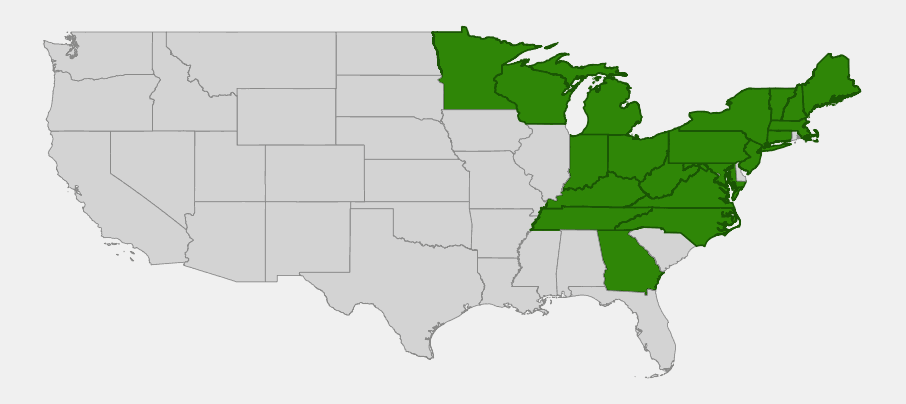
Mountain woodsorrel is native to northeastern North America. USDA PLANTS records it from 20 states, from Maine and the rest of northern New England south through New York, New Jersey and Pennsylvania, west through Ohio, Indiana and Michigan to Wisconsin and Minnesota, and south in the Appalachian Mountains through Maryland, West Virginia, Virginia, Kentucky, Tennessee and North Carolina to northern Georgia. In Canada it ranges from Ontario and Quebec to the Maritime provinces, Newfoundland and Labrador.
It is common in the spruce-fir and northern hardwood forests of northern New England, the Adirondacks, the Catskills and the upper Great Lakes. South of Pennsylvania it is a mountain plant, found mainly at high elevations in the Appalachians, such as in the spruce-fir forests of the Great Smoky Mountains. Records from Indiana and similar lowland states are scattered and local.
It grows in cool, moist, shady forests: under spruce, fir and hemlock, in northern hardwood forests of maple, beech and birch, on mossy logs, boulders and stream banks, and in damp ravines. It needs soil that stays cool and moist all summer.
📋 Regional plant lists featuring Mountain Woodsorrel: New York, Pennsylvania & Northern New Jersey · Ohio & Indiana · Michigan, Wisconsin & Eastern Minnesota · Kentucky & Tennessee · Connecticut, Massachusetts & Rhode Island · New Hampshire, Maine & Vermont · Maryland, Virginia & West Virginia · Delaware, Southern New Jersey & Long Island · Alabama, Georgia & Mississippi · North & South Carolina
Growing & Care Guide
Mountain woodsorrel is lovely but demanding. It grows well only where summers are cool and the soil stays moist, as in northern New England, the upper Great Lakes and high Appalachian elevations. It is occasionally offered by native plant nurseries; buy nursery-propagated plants and never dig them from the wild.
Light
Give it part to full shade. It grows naturally under dense conifer and hardwood canopies and suffers quickly in afternoon sun or heat.
Soil & Water
It needs cool, acid, humus-rich soil that never dries out, such as a mix of leaf mold and peat-free compost over a moist, shaded site. A mossy bank or the north side of a log or boulder is ideal. Water during dry spells; drought and hot soil are the main reasons it fails in gardens.
Planting Tips
Plant small clumps in spring in a shaded, sheltered spot, setting the rhizomes just below the surface and covering them lightly with leaf mold. It is best suited to woodland and shade gardens in zones 3 to 6 where summers are cool. In warmer areas, foamflower or partridgeberry are easier native choices for shade. Choose the native Oxalis montana rather than the similar Eurasian wood sorrel sold in some garden centers.
Pruning & Maintenance
No pruning is needed. Leave fallen leaves in place as a natural mulch and keep competing plants from smothering the patch. Avoid fertilizer and lime.
Propagation
Divide established patches in early spring by separating sections of rhizome with leaves attached. Seeds can be sown fresh in a cool, shaded, moist spot, but seedlings are slow. Collect seed or divisions only from your own plants or with permission, never from wild populations.
Landscape Uses
- Shade and woodland gardens: a delicate ground cover for cool, moist, shaded spots in northern gardens
- Moss and rock gardens: looks natural on mossy logs, boulders and stream banks
- Wildflower walks: a common, easy-to-spot bloom of northern and high-elevation forests in early summer
- Naturalizing: fills gaps among ferns and other shade plants in cool woodland settings
Wildlife & Ecological Value
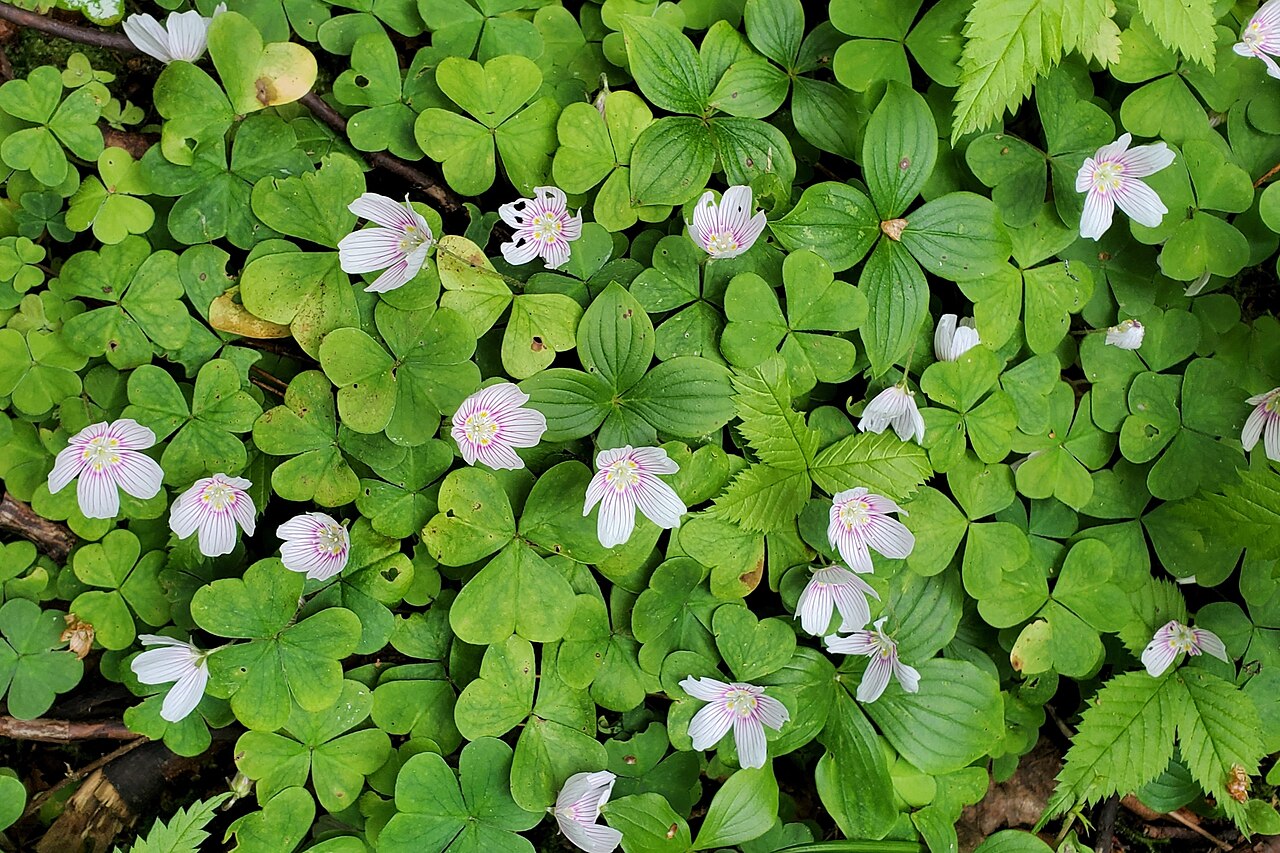
Mountain woodsorrel is a small plant, but its flowers feed early-summer insects in shaded forests where few other plants bloom.
For Pollinators
The open flowers are visited by small bees, flies and other insects, which are guided to the nectar by the pink veins on the petals. The closed flowers produced later in the season pollinate themselves, ensuring seed even when insects are scarce.
For Birds
Ground-feeding birds may pick at the leaves or seeds, but it is not an important bird food. The carpets of leaves provide cover for insects that forest birds eat.
For Mammals
Small mammals and deer may nibble the leaves. The plant contains oxalic acid, which gives the leaves their sour taste and probably discourages heavy browsing.
Ecosystem Role
Mountain woodsorrel is part of the characteristic ground layer of spruce-fir and northern hardwood forests, along with goldthread, Canada mayflower, mosses and ferns. Its carpets help hold moisture and soil on the forest floor.
Cultural & Historical Uses
The sour taste of woodsorrel leaves comes from oxalic acid. Woodsorrels have been nibbled for their lemony flavor for centuries, and the name “sorrel” comes from an old word for sour. Oxalic acid is harmful in large amounts, so this is not a plant to eat in quantity, and people with kidney problems should avoid it.
Wood sorrels are among the plants that have been called “shamrock”, and the Eurasian wood sorrel has long been linked with Irish tradition. The North American mountain woodsorrel looks very much like it, and older books often called it Oxalis acetosella.
The genus name Oxalis comes from the Greek for “sour”, and montana means “of the mountains”, for its high-elevation habitats in the South. The leaflets folding down at night is a movement called nyctinasty, which may help reduce heat and water loss.
Frequently Asked Questions
Is mountain woodsorrel easy to grow?
Only in cool climates. It needs shade, cool summers and constantly moist, acid, humus-rich soil. It does well in northern woodland gardens but often fails in hot, dry or sunny sites.
Is mountain woodsorrel the same as Oxalis acetosella?
They are very similar. The Eurasian wood sorrel is Oxalis acetosella, and some botanists treat the North American plant as a subspecies of it. USDA PLANTS treats it as a separate species, Oxalis montana.
Is mountain woodsorrel edible?
The leaves are sour from oxalic acid and have been nibbled in small amounts. Oxalic acid is harmful in large quantities, so it should not be eaten in quantity, and pets and livestock should not graze on it heavily.
Why do the leaves fold up?
Woodsorrel leaflets fold down at night, in cold weather and in strong sunlight. This movement is thought to help the plant reduce water loss and protect its leaves.
When does mountain woodsorrel bloom?
The showy white flowers open from May to July, and into August in the far North and at high elevations. Small closed flowers form later in summer.

Looking for a nursery that carries Mountain Woodsorrel?
Browse our native plant nursery directory: Connecticut & Georgia · Indiana · Kentucky, Maine, Maryland, Massachusetts, Michigan & Minnesota · New Hampshire, New Jersey, New York, North Carolina & Ohio · Pennsylvania, Tennessee, Vermont & Virginia · West Virginia & Wisconsin