
Diamond-Flowers (Stenaria nigricans)
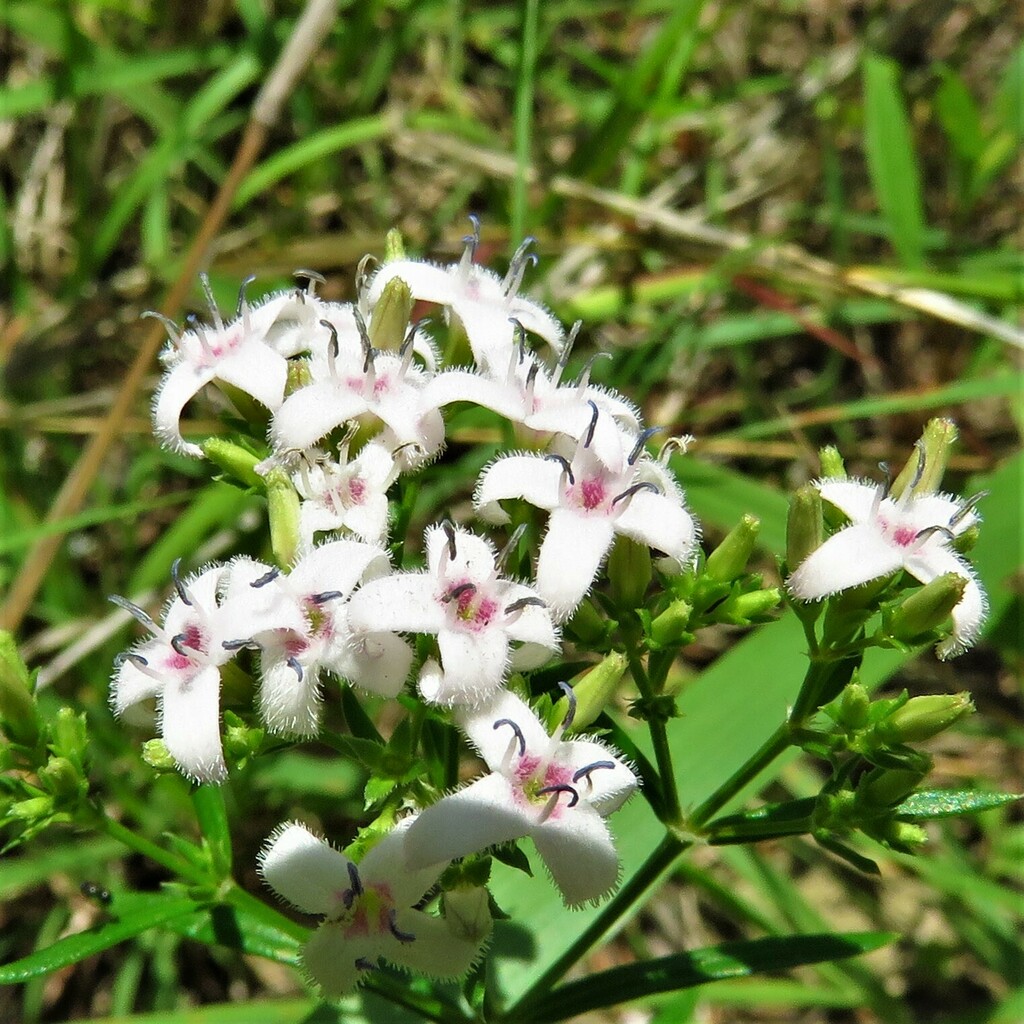
Stenaria nigricans, called Diamond-Flowers, prairie bluets or narrowleaf bluet, is a small, wiry perennial wildflower of dry, rocky and sunny places in the central and southern United States. From late spring to fall it bears clusters of tiny, four-lobed, star-shaped flowers, white to pale pink or lavender, on bushy plants with very narrow leaves. It belongs to the coffee or madder family (Rubiaceae) and is a relative of the familiar spring bluets.
The plant has been placed in several genera over the years and is still published as Hedyotis nigricans or Houstonia nigricans in many references. The species name nigricans, “becoming black,” refers to the way the plant turns black when it is dried for herbarium specimens.
Diamond-flowers is tough and long-blooming, thriving in thin soil over limestone, sandstone or gravel where few garden plants survive. This guide covers how to identify it, where it grows, how to use it in dry gardens and rock gardens, and its value to small pollinators.
Identification
Diamond-flowers can be recognized by its combination of very narrow, opposite leaves, wiry stems with a woody base, and branched clusters of tiny, four-lobed flowers produced over a long season.
Stems & Growth Habit
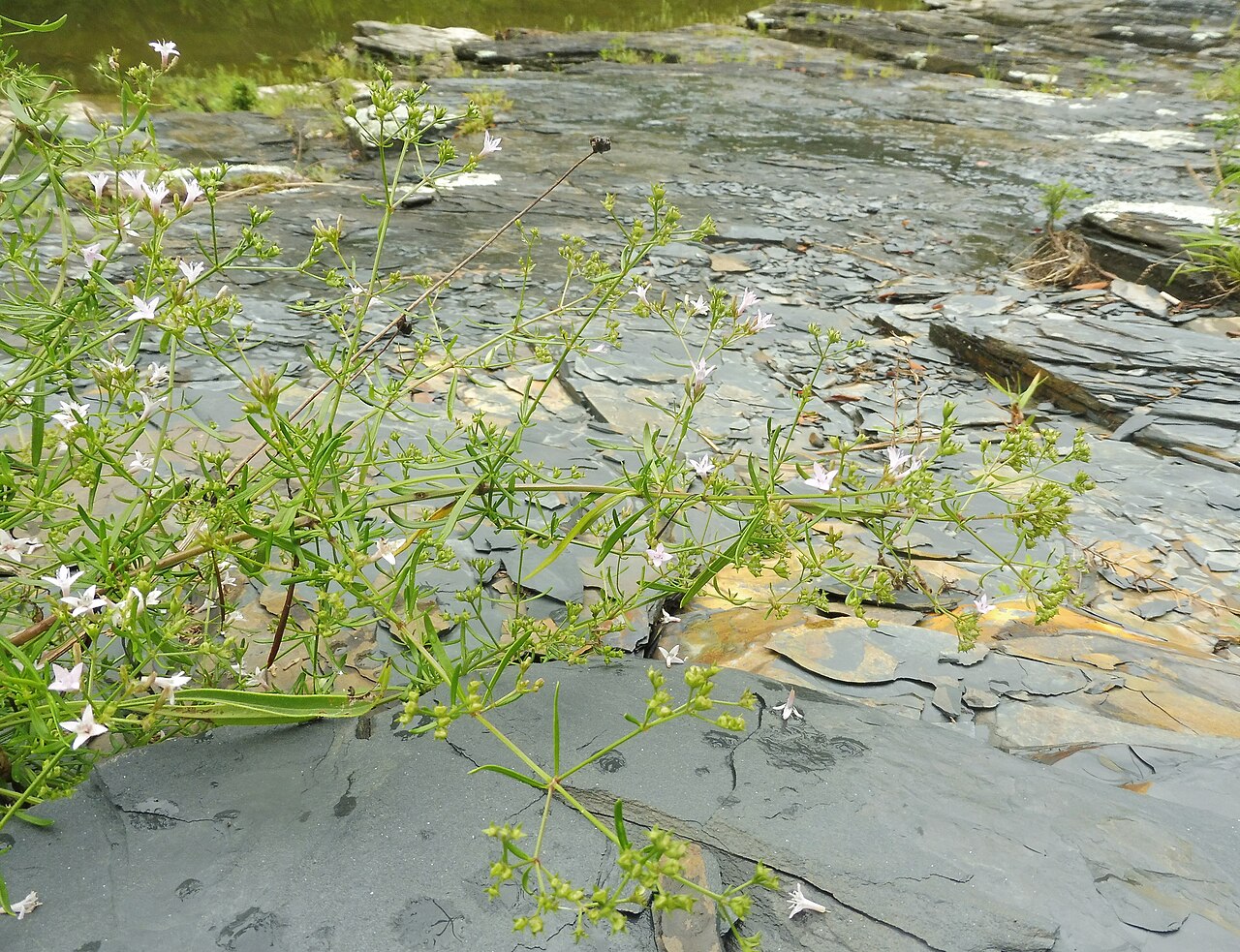
Plants are usually 4 to 18 inches tall and often as wide, with many slender, upright to sprawling stems arising from a woody base and a deep taproot. The stems are often angled and branch toward the top, giving a bushy, wiry look. In thin soils on rock, plants may be only a few inches tall and form low mats.
Leaves
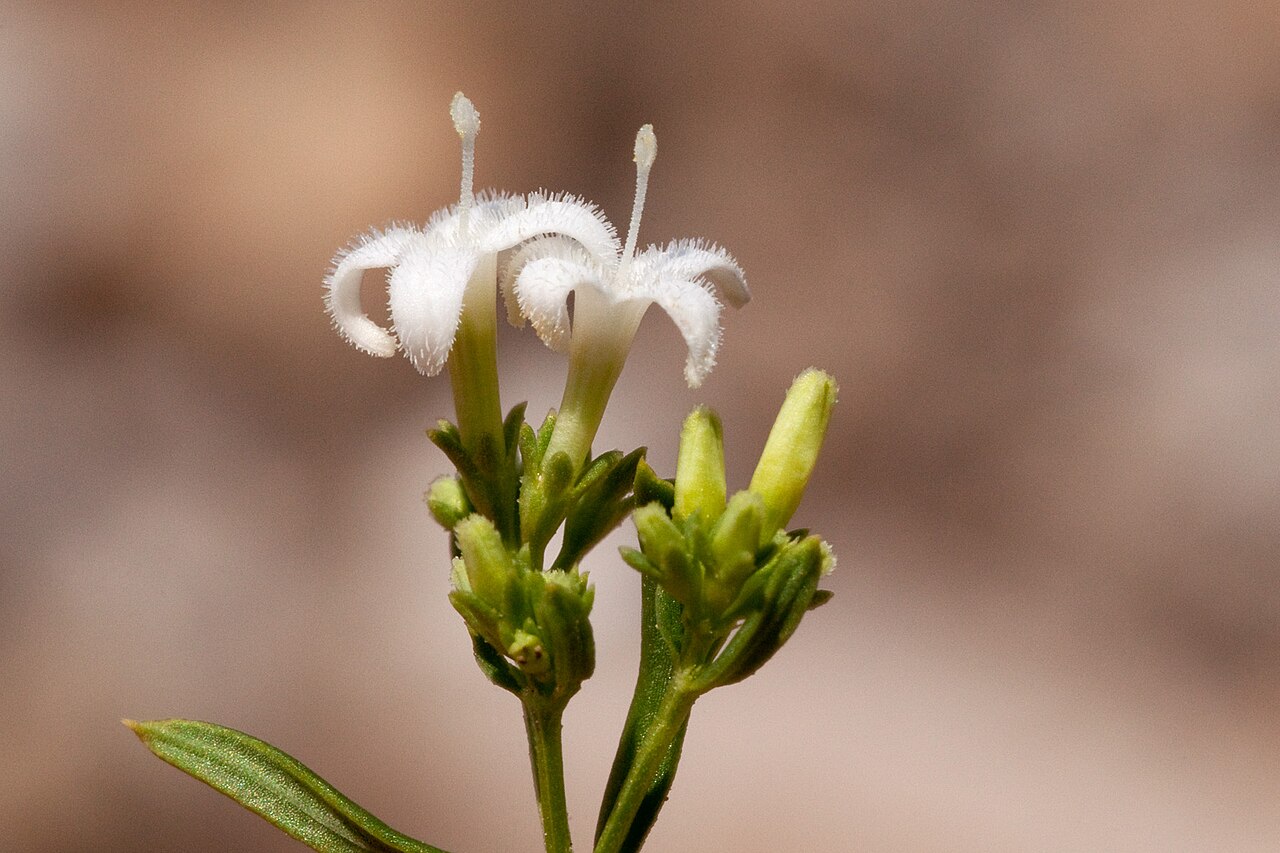
The leaves are opposite, narrow and linear, about ½ to 1½ inches long and usually less than ⅛ inch wide, often with rolled edges. Small clusters of shorter leaves are often found in the leaf axils. A small, fringed stipule connects each pair of leaves across the stem, a characteristic of the coffee family.
Flowers
The flowers are borne in branched, flat-topped to rounded clusters at the tips of the stems. Each flower is a small tube about ¼ inch long that opens into four pointed lobes, forming a tiny star about ¼ inch across. The flowers are white to pale pink or lavender, sometimes with a pinkish center, and the lobes are hairy on the inner surface. Flowering is long, from about May to October, and in the South and in Texas it may start in spring and continue into November.
Fruit & Seeds
The fruit is a small, rounded capsule about ⅛ inch long, topped by the persistent sepals. It opens at the top to release a few tiny, dark seeds. Several varieties are recognized, including var. floridana, a smaller plant of the pine rocklands of south Florida and the Keys.
Quick Facts
| Scientific Name | Stenaria nigricans (syn. Hedyotis nigricans, Houstonia nigricans) |
| Family | Rubiaceae (coffee or madder family) |
| Plant Type | Herbaceous perennial with a woody base |
| Mature Height | 4–18 in |
| Mature Spread | 6–12 in |
| Growth Rate | Moderate |
| Sun Exposure | Full sun |
| Water Needs | Low; very drought tolerant once established |
| Soil Type | Thin, rocky, gravelly or sandy soils; limestone and shale glades |
| Soil pH | About 6.5–8.5 |
| Bloom Time | May–October (spring to November in the South) |
| Flower Color | White to pale pink or lavender |
| Fall Color | None |
| Fruit | Small rounded capsule with tiny dark seeds |
| Deer Resistant | Moderately; occasionally browsed |
| USDA Hardiness Zones | 5–9 |
Native Range
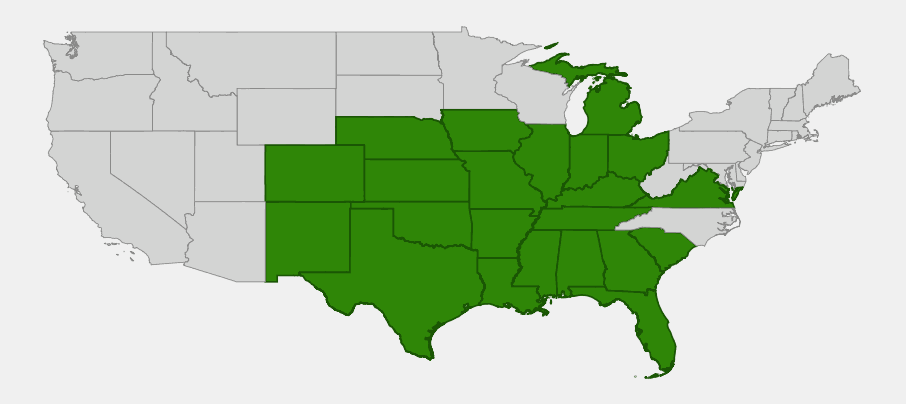
Diamond-flowers is native to the central and southern United States and northern Mexico. Its center is the southern Great Plains and the Ozarks: Texas, Oklahoma, Kansas, Missouri and Arkansas, where it is common on prairies, glades and rocky hillsides. From there it extends east through the lower Midwest and the Ohio Valley to Ohio, Kentucky, Tennessee and Virginia, south to the Gulf Coast states and Florida, and west to New Mexico and southeastern Colorado.
It becomes rare toward the edges of its range. NatureServe ranks it as critically imperiled in Colorado and Virginia, and as presumed extirpated in Michigan. A collection from New Hampshire listed by USDA PLANTS is far outside the natural range and is generally regarded as adventive, so it is not mapped here, and populations reported from Ontario are considered introduced. In Florida, the variety floridana grows in the pine rocklands of the southern peninsula and the Keys.
Throughout its range it is a plant of open, sunny, dry habitats with thin soil: limestone, dolomite and shale glades, rocky prairies, barrens, bluff tops, sandy or gravelly hills, and roadsides. It is often one of the most abundant wildflowers in Ozark and central Texas glades.
📋 Regional plant lists featuring Diamond-Flowers: Ohio & Indiana · Kentucky & Tennessee · Nebraska, Kansas & Eastern Colorado · Maryland, Virginia & West Virginia · Illinois, Iowa & Missouri · Alabama, Georgia & Mississippi · North & South Florida · North & South Carolina · Arkansas, Louisiana, Eastern Oklahoma & Eastern Texas · South & West Texas · Arizona & New Mexico
Growing & Care Guide
Diamond-flowers is an excellent small plant for hot, dry, sunny gardens, especially rock gardens, gravel gardens and the edges of paths, where its long season of tiny flowers adds a delicate touch. It is offered by some native plant nurseries in Texas and the southern Plains and is easy to grow from seed.
Light
Plant in full sun. In shade it becomes thin and floppy and flowers little.
Soil & Water
Diamond-flowers needs excellent drainage. It does best in thin, rocky, gravelly or sandy soil, including alkaline soils over limestone. Rich, moist garden soil and heavy clay that stays wet shorten its life. Water new plants until they are established. After that, its deep taproot carries it through drought, and extra summer watering is rarely needed.
Planting Tips
Plant small container plants in spring or fall, 8 to 12 inches apart. Use it between stones in a rock garden, along the edge of a gravel path, in a green roof planting or among short prairie grasses such as little bluestem and sideoats grama. Its fine texture combines well with low, bolder plants like Missouri primrose.
Pruning & Maintenance
Little care is needed. Shear plants back lightly in midsummer if they become leggy; they will regrow and bloom again. Cut old stems back to the woody base in late winter. Do not fertilize. Plants self-sow modestly in open, gravelly ground.
Propagation
Grow from seed sown on the surface of a gritty mix in fall or spring; the seeds are tiny and need light. Germination usually occurs within a few weeks in warm weather. Plants often bloom in their first or second year. The deep taproot makes established plants difficult to move or divide.
Landscape Uses
- Rock and gravel gardens: thrives in thin, well-drained soil among stones
- Xeriscapes: very drought tolerant once established
- Prairie and glade restoration: within its native range, on thin-soiled, rocky sites
- Pollinator gardens: a long season of small flowers for small bees, flies and butterflies
- Green roofs and path edges: small size and tolerance of heat and drought
Wildlife & Ecological Value
Small as its flowers are, diamond-flowers blooms for months on end in hot, dry habitats, providing a steady supply of nectar when many other plants have stopped flowering.
For Pollinators
The tiny, tubular flowers are visited by small bees, including sweat bees, as well as by bee flies, small butterflies such as skippers and hairstreaks, and day-flying moths. The long bloom season makes it a dependable nectar source on glades and dry prairies through the heat of summer.
For Birds
The tiny seeds are of little importance to birds, but glades and rocky prairies where diamond-flowers grows are habitat for birds such as the painted bunting, field sparrow and greater roadrunner in the southern part of its range.
For Mammals
Deer and livestock occasionally browse the plant, but it is not a preferred food. Its wiry, woody base allows it to regrow after grazing.
Ecosystem Role
Diamond-flowers is a characteristic plant of glades: open, rocky natural communities with thin soil that are kept free of trees by drought and fire. Many glades in the Ozarks and central Texas have been invaded by eastern red cedar or ashe juniper because fires have been suppressed. Restoration by prescribed burning and cedar removal often brings back abundant diamond-flowers and other glade wildflowers.
Cultural & Historical Uses
The French naturalist Jean-Baptiste Lamarck first described this plant in the late eighteenth century as Gentiana nigricans, placing it in the gentian family. It was later moved to Houstonia, then to Hedyotis, and more recently the American botanist Edward Terrell placed it in Stenaria, a small genus of North American species related to the bluets. Many field guides still use one of the older names.
The genus name Stenaria probably comes from the Greek stenos, narrow, a fitting description of the slender leaves. The common name diamond-flowers is thought to refer to the small, star- or diamond-shaped flowers that sparkle across rocky prairies and glades.
Few records describe uses of diamond-flowers by Indigenous peoples, although related plants in the coffee family have been used medicinally in many parts of the world. It is valued today mainly as a resilient wildflower of glades and dry prairies, and increasingly as a garden plant for water-wise landscapes in Texas and the southern Plains.
Frequently Asked Questions
Is diamond-flowers the same as Hedyotis nigricans?
Yes. The plant has been called Hedyotis nigricans and Houstonia nigricans; most current references use Stenaria nigricans.
Why is it called nigricans?
The Latin name means “becoming black.” The plant blackens when it dries, which is especially noticeable on herbarium specimens.
Is it related to bluets?
Yes. It is in the same family as bluets (Houstonia) and was once placed in that genus. Bluets bloom mainly in spring and have larger, often blue flowers; diamond-flowers blooms from late spring to fall and has smaller, white to pale pink flowers.
Does diamond-flowers need water?
Very little once established. It grows naturally on dry, rocky glades and prairies and has a deep taproot. Overwatering and poor drainage are more likely to harm it than drought.
How long does it bloom?
It has one of the longest bloom seasons of any small native wildflower, flowering from about May to October, and longer in the South.

Looking for a nursery that carries Diamond-Flowers?
Browse our native plant nursery directory: Alabama & Arkansas · Colorado, Florida & Georgia · Illinois, Indiana, Iowa & Kansas · Kentucky, Louisiana, Michigan, Mississippi & Missouri · Nebraska, New Mexico, Ohio & Oklahoma · South Carolina, Tennessee, Texas & Virginia