
Swamp Candles (Lysimachia terrestris)

Lysimachia terrestris, known as Swamp Candles (USDA: earth loosestrife), is a native wetland perennial of eastern North America, named for its slender, upright spikes of bright yellow flowers that stand above marsh vegetation like lit candles in midsummer. It belongs to the primrose family (Primulaceae; some references place Lysimachia in the Myrsinaceae). Other common names include swamp loosestrife and yellow loosestrife.
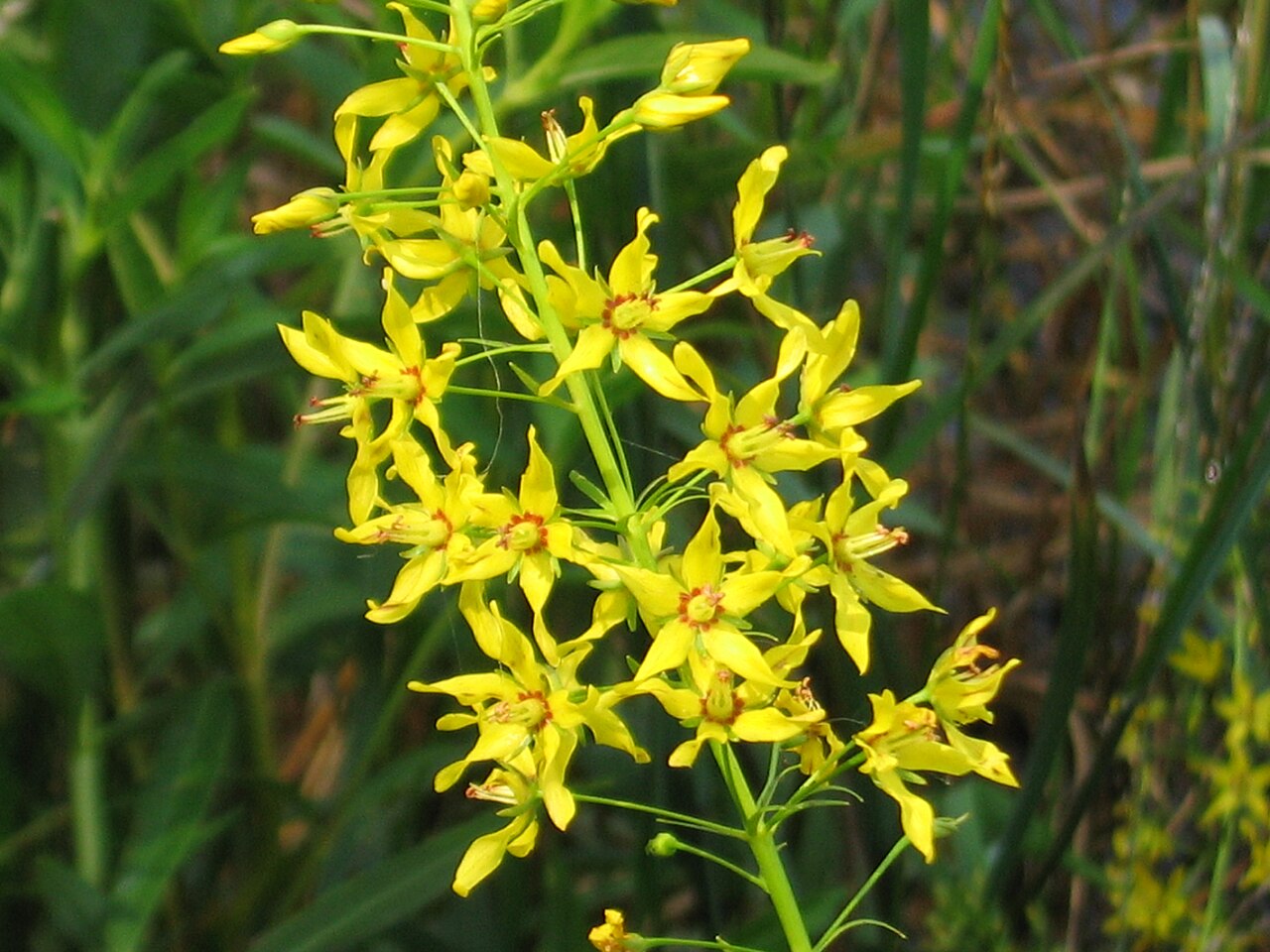
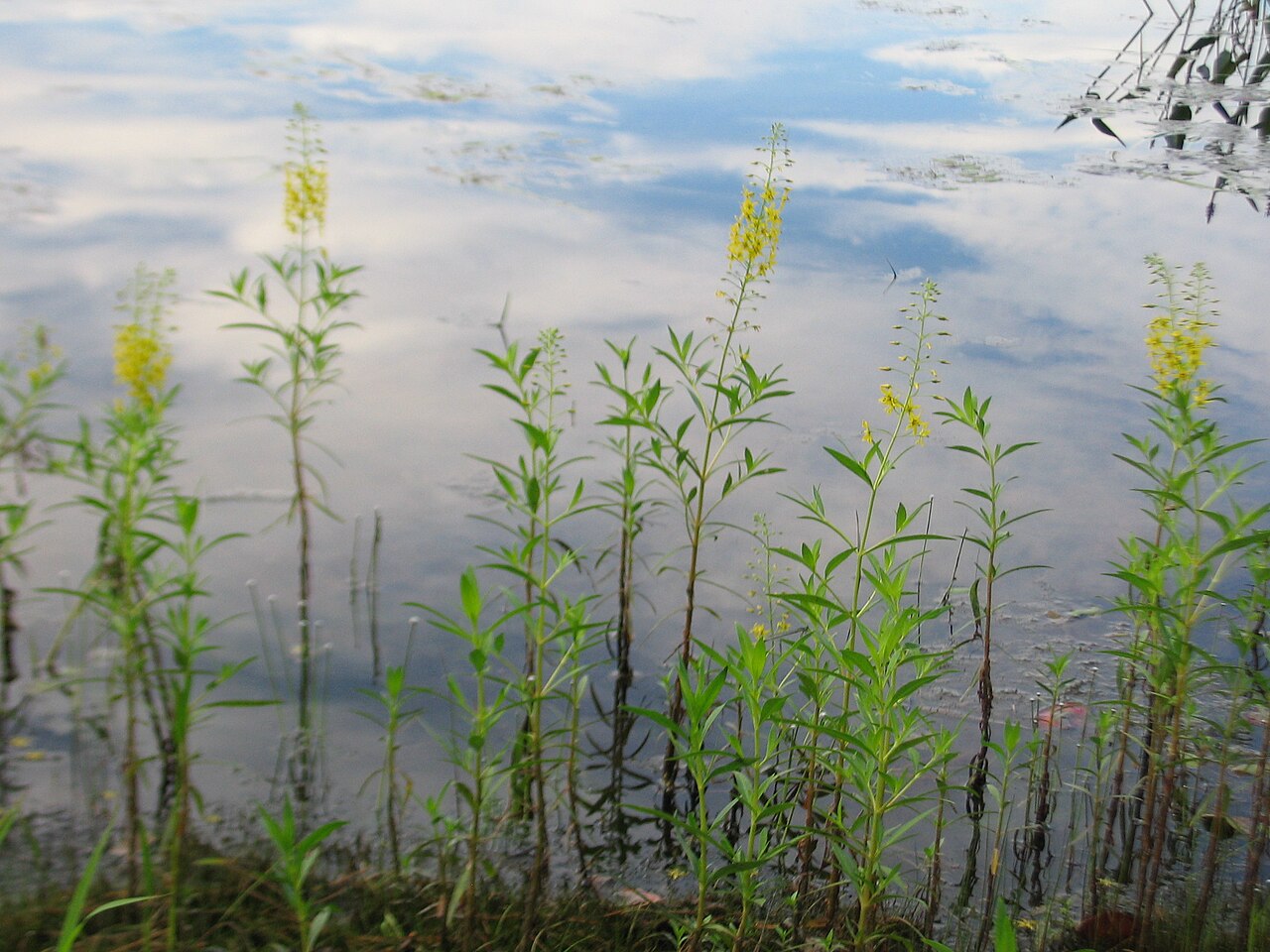
Plants grow 1 to 3 feet tall from creeping rhizomes and form loose colonies on pond and lake shores, in marshes, bogs, wet meadows and ditches. From June to August each stem ends in a spike of starry, five-petaled flowers, yellow with a ring of red streaks at the center. In late summer, many plants produce odd, reddish, rice-grain-like bulblets in the leaf axils. These drop off and grow into new plants, a habit that once fooled botanists into thinking the plant was a kind of mistletoe.
Swamp candles is an easy and attractive plant for rain gardens, pond edges and other wet, sunny spots. Its flowers produce floral oil as well as pollen, and they are visited by specialized oil-collecting bees. It is a well-behaved native alternative to invasive purple loosestrife and to the aggressive European yellow loosestrife sold in garden centers.
Identification
Swamp candles is easy to recognize in bloom: a single, narrow, cylindrical spike of yellow, red-marked flowers at the top of a leafy, unbranched stem, usually in wet ground.
Stems & Roots
Stems are smooth, erect and usually unbranched below the flower spike, 1 to 3 feet tall. The plant spreads by slender rhizomes, so it often grows in loose patches. In wet sites, stems may lean or sprawl, and they can root where they touch the mud.
Leaves
Leaves are opposite (occasionally in whorls of three), narrowly lance-shaped, 2 to 4 inches long and about 1/4 to 3/4 inch wide, smooth-edged and stalkless or nearly so. They are dotted with tiny dark glands when held up to the light, a feature shared by many loosestrifes. Lower leaves are smaller.
Flowers
From June to August, the stem ends in a dense, upright raceme 4 to 12 inches long. Each flower sits on a slender stalk and is about 1/2 inch across, with five yellow, pointed petals streaked with dark red and a ring of red marks around the center, plus five stamens. The flowers open from the bottom of the spike upward over several weeks.
Bulblets
In late summer, especially on plants that flowered poorly, small reddish-brown bulblets about 1/2 inch long form in the leaf axils. They look like grains of rice or tiny worms. They fall off in autumn, overwinter and sprout into new plants the next spring, helping the plant spread through wetlands. Bulblet-bearing plants were once described as a separate species.
Fruit & Seeds
Flowers that are pollinated produce small, round capsules about 1/8 inch wide, which split open to release a few seeds. Seed set is often low, and the plant reproduces more through rhizomes and bulblets.
Look-alikes
Tufted loosestrife (Lysimachia thyrsiflora) has dense, round tufts of yellow flowers in the leaf axils rather than a terminal spike; it hybridizes with swamp candles to form L. × commixta. Whorled loosestrife has leaves and single flowers in whorls of four along the stem and grows in drier woods. Fringed loosestrife has broader leaves on fringed stalks and nodding flowers. Introduced garden loosestrife (L. vulgaris) and large yellow loosestrife (L. punctata) are larger and hairier with bigger flowers.
Quick Facts
| Scientific Name | Lysimachia terrestris |
| Family | Primulaceae (primrose family); sometimes Myrsinaceae |
| Plant Type | Herbaceous perennial; rhizomatous wetland wildflower |
| Mature Height | 1–3 ft |
| Mature Spread | 1–2 ft; spreads by rhizomes and bulblets |
| Growth Rate | Moderate to fast in wet soil |
| Sun Exposure | Full sun to part shade |
| Water Needs | High; wet soil or shallow water up to a few inches |
| Soil Type | Wet loam, muck, peat or sand |
| Soil pH | About 4.5–7.0 (acidic to neutral) |
| Bloom Time | June–August |
| Flower Color | Yellow with red streaks and a red center ring |
| Fall Color | Leaves turn yellowish; reddish bulblets in leaf axils |
| Fruit | Small round capsule; reddish axillary bulblets in late summer |
| Deer Resistant | Moderate |
| USDA Hardiness Zones | 3–8 |
Native Range
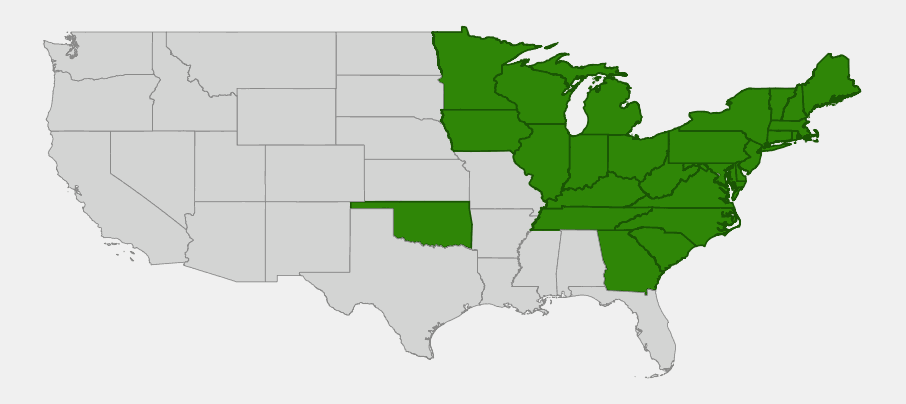
Swamp candles is native to eastern North America, from Newfoundland, Labrador and Quebec west to Ontario and Manitoba, and south in the United States through New England, New York and the Great Lakes states to the Ohio Valley and the mid-Atlantic. It is common across the glaciated Northeast and the upper Midwest, from Maine and Massachusetts west to Minnesota, Wisconsin and Iowa.
Southward it becomes scattered. It follows the Appalachians and the Atlantic Coastal Plain south to Virginia, the Carolinas, Tennessee and northern Georgia, where it is local and mostly found in mountain bogs and wet meadows. USDA PLANTS also lists it for Oklahoma, an outlying record well west of its main range. USDA records it in Idaho, Oregon, Washington and British Columbia as well, but the Burke Herbarium and the Washington flora treat the Pacific Northwest plants as introduced from eastern North America, where they are a weed of cultivated cranberry bogs. Those states are not counted as native range here.
It grows in open, wet places: marshy shores of ponds and lakes, bogs and fens, sedge meadows, swamp openings, wet ditches and streambanks. It tolerates acidic peat as well as more neutral mineral soils and often grows in a few inches of standing water.
📋 Regional plant lists featuring Swamp Candles: New York, Pennsylvania & Northern New Jersey · Ohio & Indiana · Michigan, Wisconsin & Eastern Minnesota · Kentucky & Tennessee · Connecticut, Massachusetts & Rhode Island · New Hampshire, Maine & Vermont · Maryland, Virginia & West Virginia · Delaware, Southern New Jersey & Long Island · Illinois, Iowa & Missouri · Alabama, Georgia & Mississippi · North & South Carolina
Growing & Care Guide
Swamp candles is one of the easier native wetland wildflowers to grow, provided its soil never dries out. It spreads at a moderate pace by rhizomes and bulblets but is not aggressive the way purple loosestrife or the European yellow loosestrifes can be. Buy nursery-grown plants or seed.
Light
Full sun gives the most flowers and the sturdiest stems. It tolerates part shade, especially in the afternoon, but blooms less and may produce more bulblets instead of flowers in shade.
Soil & Water
Plant it in constantly moist to wet soil: muck, peat, sandy or loamy soil at the edge of a pond, in a rain garden low spot or in a bog garden. It handles standing water a few inches deep and seasonal flooding. Acidic to neutral soil is best. It does not tolerate drought, so avoid dry beds.
Planting Tips
Plant in spring or early fall, 12 to 18 inches apart, in groups so the yellow spikes make a show. At a pond, set the crowns at the water line or in up to about 3 inches of water. In a container water garden, use a pot of heavy loam set just below the surface. Combine it with blue flag iris, pickerelweed and swamp milkweed for a long season of color.
Pruning & Maintenance
Little care is needed. Cut back or leave the stems standing in fall; the old stems hold bulblets that will drop and sprout nearby. If it spreads farther than you want in a small garden, pull extra shoots or bulblet seedlings in spring, which is easy in soft, wet soil.
Propagation
The easiest method is to collect bulblets from your own plants in late summer and press them into wet soil or a pot of moist mix kept outdoors over winter. Clumps can also be divided in spring. Seed needs a period of cold, moist stratification and should be surface-sown on wet soil.
Landscape Uses
- Pond and lake edges: yellow spikes above the waterline in midsummer
- Rain gardens and bioswales: for the wettest, sunniest zone
- Bog and wetland gardens: with irises, pickerelweed, sedges and ferns
- Pollinator plantings: floral oil and pollen for specialist Macropis bees
- Wetland restoration: a native alternative to invasive purple and yellow loosestrifes
Wildlife & Ecological Value
Swamp candles supports a small but special group of pollinators and adds structure and cover to wetland edges.
For Pollinators
Like other Lysimachia species, swamp candles offers pollen and floral oil instead of nectar. Oil-collecting bees of the genus Macropis depend on loosestrife flowers: females gather the oil to waterproof their underground nest cells and mix it with pollen as food for their larvae. Other small bees and flies also visit for pollen. Planting native loosestrifes is one of the few ways to help these specialist bees.
For Birds
The plant has little food value for birds, but dense stands along shores provide cover for wetland birds such as rails, swamp sparrows and common yellowthroats, which forage among emergent plants.
For Mammals
Muskrats and deer may eat the foliage occasionally. It is not a major food plant for mammals.
Ecosystem Role
Swamp candles helps stabilize mucky shorelines with its rhizomes and contributes to the diverse emergent plant community of marshes, bogs and wet meadows. Its bulblets let it colonize newly exposed mud and disturbed wet ground. It is a host plant for the oil-collecting Macropis bees and their cuckoo bee parasite Epeoloides.
Cultural & Historical Uses
The bulblets of swamp candles caused a famous botanical mix-up. When Linnaeus received a specimen with bulblets but no flowers, he took the odd, slender bulblets for the fruits of a mistletoe and named it Viscum terrestre, “earth mistletoe.” The species name terrestris and the USDA common name earth loosestrife both trace back to that early mistake.
The genus name Lysimachia is traditionally said to honor Lysimachus, a general of Alexander the Great and later king of Thrace, who according to legend calmed a raging bull by waving a loosestrife plant at it. The common name loosestrife is a translation of the Greek name, “ending strife.”
Despite the shared name, swamp candles is not related to the invasive purple loosestrife (Lythrum salicaria), which belongs to a different family. Where it is native, swamp candles is a valued part of marsh and bog communities. In the Pacific Northwest, where it was introduced with cranberry cultivation, it is treated as a weed of cranberry bogs.
Frequently Asked Questions
Is swamp candles invasive?
Not in eastern North America, where it is native. It spreads by rhizomes and bulblets but stays within wet habitats and coexists with other plants. In the Pacific Northwest it is introduced and is a weed in cranberry bogs.
What are the red rice-like things on the stems in late summer?
Those are bulblets, small vegetative buds that form in the leaf axils. They drop off in fall and grow into new plants the next spring.
Is swamp candles the same as purple loosestrife?
No. Purple loosestrife (Lythrum salicaria) is an invasive Eurasian plant in a different family with magenta flowers. Swamp candles is a native Lysimachia with yellow flowers.
Will swamp candles grow in standing water?
Yes. It grows well in saturated soil and in water up to about 3 inches deep, as on pond margins. It will not survive in dry soil.
Why is it called earth loosestrife?
The name comes from its scientific name, terrestris, which Linnaeus gave when he mistook its bulblets for mistletoe fruits and called it “earth mistletoe.” USDA PLANTS uses earth loosestrife as its common name.

Looking for a nursery that carries Swamp Candles?
Browse our native plant nursery directory: Connecticut, Delaware & Georgia · Illinois, Indiana & Iowa · Kentucky, Maine, Maryland, Massachusetts, Michigan & Minnesota · New Hampshire, New Jersey, New York, North Carolina, Ohio & Oklahoma · Pennsylvania, Rhode Island, South Carolina, Tennessee, Vermont & Virginia · West Virginia & Wisconsin