
Purple-stemmed Angelica (Angelica atropurpurea)
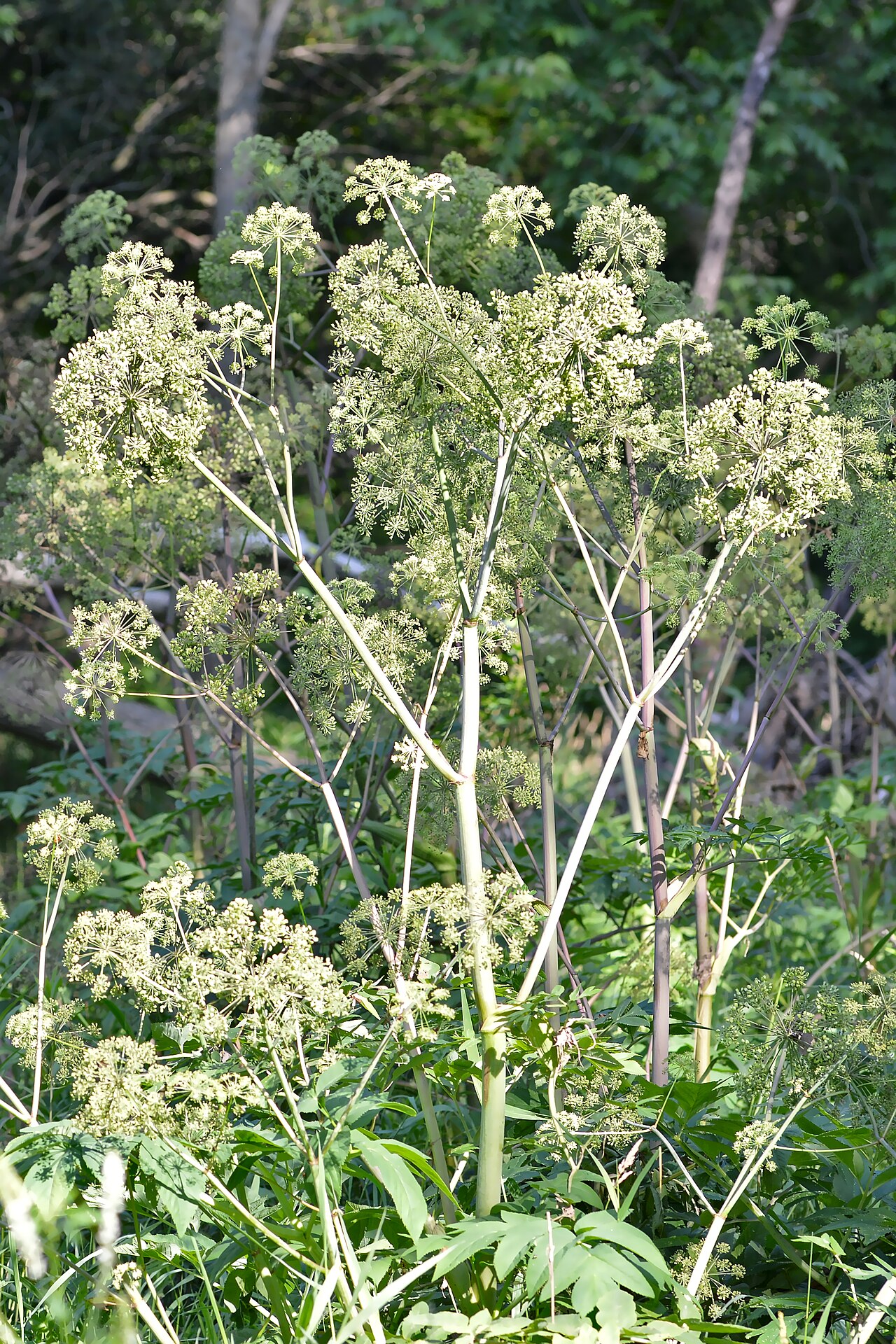
Angelica atropurpurea, known as Purple-stemmed Angelica, purplestem angelica (its USDA name) or great angelica, is a towering native wildflower of streambanks, wet meadows and swamps in northeastern North America. In early summer it raises smooth, dark purple stems as thick as a broom handle to 4 to 8 feet tall, topped by spherical umbels of tiny greenish-white flowers up to about 8 inches across.
It is a member of the carrot family (Apiaceae) and is usually a biennial or short-lived perennial: it spends a year or more as a large rosette of divided leaves, then flowers, sets seed and dies. Its bold form and big globes of flowers make it a striking plant for rain gardens and wet edges, and the flowers are swarmed by wasps, flies, beetles and bees.
It also needs a clear safety note: purple-stemmed angelica resembles deadly water hemlock (Cicuta maculata), which grows in the same wet places, and its sap can cause skin blistering in sunlight. Never eat any wild-collected plant in this family. This guide covers identification, range, growing it, its wildlife value and how to handle it safely.
Identification
Purple-stemmed angelica is one of the largest wildflowers in eastern wetlands. The combination of a smooth, hairless, purple stem, inflated leaf sheaths and spherical umbels identifies it.
Stems
The stout, hollow stem is smooth and hairless, usually solid dark purple or purple-blotched, and up to 2 inches thick at the base. Plants are typically 4 to 8 feet tall when flowering.
Leaves
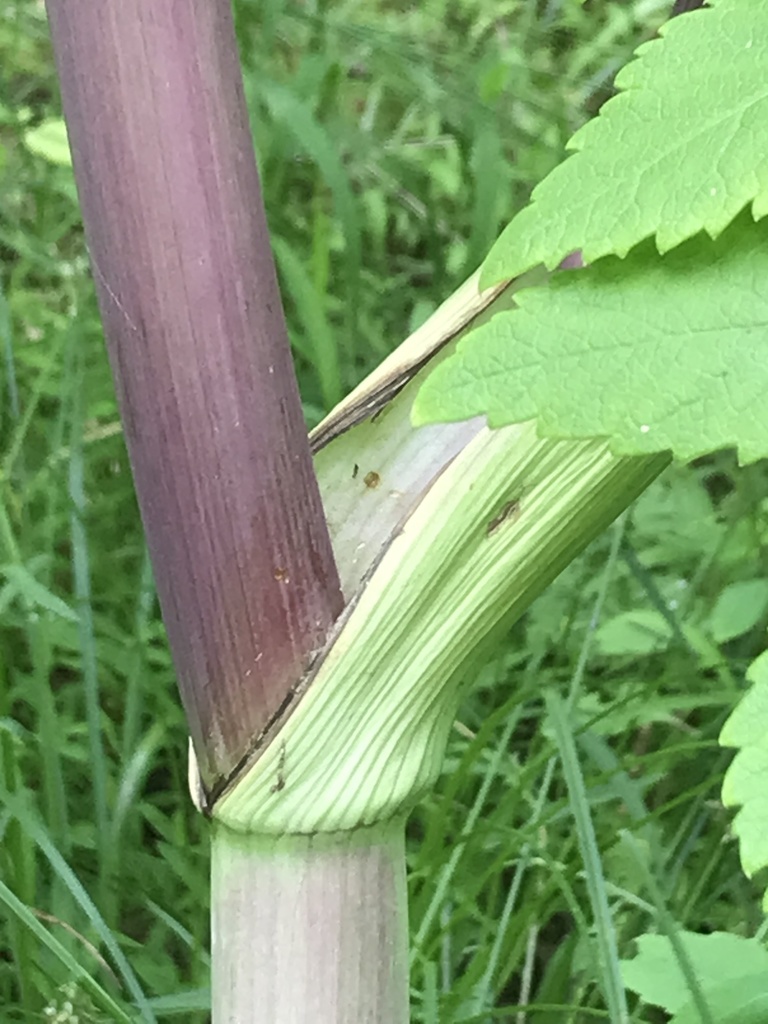
The large leaves are divided two or three times into many toothed, oval to lance-shaped leaflets 1½ to 4 inches long. The base of each leaf stalk widens into a conspicuous inflated sheath that wraps around the stem, and the upper leaves are reduced to little more than these sheaths. First-year plants form a broad rosette of leaves without a flowering stem.
Flowers
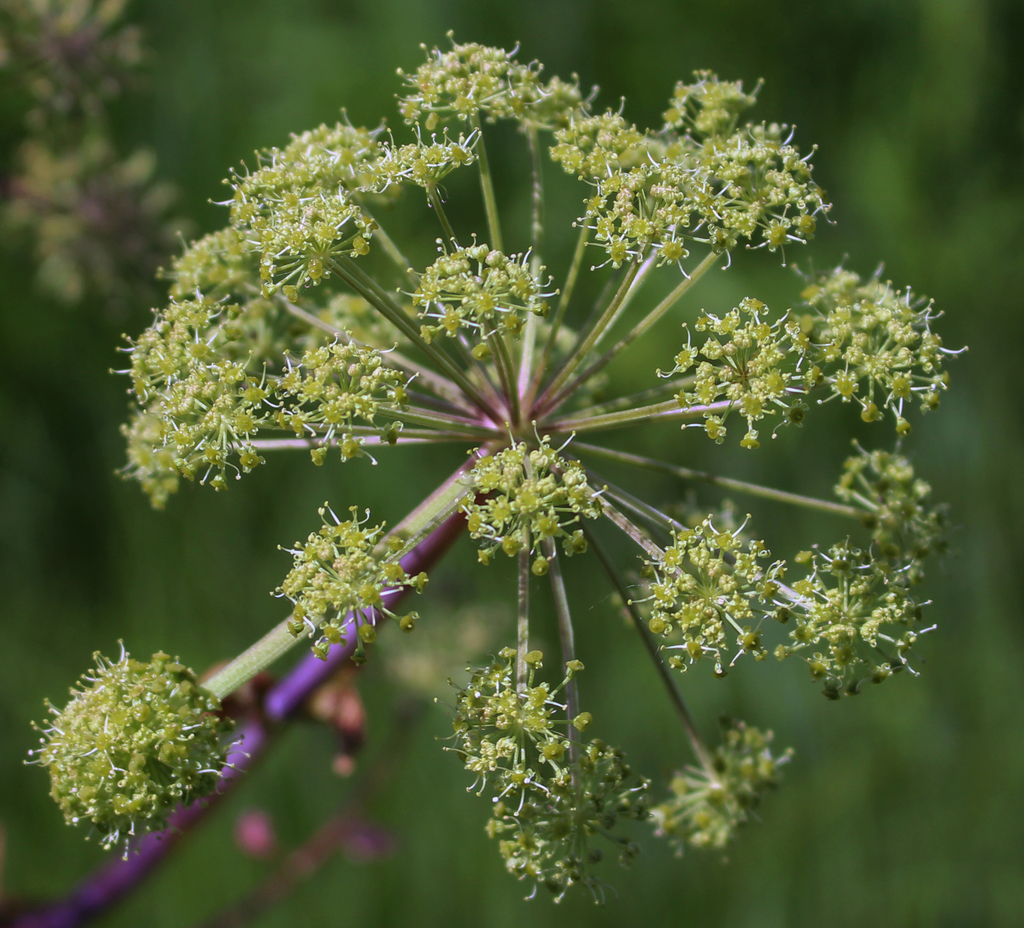
From late May into August the stem ends in large, rounded compound umbels, each made of many smaller umbels on stalks of nearly equal length, so the whole head is almost a sphere 4 to 8 inches across. The individual flowers are tiny, with five greenish-white petals.
Fruit & Seeds
The flat, oval, dry fruits split into two winged halves, each about ¼ inch long. Seed heads ripen from mid to late summer and the parent plant usually dies after fruiting.
Similar Species
Water hemlock (Cicuta maculata), one of the most toxic plants in North America, grows in the same habitats. It has flat-topped (not spherical) umbels, leaflets with veins running to the notches between the teeth, and stems that are often streaked rather than solid purple. Cow parsnip (Heracleum maximum) has hairy stems and very broad, maple-like leaflets. Non-native wild parsnip and giant hogweed also cause severe burns. Learn these plants before handling any large member of the carrot family.
Quick Facts
| Scientific Name | Angelica atropurpurea |
| Family | Apiaceae (carrot family) |
| Plant Type | Herbaceous biennial or short-lived perennial |
| Mature Height | 4–8 ft in flower |
| Mature Spread | 2–4 ft |
| Growth Rate | Fast |
| Sun Exposure | Full sun to part shade |
| Water Needs | High; moist to wet soil |
| Soil Type | Rich, moist to wet loam, muck or alluvial soil |
| Soil pH | About 5.5–7.5 |
| Bloom Time | Late May–August |
| Flower Color | Greenish-white |
| Fall Color | None notable; plant dies after seeding |
| Fruit | Flat, winged, dry fruits in large round heads |
| Deer Resistant | Moderately; seldom heavily browsed |
| USDA Hardiness Zones | 3–7 |
Native Range
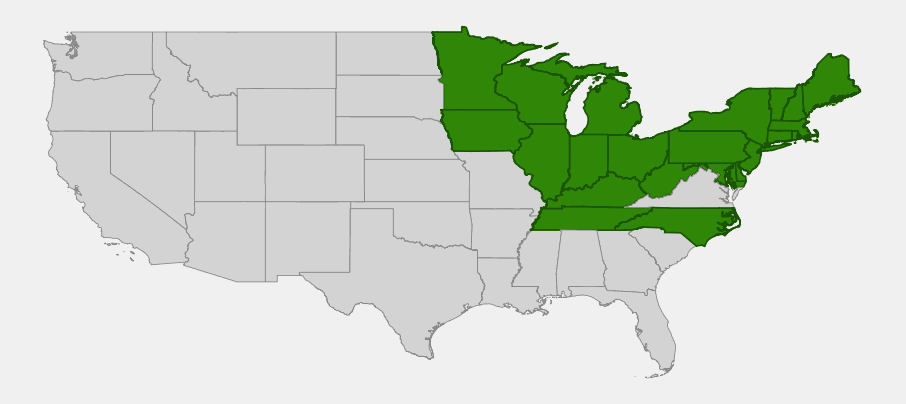
Purple-stemmed angelica is native to northeastern North America. In the United States USDA PLANTS records it from Minnesota, Iowa and Illinois east through the Great Lakes states and Ohio Valley to New England, and south through the Appalachians to Kentucky, Tennessee and North Carolina. In Canada it grows from Ontario and Quebec east to the Maritime provinces, Newfoundland and Labrador.
It is most common in the Great Lakes region, New York and New England, becoming scattered and largely confined to the mountains at the southern end of its range.
It grows in streambanks and river floodplains, wet meadows, swamps, fens, marsh edges, wet thickets and seepy woods, usually in rich, moist to wet soil and in sun or light shade.
📋 Regional plant lists featuring Purple-stemmed Angelica: New York, Pennsylvania & Northern New Jersey · Ohio & Indiana · Michigan, Wisconsin & Eastern Minnesota · Kentucky & Tennessee · Connecticut, Massachusetts & Rhode Island · New Hampshire, Maine & Vermont · Maryland, Virginia & West Virginia · Delaware, Southern New Jersey & Long Island · Illinois, Iowa & Missouri · North & South Carolina
Growing & Care Guide
Purple-stemmed angelica is easy to grow in consistently moist soil and makes a dramatic vertical accent. Because individual plants die after flowering, think of it as a self-sowing biennial: leave some seed heads so new rosettes replace the old plants.
Light
Full sun to part shade. It flowers best in sun as long as the soil stays moist; in drier sites give it afternoon shade.
Soil & Water
Plant in rich, moist to wet soil: a rain garden, pond edge, streambank or low spot. It tolerates seasonal flooding and heavy soils but suffers in dry, sandy ground. Water during droughts in the first season.
Planting Tips
Give it room; a flowering plant can be 3 feet wide. Set it toward the back of a wet border with Joe-Pye weed, swamp milkweed and blue flag iris. Plant groups of different ages so some plants bloom every year.
Pruning & Maintenance
Little care is needed. Leave seed heads to ripen if you want seedlings, or cut them before they drop if you do not. Remove the dead stalks after seeding. Wear gloves and long sleeves when cutting stems, and avoid getting sap on skin in sunlight.
Propagation
Grow it from seed. Sow fresh seed outdoors in fall, or give it a cold, moist period of about two months before spring sowing; the seeds need light to germinate, so press them onto the soil surface. Seedlings form rosettes in their first year and usually bloom in the second or third year. Older plants have large taproots and do not transplant well.
Landscape Uses
- Rain gardens and bioswales: tolerates periodic flooding and saturated soils
- Pond, stream and wetland edges: a bold vertical accent in wet ground
- Pollinator gardens: its big umbels feed a huge variety of insects
- Butterfly gardens: a native host plant for swallowtail caterpillars
- Wetland restoration: within its native range, from locally sourced seed
Wildlife & Ecological Value
Purple-stemmed angelica is a busy plant in summer: its open flowers offer easy nectar to many short-tongued insects, and its leaves feed swallowtail caterpillars.
For Pollinators
The flowers are visited by a wide range of insects, especially wasps, flies (including syrphid flies), beetles and small bees. Because these insects include many predators and parasitoids of garden pests, the Xerces Society notes it as a plant that supports conservation biological control.
For Birds
Birds use the tall stems as perches, and insect-eating birds forage on the many insects that visit the flowers.
For Mammals
It is not a major food plant for mammals. The plant’s strong-smelling, chemically defended foliage is browsed less than many wetland plants.
Ecosystem Role
It is a larval host for the black swallowtail (Papilio polyxenes) and, in the Canadian Maritimes, the short-tailed swallowtail (Papilio brevicauda), both of which feed on plants in the carrot family. As a tall wetland forb it adds structure to wet meadows and streambanks.
Cultural & Historical Uses
The genus name Angelica comes from the Latin for “angelic,” a name given to the European garden angelica for its reputed medicinal powers. The species name atropurpurea means “dark purple,” for its stems. Indigenous peoples and early settlers used purple-stemmed angelica in traditional medicine, but these uses are not a guide to safe use today.
Safety note: Do not eat purple-stemmed angelica or any wild-collected plant in the carrot family. It is easily confused with water hemlock, which can be fatal in small amounts, and with poison hemlock, and mistakes in identification have killed foragers. Its sap contains furanocoumarins that can cause phytophotodermatitis: skin that touches the sap and is then exposed to sunlight may redden, blister and stay discolored for weeks. Wear gloves and long sleeves when cutting it, and wash skin promptly if sap gets on it.
Even with these cautions, it is a valuable and beautiful native plant. Grown in the right spot and handled with care, it brings architectural drama and a great deal of insect life to wet gardens.
Frequently Asked Questions
Is purple-stemmed angelica poisonous?
It is not one of the deadliest plants, but it is not safe to eat, and its sap can blister skin in sunlight. The bigger danger is confusing it with water hemlock or poison hemlock, which are deadly. Never eat a wild-collected plant in the carrot family.
How do I tell it from water hemlock?
Purple-stemmed angelica has smooth, solid dark purple stems, inflated leaf sheaths and nearly spherical flower heads. Water hemlock has flat-topped umbels, leaflet veins that end in the notches between the teeth, and often streaked stems. If in doubt, do not touch or taste it.
Why did my angelica die after it flowered?
It is a biennial or short-lived perennial that usually dies after setting seed. Leave some seed heads so new plants come up, and plant groups of different ages.
Do butterflies use purple-stemmed angelica?
Yes. It is a larval host for the black swallowtail, and the short-tailed swallowtail uses it in Atlantic Canada. Its flowers are visited mainly by wasps, flies, beetles and bees.
Can it grow in a regular garden bed?
Only if the soil stays moist. It does best in rain gardens, pond and stream edges, and low, wet spots in sun or part shade.

Looking for a nursery that carries Purple-stemmed Angelica?
Browse our native plant nursery directory: Connecticut & Delaware · Illinois, Indiana & Iowa · Kentucky, Maine, Maryland, Massachusetts, Michigan & Minnesota · New Hampshire, New Jersey, New York, North Carolina & Ohio · Pennsylvania, Rhode Island, Tennessee & Vermont · West Virginia & Wisconsin