
Western Spiderwort (Tradescantia occidentalis)
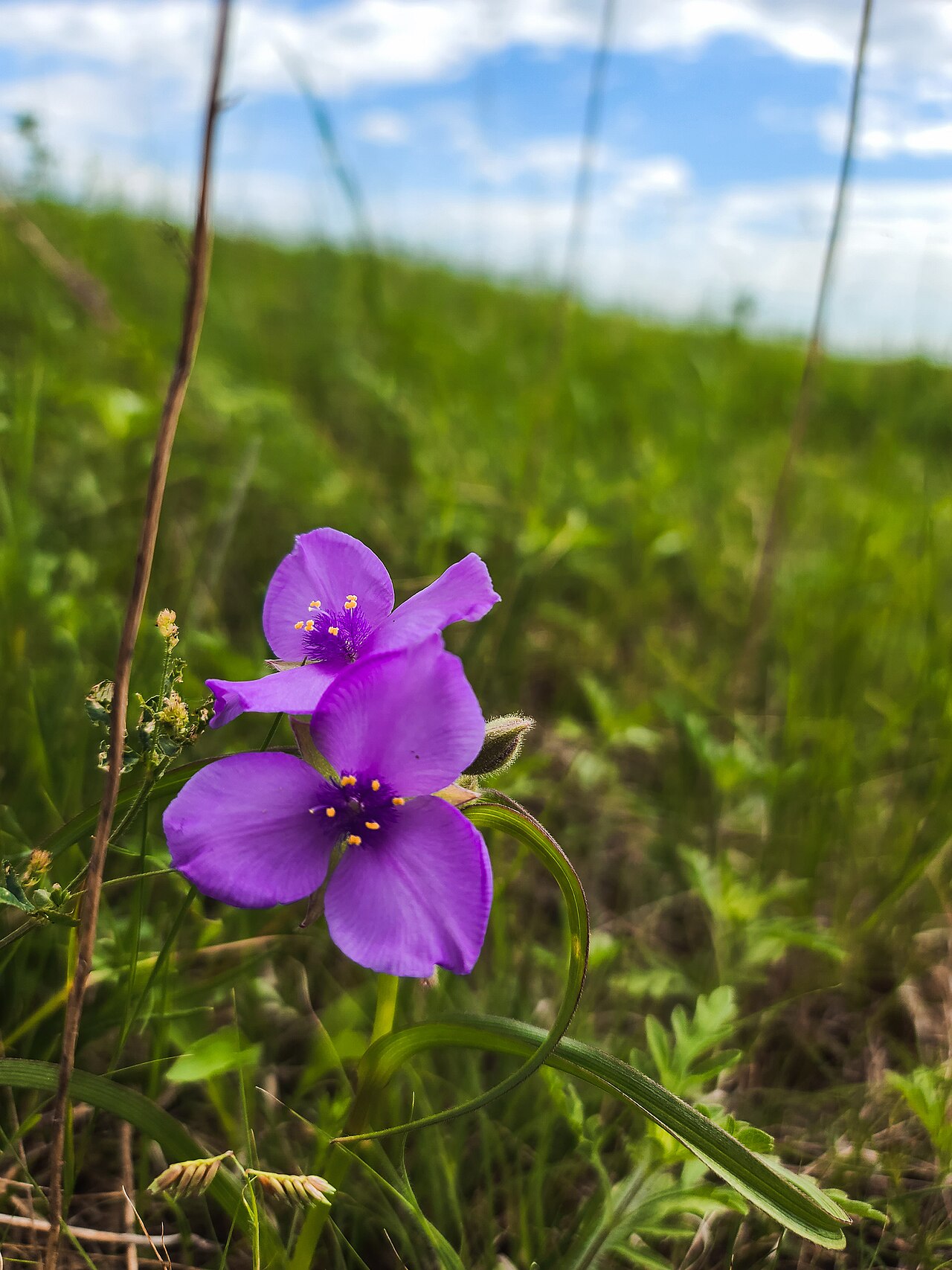
Tradescantia occidentalis, known as Western Spiderwort (USDA: prairie spiderwort), is a tough, drought-tolerant perennial of the Great Plains, the Rocky Mountain foothills and the Southwest. It belongs to the spiderwort family (Commelinaceae). It grows in loose clumps 8 to 24 inches tall (occasionally to 3 feet), with long, narrow, grass-like leaves that are bluish green with a whitish, waxy bloom.
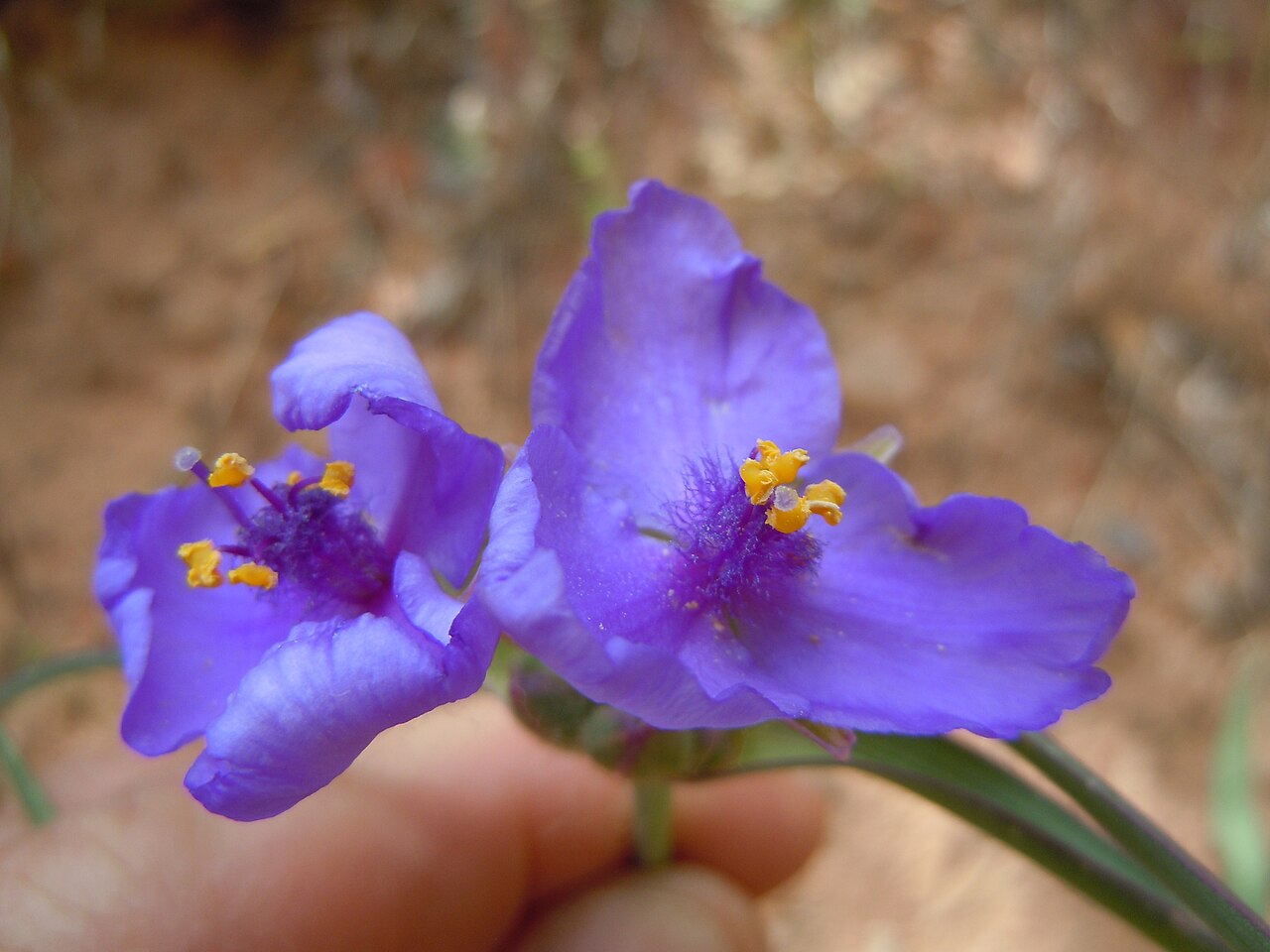
From late spring into midsummer, clusters of buds at the stem tips open one or a few at a time into three-petaled flowers about 1 inch across, usually blue to violet, sometimes rose-purple or rarely white. Each flower lasts only a single morning, closing and melting into a jelly-like drop by afternoon, but new flowers open every day for weeks. Six stamens with bright yellow anthers and fuzzy, purple-bearded filaments stand out against the petals.
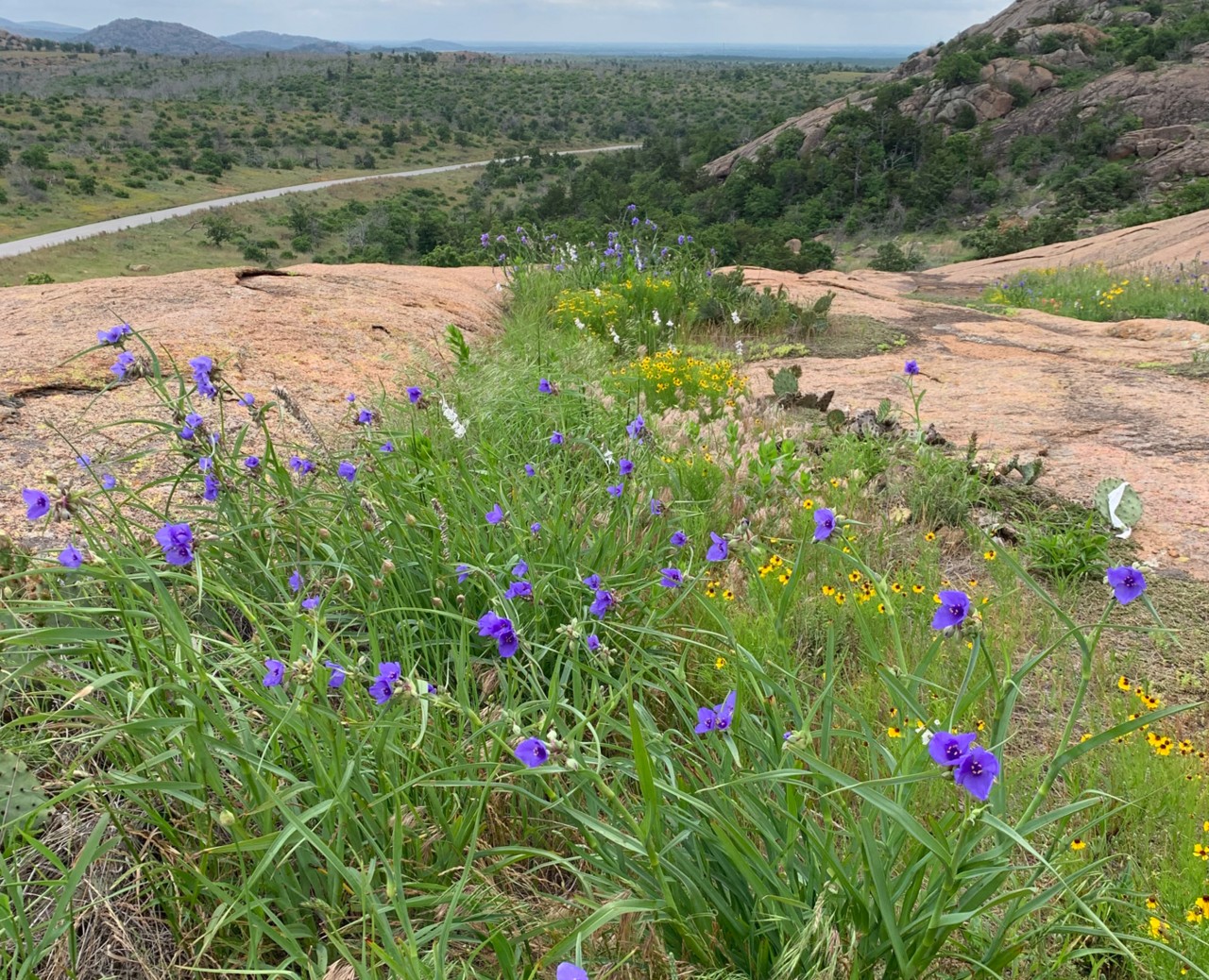
Western spiderwort grows mainly in dry, sandy or gravelly soil: sand prairies, sandhills, plains grasslands, rocky slopes and open pinyon-juniper and ponderosa pine woodlands. It is a good choice for dry, sunny native gardens and rock gardens in the Plains and the West, where it needs little or no extra water once established.
Identification
Several spiderworts grow in the Plains. Western spiderwort is best told by its narrow, waxy, bluish leaves and the small, sticky glandular hairs on the flower stalks and sepals.
Stems & Growth Habit
The plant forms a loose clump of upright or slightly sprawling stems from a cluster of thick, fleshy roots. The stems are smooth, often bluish with a waxy bloom, and may branch near the base. Plants are usually 8 to 24 inches tall in dry sites and taller where moisture is better.
Leaves
The leaves are alternate, long and narrow, 4 to 12 inches long and less than 1/2 inch wide, often folded lengthwise into a channel. They are smooth and bluish green with a whitish, waxy coating. The leaf bases form sheaths around the stem. Two leaf-like bracts sit beneath each flower cluster.
Flowers
The flowers are about 3/4 to 1 1/4 inches across, with three broad petals and three smaller, green, boat-shaped sepals. Petals are typically blue or violet, sometimes rose-purple, magenta or white. The six stamens have hairy, purple filaments and bright yellow anthers. The flower stalks and sepals are covered in short, gland-tipped hairs that feel slightly sticky. Bloom is from about May to July, with scattered flowers later in wet years. Each flower opens in the morning and fades by afternoon.
Fruit & Seeds
Each flower that is pollinated forms a small, three-celled capsule about 1/4 inch long. The capsules split open in summer to release a few grayish, wrinkled seeds, which drop near the parent plant.
Look-alikes
Bracted Spiderwort has broader leaves and hairs on the flower stalks without glands. Common Spiderwort (Ohio spiderwort) is taller, with smooth, hairless flower stalks and sepals and grows mostly in the eastern Plains and East. Virginia Spiderwort is an eastern woodland species with hairy, non-waxy leaves. Spiderworts often hybridize where they meet, so some plants are hard to name.
Safety Note
Spiderworts are not considered seriously toxic, and young leaves and flowers of some species have been eaten. The sap can mildly irritate sensitive skin, and some pets may react to chewing the leaves. Do not eat wild plants unless you are certain of the identification.
Quick Facts
| Scientific Name | Tradescantia occidentalis |
| Family | Commelinaceae (spiderwort family) |
| Plant Type | Herbaceous perennial with fleshy roots |
| Mature Height | 8–24 in (to 3 ft) |
| Mature Spread | 8–18 in |
| Growth Rate | Moderate |
| Sun Exposure | Full sun to part shade |
| Water Needs | Low; dry, well-drained soil |
| Soil Type | Sand, sandy loam, gravel, rocky soils |
| Soil pH | About 6.0–8.0 |
| Bloom Time | May–July |
| Flower Color | Blue to violet, sometimes rose-purple or white |
| Fall Color | None; foliage dies back in summer heat or fall |
| Fruit | Small three-celled capsule |
| Deer Resistant | Moderately; occasionally browsed |
| USDA Hardiness Zones | 3–9 |
Native Range
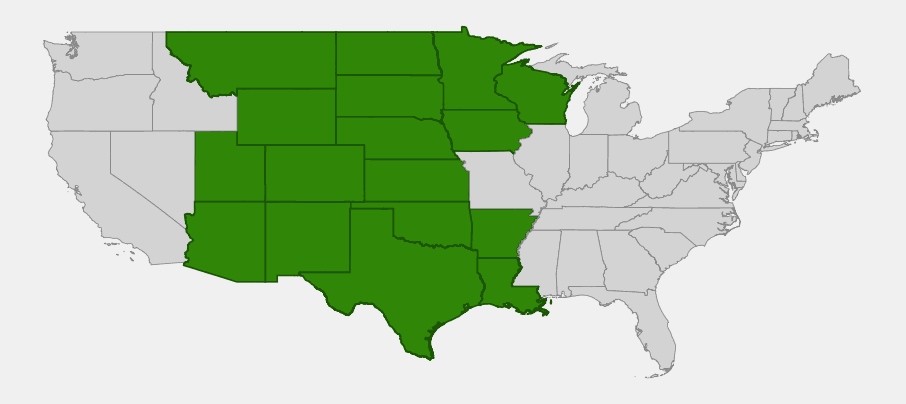
Western spiderwort is native to the Great Plains, the Rocky Mountain region and the Southwest. USDA PLANTS records it in 19 states and three Canadian provinces. It ranges from southern Alberta, Saskatchewan and Manitoba south through Montana, the Dakotas, Minnesota, Wisconsin and Iowa, across Wyoming, Nebraska, Colorado and Kansas, and south to Utah, Arizona, New Mexico, Oklahoma, Texas, Arkansas and Louisiana.
It is most common on the sandy soils of the central and western Plains and in the foothills and mesas of the Southwest. In Wisconsin and Minnesota it is mostly a plant of sand prairies and sandy river terraces; in Arkansas and Louisiana it grows on sandy uplands. In Canada it is at the northern edge of its range and grows only on a few sand hills and dunes, where it is considered at risk. USDA also lists it in New Jersey and New York, but NatureServe treats those records as introduced, so they are not shown on the map.
Typical habitats include sand prairies and sandhills, stabilized dunes, mixed-grass and shortgrass prairie, rocky and gravelly slopes, canyon sides, open pinyon-juniper and ponderosa pine woodlands, roadsides and old fields. It usually grows in full sun, in soils that drain quickly.
📋 Regional plant lists featuring Western Spiderwort: Montana & Wyoming · Michigan, Wisconsin & Eastern Minnesota · Nebraska, Kansas & Eastern Colorado · Utah & Western Colorado · Arizona & New Mexico · Illinois, Iowa & Missouri · Arkansas, Louisiana, Eastern Oklahoma & Eastern Texas · South & West Texas · North Dakota, South Dakota & Western Minnesota
Growing & Care Guide
Western spiderwort is an easy, long-lived perennial for dry, sunny gardens. It is more drought tolerant and more compact than the eastern spiderworts usually sold in nurseries. Buy nursery-grown plants or seed; never dig plants from the wild, especially at the edge of its range where it is rare.
Light
Full sun gives the most flowers and the most compact plants. It tolerates part shade, especially afternoon shade in hot desert gardens, but becomes floppier and blooms less in heavy shade.
Soil & Water
Plant it in well-drained sandy, gravelly or rocky soil. It tolerates poor, lean soils and both slightly acidic and alkaline conditions, but it rots in heavy, wet clay. Water regularly the first season, then only during long droughts. In very dry summers the foliage may go partly dormant after bloom and return the next spring.
Planting Tips
Plant in spring or early fall, setting the crown at soil level. Space plants 12 to 18 inches apart. It looks best in groups, scattered among bunchgrasses such as little bluestem and blue grama, or in a sunny rock garden or xeric border where the grassy foliage and blue flowers can mix with other prairie wildflowers.
Pruning & Maintenance
Little maintenance is needed. If foliage becomes ragged after flowering, cut it back by half to tidy the plant and encourage fresh growth. Avoid fertilizer and rich soil amendments, which cause floppy growth. Plants may self-sow modestly in open, sandy soil.
Propagation
Divide clumps in early spring or fall. Seed sown outdoors in fall germinates the next spring; for spring sowing, give seeds about 4 to 8 weeks of cold, moist stratification first. Seedlings usually flower in their second or third year. Stem cuttings taken in early summer also root readily.
Landscape Uses
- Xeriscapes and dry gardens: blue flowers with almost no supplemental water
- Prairie and meadow plantings: scattered among bunchgrasses on sandy or rocky soil
- Rock gardens: a compact, grass-like plant with long bloom
- Pollinator gardens: abundant pollen for native bees in late spring and early summer
- Sandhill and dune restoration: a native forb for sandy soils within its range
Wildlife & Ecological Value
Western spiderwort is a common part of the spring and early summer bloom in sandy prairies and plains grasslands, valued above all as a pollen source for bees.
For Pollinators
The flowers have no nectar but offer plenty of pollen, which attracts bumblebees, sweat bees, mining bees and other native bees, as well as syrphid flies. Bees collect the pollen by buzzing or scrambling over the anthers in the morning, while the flowers are open.
For Birds
The small seeds are eaten occasionally by ground-feeding birds. Clumps add low cover in open grasslands for ground-nesting birds.
For Mammals
Deer, pronghorn, livestock and rabbits sometimes graze the tender foliage and flowers, and the plant often decreases under heavy grazing.
Ecosystem Role
As one of the early-blooming prairie wildflowers, it supports native bees before many summer wildflowers open. Its fleshy roots let it survive drought and fire, and it recovers quickly after prairie burns. In Canada, its rarity makes it a focus of sand-hill and dune conservation.
Cultural & Historical Uses
Spiderworts are named for the stringy, cobweb-like sap that can be drawn out of a broken stem, or, some say, for the spidery look of the leaves and hairy stamens. The genus name Tradescantia honors John Tradescant, gardener to King Charles I of England, and his son, who brought American spiderworts to English gardens in the 1600s. The species name occidentalis means “western.”
Spiderwort stamen hairs are famous in science. Each hair is a chain of single cells, and their color changes from blue to pink when the cells are damaged by radiation or certain chemicals. Researchers have used spiderwort stamen-hair tests to detect mutations caused by radiation and air pollution. The large, visible cells are also used in classrooms to show cytoplasmic streaming under the microscope.
Plains Indigenous peoples used spiderworts in several ways, including eating the young shoots and flowers and using the plant in traditional medicine. Today western spiderwort is valued mainly as a garden plant for dry, sunny sites and as an indicator of healthy sandy grasslands.
Frequently Asked Questions
Why do spiderwort flowers only last one day?
Each flower opens in the morning and closes by midday or early afternoon, after which the petals collapse into a jelly-like drop. A single clump produces new flowers almost every day for several weeks.
How do I tell western spiderwort from other spiderworts?
Look for narrow, waxy, bluish leaves and short, sticky, gland-tipped hairs on the flower stalks and sepals. Common spiderwort has smooth stalks and sepals, and bracted spiderwort has non-glandular hairs and broader leaves.
Is western spiderwort drought tolerant?
Yes. It grows naturally on sand prairies and dry, rocky slopes and needs little water once established. In very dry summers it may go partly dormant after flowering.
Is western spiderwort invasive?
No. It forms clumps and may self-sow a little in open sandy soil, but it does not spread aggressively.
Does western spiderwort attract pollinators?
Yes. Its flowers offer abundant pollen and attract bumblebees, sweat bees and other native bees in the morning.

Looking for a nursery that carries Western Spiderwort?
Browse our native plant nursery directory: Arizona & Arkansas · Colorado · Iowa & Kansas · Louisiana, Minnesota & Montana · Nebraska, New Mexico, North Dakota & Oklahoma · South Dakota, Texas & Utah · Wisconsin & Wyoming