
Drummond’s Skullcap (Scutellaria drummondii)
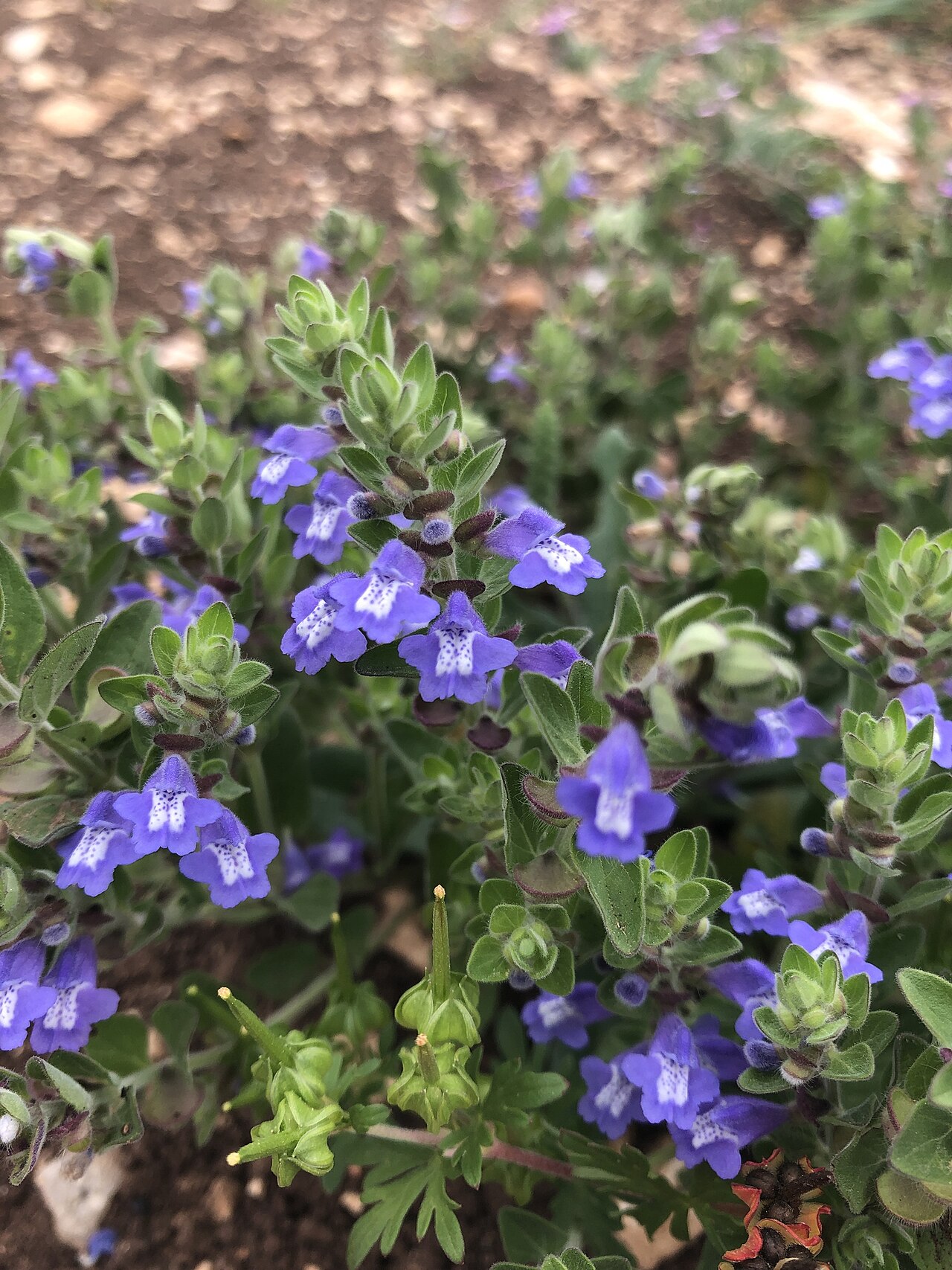
Scutellaria drummondii, known as Drummond’s Skullcap, is a small native wildflower in the mint family (Lamiaceae). It forms low, bushy clumps usually 4 to 12 inches tall, with small, soft-hairy, oval leaves and, in spring, many violet-blue, two-lipped flowers with white-spotted lower lips. It is usually an annual, though some plants live for more than one season.
Its range is centered on Texas, where it is one of the familiar spring wildflowers of the Hill Country, the Edwards Plateau and South and West Texas. It extends north into Oklahoma, east into Louisiana and west into southern New Mexico, with USDA records from Arizona at the western edge of its range, and south into northeastern Mexico. It grows in prairies, rocky limestone openings, caliche, roadsides and woodland edges.
For gardeners in the Southwest and southern Plains, it is a tidy, drought-tolerant self-seeder for rock gardens, path edges and wildflower meadows, and its flowers draw small native bees. Note that the foliage has been reported to be toxic, so do not eat it and keep grazing animals away from large stands.
Identification
Look for a low, branching, softly hairy plant with small, opposite, untoothed oval leaves and violet-blue, two-lipped flowers in the leaf axils, on dry, rocky or sandy ground in spring.
Growth Habit
A low, much-branched annual or short-lived perennial, usually 4 to 12 inches tall, often branching from the base to form a rounded mound. The stems are square, as in most mints, and covered with soft, often glandular hairs.
Leaves
The leaves are opposite, small (about 1/3 to 3/4 inch long), oval to oblong, with smooth edges and short stalks. They are densely hairy and grayish green and crowded along the stems.
Flowers
The flowers grow singly or in pairs in the axils of the upper leaves. Each is about 1/2 inch long, violet-blue to purple, with a hooded upper lip and a broad, notched lower lip marked with white. The calyx has a small raised crest or cap on its upper side, the feature that gives skullcaps their name. Flowering is mainly from March to June, and sometimes again after fall rains.
Fruit
After flowering, the two-lipped calyx closes over four small, warty nutlets. When ripe, the upper part of the calyx falls away to release them.
Look-alikes
Wright’s skullcap (Scutellaria wrightii) is a perennial with a woody base, narrower leaves and somewhat larger flowers. Prairie skullcap (Scutellaria resinosa) is also a perennial, with resin-dotted leaves. Small blue mints such as henbit (Lamium amplexicaule, not native) have leaves clasping the stem and flowers in whorls rather than in pairs.
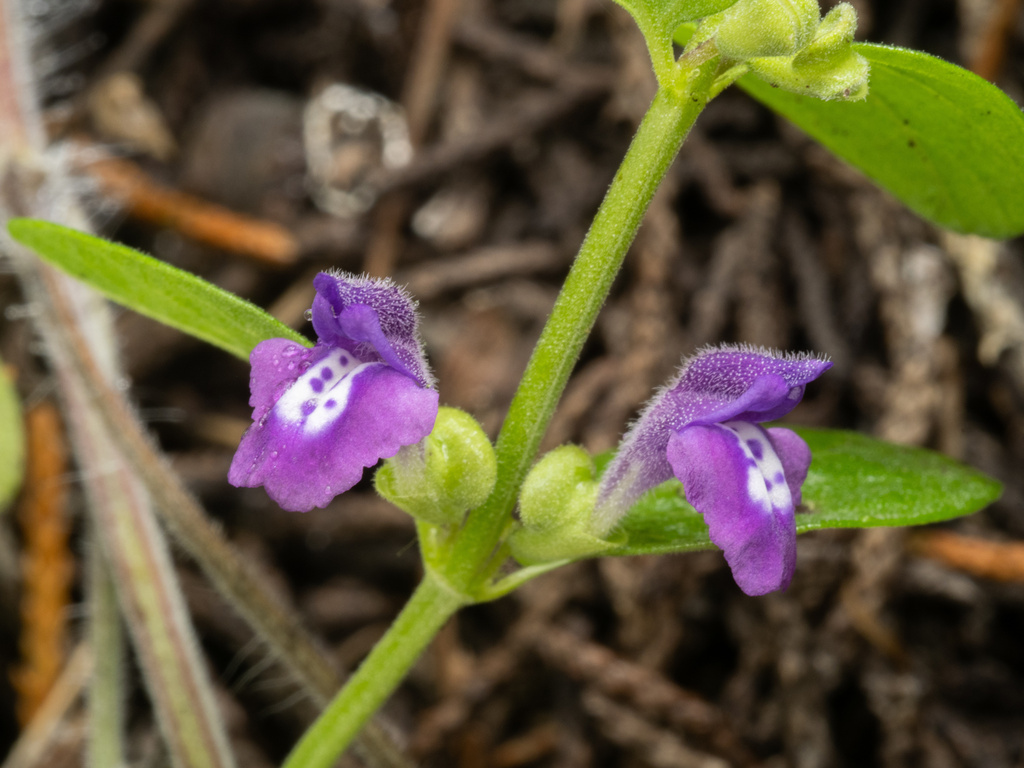
Quick Facts
| Scientific Name | Scutellaria drummondii |
| Family | Lamiaceae (mint family) |
| Plant Type | Annual or short-lived perennial wildflower |
| Mature Height | 4–12 in |
| Mature Spread | 6–12 in |
| Growth Rate | Fast |
| Sun Exposure | Full sun to light shade |
| Water Needs | Low; dry, well-drained soil |
| Soil Type | Rocky, gravelly, sandy, caliche or limestone soils |
| Soil pH | Neutral to alkaline (about 6.5–8.5) |
| Bloom Time | Spring (March–June), sometimes fall |
| Flower Color | Violet-blue with white markings |
| Fall Color | None |
| Fruit | Four small nutlets enclosed in the crested calyx |
| Deer Resistant | Yes; hairy, aromatic foliage is seldom browsed |
| USDA Hardiness Zones | 7–10 |
Native Range
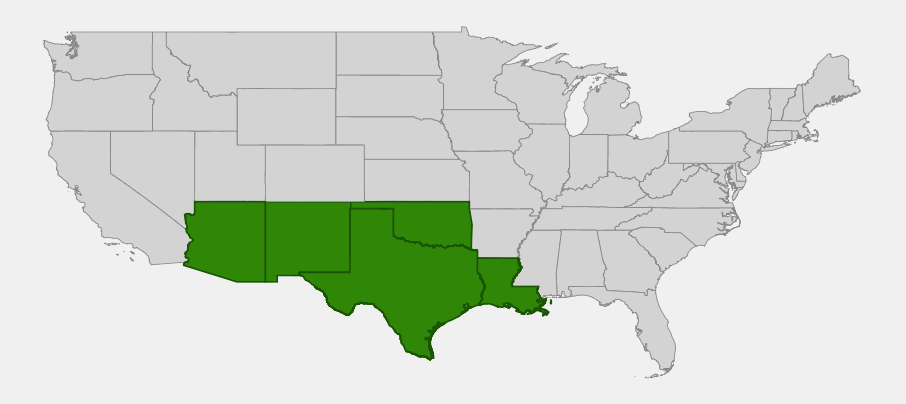
Drummond’s skullcap is native to the south-central United States and northeastern Mexico. USDA PLANTS records it as native in five states: Arizona, Louisiana, New Mexico, Oklahoma and Texas. USDA also lists Florida, but the Atlas of Florida Plants treats it as not native there, so Florida is left off this map.
It is most abundant in Texas, especially on the Edwards Plateau, in the Hill Country, the Cross Timbers and Blackland Prairie, South Texas and the Trans-Pecos. It reaches north into central and southern Oklahoma and east into Louisiana, and grows in southeastern New Mexico. Records from Arizona lie at the western edge of its range. In Mexico it grows in Coahuila, Nuevo León, Tamaulipas and Chihuahua.
It favors dry, open places with thin soil: rocky limestone and caliche slopes, prairies and grasslands, sandy or gravelly flats, roadsides and the edges and openings of oak and juniper woodlands, mostly at low to moderate elevations.
📋 Regional plant lists featuring Drummond’s Skullcap: Arizona & New Mexico · Arkansas, Louisiana, Eastern Oklahoma & Eastern Texas · South & West Texas
Growing & Care Guide
Drummond’s skullcap is easy to grow in sunny, dry, well-drained spots. As a mostly annual plant, it keeps itself going by reseeding.
Light
Full sun to light shade. It blooms most heavily in full sun.
Soil & Water
It thrives in lean, rocky, gravelly, sandy or caliche soils, including shallow soil over limestone. Good drainage is essential; it rots in soggy clay. Water seedlings in a dry spring, but established plants need little or no irrigation.
Planting Tips
Sow seed in fall on bare, open soil and rake it in lightly, so it can germinate with winter and spring moisture. Transplants are occasionally sold by native nurseries; set them 8 to 12 inches apart. It looks best along path edges, in rock gardens, between pavers and in low wildflower plantings with spring annuals.
Pruning & Maintenance
No pruning is needed. Leave plants in place until they have dropped their seed in early summer, then pull or cut the dry stems. Keep some open ground nearby so seedlings can return.
Propagation
Grow it from seed, collected when the calyxes dry and begin to open. Sow in fall. Plants often reseed on their own in suitable sites.
Landscape Uses
- Rock gardens: a low, tidy bloomer for thin, rocky soil
- Wildflower meadows: spring color with bluebonnets and other annuals
- Path and border edges: fills gaps between stones and pavers
- Pollinator gardens: spring nectar for small native bees
- Xeriscapes: needs little or no supplemental water
Wildlife & Ecological Value
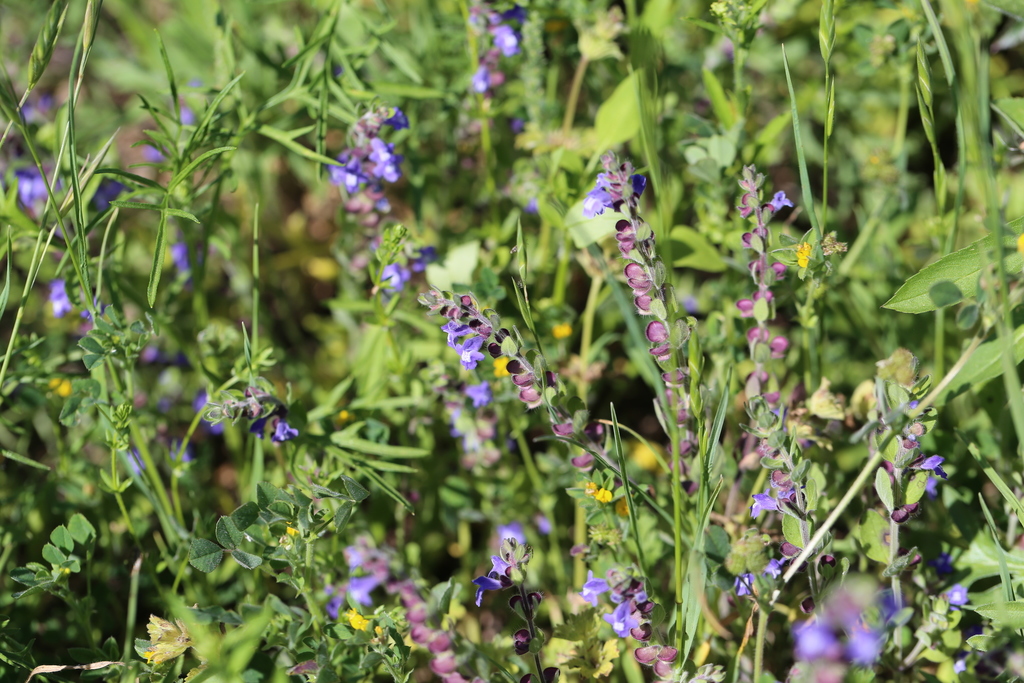
Drummond’s skullcap adds spring color and nectar to the grasslands and rocky openings of Texas and the southern Plains.
For Pollinators
The two-lipped flowers are visited mainly by small to medium native bees, which land on the broad lower lip to reach the nectar, as well as by small butterflies and bee flies.
For Birds
Ground-feeding birds may eat the small nutlets, and the open, rocky grasslands where it grows are habitat for many native birds.
For Mammals
The hairy foliage is rarely browsed. The plant has been reported to be toxic, so it is not a forage plant.
Ecosystem Role
As a fast-growing spring annual, it quickly covers bare, rocky or disturbed soil after winter rains and adds to the diversity of spring wildflowers in prairies, Hill Country openings and roadsides.
Cultural & Historical Uses
The species is named for Thomas Drummond, a Scottish naturalist who collected plants in Texas in 1833–1834. Many Texas wildflowers, including Drummond phlox, carry his name.
The genus name Scutellaria comes from the Latin scutella, meaning a little dish or shield, after the small crest on the calyx. The common name skullcap comes from the same feature, which reminded early botanists of a helmet or cap.
A variety found on the Edwards Plateau, Scutellaria drummondii var. edwardsiana, is sometimes called plateau skullcap. Some skullcaps have been used in herbal medicine, but this species is reported to be toxic and should not be eaten.
Frequently Asked Questions
Is Drummond’s skullcap an annual or a perennial?
It is usually an annual, though some plants survive for more than one season. It reseeds readily.
When does Drummond’s skullcap bloom?
Mainly from March to June, and sometimes again after fall rains.
Is Drummond’s skullcap toxic?
Its foliage has been reported to be toxic. Do not eat it, and keep it away from grazing animals in large amounts.
Where does Drummond’s skullcap grow?
It grows mainly in Texas, and also in Oklahoma, Louisiana, New Mexico, Arizona and northeastern Mexico, on dry, rocky or sandy soils.
How do I grow Drummond’s skullcap?
Sow seed in fall on bare, well-drained soil in full sun and let it reseed. It needs little water once established.

Looking for a nursery that carries Drummond’s Skullcap?
Browse our native plant nursery directory: Arizona · Louisiana · New Mexico & Oklahoma · Texas