
Miami Mist (Phacelia purshii)
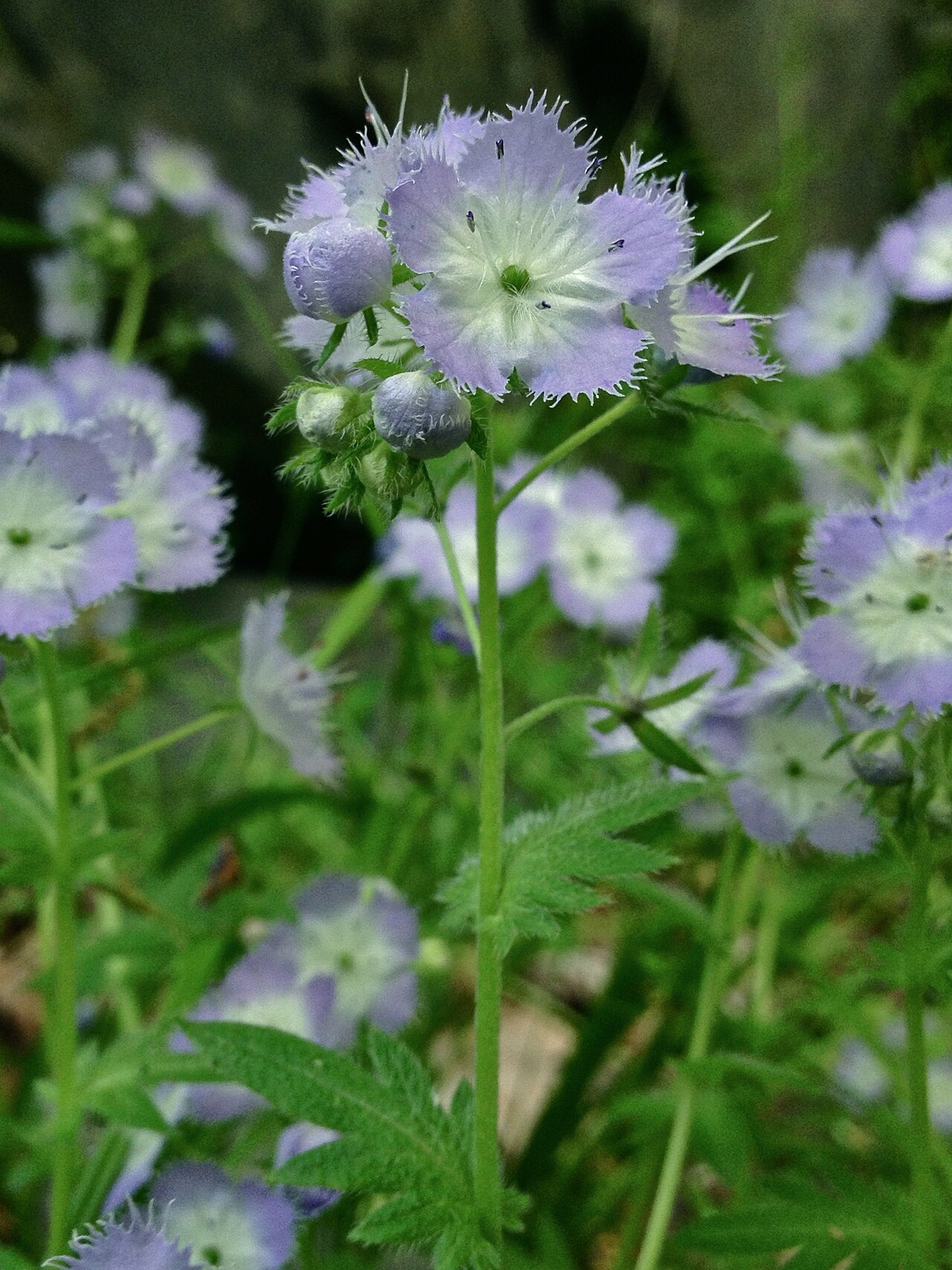
Phacelia purshii, known as Miami Mist or Pursh's phacelia, is a dainty winter annual in the borage family (Boraginaceae; formerly the waterleaf family, Hydrophyllaceae). In mid-spring it produces loose, coiled clusters of pale blue to lavender, sometimes nearly white flowers whose petals are edged with a delicate fringe. Plants are usually 6 to 16 inches tall, with soft, deeply divided leaves.
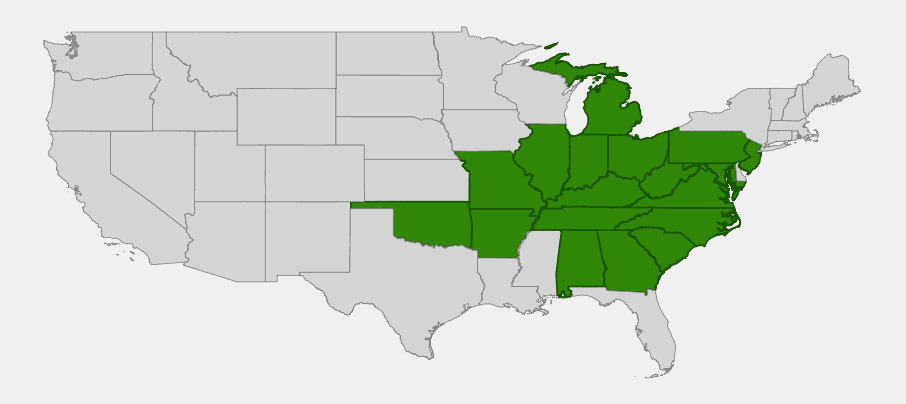
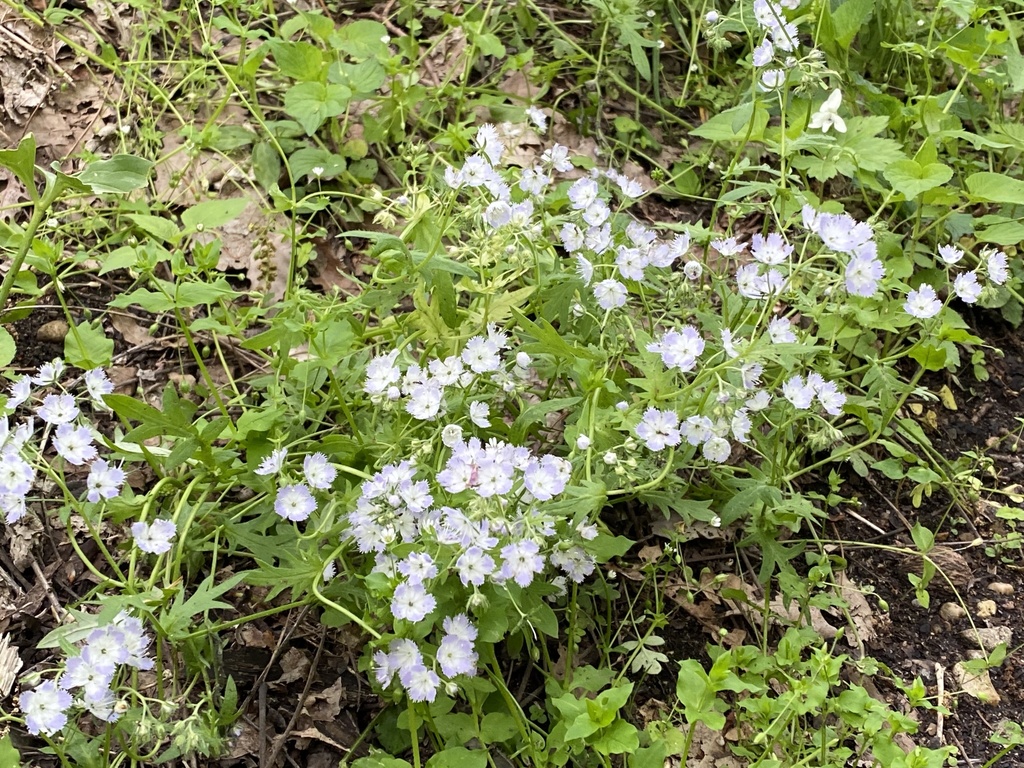
Miami mist grows from Pennsylvania, Ohio and southern Ontario south to Georgia and Alabama and west to Illinois, Missouri, Arkansas and Oklahoma. It is most common in the Ohio Valley and the Interior Low Plateaus of Kentucky and Tennessee, where it can carpet moist woods, floodplains, meadows and roadsides with a haze of blue in April and May. Its common name refers to the Miami River valleys of southwestern Ohio.
Because it is an annual, Miami mist is best used in gardens by sowing seed and letting it self-sow year after year in a moist, partly shaded spot. Its flowers are an important early food source for native bees.
Identification
Look for a low, branching spring annual with fern-like leaves and coiled sprays of half-inch, pale blue flowers whose petals have fringed edges.
Growth Habit
Seeds germinate in fall and the plants overwinter as small rosettes. In spring they send up one or several slender, branched, hairy stems, usually 6 to 16 inches tall and sometimes taller, that lean or sprawl when crowded. After setting seed in late spring the plants die.
Leaves
The leaves are alternate and deeply cut (pinnately divided) into 5 to 15 narrow, pointed or toothed lobes, giving them a ferny look. Lower leaves have stalks; upper leaves are smaller and stalkless. Stems and leaves are covered with short hairs.
Flowers
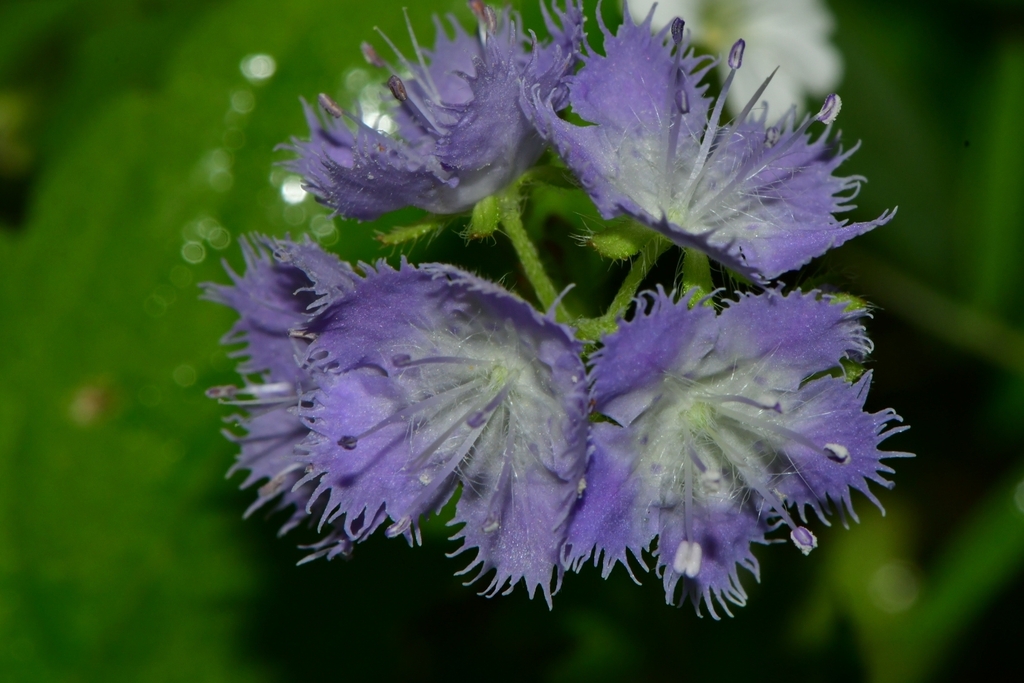
The flowers are borne in coiled clusters (scorpioid cymes) that unroll as the buds open, like a fiddlehead. Each flower is about 1/2 inch across, bowl-shaped, with five rounded petals that are pale blue, lavender or occasionally white, with a paler center. The petal edges are deeply fringed, and five stamens with pale anthers stick out beyond the petals. Bloom time is April to early June.
Fruit
The fruit is a small, rounded capsule that holds a few small, pitted seeds. The seeds ripen in late spring and fall near the parent plant.
Look-alikes
Fernleaf phacelia (Phacelia bipinnatifida) is a biennial of rocky woods with larger, darker violet-blue flowers whose petals are not fringed, and with sticky, glandular hairs. Fringed phacelia (Phacelia fimbriata) of the southern Appalachian mountains also has fringed petals, but its flowers are white and smaller. Small-flower phacelia (Phacelia dubia) has smaller, unfringed flowers.
Quick Facts
| Scientific Name | Phacelia purshii |
| Family | Boraginaceae (borage family; formerly Hydrophyllaceae) |
| Plant Type | Winter annual wildflower |
| Mature Height | 6–16 in |
| Mature Spread | 6–12 in |
| Growth Rate | Fast (completes its life cycle in one season) |
| Sun Exposure | Full sun to part shade |
| Water Needs | Medium; moist in spring |
| Soil Type | Moist, rich loam or alluvial soil |
| Soil pH | Slightly acidic to neutral or alkaline (about 6.0–7.5) |
| Bloom Time | April–early June |
| Flower Color | Pale blue to lavender, occasionally white |
| Fall Color | None (overwinters as small rosettes) |
| Fruit | Small rounded capsules |
| Deer Resistant | Moderately; hairy foliage is not a favorite |
| USDA Hardiness Zones | 5–8 |
Native Range
USDA PLANTS lists Miami mist as native in Ontario and in 18 states from New Jersey, Pennsylvania and Michigan south to Georgia and Alabama and west to Missouri, Arkansas and Oklahoma. USDA also has records from Connecticut and Rhode Island, but Go Botany treats those New England populations as introduced, probably escaped from cultivation, so they are not included on our map.
The center of its range is the Ohio River basin and the Interior Low Plateaus of Ohio, Indiana, Kentucky and Tennessee, where it is common in moist woods and bottomlands. It extends east through Pennsylvania, West Virginia, Maryland and Virginia, into the Piedmont and mountains of the Carolinas and Georgia, and south to northern Alabama. Records from New Jersey, Michigan and Oklahoma are few and best treated as outlying. In Canada it is known only from extreme southwestern Ontario, including Pelee Island.
It grows in moist deciduous woods, floodplains and stream banks, wet meadows, thickets, woodland edges, fields and roadsides, often on rich or limestone-derived soils.
📋 Regional plant lists featuring Miami Mist: New York, Pennsylvania & Northern New Jersey · Ohio & Indiana · Michigan, Wisconsin & Eastern Minnesota · Kentucky & Tennessee · Maryland, Virginia & West Virginia · Delaware, Southern New Jersey & Long Island · Illinois, Iowa & Missouri · Alabama, Georgia & Mississippi · North & South Carolina · Arkansas, Louisiana, Eastern Oklahoma & Eastern Texas
Growing & Care Guide
Miami mist is a charming annual for naturalistic gardens. Once established from seed, it can maintain itself for years by self-sowing, as long as the soil is moist in spring and there is some open ground for seedlings.
Light
Part shade under deciduous trees is ideal, with sun in spring before the canopy fills in. It also grows in full sun where the soil stays moist through spring.
Soil & Water
Moist, rich, well-drained loam is best, including the alluvial soils of floodplains. It tolerates clay and limestone soils. Keep the soil from drying out in fall, when the seedlings germinate, and in spring, when the plants grow and bloom. Summer dryness does not matter once the seeds have set.
Planting Tips
Sow fresh seed in late spring or early summer, or in early fall, on bare or lightly raked soil and press it in. Seeds germinate in fall. Container-grown plants are sometimes available in spring and should be planted in drifts. Mulch heavily only where you do not want seedlings.
Pruning & Maintenance
Let the plants set seed before you remove them in early summer. Avoid thick mulch and frequent soil disturbance in areas where you want it to self-sow, and keep aggressive groundcovers away from the colony.
Propagation
It grows only from seed. Collect capsules as they turn brown in late spring and sow the seed promptly, or simply shake the dry stems over the area where you want new plants.
Landscape Uses
- Woodland gardens: a haze of pale blue flowers among spring ephemerals
- Meadows and lawn edges: self-sows in moist, partly shaded openings
- Rain gardens and floodplain plantings: suits moist, rich soils in spring
- Pollinator gardens: an important spring food source for native bees
- Naturalized areas: establishes from seed and returns year after year
Wildlife & Ecological Value
Miami mist blooms at a time when many native bees are emerging and looking for pollen to provision their nests.
For Pollinators
The Xerces Society notes that Miami mist is of special value to native bees. Bumble bee queens, mason bees, mining bees and small sweat bees visit the flowers for nectar and pollen, along with flies and early butterflies.
For Birds
Its tiny seeds are of minor value to birds, but the insects it supports feed spring migrants and nesting songbirds.
For Mammals
Deer and rabbits may nibble it, but its hairy foliage is not a preferred food.
Ecosystem Role
As a winter annual, it uses the moist, sunny weeks of early spring before the tree canopy closes, and its fall rosettes cover bare floodplain soil through winter.
Cultural & Historical Uses
The species name honors Frederick Pursh (1774–1820), a German-born botanist who worked in North America and published one of the first floras of the continent, Flora Americae Septentrionalis, in 1814. The genus name Phacelia comes from the Greek phakelos, “bundle,” for the clustered flowers.
The common name “Miami mist” refers to the valleys of the Great Miami and Little Miami Rivers in southwestern Ohio, where the plant is abundant and colors fields and woodlands with a blue mist in spring.
Go Botany notes that the Cherokee used a poultice of this plant to treat swollen joints. Today it is valued mainly as a wildflower, not as a medicine.
Frequently Asked Questions
Is Miami mist an annual or a perennial?
It is a winter annual. Seeds sprout in fall, the plants overwinter as small rosettes, bloom in spring and die after setting seed. Colonies persist by self-sowing.
How can I tell Miami mist from fernleaf phacelia?
Miami mist has smaller, paler flowers with fringed petal edges and is an annual. Fernleaf phacelia has larger, darker violet-blue flowers without fringes and sticky, glandular hairs.
How do I grow Miami mist?
Sow fresh seed on bare, moist soil in late spring or fall in part shade. Leave the plants to set seed each year, and avoid thick mulch where you want it to return.
Why is it called Miami mist?
The name comes from the Miami River valleys of southwestern Ohio, where it grows in abundance and creates a blue mist of flowers in spring.
Is Miami mist native to New England?
No. It has been found in Connecticut and Rhode Island, but Go Botany considers those plants introduced, probably escaped from cultivation.

Looking for a nursery that carries Miami Mist?
Browse our native plant nursery directory: Alabama & Arkansas · Georgia · Illinois & Indiana · Kentucky, Maryland, Michigan & Missouri · New Jersey, North Carolina, Ohio & Oklahoma · Pennsylvania, South Carolina, Tennessee & Virginia · West Virginia