
Goldenseal (Hydrastis canadensis)
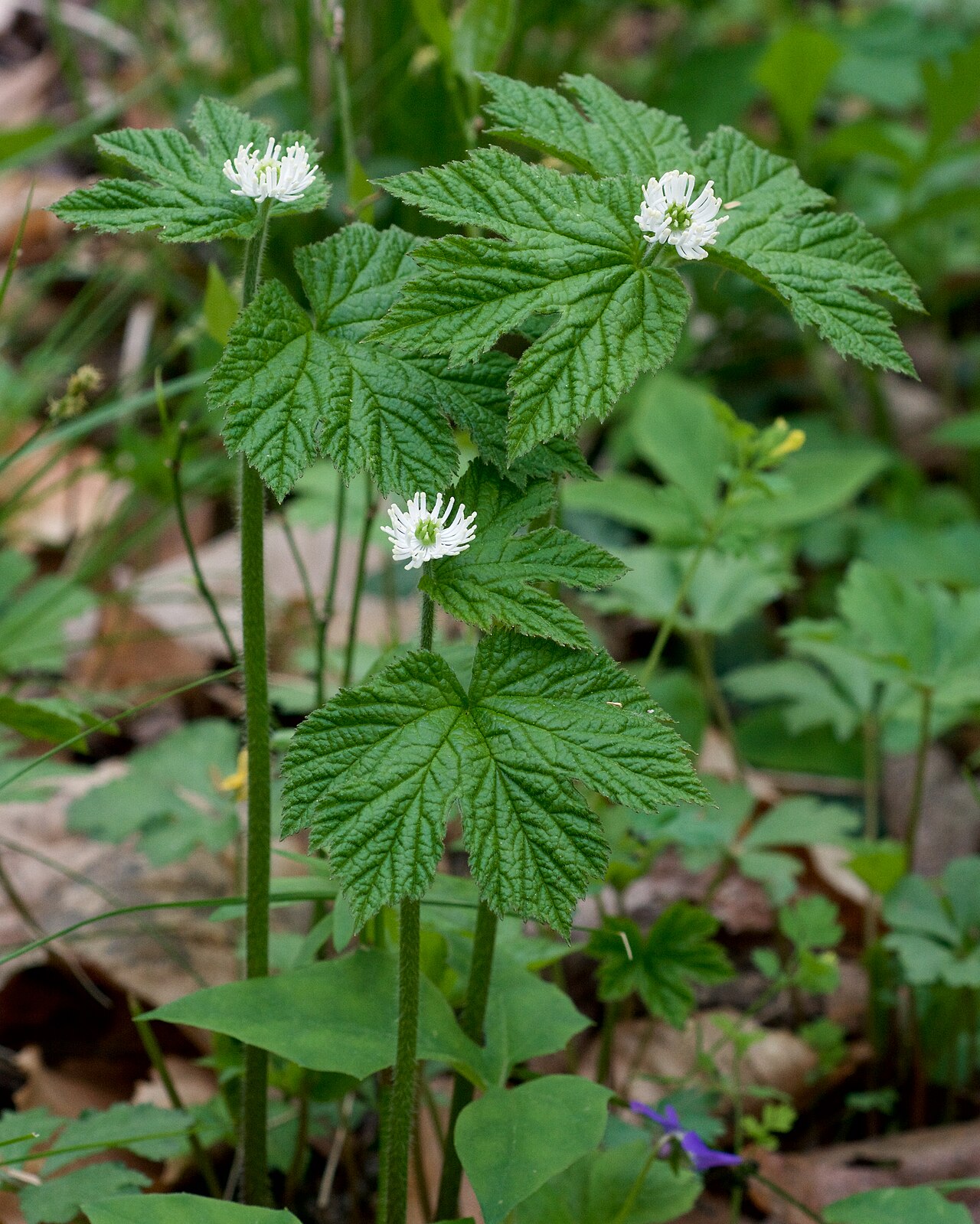
Hydrastis canadensis, known as Goldenseal (also orangeroot or yellow puccoon), is a low woodland perennial of rich, moist deciduous forests in eastern North America. It grows 6 to 15 inches tall, with one or two large, deeply lobed, wrinkled leaves and, in early spring, a single small flower made of a brush of white stamens. By midsummer the flower becomes a bright red, raspberry-like fruit. Its name comes from its knotty, bright yellow rhizome, which leaves scars that some people thought resembled the marks of a wax seal.
Goldenseal is one of the most heavily harvested medicinal plants in North America. Its roots have been dug for the herbal trade since the 1800s, and wild collection, along with loss of its rich forest habitat, has made it scarce in many areas. It is listed in Appendix II of CITES, which regulates international trade in its roots, and it is listed as endangered in New Jersey and as rare or protected in a number of other states, mostly at the edges of its range.
Never dig goldenseal from the wild. Buy nursery-propagated plants from reputable native plant or woodland herb nurseries. Grown in the right place, under deciduous trees in moist, humus-rich soil, it slowly spreads into an attractive groundcover. This page is about gardening and conservation, not medicine: goldenseal contains potent alkaloids and can be toxic in large doses.
Identification
Goldenseal is distinctive in spring: look for a hairy stem with two large, maple-like leaves near the top and one fluffy white flower sitting just above them, in rich, shady woods.
Growth Habit
A herbaceous perennial that spreads slowly from a thick, knotty, yellow rhizome with many fibrous roots. Each spring it sends up a single leaf (on non-flowering plants) or a hairy, forked stem 6 to 15 inches tall bearing two leaves and one flower. Over many years it can form patches of dozens of stems. The plants die back to the ground by late summer or fall.
Leaves
The leaves are palmately lobed, with five to seven toothed lobes, and look somewhat like maple or grape leaves. They are wrinkled and hairy, especially on the veins. At flowering time they are small and still unfolding, but they keep growing after bloom to 4 to 10 inches across, so a plant in summer looks larger and leafier than in spring.
Flowers
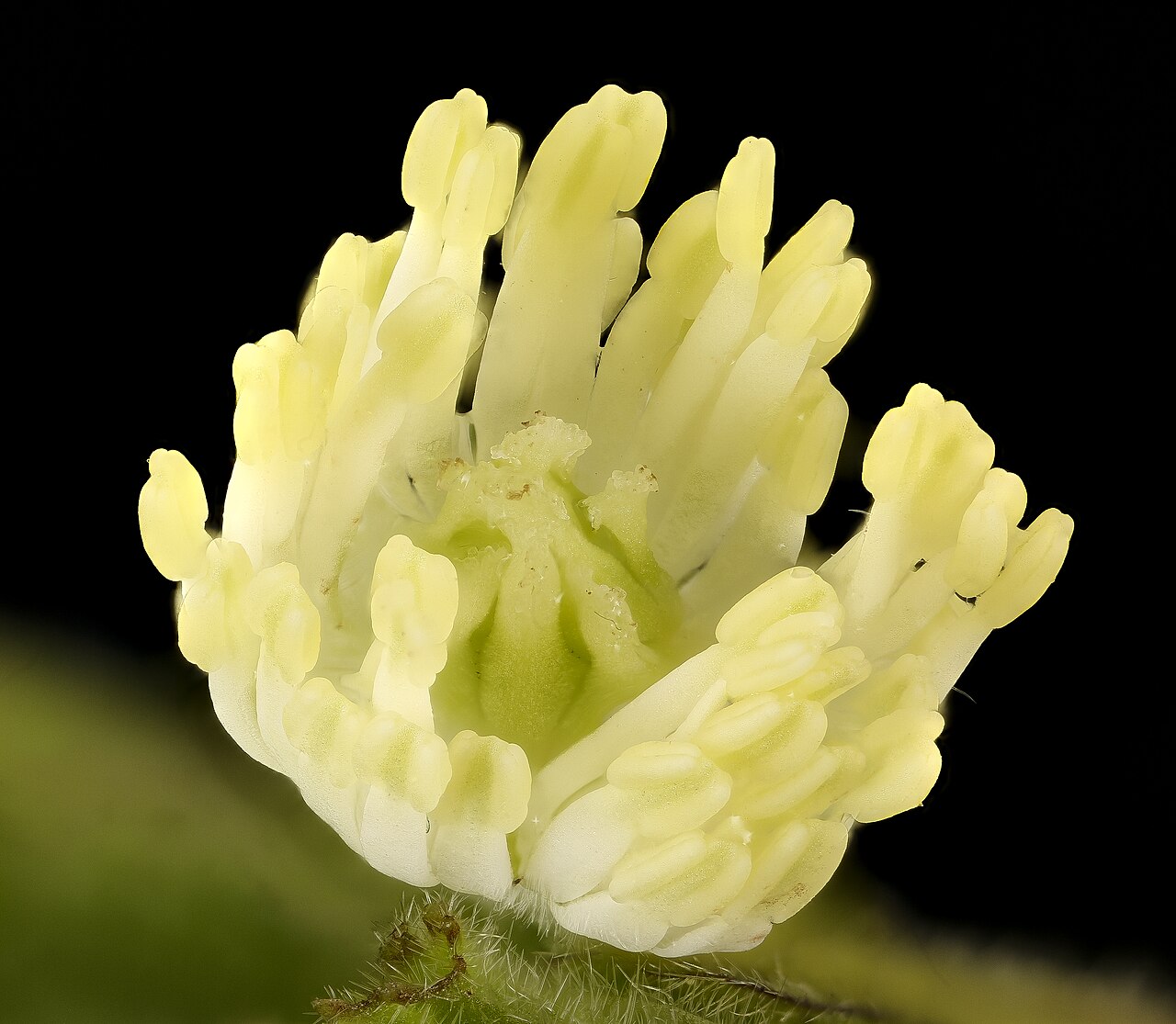
The single flower appears in April or May, at the top of the stem just above the upper leaf. It has no petals, and its three small, greenish-white sepals drop as soon as it opens. What you see is a fluffy, 1/2-inch tuft of many white to creamy stamens surrounding a small cluster of green pistils.
Fruit & Seeds
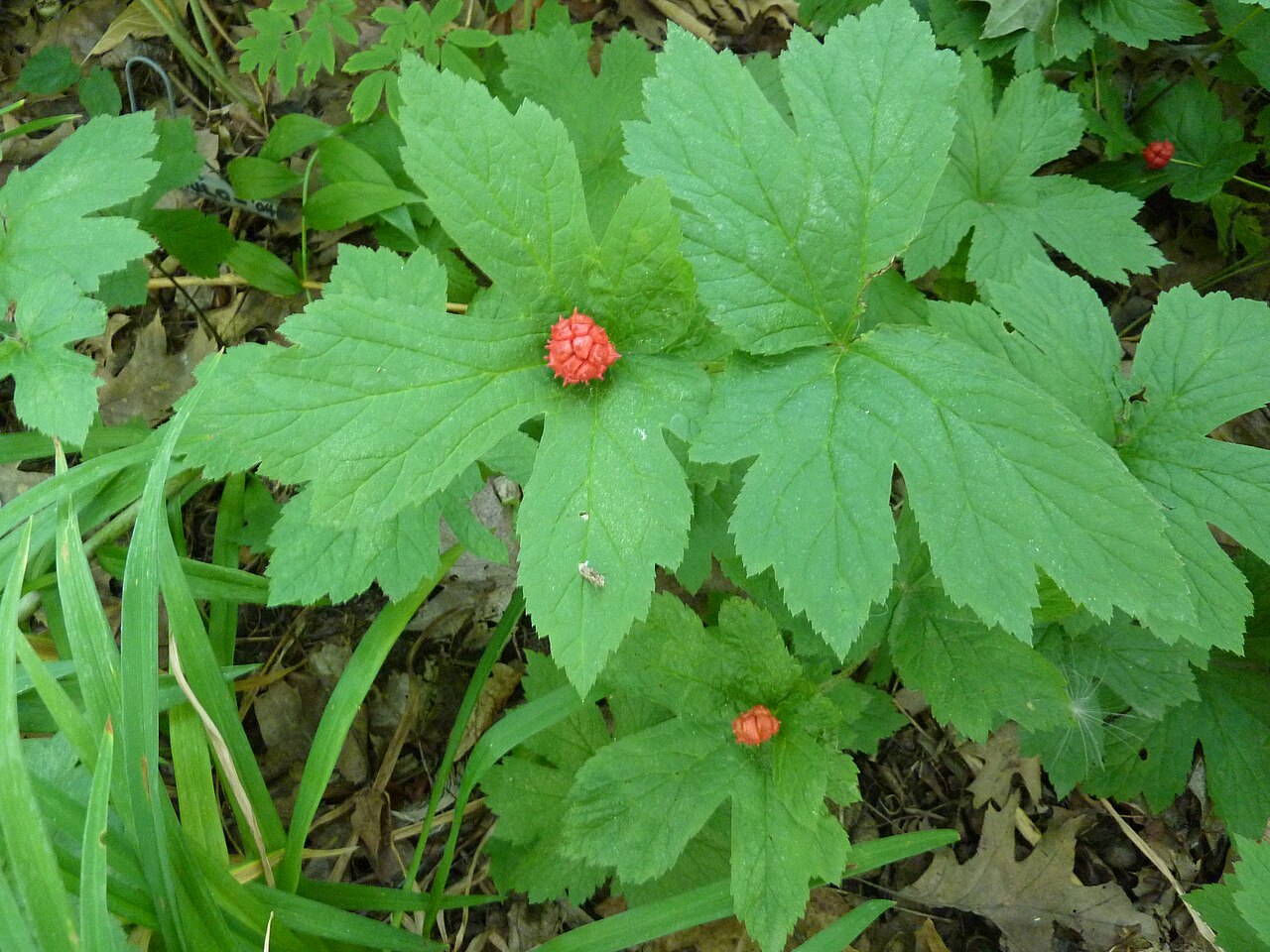
By midsummer the pistils develop into a bright red, fleshy, raspberry-like aggregate fruit about 1/2 inch across, containing several small, shiny black seeds. The fruit is held above the leaves and is easy to spot from July into August.
Roots
The rhizome is knobby, about 1/2 to 3/4 inch thick and bright yellow to orange-yellow inside, with many fine yellow roots. The yellow color comes from alkaloids such as berberine. Do not dig plants to look at the roots; the color is well known and digging kills the plant.
Look-alikes & Safety
Mayapple has umbrella-like leaves and a nodding white flower with petals beneath them. Young American Ginseng grows in the same habitat but has compound leaves of five leaflets and a cluster of small greenish flowers. Safety: goldenseal contains the alkaloids berberine and hydrastine. In large doses it can cause nausea, vomiting, nervous system effects and other serious problems, and it interacts with some medications. Do not eat it, and keep children and pets from chewing the roots or berries.
Quick Facts
| Scientific Name | Hydrastis canadensis |
| Family | Ranunculaceae (buttercup family) |
| Plant Type | Herbaceous woodland perennial; spreads by rhizomes |
| Mature Height | 6–15 in |
| Mature Spread | 8–12 in per plant; slowly forms patches |
| Growth Rate | Slow |
| Sun Exposure | Part shade to full shade |
| Water Needs | Medium; evenly moist, well-drained soil |
| Soil Type | Rich, loose, humus-rich forest loam |
| Soil pH | Slightly acidic to neutral (about 5.5–7.2) |
| Bloom Time | April–May |
| Flower Color | White to creamy (stamens; no petals) |
| Fall Color | Leaves yellow and die back by late summer or fall |
| Fruit | Bright red, raspberry-like berry cluster, July–August |
| Deer Resistant | Mostly; occasionally browsed |
| USDA Hardiness Zones | 3–8 |
Native Range
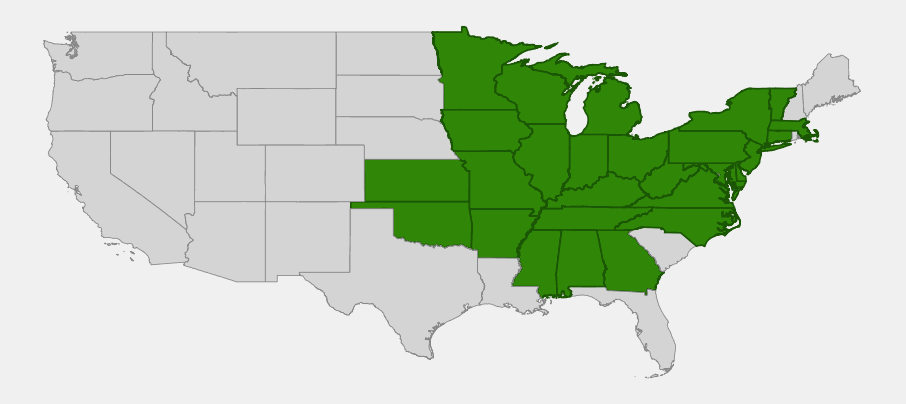
Goldenseal is native to eastern North America. USDA PLANTS lists it as native in the lower 48 states and Canada, where it occurs only in southern Ontario. In the United States it is recorded from 27 states, from Vermont and Massachusetts west through the Great Lakes states to Minnesota, Iowa and eastern Kansas, and south to the mountains of Georgia and Alabama, Mississippi, Arkansas and Oklahoma.
Its stronghold is the Ohio River valley and the central Appalachians: Ohio, Indiana, Kentucky, West Virginia, Tennessee and parts of Pennsylvania, Virginia and North Carolina have the most populations. Toward the edges of its range, such as New England, New Jersey, Minnesota, Kansas, Oklahoma and the Deep South, it is rare and scattered. USDA PLANTS lists it as endangered in New Jersey, and NatureServe ranks it globally as vulnerable to apparently secure (G3G4).
Goldenseal grows in rich, moist, deciduous and mixed hardwood forests, often on north- or east-facing slopes, in ravines and on well-drained floodplain terraces. It favors deep, loose, humus-rich soils, often over limestone, under sugar maple, beech, oaks, basswood and tulip tree.
📋 Regional plant lists featuring Goldenseal: New York, Pennsylvania & Northern New Jersey · Ohio & Indiana · Michigan, Wisconsin & Eastern Minnesota · Kentucky & Tennessee · Nebraska, Kansas & Eastern Colorado · Connecticut, Massachusetts & Rhode Island · New Hampshire, Maine & Vermont · Maryland, Virginia & West Virginia · Delaware, Southern New Jersey & Long Island · Illinois, Iowa & Missouri · Alabama, Georgia & Mississippi · North & South Carolina · Arkansas, Louisiana, Eastern Oklahoma & Eastern Texas
Growing & Care Guide
Goldenseal is a rewarding plant for patient woodland gardeners. Growing it in gardens and forest farms also eases pressure on wild populations. Start with nursery-propagated plants or rhizome pieces from a reputable grower. Never dig it from the wild, and do not buy plants or roots of unknown origin.
Light
Give it part to full shade, ideally the kind of dappled shade found under tall deciduous trees, with about 70 to 80 percent shade in summer. Spring sun before the trees leaf out is fine, but summer sun scorches the leaves.
Soil & Water
It needs loose, deep, humus-rich soil that stays evenly moist but drains well, like natural forest soil with plenty of leaf mold. The Lady Bird Johnson Wildflower Center lists circumneutral soil. Heavy clay and waterlogged soil cause root rot. Water during dry spells in its first years.
Planting Tips
Plant rhizome pieces or potted plants in early fall (best) or early spring, with the buds about 1 to 2 inches below the soil surface, 6 to 12 inches apart. Work in compost or leaf mold, then mulch with shredded hardwood leaves. A deciduous leaf winter cover is desirable, so leave fallen leaves in place.
Pruning & Maintenance
No pruning is needed. Let the leaves die back naturally in late summer. Keep it free of aggressive groundcovers and weeds. Slugs and fungal leaf diseases can be problems in crowded, damp beds; good air circulation helps. Leave the plants undisturbed to spread.
Propagation
The easiest method is division: in fall, lift a clump and cut the rhizome into pieces, each with a bud and roots, and replant them at once. Plants also grow from small root fragments left in the soil. Seed is slow: collect ripe red fruits, clean the seeds and sow them immediately without letting them dry out. Germination usually takes until the following spring or later, and seedlings take several years to flower.
Landscape Uses
- Woodland and shade gardens: a slowly spreading groundcover under deciduous trees
- Conservation plantings: growing nursery stock helps protect wild plants
- Forest farming: grown under forest canopy by woodland herb growers
- Native plant education: a story of medicinal use, overharvest and conservation
- Spring ephemeral gardens: with mayapple, bloodroot, ginger and hepatica
Wildlife & Ecological Value
Goldenseal is a small part of rich forest communities. Its early flowers and bright fruit link it to insects and birds of the woodland floor.
For Pollinators
The petal-less flowers offer pollen and are visited by small bees, such as sweat bees, and flies in early spring. The flowers can also self-pollinate.
For Birds
The red fruits are probably eaten by woodland birds and may also be eaten by small mammals, which helps disperse the seeds.
For Mammals
Deer usually avoid it, though plants are occasionally browsed. Small mammals may eat the fruits. Its main threat from people is root digging for the herbal trade.
Ecosystem Role
Goldenseal is part of the herb layer of rich mesic hardwood forests, along with spring ephemerals and other woodland perennials. Healthy goldenseal patches are often a sign of mature, undisturbed forest with deep, fertile soil.
Cultural & Historical Uses
Cherokee and other Native American peoples of the eastern woodlands used goldenseal root as a medicine and as a yellow dye for clothing, baskets and weapons. European settlers learned of it from them, and by the 1800s it had become a popular remedy in American folk and patent medicine.
Demand for the root grew so much that, by the early 1900s, botanists were warning that wild goldenseal was disappearing from much of its range. Overharvest has continued with the modern herbal supplement trade. In 1997 goldenseal was listed in Appendix II of CITES, which requires permits for international trade in its roots. This page does not make any health claims; anyone considering herbal products should consult a doctor, since goldenseal can be toxic in large doses and interacts with medications.
Today conservation groups encourage growers and buyers to use cultivated rather than wild-harvested goldenseal. Forest farmers in Appalachia and elsewhere grow it under the shade of hardwood trees, and home gardeners can help by planting nursery-propagated stock in suitable woodland gardens.
Frequently Asked Questions
Is goldenseal endangered?
It is not federally listed, but it is listed in CITES Appendix II, which regulates international trade. It is listed as endangered in New Jersey and is rare or protected in several other states at the edges of its range. Wild populations have declined because of overharvest and habitat loss.
Can I dig goldenseal from the woods?
No. Never dig wild plants. Buy nursery-propagated plants or rhizome pieces from a reputable grower, and check that they are not wild-collected.
Is goldenseal toxic?
It contains potent alkaloids, including berberine and hydrastine. In large doses it can be toxic, and it interacts with some medications. Do not eat any part of the plant, and keep pets and children away from the roots and berries.
How fast does goldenseal spread?
Slowly. In good conditions a patch expands from its rhizomes over several years. Dividing clumps in fall is the quickest way to get more plants.
Where should I plant goldenseal?
In shade under deciduous trees, in loose, moist, well-drained, humus-rich soil, ideally with a layer of fallen leaves in winter.

Looking for a nursery that carries Goldenseal?
Browse our native plant nursery directory: Alabama & Arkansas · Connecticut, Delaware & Georgia · Illinois, Indiana, Iowa & Kansas · Kentucky, Maryland, Massachusetts, Michigan, Minnesota, Mississippi & Missouri · New Jersey, New York, North Carolina, Ohio & Oklahoma · Pennsylvania, Tennessee, Vermont & Virginia · West Virginia & Wisconsin