
Lanceleaf Springbeauty (Claytonia lanceolata)
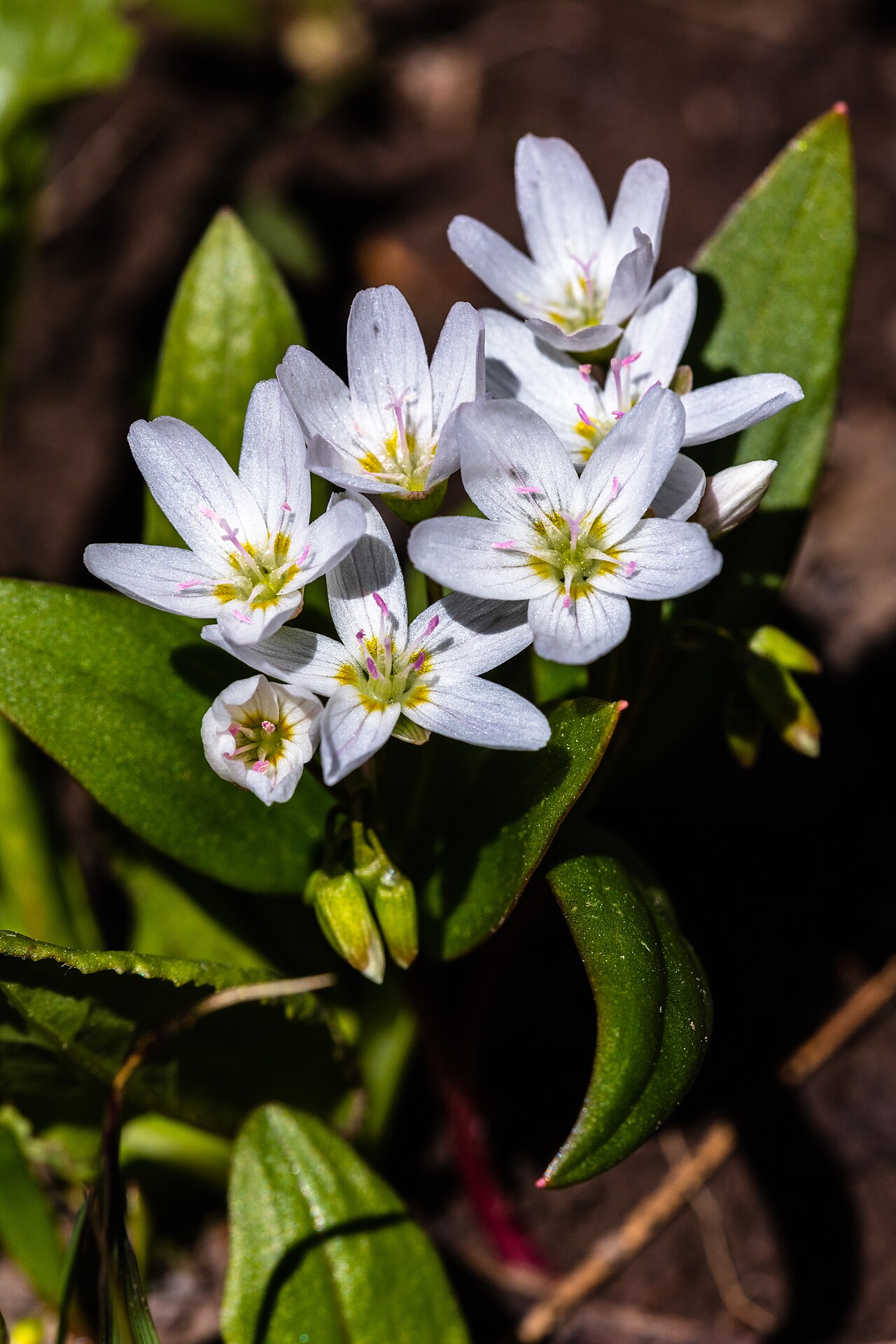
Claytonia lanceolata, known as Lanceleaf Springbeauty or western springbeauty, is one of the first wildflowers to bloom in the mountains and foothills of the American West. It belongs to the miner’s lettuce family (Montiaceae), formerly included in the purslane family. Each plant grows from a small, round underground corm and sends up a short stem, 2 to 8 inches tall, with a single pair of narrow, lance-shaped leaves and a loose cluster of white to pale pink, five-petaled flowers.
Lanceleaf springbeauty often blooms right at the edge of melting snowbanks, from March in the sagebrush foothills to July in the high mountains. Masses of the small, pink-veined flowers can whiten whole slopes for a few weeks. By early summer the plants have set seed and died back to the corm, resting underground until the next spring.
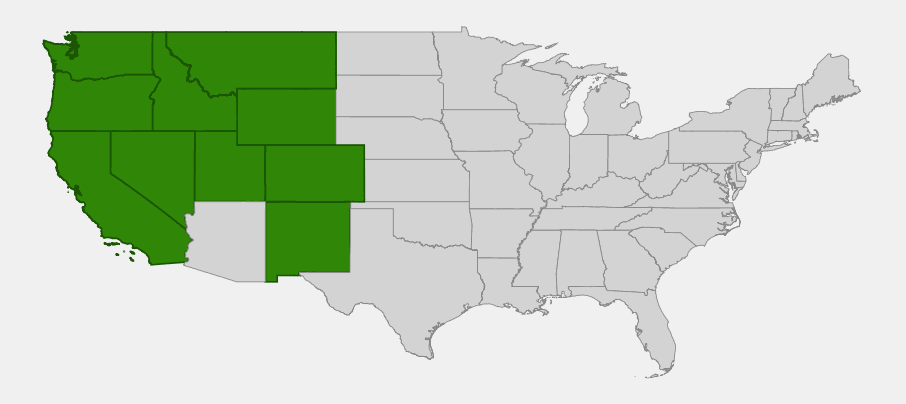
The species grows from British Columbia and Alberta south through Washington, Oregon, Idaho and Montana to the Sierra Nevada of California, Nevada, Utah, Wyoming, Colorado and New Mexico. Its starchy corms, sometimes called Indian potatoes, were an important traditional food for many Indigenous peoples of the Northwest and are still eaten by bears, ground squirrels and other wildlife. It is rarely grown in gardens but is a joy to find on spring hikes.
Identification
Look for a small, fleshy spring plant with a single pair of opposite, lance-shaped leaves partway up the stem and a cluster of white or pinkish, pink-veined flowers above them, usually near melting snow or in spring-moist, open ground.
Corm & Stem
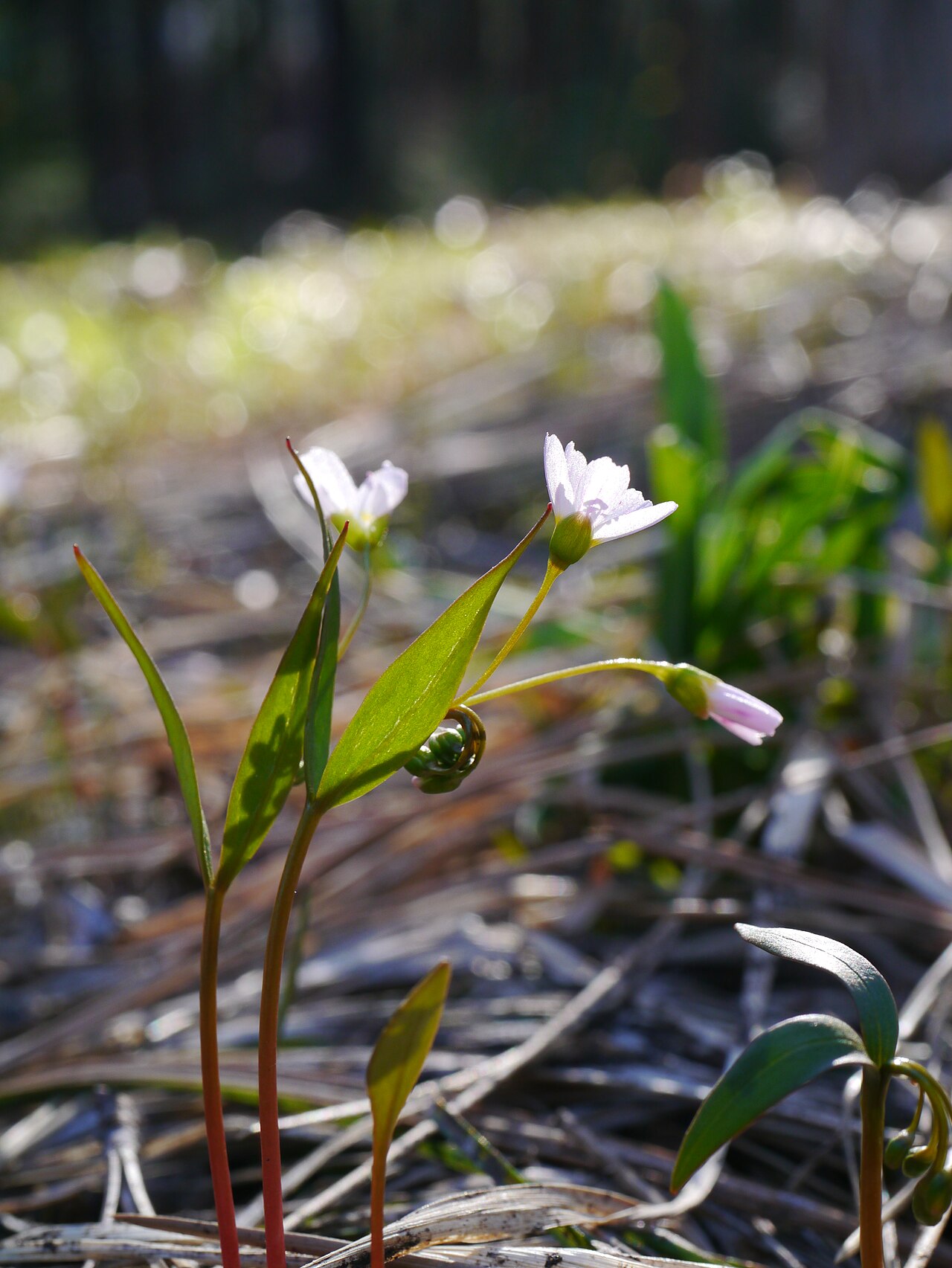
Each plant grows from a round, potato-like corm about 1/2 to 1 inch across, buried a few inches deep. One to several slender, succulent stems, often reddish, rise 2 to 8 inches above the ground.
Leaves
There are usually no basal leaves at flowering, or only one or two long-stalked ones. The stem carries a single pair of opposite, stalkless leaves, lance-shaped to narrowly oval, about 1 to 3 inches long, smooth and slightly fleshy.
Flowers
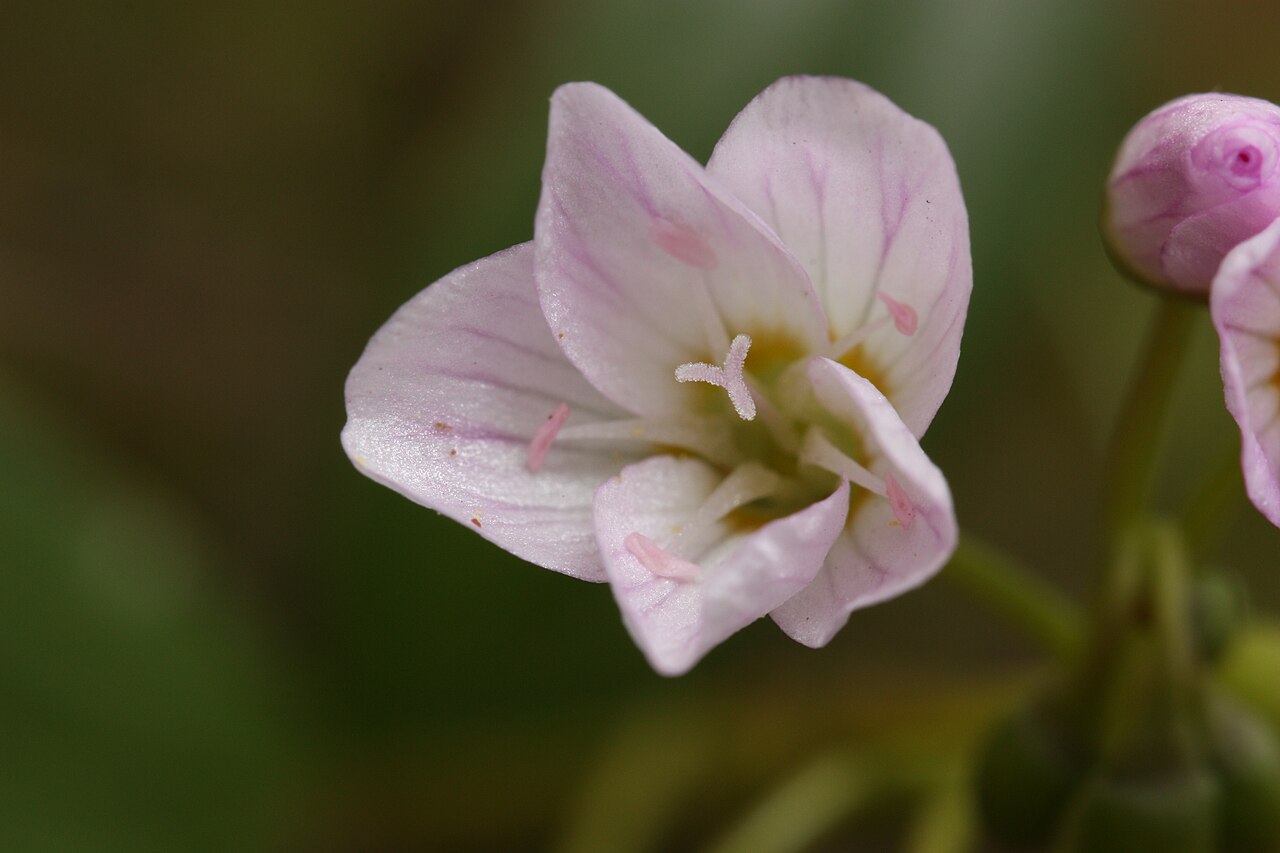
Three to 15 flowers form a loose, one-sided cluster at the top of the stem. Each flower is about 1/2 to 3/4 inch across, with two green sepals and five white to pink petals marked with fine pink veins, often with a small yellow spot at the base of each petal. The five stamens have pink anthers. Bloom time follows snowmelt, from March at low elevations to July in the high mountains.
Fruit & Seeds
Each flower produces a small capsule that splits into three parts, throwing out a few shiny black seeds. The seeds carry small fleshy appendages that may attract ants.
Look-alikes
Candy flower (Claytonia sibirica) has broad, oval leaves and grows in moist, shady lowland forests. Miner’s lettuce (C. perfoliata) has its upper leaves fused into a round disk around the stem. Alpine springbeauty (C. megarhiza) has a thick taproot and a rosette of spoon-shaped leaves. In the southern Rockies, some botanists treat plants with narrower leaves as a separate species, Rocky Mountain springbeauty (C. rosea).
Quick Facts
| Scientific Name | Claytonia lanceolata |
| Family | Montiaceae (miner’s lettuce family) |
| Plant Type | Herbaceous perennial spring ephemeral from a corm |
| Mature Height | 2–8 in |
| Mature Spread | 2–6 in |
| Growth Rate | Fast in spring; dormant by early summer |
| Sun Exposure | Full sun to part shade |
| Water Needs | Medium in spring (snowmelt-moist); dry in summer |
| Soil Type | Well-drained loam, gravelly or rocky soil |
| Soil pH | Slightly acidic to neutral |
| Bloom Time | March–July (following snowmelt) |
| Flower Color | White to pale pink with pink veins |
| Fall Color | None; dormant by summer |
| Fruit | Small three-parted capsule with shiny black seeds |
| Deer Resistant | No; grazed by deer and elk, corms eaten by rodents and bears |
| USDA Hardiness Zones | 3–7 |
Native Range
Lanceleaf springbeauty is widespread in the mountains of western North America. USDA PLANTS lists it as native in Canada and the lower 48 states, with records from Washington, Oregon, California, Idaho, Nevada, Montana, Wyoming, Utah, Colorado and New Mexico. In Canada it grows in British Columbia, Alberta and Saskatchewan. The Lady Bird Johnson Wildflower Center summarizes its range as British Columbia to southern California, east to Alberta and New Mexico.
It is common in the Cascades and the mountains east of them, in the Blue and Wallowa Mountains, throughout the northern and middle Rocky Mountains of Idaho, Montana and Wyoming, and in the mountains of the Great Basin. It extends south in the Sierra Nevada of California and in the southern Rockies of Colorado and northern New Mexico. In western Washington it is found in the Olympic Mountains and on the west side of the Cascades at higher elevations, and it reaches the Columbia River Gorge.
Habitats range from spring-moist sagebrush slopes and open ponderosa pine forests in the foothills to mountain meadows, aspen groves, subalpine forests and alpine slopes, always in places that are wet from snowmelt in spring and dry by summer.
📋 Regional plant lists featuring Lanceleaf Springbeauty: Idaho, Eastern Oregon & Eastern Washington · Montana & Wyoming · Utah & Western Colorado · Western Oregon & Western Washington · California & Nevada
Growing & Care Guide
Lanceleaf springbeauty is seldom offered by nurseries and is best enjoyed in the wild. Gardeners in the West can grow it from seed in a rock garden or naturalistic planting that is moist in spring and dry in summer. Do not dig corms from the wild; transplanted corms rarely establish and digging damages wild populations.
Light
Give it full sun to part shade, such as an open slope, a rock garden or the edge of an open woodland.
Soil & Water
It needs well-drained loam or gravelly soil that is moist in spring, as from melting snow, and dry once the plants go dormant in summer. Summer watering and soggy soil can rot the corms.
Planting Tips
Sow fresh seed outdoors in fall where it is to grow, or in pots left outside for the winter. Combine it with other early-spring natives such as glacier lily, yellow fritillary and early blue violet, and with bunchgrasses that cover the space after it goes dormant. Mark the location so you do not dig into it in summer.
Pruning & Maintenance
No pruning is needed. Let the foliage wither on its own after seeding, since it feeds the corm for next year. Protect plants from gophers and ground squirrels if they are a problem.
Propagation
Propagate by seed, which should be sown as soon as it ripens. Seeds need a winter of cold, moist conditions to germinate, and seedlings take a few years to form a corm large enough to flower. Offsets from established corms in cultivation can also be separated.
Landscape Uses
- Rock and alpine gardens: an early spring flower for gritty, spring-moist soil
- Naturalistic western gardens: pairs with glacier lilies and fritillaries
- Pollinator habitat: one of the first nectar and pollen sources of spring
- Habitat restoration: a native spring forb of mountain meadows and sagebrush slopes
- Wildflower viewing: a classic sign of spring along melting snowbanks
Wildlife & Ecological Value
As one of the earliest flowers of the mountain spring, lanceleaf springbeauty feeds pollinators just emerging from winter and provides a valuable food for mammals.
For Pollinators
The flowers provide early nectar and pollen for native bees such as mining bees (Andrena) and bumble bee queens, as well as bee flies, flies and small beetles. The pink veins act as nectar guides.
For Birds
Grouse and other ground-feeding birds may eat the leaves, flowers or seeds in spring, when other food is scarce.
For Mammals
The starchy corms are dug up and eaten by grizzly and black bears, marmots, pocket gophers and ground squirrels, and deer and elk graze the leaves and flowers. In some mountain areas, springbeauty corms are an important spring food for bears.
Ecosystem Role
By flowering and fruiting quickly after snowmelt, the plant makes use of the brief moist season and stores energy underground. Its corms are a significant early-season food in mountain ecosystems, and its flowers help sustain the first generation of spring pollinators.
Cultural & Historical Uses
The genus Claytonia honors John Clayton, a colonial Virginia botanist of the 1700s. The species was described by Frederick Pursh in 1814 in his Flora Americae Septentrionalis, based on a specimen collected during the Lewis and Clark Expedition.
The corms of lanceleaf springbeauty were a traditional food for many Indigenous peoples of the Northwest and northern Rockies, including Interior Salish and Plateau peoples. They were dug in spring, eaten raw or cooked, and have a mild, starchy flavor sometimes compared to potatoes or chestnuts, which is the origin of the names Indian potato and mountain potato. Traditional harvesting typically left smaller corms to keep growing.
Today, springbeauty is mainly valued as a harbinger of spring by hikers in the western mountains. Because populations can be damaged by digging, recreational foraging is discouraged in most parks and protected areas.
Frequently Asked Questions
Are springbeauty corms edible?
The corms were a traditional food of many Indigenous peoples and are eaten by wildlife. However, digging them damages wild populations, and collecting is prohibited in many parks and protected areas. Leave wild plants for wildlife.
When does lanceleaf springbeauty bloom?
Soon after the snow melts, from March in low foothills to June or July in the high mountains.
Why do the plants disappear in summer?
Lanceleaf springbeauty is a spring ephemeral. After it flowers and sets seed, the leaves and stems die back and the plant survives as a corm underground until the next spring.
Can I grow it in my garden?
It can be grown from seed in a western rock garden or naturalistic planting with soil that is moist in spring and dry in summer. It is rarely available from nurseries; never dig plants from the wild.
How is it different from candy flower?
Candy flower (Claytonia sibirica) has broad, oval leaves and grows in moist, shady lowland forests, often blooming for months. Lanceleaf springbeauty has a single pair of narrow leaves and grows in open, snowmelt-fed places.

Looking for a nursery that carries Lanceleaf Springbeauty?
Browse our native plant nursery directory: California · Colorado · Idaho · Montana · Nevada & New Mexico · Oregon · Utah · Washington · Wyoming