
Small Venus’ Looking-glass (Triodanis biflora)
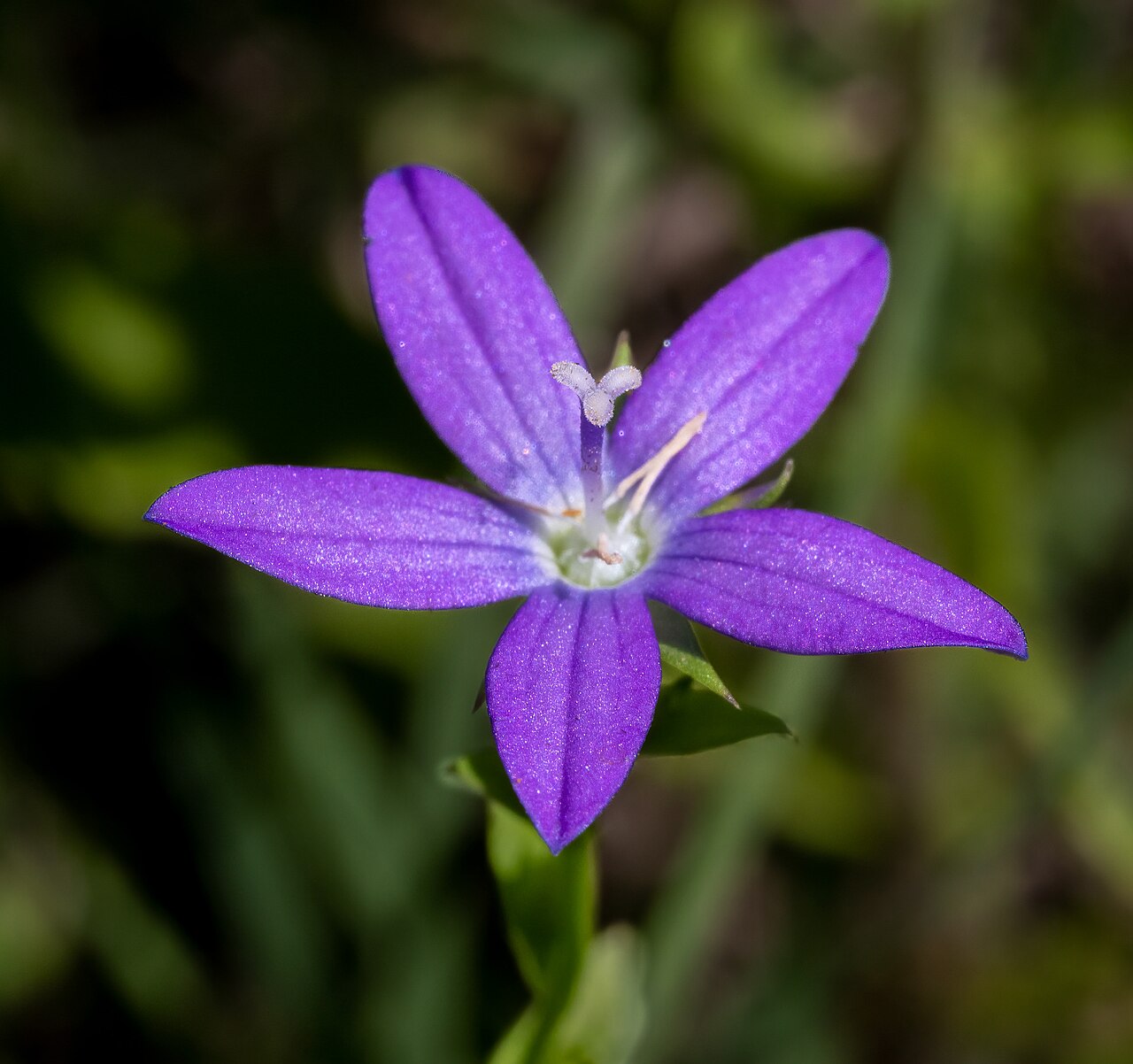
Triodanis biflora, known as Small Venus’ Looking-glass (USDA: small Venus’ looking-glass), is a slender native annual in the bellflower family (Campanulaceae). It grows in sunny, open places across the southern United States from the Carolinas and Florida to Texas, north into the Midwest, and west to Arizona, California and southwestern Oregon. In spring its thin, upright stems carry small violet-blue, star-shaped flowers at their tips.
It is closely related to Clasping Venus’ Looking-glass (Triodanis perfoliata), and some botanists treat it as a variety of that species, T. perfoliata var. biflora. USDA PLANTS keeps it as a separate species. The easiest difference is in the leaves: in small Venus’ looking-glass they are narrow and do not clasp the stem, while clasping Venus’ looking-glass has rounded, heart-shaped leaves that wrap around it. The older name Specularia biflora is also seen in older books.
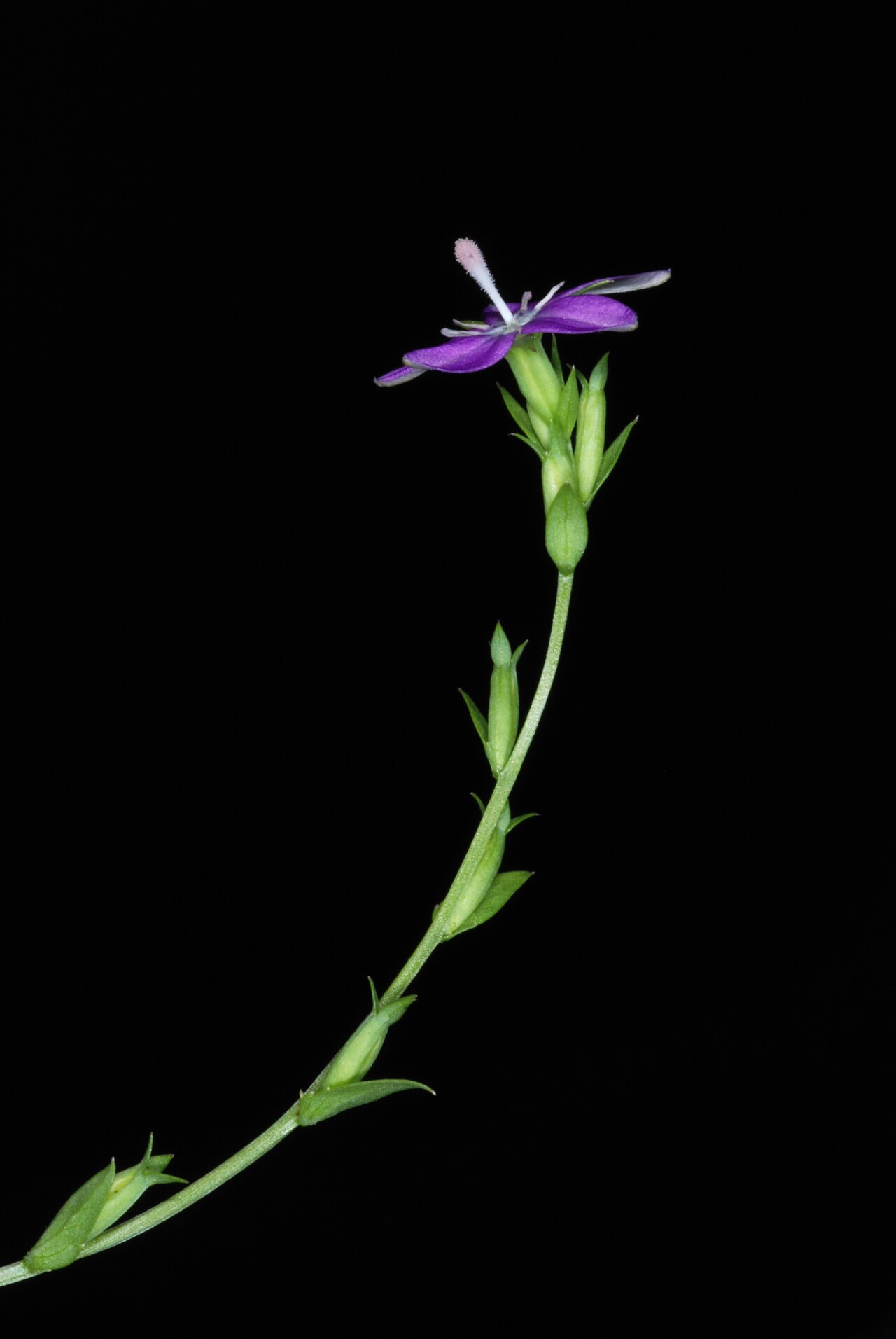
Like its relative, small Venus’ looking-glass has two kinds of flowers. Most are tiny, closed flowers that pollinate themselves without opening, and only the top one or two on a stem open into showy blue stars. This strategy lets the plant set seed reliably even when pollinators are scarce. It is a pretty, self-sowing annual for meadows, prairies, lawns and gravel gardens.
Identification
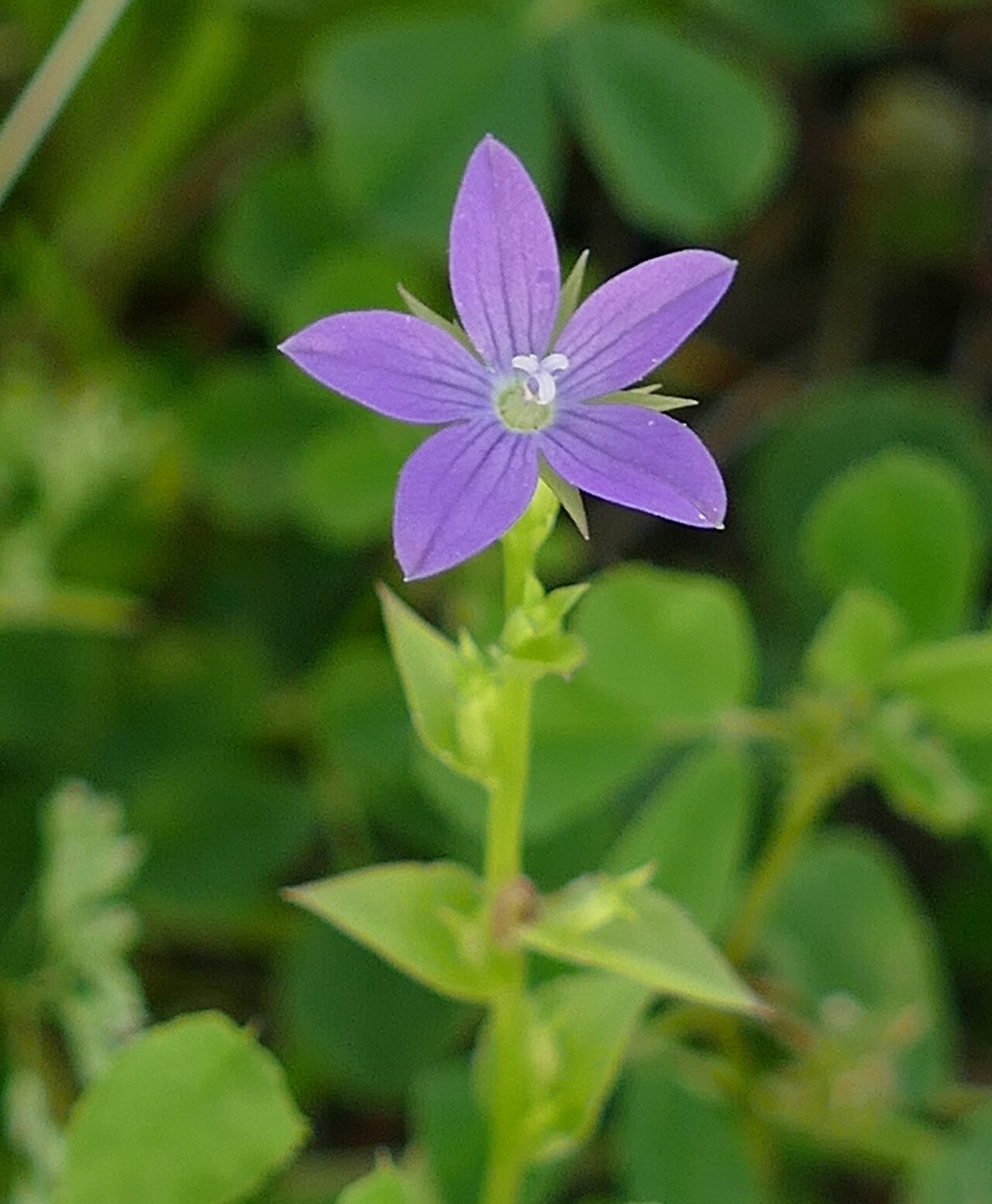
Small Venus’ looking-glass is a small, wiry annual. Look for narrow, unclasping leaves along a thin stem, small closed flower buds in the leaf axils, and one or two open blue-violet flowers at the top.
Growth Habit
Plants are usually 6 to 20 inches tall, with one or a few slender, upright stems that branch from the base. The stems are angled and often have short, stiff hairs along the angles. Seedlings form a small rosette in fall or winter, then send up stems in spring.
Leaves
The leaves are alternate, small, about 1/4 to 3/4 inch long, oval to narrowly elliptic, with smooth or slightly toothed edges. They sit directly on the stem but do not clasp it, and they become smaller and narrower up the stem.
Flowers
The lower flowers are cleistogamous: small, closed and self-pollinating, with no visible petals. Only the uppermost one or two flowers open. These open flowers are about 1/2 inch wide, with five pointed, violet-blue to purple lobes around a pale center and a three-lobed white stigma. Flowering is usually April to June, earlier in the Deep South and Texas.
Fruit & Seeds
The fruit is a narrow, cylindrical capsule topped by the persistent calyx lobes. It releases its seeds through small pores near the top of the capsule, a key difference from clasping Venus’ looking-glass, whose pores are near the middle. The seeds are tiny, shiny and lens-shaped.
Look-alikes
Clasping Venus’ Looking-glass (Triodanis perfoliata) has round, scalloped leaves that clasp the stem, more open flowers along the stem, and capsule pores near the middle. Western Venus’ looking-glass (T. holzingeri) of the Great Plains and Southwest is similar; botanists separate it by details of the bracts and capsules. Bluebell bellflowers (Campanula) have bell-shaped flowers rather than flat stars.
Safety
Small Venus’ looking-glass is not known to be toxic. It is harmless to people and pets.
Quick Facts
| Scientific Name | Triodanis biflora (syn. T. perfoliata var. biflora) |
| Family | Campanulaceae (bellflower family) |
| Plant Type | Winter or spring annual wildflower |
| Mature Height | 6–20 in |
| Mature Spread | 2–6 in |
| Growth Rate | Fast |
| Sun Exposure | Full sun to partial shade |
| Water Needs | Low to moderate |
| Soil Type | Sandy, gravelly or loamy, well-drained soil |
| Soil pH | About 5.5–7.5 |
| Bloom Time | April–June (from March in the Deep South) |
| Flower Color | Violet-blue to purple |
| Fall Color | None; dies by summer |
| Fruit | Narrow capsule opening by pores near the top |
| Deer Resistant | Moderately |
| USDA Hardiness Zones | 5–10 (grows as an annual) |
Native Range
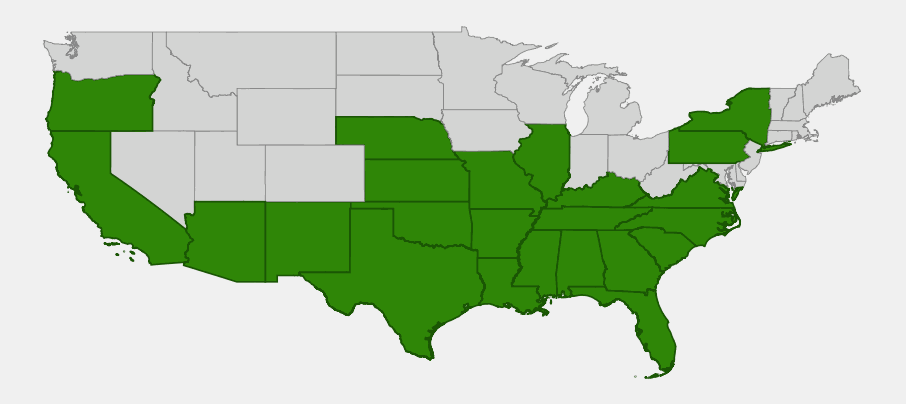
Small Venus’ looking-glass is native to the southern and western United States and also extends into Mexico. USDA PLANTS lists it as native in the lower 48 states and records it from 23 states: Alabama, Arizona, Arkansas, California, Florida, Georgia, Illinois, Kansas, Kentucky, Louisiana, Mississippi, Missouri, Nebraska, New Mexico, New York, North Carolina, Oklahoma, Oregon, Pennsylvania, South Carolina, Tennessee, Texas and Virginia. USDA lists it as introduced in Hawaii, which is not included here.
It is most common in the Southeast and the southern Great Plains, especially in Texas, Oklahoma, Louisiana and the Gulf states, including the Edwards Plateau and Hill Country of Texas. In the West it grows in Arizona and New Mexico and in California, reaching southwestern Oregon west of the Cascades. Records in New York and Pennsylvania are outlying, at the northeastern edge of its range.
It grows in open, sunny or lightly shaded places, often on sandy or disturbed soil: fields, prairies, pastures, roadsides, lawns, open woods and woodland edges, rock outcrops and old fields.
📋 Regional plant lists featuring Small Venus’ Looking-glass: New York, Pennsylvania & Northern New Jersey · Kentucky & Tennessee · Nebraska, Kansas & Eastern Colorado · Maryland, Virginia & West Virginia · Delaware, Southern New Jersey & Long Island · Arizona & New Mexico · Illinois, Iowa & Missouri · Alabama, Georgia & Mississippi · North & South Florida · North & South Carolina · Arkansas, Louisiana, Eastern Oklahoma & Eastern Texas · South & West Texas · Western Oregon & Western Washington · California & Nevada
Growing & Care Guide
Small Venus’ looking-glass is not sold as a nursery plant, but it often appears in native meadows and lawns, and seed is occasionally available in native wildflower mixes. It is easy to keep once present: let it reseed.
Light
Full sun to partial shade. It flowers best in sun.
Soil & Water
It prefers well-drained sandy, gravelly or loamy soil and tolerates poor, thin soil. Winter and spring rain is usually enough; it needs no summer water because it dies after seeding.
Planting Tips
Scatter seed on bare or lightly disturbed soil in fall. It does well in wildflower meadows, prairie plantings, gravel gardens and low-mow lawns with other spring annuals such as bluebonnets, Indian blanket and bluets.
Pruning & Maintenance
No pruning is needed. Delay mowing until the capsules turn brown in late spring or early summer so the seeds can drop. Keep some bare soil available, because dense turf and mulch prevent reseeding.
Propagation
Grow it from seed. The seeds are tiny; sow them on the surface in fall and do not cover them deeply. They germinate in fall or late winter. Established patches reseed themselves, helped by the self-pollinating closed flowers, which set seed every year.
Landscape Uses
- Wildflower meadows: small blue stars among spring wildflowers and grasses
- Low-mow and native lawns: a self-sowing lawn wildflower
- Prairie and savanna plantings: part of the spring annual layer
- Gravel and rock gardens: thrives in thin, well-drained soil
- Pollinator gardens: nectar and pollen for small native bees
Wildlife & Ecological Value
Small Venus’ looking-glass is a modest but widespread member of the spring wildflower community in open habitats of the South and West.
For Pollinators
The open flowers are visited by small native bees, such as sweat bees, and by small butterflies and flies. Because most flowers self-pollinate, the plant does not depend on these visitors, but they help produce cross-pollinated seed.
For Birds
Small seed-eating birds may take the tiny seeds, and insects on the plants are food for insect-eating birds.
For Mammals
Rabbits and deer may nibble the plants, but it is too small to be an important food.
Ecosystem Role
As a spring annual, it covers bare soil early in the year and then dies back, making room for summer plants. Its mix of closed, self-pollinating flowers and open, insect-pollinated flowers is a well-studied example of how plants balance reliable seed production with cross-pollination.
Cultural & Historical Uses
The name Venus’ looking-glass was first given to a European relative, Legousia speculum-veneris, whose shiny seeds were said to look like little mirrors. The genus name Triodanis refers to the three teeth of the calyx in some flowers, and biflora means two-flowered, perhaps for the one or two open flowers at the top of each stem.
Botanists have long debated whether small Venus’ looking-glass is a separate species or a variety of clasping Venus’ looking-glass. The two often grow together and share the same unusual flowering system. USDA PLANTS and many state floras treat Triodanis biflora as its own species, while others call it T. perfoliata var. biflora.
Plants with both closed and open flowers on the same plant, a system called cleistogamy, have been studied as models of plant mating strategies, and Triodanis species are among the North American plants used in such studies.
Frequently Asked Questions
How is small Venus’ looking-glass different from clasping Venus’ looking-glass?
Small Venus’ looking-glass has small, narrow leaves that do not clasp the stem, usually only one or two open flowers at the top, and capsules that open near the top. Clasping Venus’ looking-glass has round, heart-shaped leaves wrapping the stem and capsules that open near the middle.
Is it native?
Yes. It is native across the southern and western United States. USDA lists it as introduced only in Hawaii.
Why do most of the flowers never open?
Most flowers on the stem are cleistogamous: they stay closed and pollinate themselves. Only the top one or two open, which lets the plant set seed reliably while still allowing some cross-pollination.
When does it bloom?
Usually April to June, beginning as early as March in the Deep South and Texas.
Can I grow it?
Yes. Scatter seed on bare soil in fall in a sunny meadow, prairie or low-mow lawn, and delay mowing until the seeds have dropped.

Looking for a nursery that carries Small Venus’ Looking-glass?
Browse our native plant nursery directory: Alabama, Arizona & Arkansas · California · Florida & Georgia · Illinois & Kansas · Kentucky, Louisiana, Mississippi & Missouri · Nebraska, New Mexico, New York, North Carolina & Oklahoma · Oregon · Pennsylvania, South Carolina, Tennessee, Texas & Virginia