
Thistle Poppy (Argemone polyanthemos)
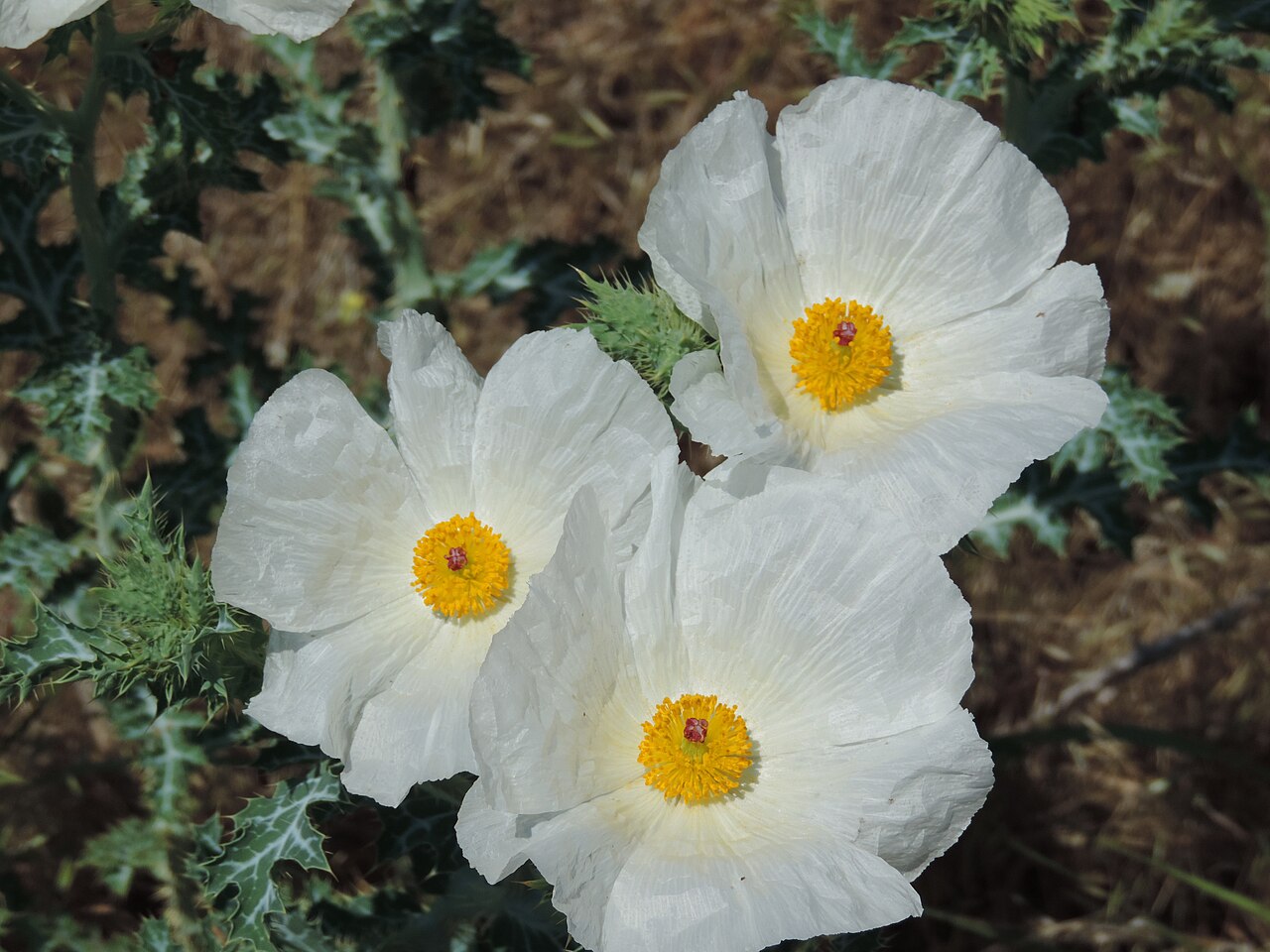
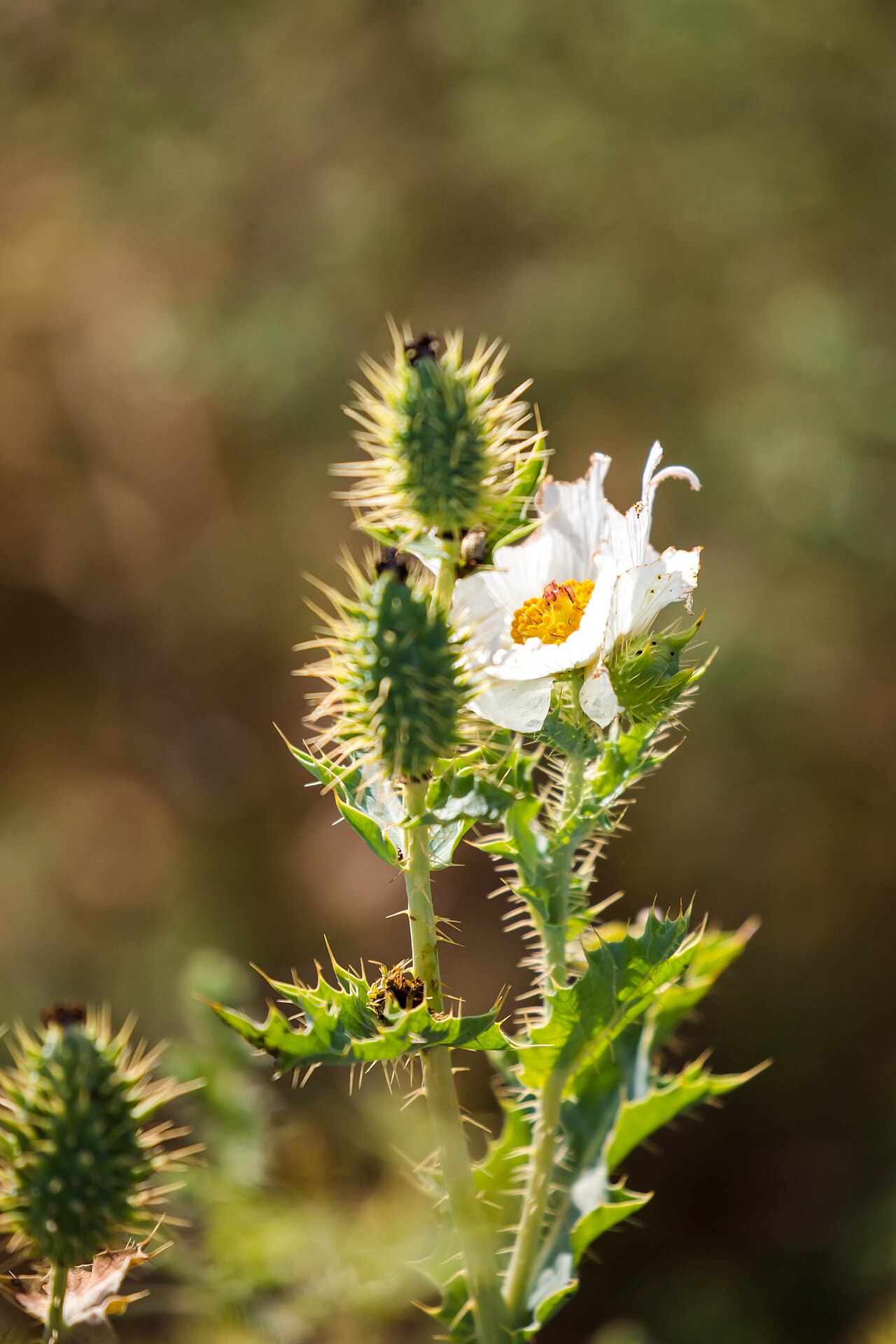
Argemone polyanthemos, known as Thistle Poppy, crested pricklypoppy or bluestem prickly poppy, is a native wildflower of the Great Plains in the poppy family (Papaveraceae). It grows as a branching, blue-green plant 1 to 3 feet tall, armed with yellowish prickles on its stems, leaf edges and seed pods, and from late spring through summer it opens large, crinkled white flowers 2 1/2 to 4 inches across with a bright center of yellow stamens.
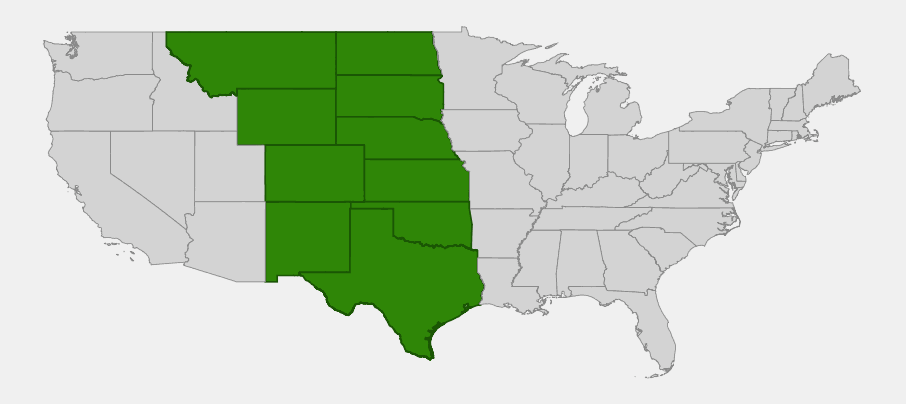
It is a short-lived plant, usually an annual or biennial. Thistle poppy grows on dry, open ground from western Texas and New Mexico north through Oklahoma, Kansas, Nebraska, Colorado and Wyoming to the Dakotas and Montana. It is a conspicuous plant of shortgrass and mixed-grass prairie, sandy roadsides and pastures, where its white flowers stand out against the grass all summer.
All parts of the plant are poisonous if eaten, and the stems contain a yellow-orange sap. Livestock avoid its bitter, spiny foliage, so it often becomes common on grazed range. In a dry, sunny wildflower garden, it is a striking, long-blooming plant that bees love.
Identification
Look for a pale blue-green, prickly plant with lobed, thistle-like leaves and large, papery white poppies with yellow centers, blooming in summer on dry prairie and roadsides.
Growth Habit
Thistle poppy grows from a stout taproot as a single upright stem that branches in the upper part, usually 1 to 3 feet tall and occasionally up to about 4 feet. The stems and foliage are a pale, waxy blue-green. Many plants form a rosette the first year and bloom heavily in the second year before dying.
Leaves
The leaves are 2 to 8 inches long, deeply cut into wavy, spiny-toothed lobes, much like a thistle. The upper leaves clasp the stem. Prickles are scattered on the lower surface veins and edges, but the upper surface is usually smooth or nearly so, which helps separate it from some other prickly poppies.
Flowers
Flowers open singly at the branch tips from about May to August, with scattered blooms into fall. Each has four to six thin, white, crinkled petals that look like crepe paper, surrounding a dense cluster of many yellow stamens and a small, lobed stigma. The buds are covered by three sepals, each tipped with a short, horn-like point, and the sepals fall as the flower opens.
Fruit
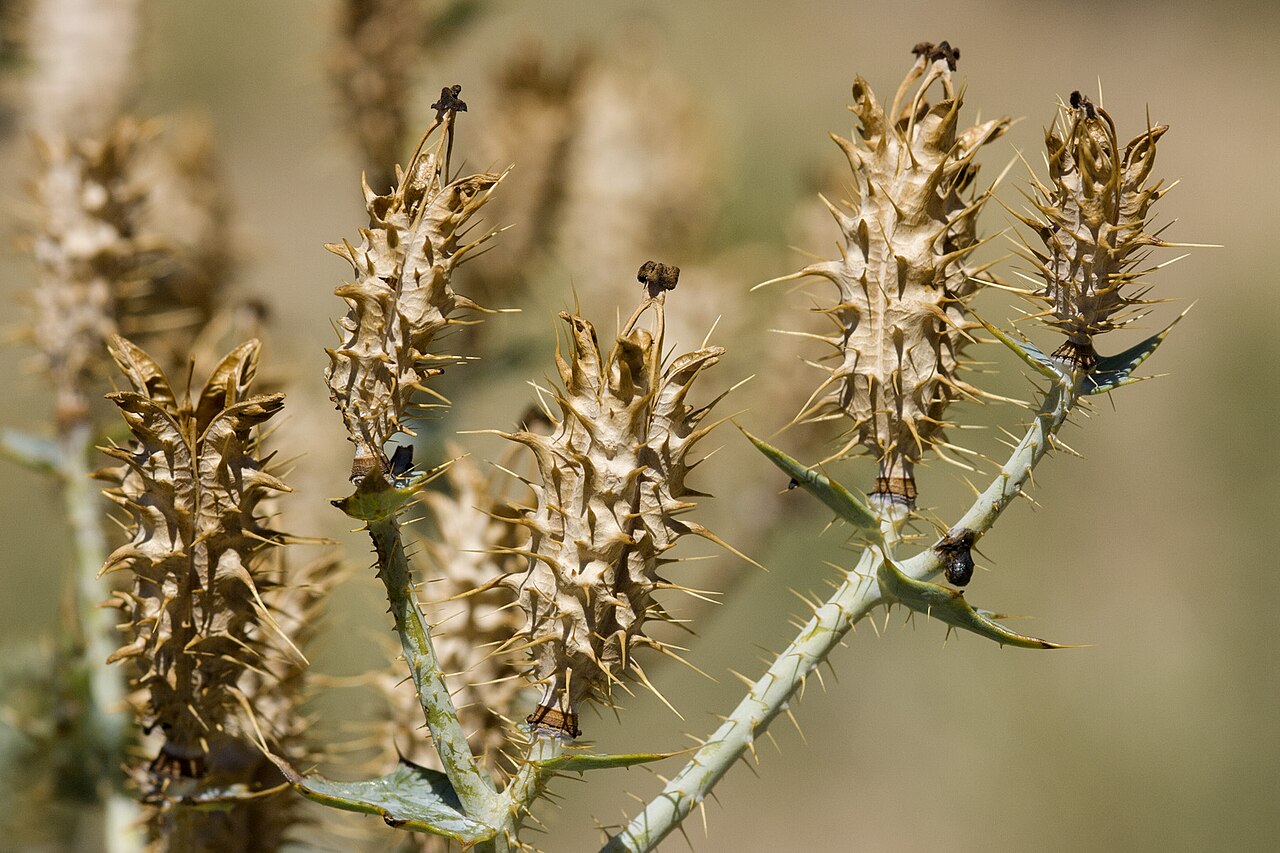
The fruit is an oblong to elliptic capsule 1 to 2 inches long, covered with sharp prickles. When dry it splits open near the top and releases numerous small, round, dark brown to black seeds.
Sap
Broken stems and leaves ooze a yellow to orange latex. Avoid getting it in your eyes or on sensitive skin.
Look-alikes
White prickly poppy (Argemone albiflora) of the eastern and southern plains has more densely prickly capsules and leaves that are often prickly on top. Flatbud prickly poppy (A. munita) grows farther west, in the Great Basin and California. Red prickly poppy (A. sanguinea) of southern Texas often has pink to lavender flowers. Thistles have similar leaves but small, brush-like flower heads, not poppies.
Quick Facts
| Scientific Name | Argemone polyanthemos (Fedde) G.B. Ownbey |
| Family | Papaveraceae (poppy family) |
| Plant Type | Annual or biennial wildflower (forb) |
| Mature Height | 1–3 ft (rarely to 4 ft) |
| Mature Spread | 1–2 ft |
| Growth Rate | Fast |
| Sun Exposure | Full sun |
| Water Needs | Low; dry soils |
| Soil Type | Sandy, gravelly, loam or clay; well drained |
| Soil pH | Neutral to alkaline (about 6.5–8.5) |
| Bloom Time | May–August, scattered into fall |
| Flower Color | White with yellow stamens |
| Fall Color | None |
| Fruit | Prickly capsules with small black seeds |
| Deer Resistant | Yes; spiny, bitter and poisonous |
| USDA Hardiness Zones | Annual/biennial (grows in zones 4–9) |
Native Range
Thistle poppy is a plant of the Great Plains, native mostly east of the Rocky Mountains in shortgrass and mixed-grass prairie. Its native range runs from the northern half of Texas, the Texas Panhandle and eastern and central New Mexico north through Oklahoma, Kansas, Nebraska and eastern Colorado and Wyoming to South Dakota, North Dakota and Montana.
USDA PLANTS also records it in a few states outside this core range, including Washington, Idaho, Utah, Iowa, Illinois and Indiana. It has spread along roads and railroads into areas next to its natural range, and those scattered populations are generally considered introduced, so they are not shown on the map. It is not native to Canada.
It grows in dry prairie and plains grassland, sandhills, rocky and gravelly slopes, pastures, overgrazed range, roadsides and other disturbed ground, usually in full sun on well-drained soil, from the low plains to about 7,500 feet.
📋 Regional plant lists featuring Thistle Poppy: Montana & Wyoming · Nebraska, Kansas & Eastern Colorado · South & West Texas · North Dakota, South Dakota & Western Minnesota
Growing & Care Guide
Thistle poppy is a showy, carefree plant for dry, sunny gardens and prairie plantings in the Great Plains. Plant it where people will not brush against its spines, and keep it away from pets and livestock forage, since it is poisonous.
Light
Full sun. It flowers poorly and sprawls in shade.
Soil & Water
It needs well-drained, lean soil: sandy, gravelly or rocky soils are ideal, and it tolerates clay if drainage is good. Once its taproot is established it needs no watering. Rich soil and frequent watering lead to weak growth and rot.
Planting Tips
Sow seed directly where you want plants, in fall or very early spring, and cover it only lightly. Thistle poppy has a deep taproot and does not transplant well, so avoid moving seedlings. Use it in xeriscapes, hell strips, gravel gardens and prairie plantings, at the back of a bed or in a spot away from paths. Wear gloves when handling plants.
Pruning & Maintenance
Little care is needed. Leave some capsules to ripen if you want plants to reseed, or remove them to limit spreading. Wear thick gloves and long sleeves when pulling or cutting plants.
Propagation
Grow it from seed. Fresh seed often germinates better after a cold, moist period over winter, so fall sowing works well. Plants usually bloom in their second year, sometimes in the first.
Landscape Uses
- Xeriscapes and gravel gardens: large white flowers all summer with no watering
- Prairie restorations: a native plains wildflower for dry, sandy sites
- Pollinator gardens: abundant pollen for native bees
- Deer- and rabbit-prone areas: its spines and toxins keep browsers away
- Roadsides and hell strips: tolerates heat, drought and poor soil
Wildlife & Ecological Value
Thistle poppy offers little nectar, but its huge pollen-rich flowers are a feast for bees in midsummer.
For Pollinators
Bumble bees, sweat bees, long-horned bees and other native bees, as well as honey bees and pollen-feeding beetles, visit the flowers to collect pollen. Bees often roll around in the dense ring of stamens, emerging dusted with yellow.
For Birds
Some ground-feeding birds may pick up the small seeds after the capsules split open, but birds make limited use of it.
For Mammals
Deer, rabbits and livestock generally avoid it because of its spines and bitter, poisonous alkaloids.
Ecosystem Role
As a short-lived pioneer, thistle poppy quickly colonizes bare ground after drought, fire or heavy grazing, holding the soil until longer-lived grasses and wildflowers return. Because animals avoid it, a large stand can be a sign of past overgrazing.
Cultural & Historical Uses
The genus name Argemone comes from a Greek word for a cataract of the eye, a condition that some prickly poppies were once thought to treat. The species name polyanthemos means “many-flowered.” The plant was first described as a variety of other prickly poppies and was recognized as a separate species by botanist G. B. Ownbey in his 1958 study of the genus.
Like other prickly poppies, thistle poppy contains bitter isoquinoline alkaloids that make it poisonous to people and livestock if eaten. Prickly poppies have a long history in folk medicine in North America and Mexico, but they should never be used for home remedies or food.
Its common name thistle poppy describes it perfectly: the leaves look like a thistle, and the flowers are pure poppy. On the High Plains, its white blooms along summer roadsides are one of the most familiar sights of the season.
Frequently Asked Questions
Is thistle poppy poisonous?
Yes. All parts of the plant, including the seeds, are poisonous if eaten, and the yellow sap can irritate skin and eyes. Keep it away from children, pets and livestock forage, and wear gloves when handling it.
Is thistle poppy a thistle?
No. It is a true member of the poppy family. Its spiny, deeply lobed leaves look like a thistle’s, but its flowers are large, papery white poppies.
Is thistle poppy an annual?
It is short-lived, usually an annual or biennial. Many plants form a rosette the first year, bloom heavily the second year and then die, but they reseed readily.
When does thistle poppy bloom?
From about May to August, with scattered flowers into fall.
How is it different from white prickly poppy?
White prickly poppy (Argemone albiflora), found farther east and south, usually has prickles on the upper leaf surfaces and more densely prickly capsules. Thistle poppy’s upper leaf surfaces are usually smooth.

Looking for a nursery that carries Thistle Poppy?
Browse our native plant nursery directory: Colorado · Kansas · Montana · Nebraska, New Mexico, North Dakota & Oklahoma · South Dakota & Texas · Wyoming