
Serpentine Fern (Aspidotis densa)
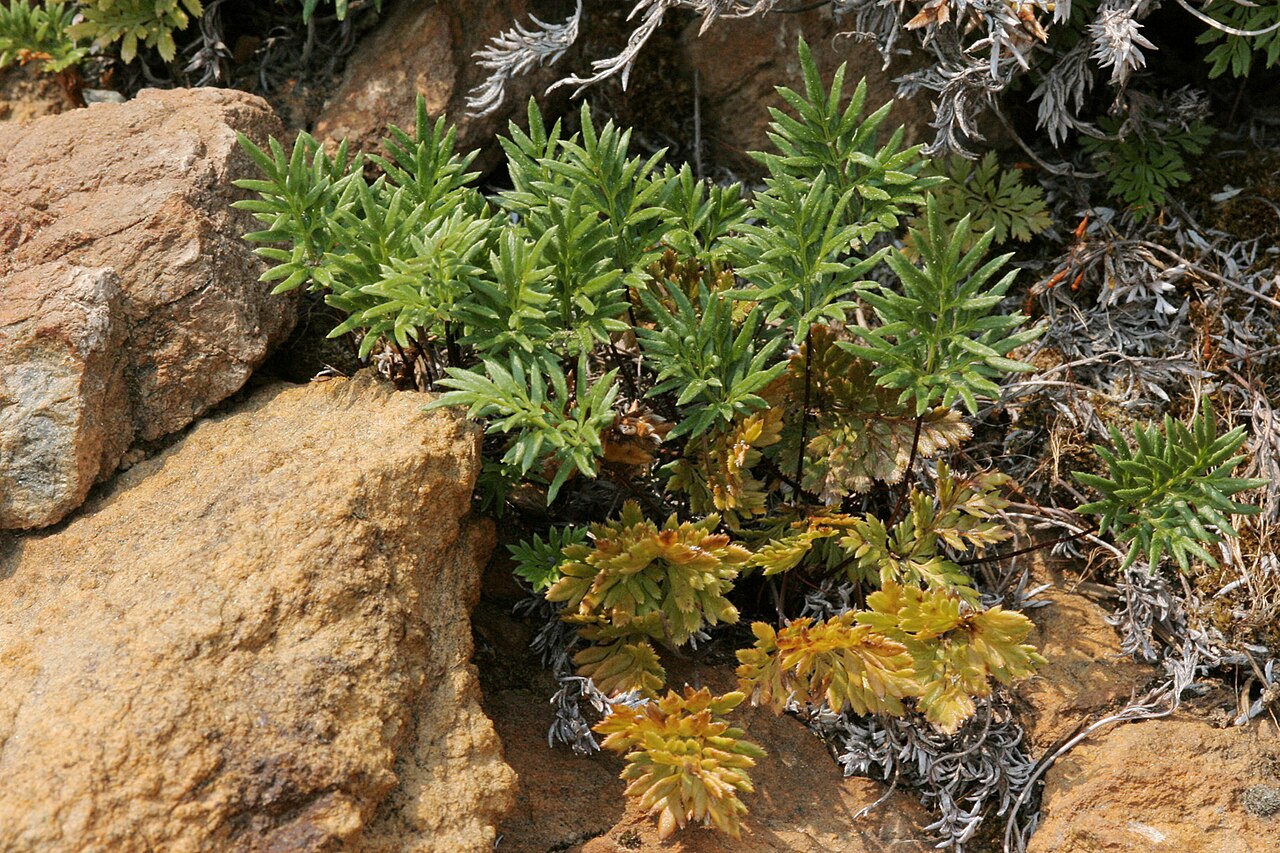
Aspidotis densa, known as Serpentine Fern, is a small, tufted, evergreen native fern of rocky places in western North America. USDA PLANTS calls it Indian’s dream, and it is also known as dense lace fern, pod fern and Oregon cliff brake. Its fronds are finely divided into many narrow, shiny, dark green segments, carried on long, wiry, dark brown stalks, giving each tuft a lacy, almost feathery look.
True to its name, this fern is best known from serpentine, the greenish ultramafic rock that weathers into soils rich in magnesium and heavy metals and poor in calcium and nutrients. It grows in crevices, talus and rocky slopes from British Columbia south through the Cascades, Siskiyou and Klamath Mountains and the Sierra Nevada to southern California, and east to Idaho, Montana and Wyoming. Small disjunct populations grow far to the east in Utah and Quebec.
Serpentine fern is a small but striking plant for rock gardens, troughs and dry stone walls in the West. It handles summer drought by going semi-dormant and greening up again with the rains. In the wild, botanists often use it as an indicator that serpentine rock is near.
Identification
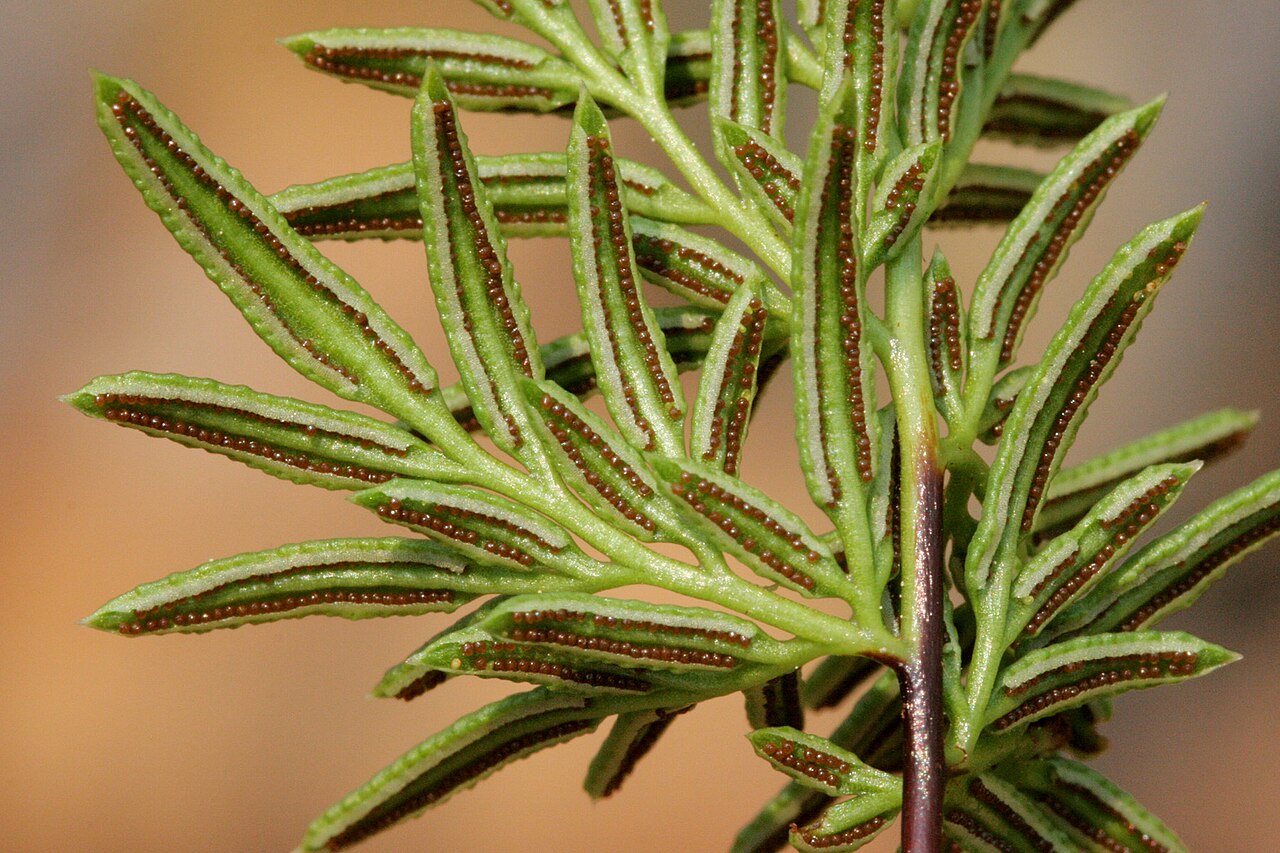
Serpentine fern forms small, dense tufts in rock crevices. Look for triangular fronds finely cut into many narrow, needle-like segments, with long, shiny, dark brown stalks, and segment edges that roll under to cover the spores.
Growth Habit
Plants grow from a short, creeping rhizome covered in narrow scales and form tight clumps, usually 4 to 10 inches tall. Over time, colonies can creep along cracks to fill rock fissures. The fronds are evergreen but may shrivel and turn brownish during summer drought.
Fronds
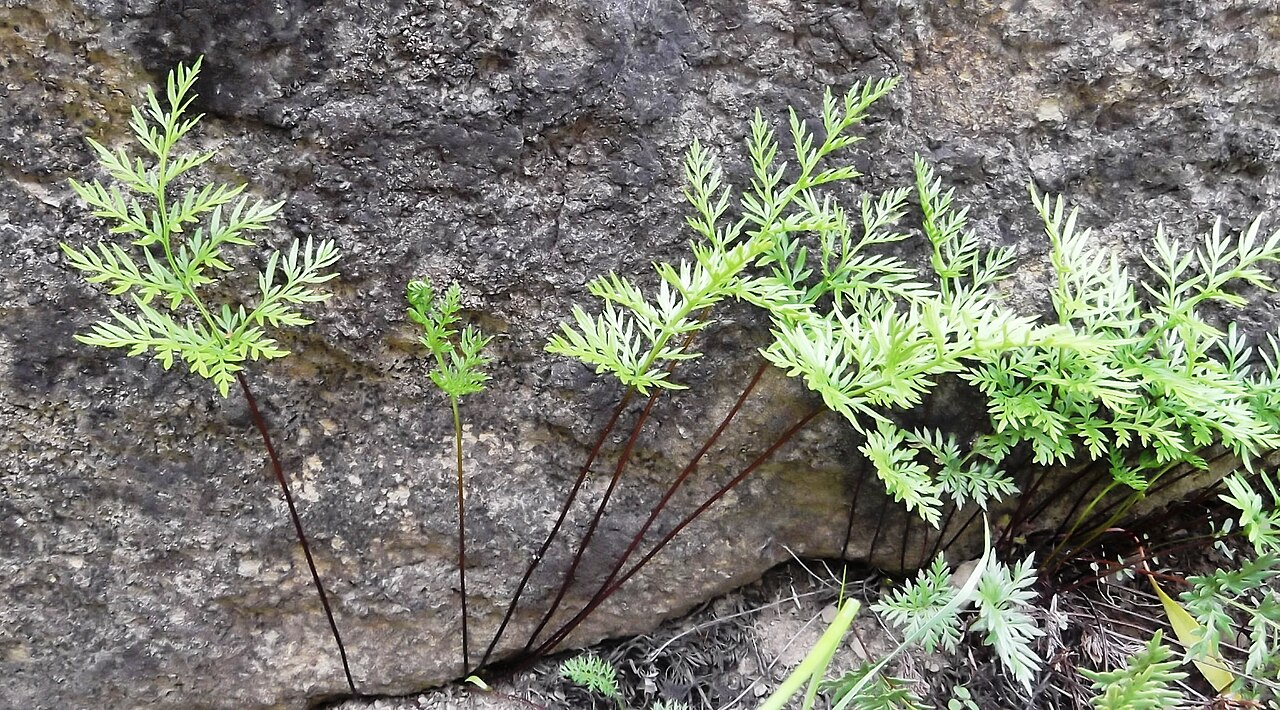
Each frond has a long, wiry stalk (stipe) that is dark brown to black and shiny, making up more than half of the frond’s length. The blade is triangular, about 1 to 3 inches long, and divided two or three times into narrow, linear segments. The blade is medium to dark green, sometimes with a slightly bluish cast. Plants often bear mostly fertile fronds; when sterile fronds are present, they are shorter, with broader, flatter, finely toothed segments.
Spores
On fertile fronds, the edges of each narrow segment fold under to form a continuous false indusium, a protective flap that covers the spore-bearing sori along the margins. When the spores ripen in summer, the edges loosen to release them. This rolled-margin structure gives the segments their narrow, pod-like look, the origin of the name pod fern.
Seasonal Changes
New fronds uncurl in spring as fiddleheads. In the dry summers of its range, the fronds may curl and brown but usually stay attached and revive with fall and winter moisture.
Look-alikes
Parsley fern (Cryptogramma acrostichoides) also grows in rocky places but has broader, parsley-like sterile fronds and grows mainly in non-serpentine talus. Lip ferns (Cheilanthes and Myriopteris) usually have hairy or scaly fronds, and cliffbrakes (Pellaea) have larger, broader, bluish segments. Serpentine fern’s smooth, shiny, very narrow segments in a dense triangular blade are distinctive.
Safety
Serpentine fern is not known to be toxic, but it is not an edible plant. Never collect it from the wild, since many of its rocky serpentine habitats are fragile and small.
Quick Facts
| Scientific Name | Aspidotis densa |
| Family | Pteridaceae (maidenhair fern family) |
| Plant Type | Small evergreen fern |
| Mature Height | 4–10 in |
| Mature Spread | 6–12 in |
| Growth Rate | Slow |
| Sun Exposure | Full sun to part shade |
| Water Needs | Low to medium; seasonally moist |
| Soil Type | Rocky, gravelly, very well-drained; often serpentine |
| Soil pH | Neutral to slightly alkaline |
| Bloom Time | None (fern); spores mature in summer |
| Flower Color | None |
| Fall Color | Evergreen; may brown in summer drought |
| Fruit | None; reproduces by spores |
| Deer Resistant | Yes |
| USDA Hardiness Zones | 5–9 |
Native Range
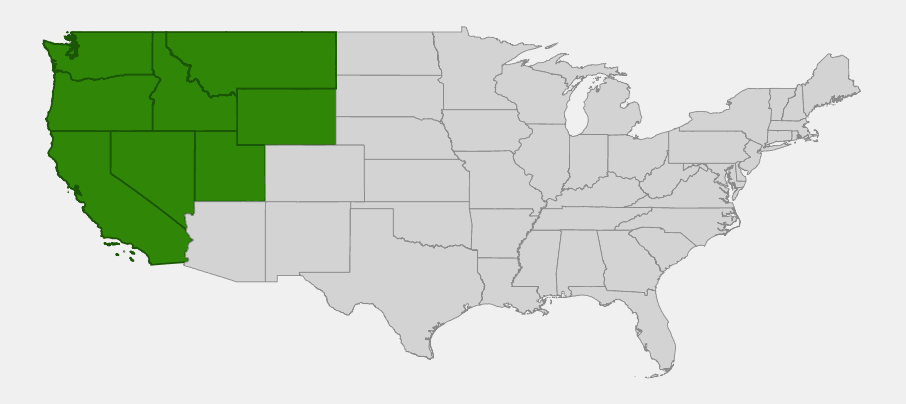
Serpentine fern is native to western North America. USDA PLANTS lists it as native in California, Idaho, Montana, Nevada, Oregon, Utah, Washington and Wyoming, and in Canada in British Columbia and Quebec. The Lady Bird Johnson Wildflower Center describes its range as southern British Columbia to the mountains of San Luis Obispo and Kern counties in California and inland to northwestern Montana, with disjunct populations in the Wasatch Mountains of Utah and the Gaspé region of Quebec.
It is most common in areas with serpentine rock: the Klamath and Siskiyou Mountains of northern California and southwestern Oregon, the Wenatchee Mountains of central Washington, the Sierra Nevada and the North Coast Ranges of California. It also grows on other rock types in the Cascades, the northern Rockies of Idaho and Montana and in northwestern Wyoming. Near the coast, it reaches almost to sea level on serpentine in places such as Marin County, California, and Washington Park near Anacortes, Washington. The eastern populations in Utah and on serpentine in Quebec are far outlying.
It grows in rock crevices, ledges, talus slopes and rocky outcrops, usually in sun or light shade, from low elevations to about 10,000 feet (3,000 m). Although strongly associated with serpentine, it also grows on basalt and other rocks.
📋 Regional plant lists featuring Serpentine Fern: Idaho, Eastern Oregon & Eastern Washington · Montana & Wyoming · Utah & Western Colorado · Western Oregon & Western Washington · California & Nevada
Growing & Care Guide
Serpentine fern is a choice plant for rock gardens and troughs in the West, but it is rarely sold. Buy it only from nurseries that propagate it from spores; never dig it from the wild. The key to success is sharp drainage and a rocky, crevice-like setting.
Light
Full sun to part shade. In hot inland gardens, afternoon shade helps; on the cooler, wetter side of the mountains it does well in full sun on a rock face.
Soil & Water
It needs very fast-draining, rocky or gravelly soil, such as a gritty mix of crushed rock and a little loam. It does not need serpentine soil in cultivation, but it will not tolerate rich, wet soil. Water it moderately in spring and fall and sparingly in summer, allowing it to go semi-dormant as it would in the wild.
Planting Tips
Tuck plants into the crevices of a rock garden, a dry stone wall, a trough or a gravel bed, with the crown just above the surface. Top-dress with gravel to keep the crown dry. Combine it with small native succulents, buckwheats and other rock plants.
Pruning & Maintenance
Little care is needed. Remove old, dead fronds in early spring before new growth emerges. Do not fertilize. Protect it from being overgrown by larger plants.
Propagation
Grow it from spores sown on a sterile, gritty medium kept moist and covered, or carefully divide established clumps in spring. Both methods are slow. Spores should come from cultivated plants or be collected sparingly and legally.
Landscape Uses
- Rock gardens: a lacy, evergreen accent tucked into rock crevices
- Troughs and containers: a small fern for alpine troughs with gritty soil
- Dry stone walls: filling cracks in walls and rocky banks
- Serpentine habitat restoration: part of the specialized flora of serpentine outcrops
- Fern collections: an unusual western dry-land fern for collectors
Wildlife & Ecological Value
Serpentine fern is a quiet but characteristic member of the unusual plant communities that grow on serpentine, some of the most specialized habitats in western North America.
For Pollinators
As a fern, it has no flowers and does not feed pollinators. It does, however, grow alongside many serpentine wildflowers that are important to native bees and butterflies.
For Birds
Ferns provide little food for birds, but rock crevices and talus where serpentine fern grows offer shelter and foraging sites for rock wrens, juncos and other birds of rocky slopes.
For Mammals
Deer generally avoid ferns. Small mammals such as pikas, chipmunks and wood rats use the rocky habitats where it grows and may shelter among the clumps.
Ecosystem Role
Serpentine fern helps colonize bare rock crevices and talus, trapping soil and organic matter that allow other plants to establish. Because it grows so consistently on ultramafic rock, it is used as a field indicator of serpentine, helping geologists and botanists map these rare habitats.
Cultural & Historical Uses
Serpentine soils are named for serpentinite, a green, often shiny rock that resembles snakeskin. These soils are low in calcium and nutrients and high in magnesium, nickel and chromium, conditions that exclude many ordinary plants. As a result, serpentine areas support a distinctive flora, with many rare and endemic species. Serpentine fern is one of the most widespread and recognizable plants of these habitats, and California has designated serpentine as its state rock.
The genus name Aspidotis comes from Greek words meaning “shield” and “ear,” a reference to the protective, rolled-under margins covering the spores. The species name densa means “dense,” for its tightly packed, finely divided fronds. It has been classified in several other genera over the years, including Cheilanthes, Pellaea and Onychium.
The origin of the common name Indian’s dream is unclear. It appears in older western botanical literature and remains the official USDA common name, while serpentine fern and dense lace fern are more descriptive names used today.
Frequently Asked Questions
Why is it called serpentine fern?
It grows most often on serpentine rock and soils, which are rich in magnesium and heavy metals and poor in nutrients. It is so closely tied to serpentine that botanists use it as an indicator of these rocks.
Does serpentine fern need serpentine soil?
No. In the wild it also grows on basalt and other rocks, and in gardens it grows in any very well-drained, rocky or gravelly mix. What it needs most is sharp drainage.
Is serpentine fern evergreen?
Yes, but its fronds may curl and turn brownish during dry summers. They usually revive when fall and winter moisture returns.
Where does serpentine fern grow?
It grows from British Columbia to southern California and east to Idaho, Montana and Wyoming, with disjunct populations in Utah and Quebec. It is most common in the Klamath and Siskiyou Mountains, the Cascades and the Sierra Nevada.
Can I collect serpentine fern from the wild?
No. Serpentine habitats are fragile and often protected, and wild-dug ferns rarely survive. Buy plants propagated from spores by a native plant nursery.

Looking for a nursery that carries Serpentine Fern?
Browse our native plant nursery directory: California · Idaho · Montana · Nevada · Oregon · Utah · Washington · Wyoming
