
Orange-Fringed Orchid (Platanthera ciliaris)
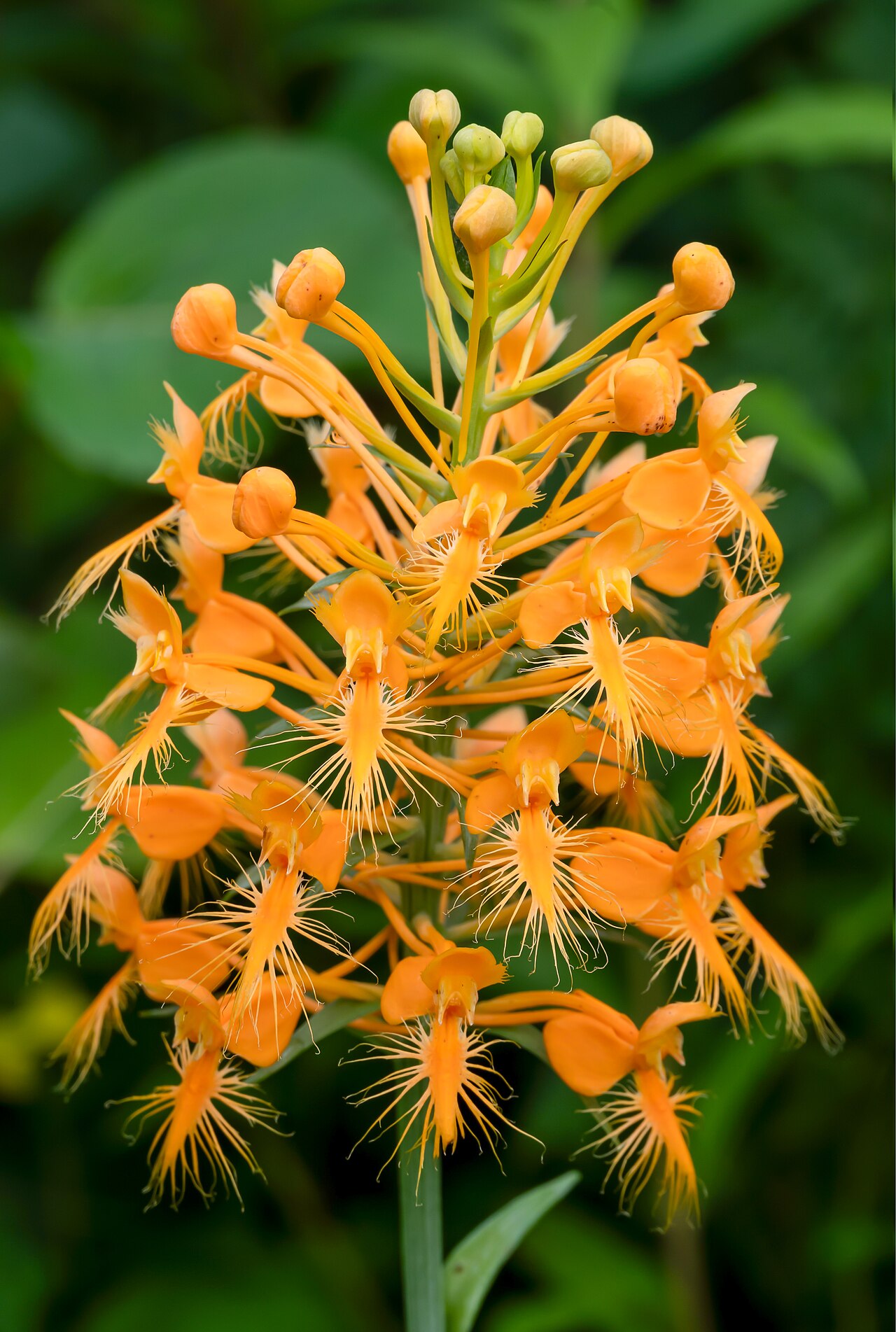
Platanthera ciliaris, known as Orange-Fringed Orchid (USDA: yellow fringed orchid), is one of the showiest native orchids of eastern North America. In mid to late summer it raises a dense spike of up to several dozen brilliant orange flowers, each with a lip cut into a long, feathery fringe. Older books list it as Habenaria ciliaris or Blephariglottis ciliaris.
It grows in acidic, moist to wet, sunny places: bogs, seepage slopes, wet meadows, pine savannas, sandy flatwoods and roadside ditches, from southern New England and Michigan south to Florida and west to eastern Texas and Oklahoma. Its long nectar spur is matched to the tongues of large butterflies, especially swallowtails, which carry its pollen from flower to flower.
Like all orchids, it depends on soil fungi to germinate and grow, and it has declined with the loss of open wetlands. It is considered rare or imperiled in several northern states. Never dig orange-fringed orchids from the wild. Wild-collected plants almost always die, and digging harms the population. Grow only nursery-propagated, laboratory-raised plants from reputable orchid specialists.
Identification
When in bloom, few plants are as unmistakable: a single upright stem topped by a cylinder of fiery orange flowers, each with a long, feathery fringed lip.
Leaves & Stem
A single smooth stem 1 to 3 feet tall rises from a cluster of fleshy roots. It carries two to four lance-shaped, keeled leaves up to about 8 inches long near the base, becoming smaller and bract-like up the stem. Some years, young or stressed plants produce only leaves and no flowers.
Flowers
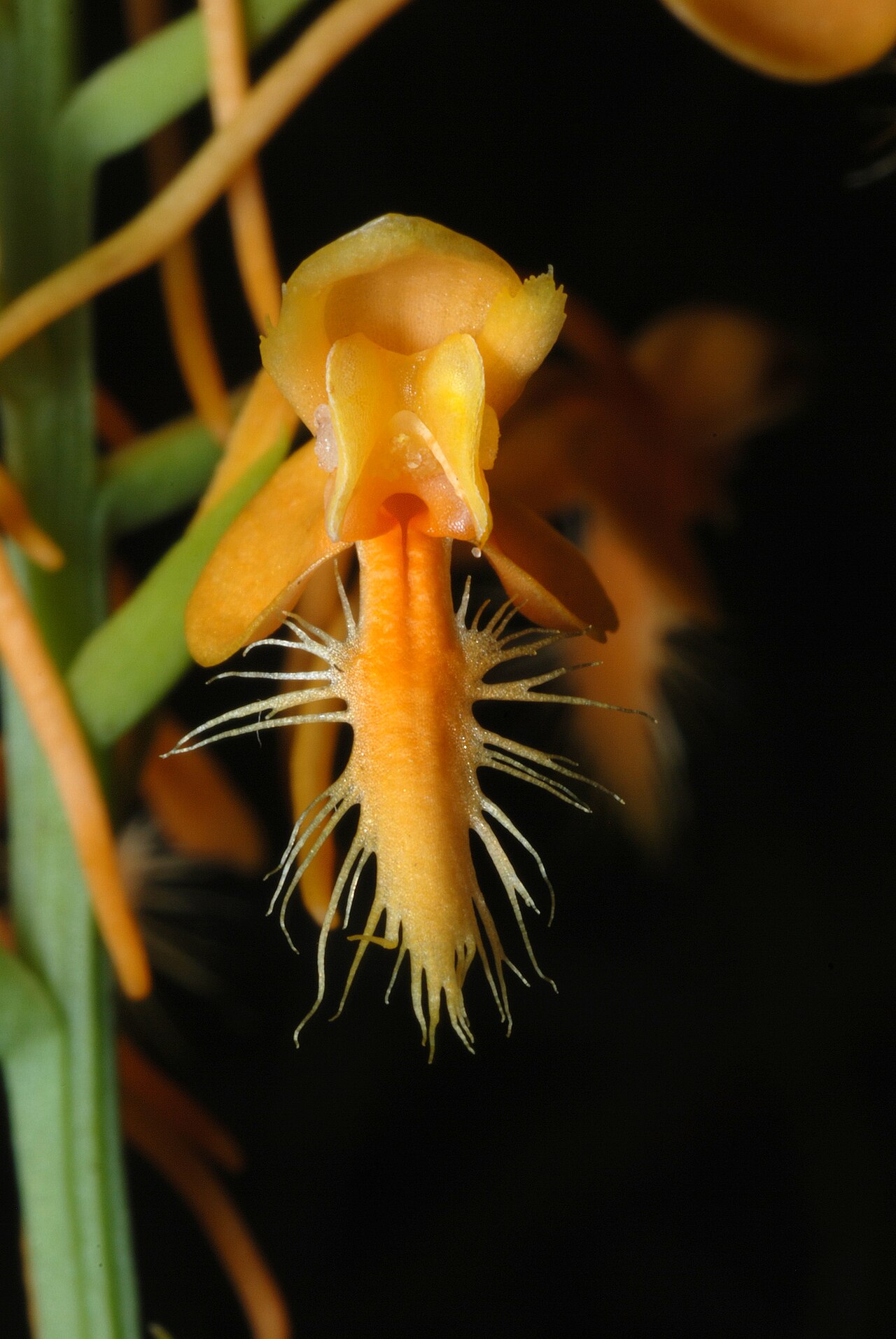
From July to August (into September in the South), the stem ends in a dense, cylindrical cluster 3 to 6 inches long of up to 60 or more flowers. Each flower is bright yellow-orange to deep orange, about 1 1/2 inches long including the spur. The upper sepal and two petals form a small hood; the lip hangs down and is deeply fringed along its edges, giving the flower a feathery look.
Spur
Behind each flower is a slender nectar spur about 1 to 1 1/4 inches long, longer than the ovary. Nectar collects at the tip, where only long-tongued insects can reach it.
Fruit & Seeds
Pollinated flowers develop into upright, ribbed capsules that release thousands of dust-fine seeds in fall. The seeds have almost no food reserves and can germinate only with the help of specific soil fungi.
Look-alikes
Crested fringed orchid (Platanthera cristata) is similar in color but smaller, with smaller flowers and a short spur shorter than the ovary. White fringed orchid (P. blephariglottis) has white flowers. Chapman’s fringed orchid (P. chapmanii) of the Gulf Coast is intermediate. Hybrids occur where species grow together, for example P. × bicolor (with white fringed orchid), which has pale yellow to cream flowers.
Conservation
Orange-fringed orchid has declined across much of its northern range through drainage, development, fire suppression and woody plant growth. It is rare in several northern states and in Ontario, where it is at the edge of its range. Plants are also stolen by collectors. Never pick the flowers or dig the plants, and stay on paths when visiting populations.
Quick Facts
| Scientific Name | Platanthera ciliaris |
| Family | Orchidaceae (orchid family) |
| Plant Type | Terrestrial orchid; herbaceous perennial |
| Mature Height | 1–3 ft in bloom |
| Mature Spread | 6–12 in |
| Growth Rate | Slow |
| Sun Exposure | Full sun to light shade |
| Water Needs | High; moist to wet, never dry |
| Soil Type | Acidic sand, sandy peat, sphagnum |
| Soil pH | About 4.5–6.0 (acidic) |
| Bloom Time | July–August (into September in the South) |
| Flower Color | Yellow-orange to deep orange |
| Fall Color | Not notable; leaves wither in fall |
| Fruit | Upright capsule with dust-like seeds |
| Deer Resistant | No; deer eat orchid flower spikes |
| USDA Hardiness Zones | 5–9 |
Native Range
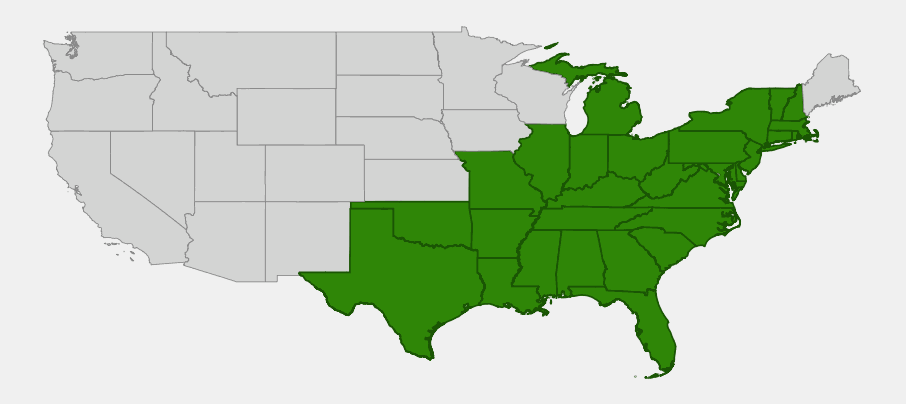
Orange-fringed orchid grows across much of the eastern United States and barely reaches southern Ontario. USDA PLANTS records it as native in 29 states, from Vermont, New Hampshire, Massachusetts and Michigan south to Florida and west to Missouri, Arkansas, eastern Oklahoma, Louisiana and eastern Texas. The northernmost records, in northern New England and Michigan, are few and scattered, and some are old.
It is most common today in the Southeast, especially on the Coastal Plain and in the southern Appalachians and Piedmont, where it still turns up in seepy roadsides, power-line cuts and pine savannas. In Texas and Oklahoma it is limited to the eastern forests; iNaturalist records in Texas cluster in the Pineywoods and Post Oak Savannah. In the Midwest and Northeast it has become rare.
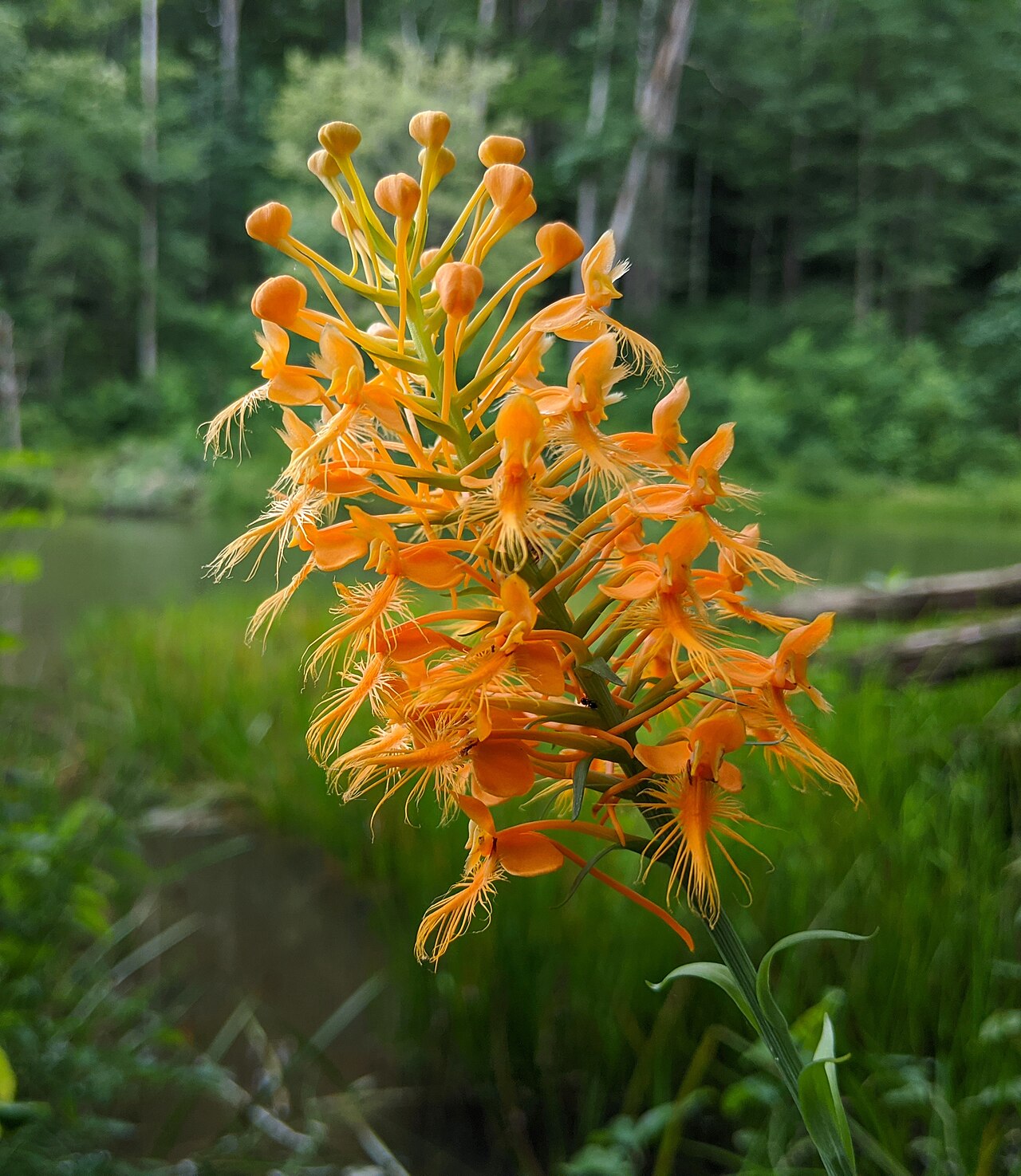
Habitats are open to lightly shaded, moist to wet places with acidic, low-nutrient soils: sphagnum bogs and fens, seepage slopes, wet meadows and prairies, wet pine flatwoods and savannas, sandy or peaty pond edges, and roadside ditches and rights-of-way that are kept open by mowing.
📋 Regional plant lists featuring Orange-Fringed Orchid: New York, Pennsylvania & Northern New Jersey · Ohio & Indiana · Michigan, Wisconsin & Eastern Minnesota · Kentucky & Tennessee · Connecticut, Massachusetts & Rhode Island · New Hampshire, Maine & Vermont · Maryland, Virginia & West Virginia · Delaware, Southern New Jersey & Long Island · Illinois, Iowa & Missouri · Alabama, Georgia & Mississippi · North & South Florida · North & South Carolina · Arkansas, Louisiana, Eastern Oklahoma & Eastern Texas
Growing & Care Guide
Orange-fringed orchid can be grown by experienced gardeners in a sunny bog garden, but it is not an easy plant. Buy only nursery-propagated plants, raised from seed in the laboratory (flasked or tissue-culture plants), from a reputable native orchid specialist. Never transplant plants from the wild; they almost never survive.
Light
Give it full sun to light shade. Plants in too much shade grow weak and stop flowering.
Soil & Water
Grow it in an acidic, low-nutrient mix such as sphagnum peat with lime-free sand, or in live sphagnum, kept constantly moist but not stagnant. A lined bog garden or a large container sunk into the ground works well. Use rainwater where possible, and never fertilize heavily. The plant relies on soil fungi throughout its life, so avoid fungicides.
Planting Tips
Plant dormant tubers or young plants in spring or fall with the growing bud just at or slightly below the surface. Place them among low bog plants such as sundews, pitcher plants and small sedges, where taller plants will not shade them.
Pruning & Maintenance
Leave the stems standing until they wither naturally, so the plant can rebuild its tuberous roots. Keep tall grasses, shrubs and weeds from crowding it. Protect flower spikes from deer and rabbits with a wire cage if needed. Mark the spot, since the plant is dormant underground for much of the year.
Propagation
Home propagation is very difficult. The dust-like seeds need specific mycorrhizal fungi to germinate, so commercial plants are raised from seed on sterile nutrient media in laboratories. Established clumps occasionally form new tubers. Leave wild plants and their seeds where they are.
Landscape Uses
- Bog gardens: a spectacular summer accent with pitcher plants and sundews
- Butterfly gardens: nectar for swallowtails and other large butterflies
- Wetland and savanna restoration: a showpiece of open, acidic, fire-maintained wetlands
- Mowed rights-of-way management: benefits from late-season mowing that keeps sites open
- Nature viewing: a highlight of summer botanical outings
Wildlife & Ecological Value
Orange-fringed orchid is part of a tightly linked network of butterflies, fungi and open wetlands.
For Pollinators
The long spur holds nectar out of reach of most insects. Large butterflies, especially swallowtails such as the spicebush, pipevine and eastern tiger swallowtails, probe the spur and pick up the pollen packets (pollinia) on their eyes or faces, carrying them to the next flower. Other large butterflies and some moths also visit.
For Birds
It has no special food value for birds, but its bog and savanna habitats support many bird species.
For Mammals
Deer, rabbits and other mammals sometimes eat the flower spikes, which can prevent seed production in small populations.
Ecosystem Role
The orchid depends on mycorrhizal fungi in the soil to germinate and to supply nutrients, especially while young. Its presence shows a healthy, open, acidic wetland with intact soil fungi. Fire, grazing or mowing that keeps woody plants and tall grasses in check often benefits it.
Cultural & Historical Uses
The species was described by Linnaeus in 1753 as Orchis ciliaris. The name ciliaris means “fringed with hairs,” describing the lip. It was later placed in Habenaria and Blephariglottis, and it is now in Platanthera, a large genus of northern temperate orchids.
USDA PLANTS calls it “yellow fringed orchid,” while most field guides and orchid enthusiasts use “orange-fringed” or “orange fringed orchid,” which better describes the color of the flowers. Old botanical works, including Curtis’s Botanical Magazine, illustrated it as one of North America’s most beautiful orchids.
Today it is a favorite subject for wildflower photographers and a focus of conservation work, from seed banking and laboratory propagation to managing powerline corridors and savannas so that they remain open, sunny and wet.
Frequently Asked Questions
Is orange-fringed orchid the same as yellow fringed orchid?
Yes. USDA PLANTS calls Platanthera ciliaris “yellow fringed orchid,” but its flowers are orange, and most guides call it orange-fringed orchid.
Can I dig up an orange-fringed orchid and move it to my garden?
No. Wild orchids depend on soil fungi and nearly always die after transplanting, and digging harms rare populations. Buy only laboratory-raised plants from reputable nurseries.
What pollinates orange-fringed orchid?
Mainly large butterflies, especially swallowtails, whose long tongues reach the nectar at the end of the long spur.
When does orange-fringed orchid bloom?
From July to August in most areas, and into September in the South.
Why are orange-fringed orchids disappearing?
Drainage and development of wetlands, fire suppression, woody plant invasion, deer browsing and illegal collection have all reduced populations, especially in the North.

Looking for a nursery that carries Orange-Fringed Orchid?
Browse our native plant nursery directory: Alabama & Arkansas · Connecticut, Delaware, Florida & Georgia · Illinois & Indiana · Kentucky, Louisiana, Maryland, Massachusetts, Michigan, Mississippi & Missouri · New Hampshire, New Jersey, New York, North Carolina, Ohio & Oklahoma · Pennsylvania, Rhode Island, South Carolina, Tennessee, Texas, Vermont & Virginia · West Virginia