
Grasswidow (Olsynium douglasii)
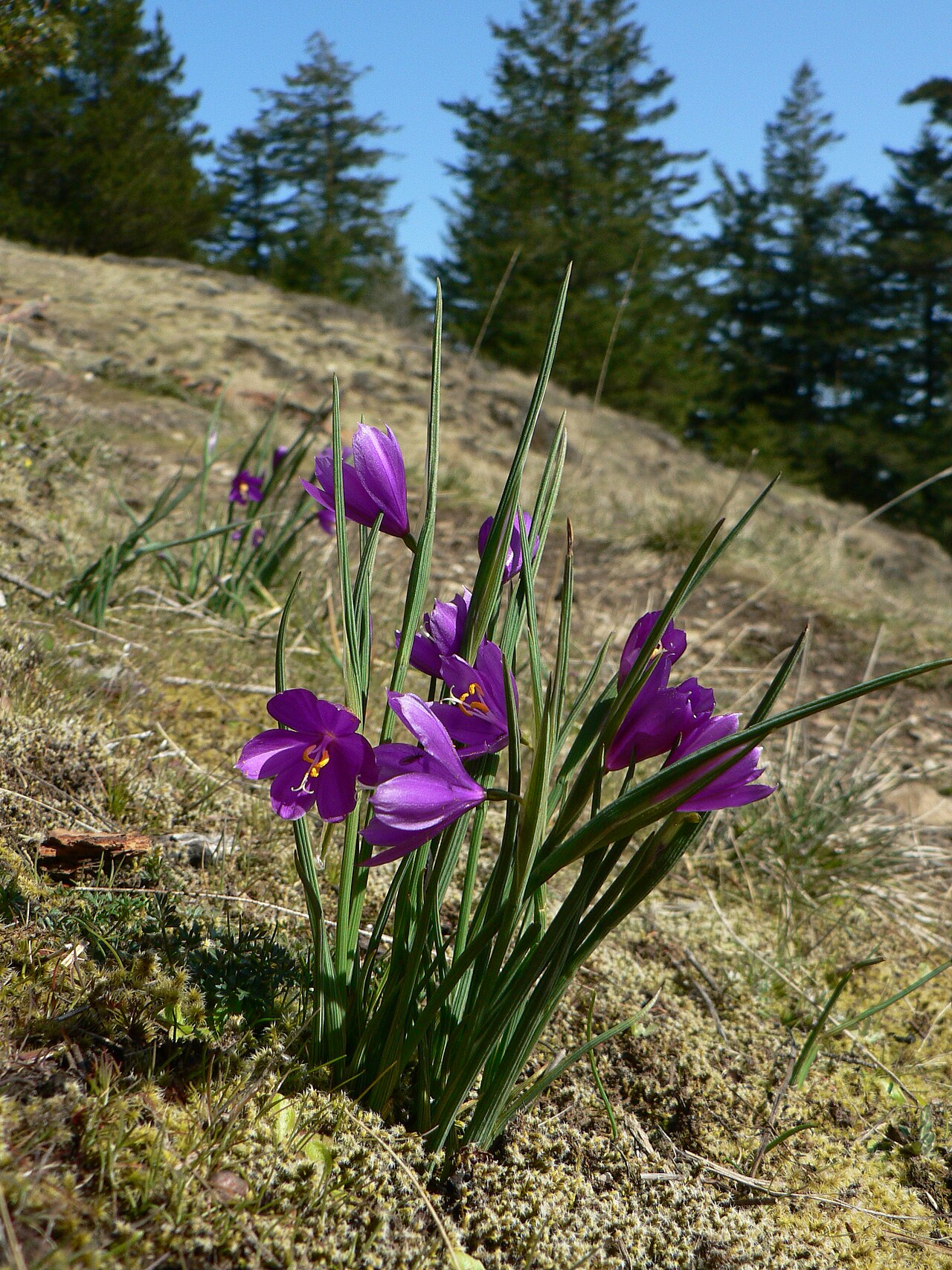
Olsynium douglasii, known as Grasswidow, Douglas’ grasswidow or purple-eyed grass, is one of the very first wildflowers to bloom in the Pacific Northwest, often opening in February or March while frost is still possible. It is a small member of the iris family (Iridaceae) with narrow, grass-like leaves and slender stems 4 to 12 inches tall, each carrying one to three nodding, bell- to star-shaped flowers about 1 to 1 1/2 inches across. The satiny flowers are a rich magenta-purple, rarely white, with bright yellow anthers.
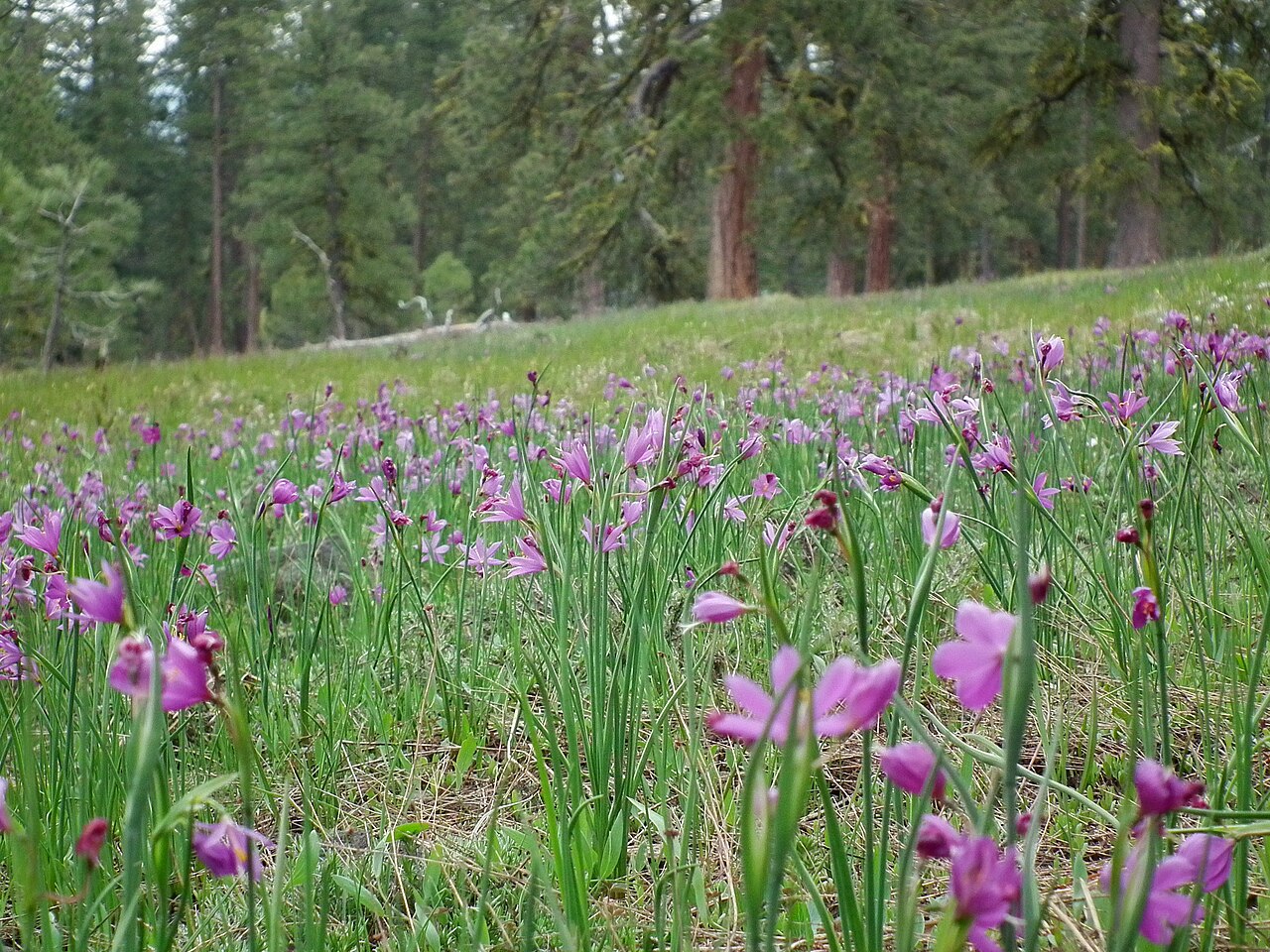
Grasswidow grows in places that are soaking wet in winter and early spring and bone dry by summer: rocky balds, basalt scablands, thin-soiled grasslands, oak savannas and open pine forest. It is common on both sides of the Cascades, from the oak balds of the Willamette Valley and the Columbia River Gorge to the sagebrush and ponderosa pine country of eastern Oregon and Washington, Idaho and southern British Columbia.
For gardeners, grasswidow is a jewel for rock gardens, gravel gardens and naturalistic meadows that mimic its natural cycle. It is sometimes grown from seed by native plant and rock garden enthusiasts. The plant disappears in summer, so it pairs well with later-blooming bunchgrasses and wildflowers. It was formerly classified as Sisyrinchium douglasii, with the blue-eyed grasses.
Identification
Look in late winter and early spring for clumps of narrow, grass-like leaves with satiny, magenta-purple, slightly nodding flowers about an inch across, growing on wet rocky slopes or in thin grassland soil.
Growth Habit
A small, clump-forming perennial 4 to 12 inches tall, growing from a short rootstock with fibrous roots. Each plant produces a few narrow, upright stems wrapped at the base by leaf sheaths. The whole plant withers and goes dormant by early summer.
Leaves
The leaves are linear and grass-like, about 1/8 inch wide, and partly sheath the flowering stem. They are often a little shorter than the stems while the plant is in flower.
Flowers
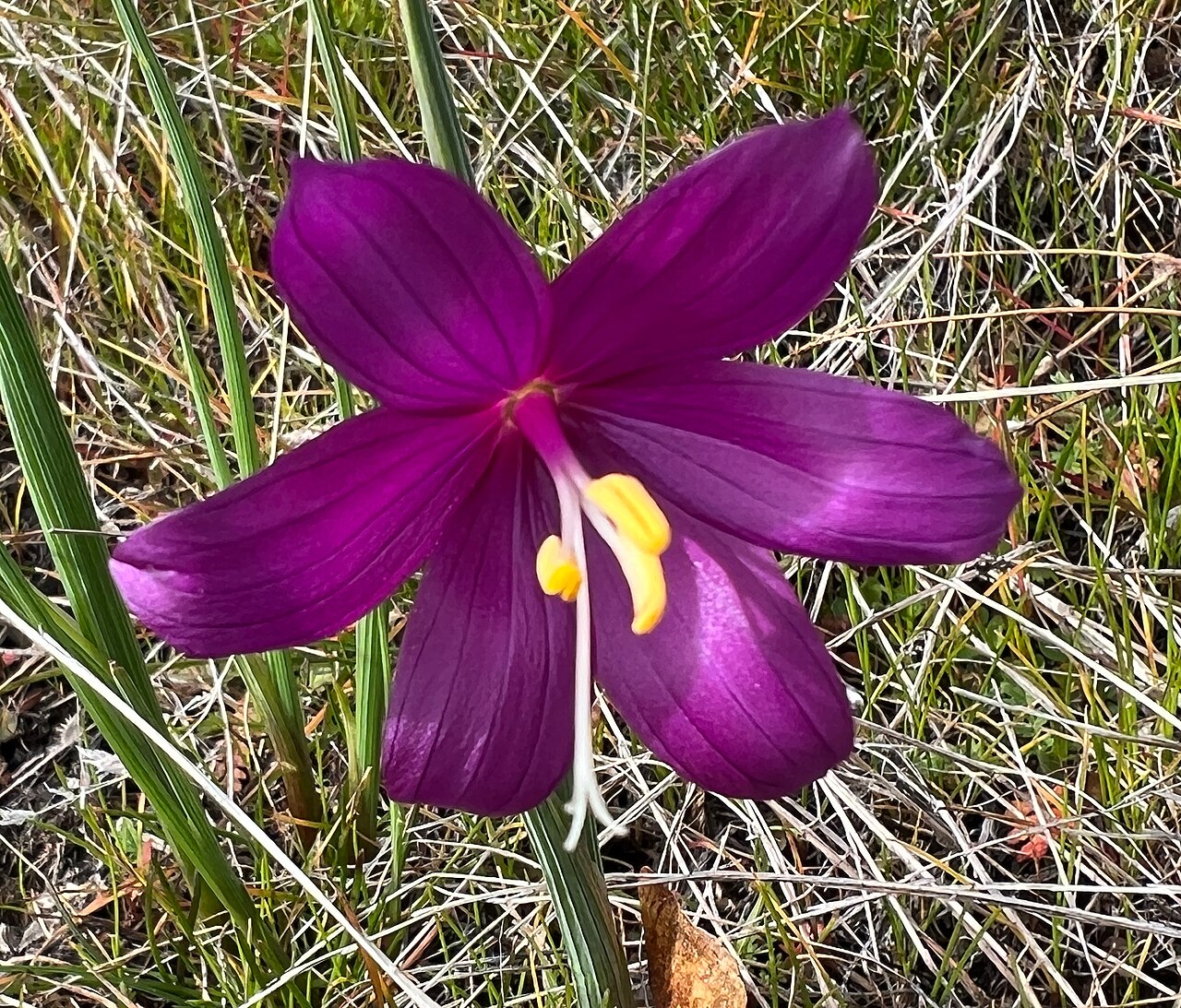
One to three flowers emerge from a pair of narrow, leaf-like bracts at the top of each stem, on short stalks that often nod. Each flower has six similar tepals, usually 1/2 to 3/4 inch long, that are magenta to reddish-purple (occasionally pink or white), satiny and slightly cupped. The three stamens have their filaments joined into a tube around the style, and the anthers are bright yellow. Bloom time is February to May, earliest at low elevations west of the Cascades.
Fruit & Varieties
The fruit is a small, rounded, three-parted capsule with several dark seeds, ripening in late spring. Two varieties are often recognized: var. douglasii, mainly west of the Cascades and in the Columbia Gorge, and var. inflatum, east of the Cascades and in the Great Basin, in which the base of the stamen tube is swollen. Some botanists treat the eastern plants as a separate species, Olsynium inflatum.
Look-alikes
Blue-eyed grasses such as western blue-eyed grass have smaller, flat, blue to purple flowers that face upward and bloom later in spring. Golden-eyed grass has yellow flowers. Grasswidow’s larger, nodding, satiny magenta flowers and very early bloom set it apart.
Quick Facts
| Scientific Name | Olsynium douglasii (syn. Sisyrinchium douglasii) |
| Family | Iridaceae (iris family) |
| Plant Type | Clumping, summer-dormant perennial herb |
| Mature Height | 4–12 in |
| Mature Spread | 3–6 in |
| Growth Rate | Slow |
| Sun Exposure | Full sun to part shade |
| Water Needs | Wet in winter and spring, dry in summer |
| Soil Type | Thin, rocky or gravelly soil; tolerates winter saturation |
| Soil pH | Slightly acidic to neutral (about 5.5–7.5) |
| Bloom Time | February–May |
| Flower Color | Magenta to reddish-purple; rarely white |
| Fall Color | None; summer dormant |
| Fruit | Small rounded capsule |
| Deer Resistant | Somewhat; seldom browsed |
| USDA Hardiness Zones | 5–9 |
Native Range
Grasswidow is native to the Pacific Northwest and the northern Great Basin, from southern British Columbia south to northern California and east to Idaho, northern Nevada and northern Utah. USDA PLANTS lists it in California, Idaho, Nevada, Oregon, Utah and Washington. Its heartland is the Columbia Basin and the lands on both sides of the Cascades in Oregon and Washington.
West of the Cascades it grows on rocky balds, mossy outcrops and oak savannas in the Willamette Valley, the Puget Trough, the San Juan Islands and southern Vancouver Island, and on basalt cliffs and grasslands of the Columbia River Gorge. East of the Cascades it is widespread in sagebrush steppe, bunchgrass prairie, basalt scablands and openings in ponderosa pine forest, reaching mid-elevations in the Blue Mountains and the mountains of Idaho. In California it is found in the northeastern corner of the state.
Its key requirement is a site that is wet in winter and early spring and dries out in summer: seepy slopes, shallow soil over rock, vernal moist flats and thin grassland soils. It often grows where snowmelt or winter rain runs over bedrock.
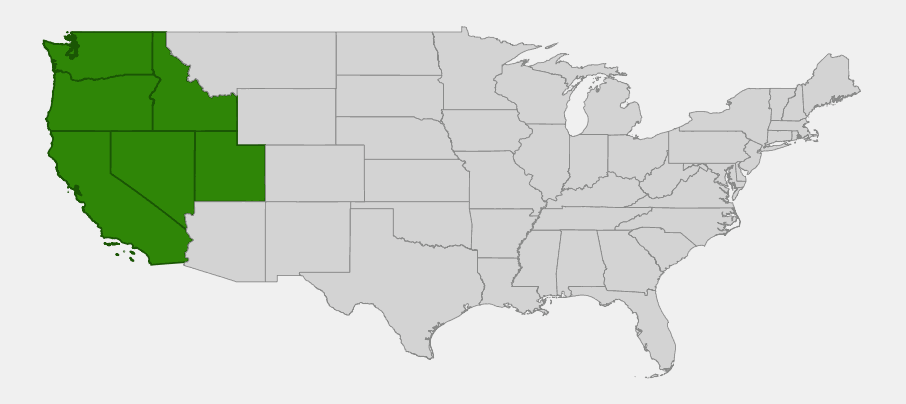
📋 Regional plant lists featuring Grasswidow: Idaho, Eastern Oregon & Eastern Washington · Utah & Western Colorado · Western Oregon & Western Washington · California & Nevada
Growing & Care Guide
Grasswidow is rarely available in nurseries, but seed is sometimes offered by native seed suppliers and rock garden society seed exchanges. It is worth the effort for an early splash of color in gardens that match its wet-winter, dry-summer rhythm. Never dig wild plants.
Light
Full sun to light part shade. On west-side balds and east-side scablands it grows in full sun.
Soil & Water
A lean, gritty or rocky soil that stays moist through winter and spring but dries out completely in summer. It tolerates soggy soil in winter, as long as it is dry while dormant. Avoid summer irrigation, which can rot the roots.
Planting Tips
Sow seed in fall in pots or directly on prepared gravelly ground so it receives winter moisture and cold. Seedlings take two to three years to flower. Grow it in a rock garden, crevice garden, trough or the thin-soiled edge of a meadow, with bunchgrasses and later wildflowers to fill the space when it goes dormant.
Pruning & Maintenance
No pruning is needed. Let foliage die back naturally after seeds ripen, and mark the spot so the dormant plants are not disturbed in summer. Keep vigorous groundcovers and heavy mulch away.
Propagation
Grow from seed, sown in fall for natural cold stratification. Established clumps can be divided carefully in summer while dormant, but they resent disturbance and are slow to recover.
Landscape Uses
- Rock and crevice gardens: vivid color in late winter, when little else blooms
- Gravel gardens and troughs: for lean, dry-summer settings
- Naturalistic meadows: with bunchgrasses, camas and balsamroot
- Early pollinator food: one of the first nectar sources for bees in spring
- Habitat restoration: oak savanna, bald and steppe restoration in the Northwest
Wildlife & Ecological Value
Grasswidow is a herald of spring in the Northwest, flowering on rocky slopes and steppe when few other flowers are open.
For Pollinators
Its very early flowers are visited by queen bumble bees, mining bees and other native bees, flies and early butterflies emerging on warm late-winter days, making it an important early nectar and pollen source.
For Birds
It offers little direct food for birds, but its early bloom supports the insects that ground-nesting and migrating birds feed on in spring.
For Mammals
Deer and elk may nibble it in early spring, and small mammals may eat the seeds, but it is not a major forage plant.
Ecosystem Role
As an early spring perennial of shallow soils, it is part of the distinctive plant communities of balds, scablands and oak savannas, which hold many specialized wildflowers and insects. It helps indicate healthy, intact native grassland.
Cultural & Historical Uses
The species is named for David Douglas, the Scottish botanist who explored the Pacific Northwest in the 1820s and collected many plants new to science.
Grasswidow’s bloom is a long-awaited sign of spring in places like the Columbia River Gorge, where hillsides turn purple with flowers in late February and March. Many wildflower walks in the Gorge and the Willamette Valley begin with grasswidow season.
Botanists have moved it among genera: it was long known as Sisyrinchium douglasii and is now placed in Olsynium, a genus that also includes species in South America. Its relationship to the blue-eyed grasses is close, but the joined stamens and nodding, bell-shaped flowers distinguish it.
Frequently Asked Questions
When does grasswidow bloom?
From February to May, depending on elevation and location. It is often one of the first wildflowers to bloom in the Pacific Northwest.
Is grasswidow a bulb?
No. It grows from a short rootstock with fibrous roots, but like a bulb it goes dormant in summer and returns each spring.
Is grasswidow the same as blue-eyed grass?
They are close relatives in the iris family. Grasswidow has larger, nodding, magenta flowers and blooms earlier; blue-eyed grasses have smaller, flat, upward-facing blue flowers.
Can I grow grasswidow in my garden?
Yes, from seed in a lean, rocky soil that is moist in winter and spring and dry in summer. It takes a few years to flower.
Does it grow west of the Cascades?
Yes. It grows on oak balds and rocky outcrops in the Willamette Valley, the Puget Trough and the Columbia River Gorge, as well as widely east of the Cascades.

Looking for a nursery that carries Grasswidow?
Browse our native plant nursery directory: California · Idaho · Nevada · Oregon · Utah · Washington