
Thyme-Leaved Bluet (Houstonia serpyllifolia)
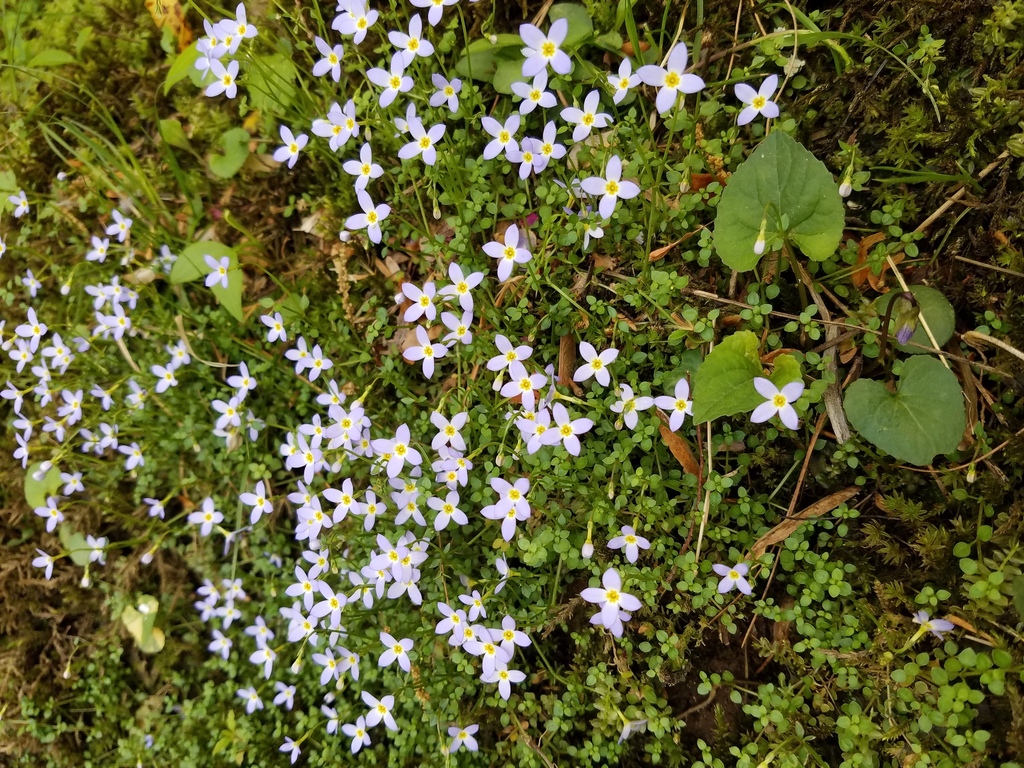
Houstonia serpyllifolia, known as Thyme-Leaved Bluet, creeping bluet or Appalachian bluet, is a tiny, creeping perennial wildflower of the southern and central Appalachian Mountains. It belongs to the madder or coffee family (Rubiaceae). Its slender stems run along the ground and root as they go, forming soft, bright green mats of tiny, rounded leaves, much like a creeping thyme. In spring the mats are dotted or completely covered with small, four-petaled, sky-blue flowers with yellow centers.
Thyme-leaved bluet is essentially an Appalachian endemic. It grows from southwestern Pennsylvania and western Maryland south through West Virginia, Virginia, eastern Kentucky and Tennessee to the mountains of the Carolinas and northern Georgia. Its home is cool, moist ground: stream banks, wet rocks and seeps, moist trailsides, grassy balds and the mossy edges of mountain roads. It was formerly named Hedyotis michauxii, and older books may use that name.
For gardeners it is a delightful groundcover for small, moist, partly shaded spaces, such as between stepping stones, at the edge of a stream or on a mossy bank. It is more tolerant of creeping and spreading than common bluets and can form a living carpet in the right spot. Buy nursery-grown plants, which are offered under both its current and former names.
Identification
Look for a low, creeping mat of tiny, round leaves on moist mountain ground, with small, four-petaled blue flowers on short, thread-like stalks in spring.
Growth Habit
Thyme-leaved bluet is a low, mat-forming perennial. Its thin stems creep along the ground and root at the nodes, so a single plant can spread into a patch a foot or more across. The mats are usually only 1 to 4 inches tall, with flower stalks rising a little above the leaves.
Leaves
The leaves are opposite, very small (about 1/8 to 1/2 inch long), and round to broadly oval, with short stalks. They are bright green, smooth or slightly hairy and closely spaced along the creeping stems, giving the plant its thyme-like look. The mats stay green through much of the year in mild weather.
Flowers
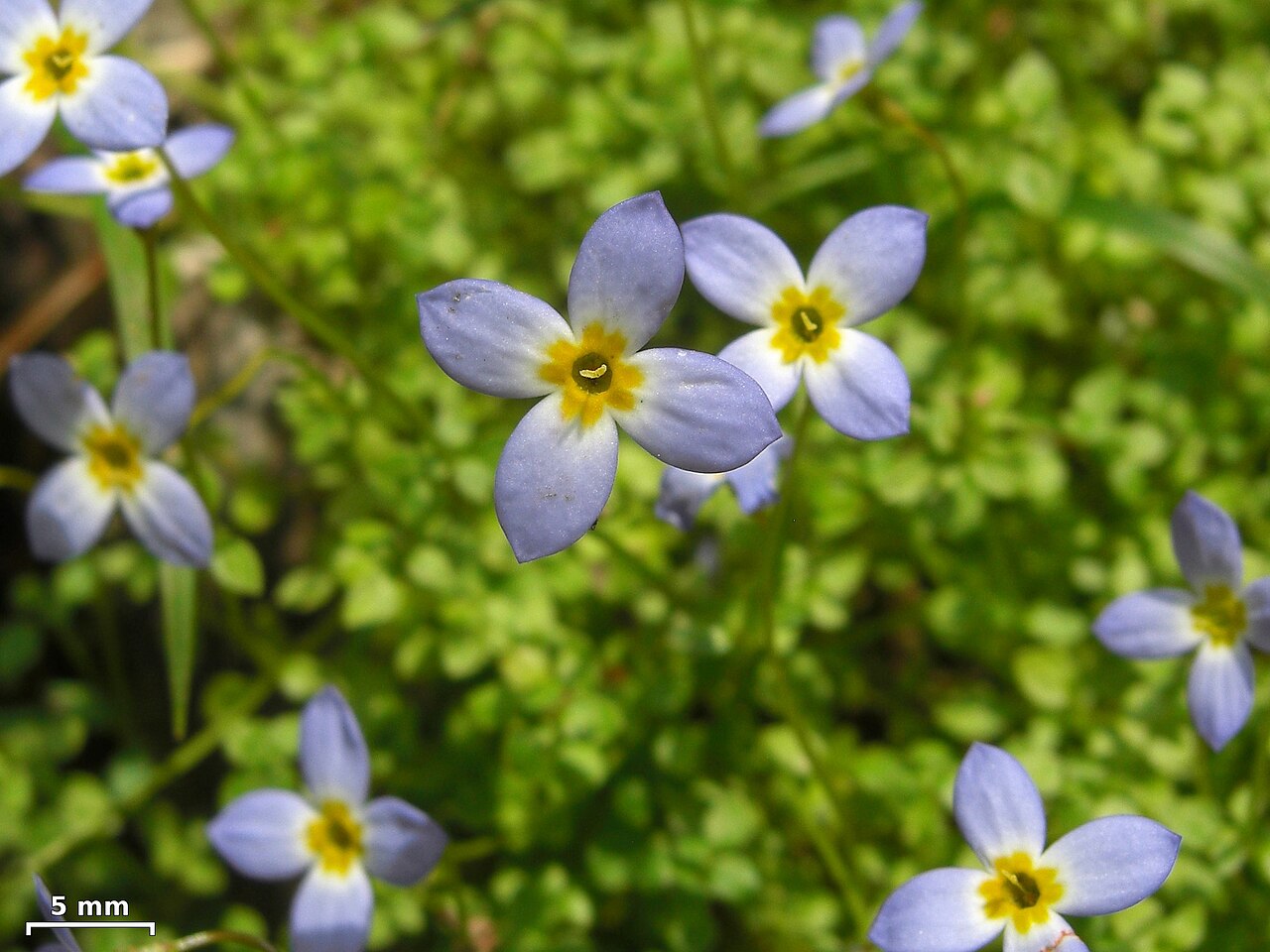
Each flower sits alone at the tip of a slender stalk about 1 to 3 inches long. The flower is about 1/3 to 1/2 inch across, with a short tube and four spreading, pointed petals that are deep blue to violet-blue or sometimes pale blue to whitish, around a yellow center. Like other bluets, the flowers come in two forms on different plants, one with long styles and short stamens and the other the reverse, which encourages cross-pollination. It blooms mainly from April to June, with a few flowers later in summer.
Fruit
The fruit is a small, two-lobed capsule, broader than long, that sits in the cup formed by the four sepals. It splits open at the top to release tiny seeds.
Look-alikes
Common bluets (Houstonia caerulea) grow in upright tufts and do not creep or root along the stems, and their flowers are usually paler. Roundleaf bluet (H. procumbens) also creeps, but it has white flowers and grows on the sandy Coastal Plain. Tiny bluet (H. pusilla) is an annual of lowland lawns and fields with dark violet flowers.
Quick Facts
| Scientific Name | Houstonia serpyllifolia |
| Family | Rubiaceae (madder family) |
| Plant Type | Creeping, mat-forming herbaceous perennial |
| Mature Height | 1–4 in |
| Mature Spread | 6–18 in |
| Growth Rate | Moderate |
| Sun Exposure | Part shade to full sun (with moisture) |
| Water Needs | Medium to high; consistently moist |
| Soil Type | Moist, humus-rich, well-drained loam; mossy rock and stream banks |
| Soil pH | Acidic (about 4.5–6.5) |
| Bloom Time | April–June, sporadically into summer |
| Flower Color | Blue to violet-blue with a yellow eye |
| Fall Color | None; often semi-evergreen |
| Fruit | Small, two-lobed capsule |
| Deer Resistant | Mostly; too small to attract much browsing |
| USDA Hardiness Zones | 5–7 |
Native Range
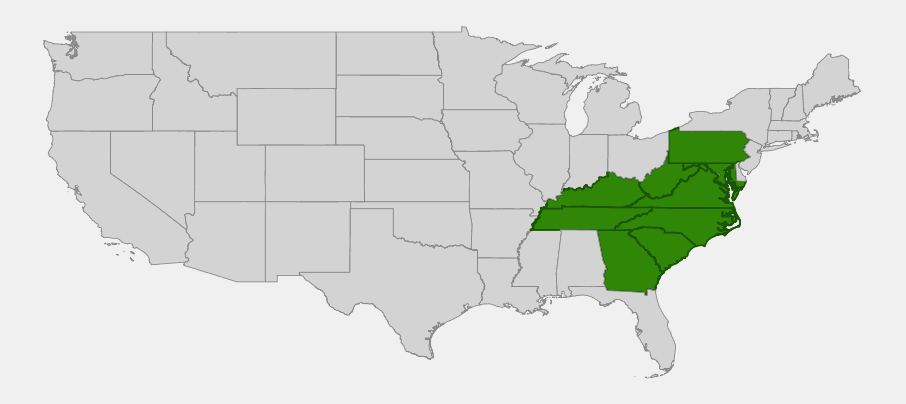
Thyme-leaved bluet is native to the Appalachian region of the eastern United States. USDA PLANTS lists it as native in Georgia, Kentucky, Maryland, North Carolina, Pennsylvania, South Carolina, Tennessee, Virginia and West Virginia. It does not grow in Canada.
The heart of its range is the Blue Ridge of North Carolina, Tennessee, Virginia, South Carolina and Georgia, including the Great Smoky Mountains, where it is common along trails and streams. It also grows in the Allegheny Mountains and Cumberland region of West Virginia, eastern Kentucky and western Virginia. Populations in western Maryland and southwestern Pennsylvania mark the northern edge of its range.
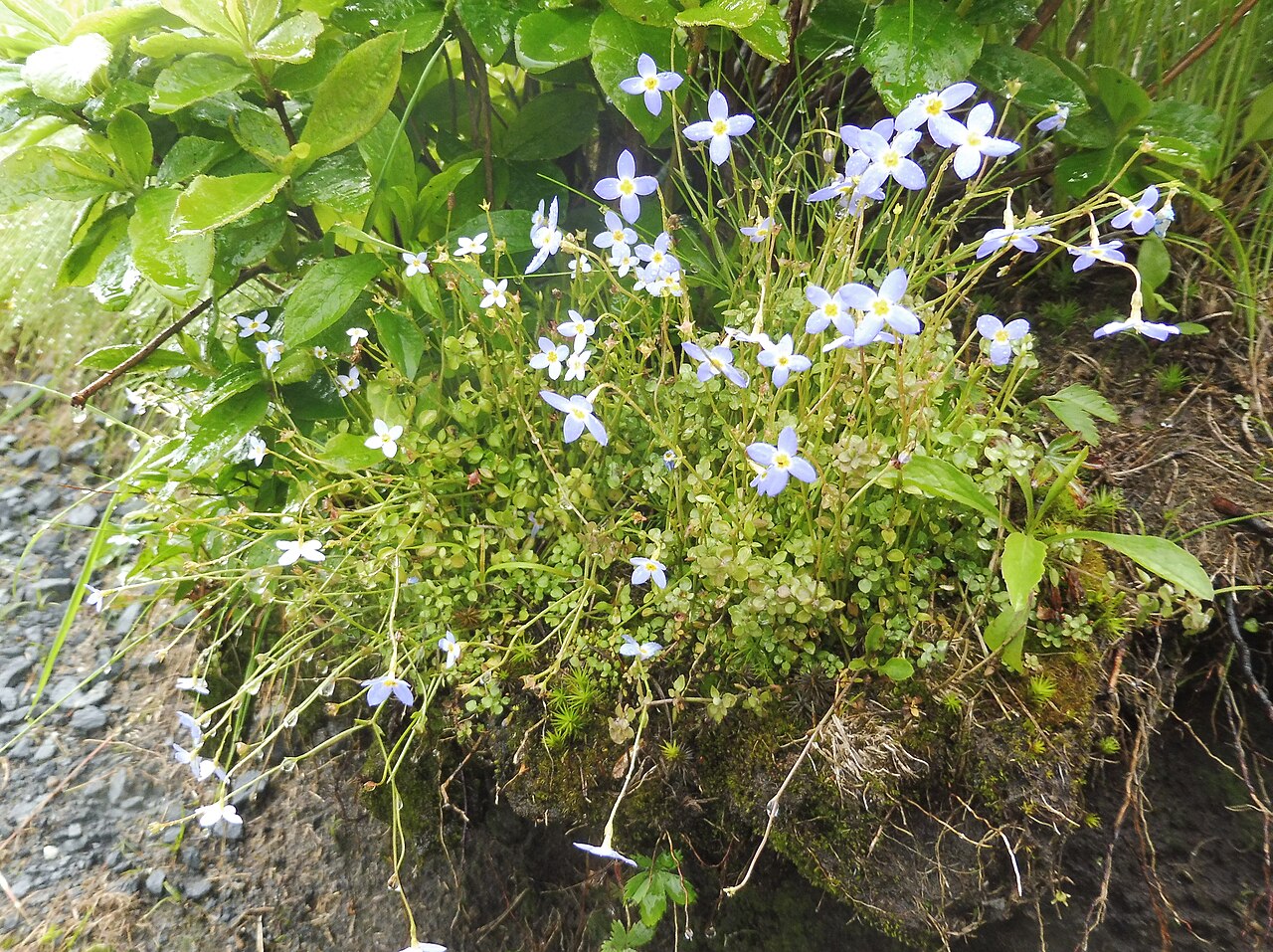
It grows at middle to high elevations, roughly 1,000 to more than 6,000 feet, in moist, often disturbed places with light or partial shade: banks of streams and spring runs, wet rocks and seepage areas, moist woods and trailsides, grassy and heath balds and road banks. It often grows with mosses on rocks and soil kept wet by seepage or mist.
📋 Regional plant lists featuring Thyme-Leaved Bluet: New York, Pennsylvania & Northern New Jersey · Kentucky & Tennessee · Maryland, Virginia & West Virginia · Alabama, Georgia & Mississippi · North & South Carolina
Growing & Care Guide
Thyme-leaved bluet is a charming groundcover for cool, moist, partly shaded spots. It does best in climates with mild summers, so it thrives in and near the Appalachians and in the cooler parts of the East.
Light
Part shade is ideal, such as dappled light or morning sun with afternoon shade. It takes more sun where the soil stays moist and summers are cool, as on mountain balds. Deep shade reduces flowering.
Soil & Water
Plant in moist, humus-rich, acidic soil that drains but never dries out. It does well in mossy, gravelly or sandy loam along streams, seeps or the shady side of rocks. Water during dry spells; long droughts and hot, dry sites kill it back.
Planting Tips
Plant in spring or early fall, setting plants about 6 to 12 inches apart. Use it between stepping stones in a shady path, at the edge of a small stream or water feature, on a moist rock wall or under taller ferns and woodland wildflowers. Keep it away from aggressive groundcovers that can smother it.
Pruning & Maintenance
No pruning is needed. Remove fallen leaves that settle on the mats in fall so they do not smother them, and pull out weeds by hand. Mats may thin after a few years in rich, crowded beds; replant divisions in fresh soil to renew them.
Propagation
Divide the mats in spring or early fall, or lift rooted pieces of stem and replant them. It also grows from seed sown on the surface of moist soil, and it may self-sow into nearby moss and gravel.
Landscape Uses
- Stepping stone paths: a soft, flowering carpet between stones in part shade
- Stream and pond edges: creeps over moist banks and rocks
- Rock and moss gardens: pairs with mosses on shaded, damp rocks
- Woodland gardens: a spring-blooming groundcover under ferns and wildflowers
- Containers and troughs: a tiny accent in moist, shaded troughs
Wildlife & Ecological Value
Though tiny, thyme-leaved bluet is a spring food source for small pollinators in Appalachian forests and balds.
For Pollinators
The flowers are visited by small bees, such as sweat bees and small carpenter bees, by bee flies and other flies, and by small butterflies. The two flower forms help ensure that pollen is carried between plants.
For Birds
It offers little food for birds, but its mats help hold moist soil and leaf litter where ground-feeding birds find insects.
For Mammals
Small mammals may nibble it, but it is too small to be an important food for deer or other large mammals.
Ecosystem Role
It is part of the diverse plant community of Appalachian stream banks, seeps and balds, where its creeping mats help stabilize soil on wet banks and trailsides. It is one of several southern Appalachian plants found mostly in this region and nowhere else.
Cultural & Historical Uses
The genus Houstonia honors William Houstoun, an 18th-century Scottish surgeon and plant collector in the Caribbean and Mexico. The species name serpyllifolia means “with leaves like serpyllum,” the creeping wild thyme, a good description of its tiny leaves.
The plant was described by the French botanist André Michaux, who explored the southern Appalachians in the late 18th century, and it has also been called Hedyotis michauxii in his honor. Nurseries often sell it as Michaux’s bluet or creeping bluet.
Mary Vaux Walcott painted thyme-leaved bluets in 1934 for her watercolor series of North American wildflowers, now held by the Smithsonian American Art Museum. Today the blue mats along the trails of the Great Smoky Mountains and the Blue Ridge Parkway are a much-loved sign of spring for hikers.
Frequently Asked Questions
How is thyme-leaved bluet different from common bluets?
Thyme-leaved bluet creeps and roots along the ground to form mats of tiny round leaves, and its flowers are often a deeper blue. Common bluets grow in upright tufts and do not creep.
Can I grow thyme-leaved bluet between stepping stones?
Yes. It is one of the best native plants for moist, partly shaded paths, and it tolerates light foot traffic at the edges of stones.
Is thyme-leaved bluet the same as Hedyotis michauxii?
Yes. Hedyotis michauxii is an older name for the same plant, and some nurseries still use it.
When does thyme-leaved bluet bloom?
Mainly from April to June, with scattered flowers later in summer in cool, moist sites.
Where does thyme-leaved bluet grow wild?
Mostly in the southern and central Appalachian Mountains, from Pennsylvania and Maryland to Georgia, along streams, seeps, trails and grassy balds.

Looking for a nursery that carries Thyme-Leaved Bluet?
Browse our native plant nursery directory: Georgia · Kentucky & Maryland · North Carolina · Pennsylvania, South Carolina, Tennessee & Virginia · West Virginia

