
Hoary Pincushion (Chaenactis douglasii)
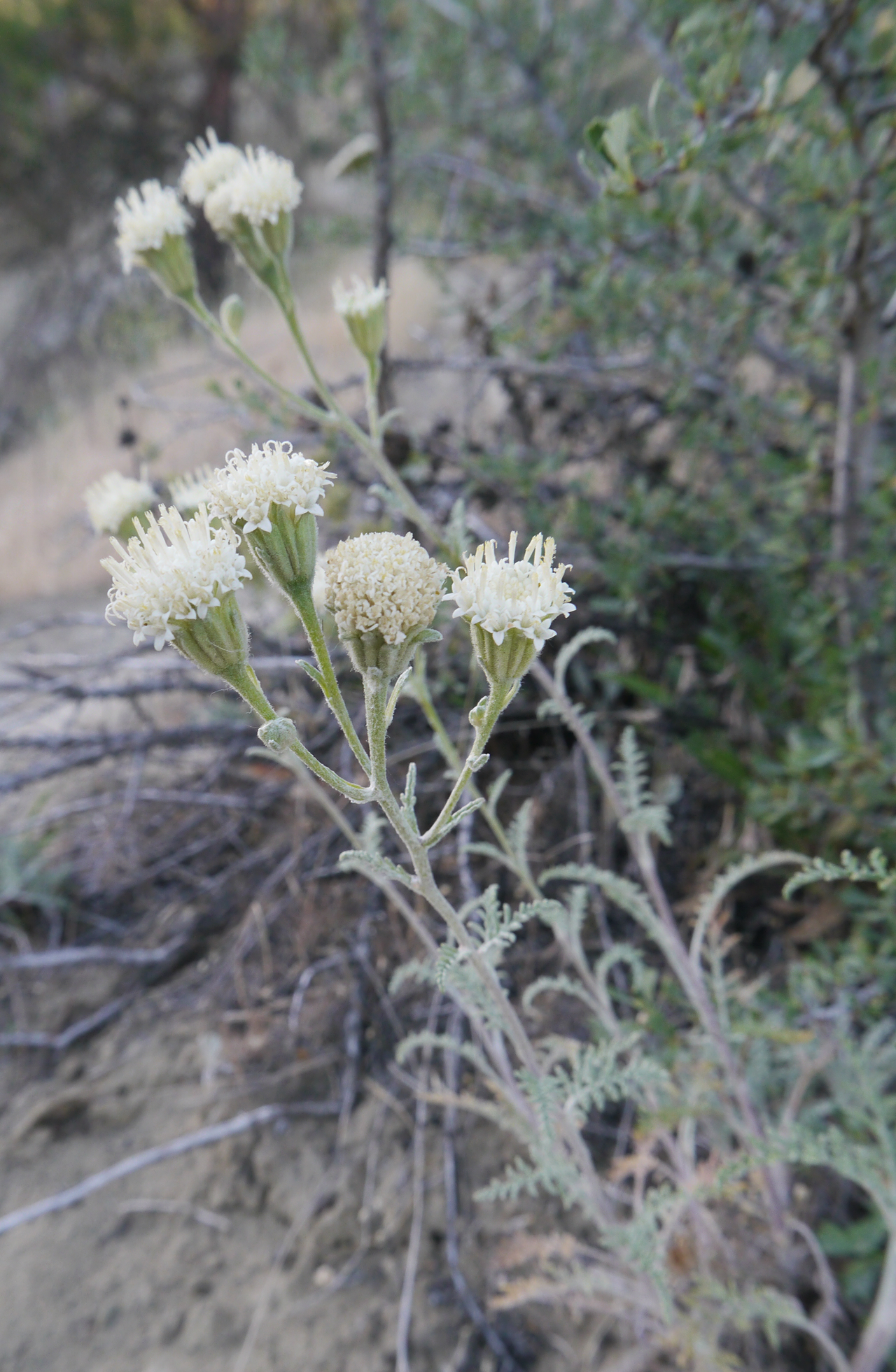
Chaenactis douglasii, known as Hoary Pincushion, Douglas’ dustymaiden (the USDA common name) or Douglas’ pincushion, is a gray-leaved wildflower of the aster family found across the dry interior West, from British Columbia and the western Dakotas to California, Arizona and New Mexico. In late spring and summer it sends up branching stems, usually 4 to 20 inches tall, topped with rounded heads of creamy white to pale pink tubular flowers.
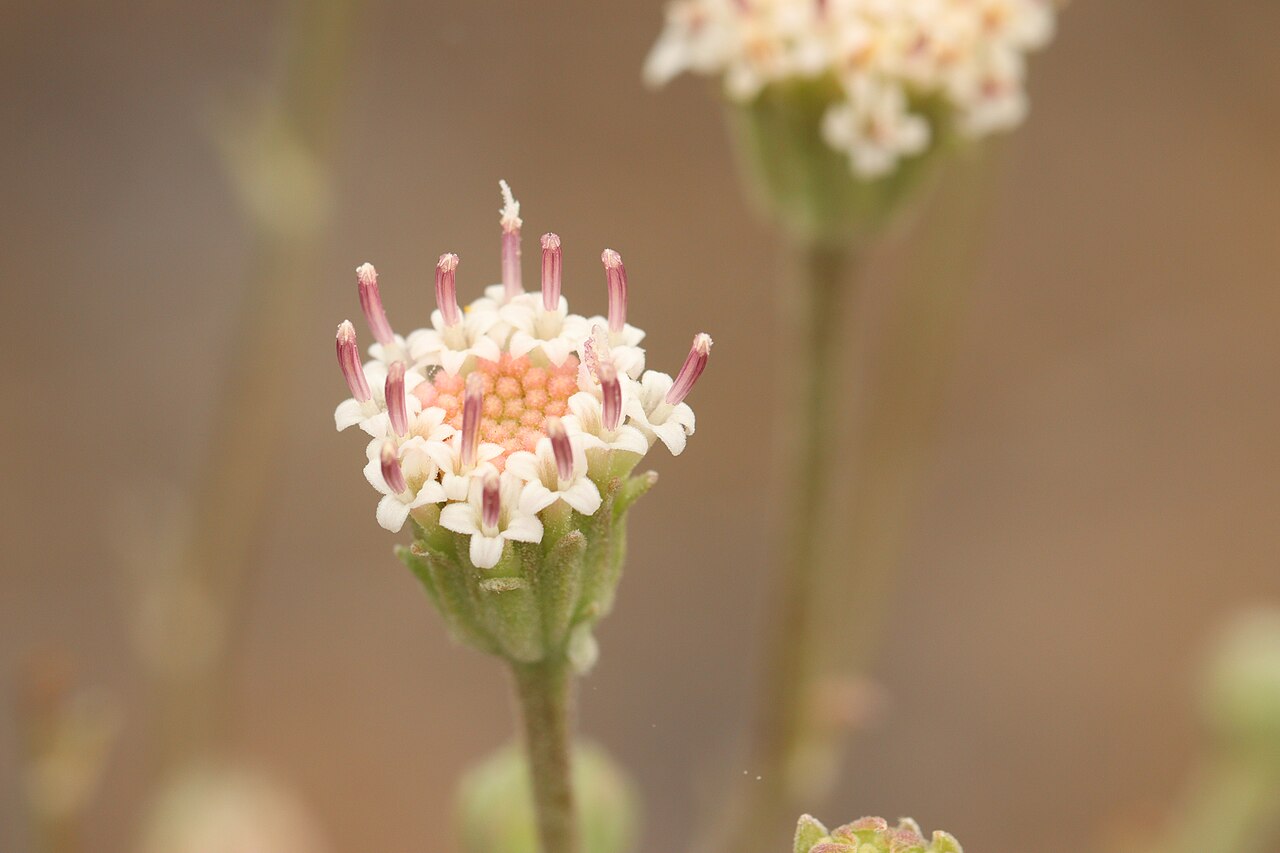
The flower heads have no petal-like rays. Instead, each head is a dense cluster of small tubular flowers whose styles stick out like pins in a pincushion, which explains both of its main common names. The finely divided, woolly gray leaves are as distinctive as the flowers and help the plant survive in hot, dry, sunny places.
Hoary pincushion is a biennial or short-lived perennial of sagebrush steppe, dry grasslands, rocky slopes and open pine woodlands, from low valleys to high mountain ridges. It attracts a wide range of bees and butterflies and is used in native seed programs for restoring sagebrush habitat. This guide covers identification, range, growing tips for dry native gardens and its value to wildlife.
Identification
Hoary pincushion is easy to recognize by its combination of gray, finely cut, woolly leaves and rayless, pincushion-like white to pinkish flower heads.
Growth Habit
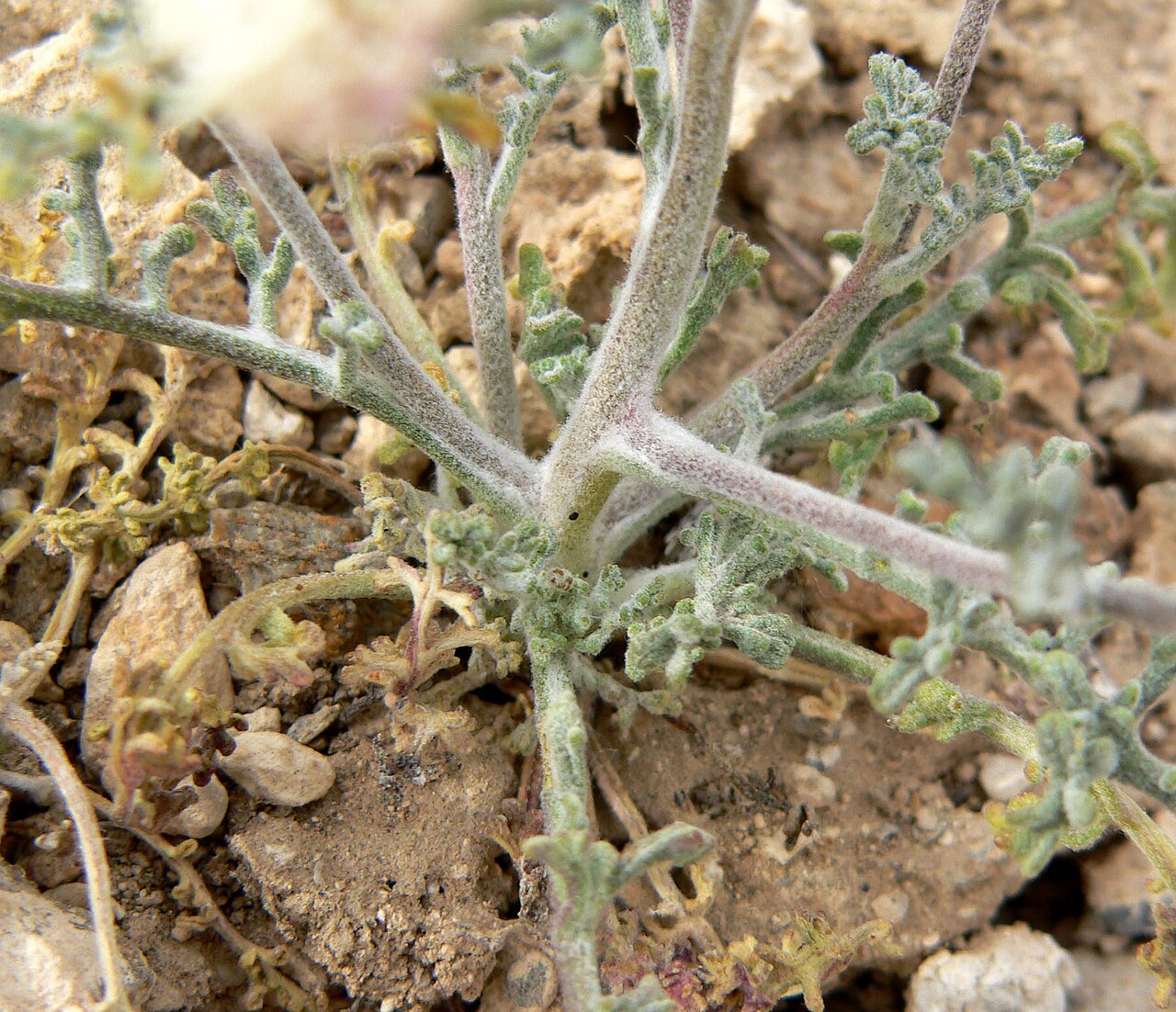
It is a biennial or short-lived perennial that grows from a taproot. In the first year it usually forms a low rosette of gray leaves; in later years it produces one to several upright, branching stems 4 to 20 inches tall (occasionally taller), each ending in one to several flower heads. The whole plant is covered with fine, cobwebby to woolly hairs, especially on the leaves and young stems.
Leaves
The leaves are mostly in a basal rosette and along the lower stem, about 1 to 4 inches long, and divided once or twice into small, narrow, often curled or twisted segments. Their dense gray or white woolly hairs give the plant its “hoary” or “dusty” appearance.
Flowers
The flower heads are about 1/2 to 3/4 inch across and made entirely of small tubular disk flowers, without the strap-shaped rays of a daisy. The flowers are white to cream or pale pink, and the outer flowers in each head are slightly larger than the inner ones. The long, protruding styles and anthers give the head a fuzzy, pin-studded look. The bracts beneath the head are glandular and sticky-hairy. Bloom time is May to August, depending on elevation.
Fruit & Seeds
The seeds (achenes) are narrow, club-shaped and finely hairy, topped by a crown of thin, papery scales that help them disperse. They ripen in mid to late summer.
Look-alikes
Other pincushions in the genus Chaenactis look similar. Esteve’s pincushion (Chaenactis stevioides) and Fremont’s pincushion (Chaenactis fremontii) are desert annuals of lower elevations, and yellow pincushion (Chaenactis glabriuscula) has yellow flowers. Yarrow has white flowers in flat-topped clusters with tiny rays and fern-like leaves that are green rather than gray.
Quick Facts
| Scientific Name | Chaenactis douglasii (Hook.) Hook. & Arn. |
| Family | Asteraceae (aster family) |
| Plant Type | Biennial or short-lived herbaceous perennial |
| Mature Height | 4–20 in (occasionally to 2 ft) |
| Mature Spread | 6–12 in |
| Growth Rate | Fast |
| Sun Exposure | Full sun |
| Water Needs | Low; drought tolerant |
| Soil Type | Well-drained sandy, gravelly or rocky soils |
| Soil pH | About 6.0–8.0 |
| Bloom Time | May–August |
| Flower Color | White to cream or pale pink |
| Fall Color | None; gray foliage |
| Fruit | Narrow achene topped with papery scales |
| Deer Resistant | Not well documented |
| USDA Hardiness Zones | 4–9 |
Native Range
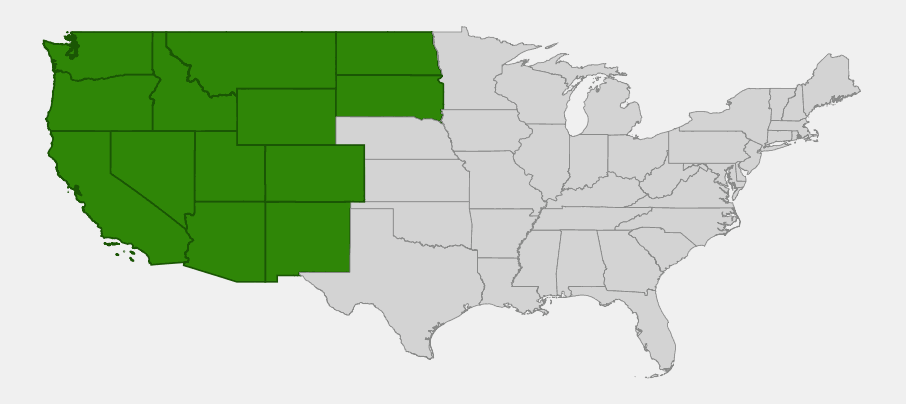
Hoary pincushion is one of the most widespread wildflowers of the interior West. USDA PLANTS lists it as native in 13 states: Washington, Oregon, Idaho, Montana, Wyoming, North Dakota, South Dakota, Colorado, Utah, Nevada, California, Arizona and New Mexico. In Canada it grows in British Columbia, Alberta and Saskatchewan.
Its stronghold is the sagebrush country of the Columbia Basin, the Snake River Plain, the Great Basin and the Colorado Plateau, but it also climbs into the Rocky Mountains and the Sierra Nevada. In Washington and Oregon it grows mainly east of the Cascades. In the Dakotas it is limited to the western parts of the states, where it reaches the eastern edge of its range on dry, eroded slopes and badlands. In California it grows mostly in the northeastern plateau and the eastern Sierra Nevada and desert mountains.
Typical habitats are sagebrush steppe, dry grasslands, juniper and ponderosa pine woodlands, rocky ridges, talus and gravel slopes, and disturbed open ground such as road cuts and burns, from low valleys to subalpine and even alpine elevations. Botanists recognize two main varieties: the common var. douglasii, and var. alpinus, a low, compact high-mountain form that some authors treat as a separate species.
📋 Regional plant lists featuring Hoary Pincushion: Arizona & New Mexico · California & Nevada · North Dakota, South Dakota & Western Minnesota · Idaho, Eastern Oregon & Eastern Washington · Montana & Wyoming · Utah & Western Colorado · Western Oregon & Western Washington
Growing & Care Guide
Hoary pincushion is an easy, fast-growing plant for dry, sunny native gardens in the interior West. Seed is sold by some western native seed companies, and plants are occasionally offered by native nurseries. Because it is short-lived, think of it as a self-sowing component of a dry meadow or rock garden rather than a permanent specimen.
Light
Plant it in full sun. It grows in open, exposed places in the wild and becomes weak and floppy in shade.
Soil & Water
It needs very well-drained sandy, gravelly or rocky soil, and it tolerates poor, low-fertility ground. Once established it needs no supplemental water in most of its range; in very hot, dry gardens an occasional deep watering during a long drought keeps it flowering longer. Avoid rich, heavy or irrigated soils, which shorten its life.
Planting Tips
Sow seed in fall on the surface of bare, open soil and press it in lightly; winter cold and moisture improve germination. Seedlings form rosettes in the first year and flower in the second. Space plants about 8 to 12 inches apart among bunchgrasses, buckwheats, penstemons and other dryland natives.
Pruning & Maintenance
No pruning is needed. Let some flower heads ripen so the plant can reseed, since individual plants live only a few years. Remove competing weeds, especially cheatgrass, which crowds out small native forbs in sagebrush gardens.
Propagation
Grow it from seed. Fresh seed sown in fall germinates well the following spring; seed sown in spring may benefit from a few weeks of cold, moist stratification. It is not usually propagated by division because of its taproot.
Landscape Uses
- Dry rock gardens and gravel gardens: its silvery foliage and white flower heads look good among rocks and contrast with green and blue-gray plants.
- Pollinator gardens: its long summer bloom draws bees, butterflies and other insects.
- Sagebrush and dryland restoration: it is grown in native seed programs and used to add forb diversity to sagebrush steppe and burned rangeland restorations.
- Xeriscapes: once established it needs no irrigation in most of the interior West.
- Naturalistic meadows: it self-sows modestly in open, gravelly ground, filling gaps between bunchgrasses.
Wildlife & Ecological Value
Hoary pincushion is a useful nectar and pollen plant in dry habitats where summer flowers can be scarce.
For Pollinators
The small tubular flowers offer nectar and pollen to a wide variety of insects, including native bees such as sweat bees, mining bees and leafcutter bees, as well as butterflies, skippers and bee flies. Its value to pollinators is one reason it is included in sagebrush restoration seed mixes.
For Birds
Insects that visit native forbs like hoary pincushion are an important food for the chicks of ground-nesting birds in sagebrush country, including greater sage-grouse. Small seed-eating birds may also eat the seeds.
For Mammals
Deer, pronghorn and livestock browse it lightly. Small rodents eat and cache the seeds.
Ecosystem Role
As a fast-growing native forb, hoary pincushion is one of the first plants to colonize disturbed ground, rocky slopes and burned areas in sagebrush and pine country, helping to stabilize soil and provide early food for insects.
Cultural & Historical Uses
The genus name Chaenactis comes from Greek words meaning “gaping ray”, referring to the enlarged, open outer flowers of some species. The species honors David Douglas, the Scottish botanist who collected plants in the Pacific Northwest in the 1820s.
Several Indigenous peoples of the Columbia Plateau and Great Basin used hoary pincushion as a medicinal plant, typically as a poultice or wash, according to ethnobotanical records. These are traditional uses only; do not use it as a remedy.
Its USDA common name, Douglas’ dustymaiden, comes from the dusty-looking gray hairs on its leaves. “Dustymaiden” is the standard name used for the whole genus in many western floras.
Frequently Asked Questions
Is hoary pincushion the same as Douglas’ dustymaiden?
Yes. Hoary pincushion, Douglas’ dustymaiden, Douglas’ pincushion and dusty maiden are all common names for Chaenactis douglasii.
Is it an annual or a perennial?
It is usually a biennial or short-lived perennial. Plants often flower in their second year and live only a few years, but they reseed in open, gravelly soil.
Where does hoary pincushion grow?
Across the dry interior West, from British Columbia and the western Dakotas south to California, Arizona and New Mexico, in sagebrush steppe, dry grasslands, open pine woodlands and rocky mountain slopes.
Does it need watering?
Only while young. Established plants are very drought tolerant and do best with no summer irrigation in well-drained soil.
What pollinators visit hoary pincushion?
Many kinds of native bees, plus butterflies, skippers and flies. Its long summer bloom makes it a useful nectar source in dry landscapes.

Looking for a nursery that carries Hoary Pincushion?
Browse our native plant nursery directory: Arizona · California · Colorado · Idaho · Montana · Nevada, New Mexico & North Dakota · Oregon · South Dakota & Utah · Washington · Wyoming

