
Alkali Mallow (Malvella leprosa)
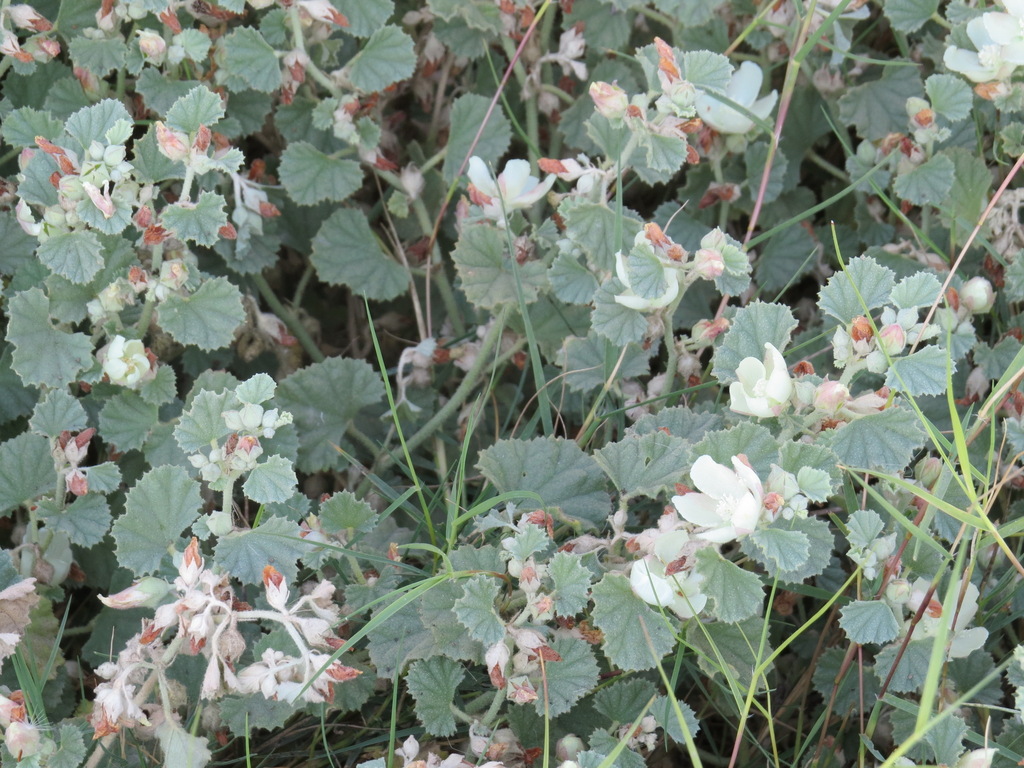
Malvella leprosa, known as Alkali Mallow, alkali sida or whiteweed, is a low, creeping perennial of the mallow family (Malvaceae). It is native across the western and south-central United States, from Washington, Idaho and Kansas south to California and Texas, and also in Mexico and, remarkably, in Argentina and Chile in South America. True to its name, it thrives in alkaline and somewhat salty soils, on valley flats, playa edges, floodplains and moist bottomlands.
Plants form low mats of gray-green, fan- to kidney-shaped leaves covered with tiny star-shaped and scale-like hairs that give them a scurfy look; leprosa means “scaly” or “scurfy.” From late spring through summer, creamy white to pale yellow, cup-shaped flowers about an inch across open in the leaf axils. The plant spreads by deep, creeping roots that send up new shoots well away from the parent plant.
This deep-rooted vigor is a double-edged sword. Alkali mallow is an honest-to-goodness native, and it is valuable for holding bare, alkaline ground where few other plants will grow. But it is also an aggressive spreader that farmers know as a persistent weed of irrigated fields, orchards and roadsides, and it is very hard to remove once established. It belongs in wild, alkaline sites and restoration plantings, not in garden beds.
Identification
Look for low, sprawling stems with gray-green, scurfy, fan-shaped leaves and creamy white, cup-shaped mallow flowers, often forming patches on alkaline flats or disturbed ground.
Growth Habit
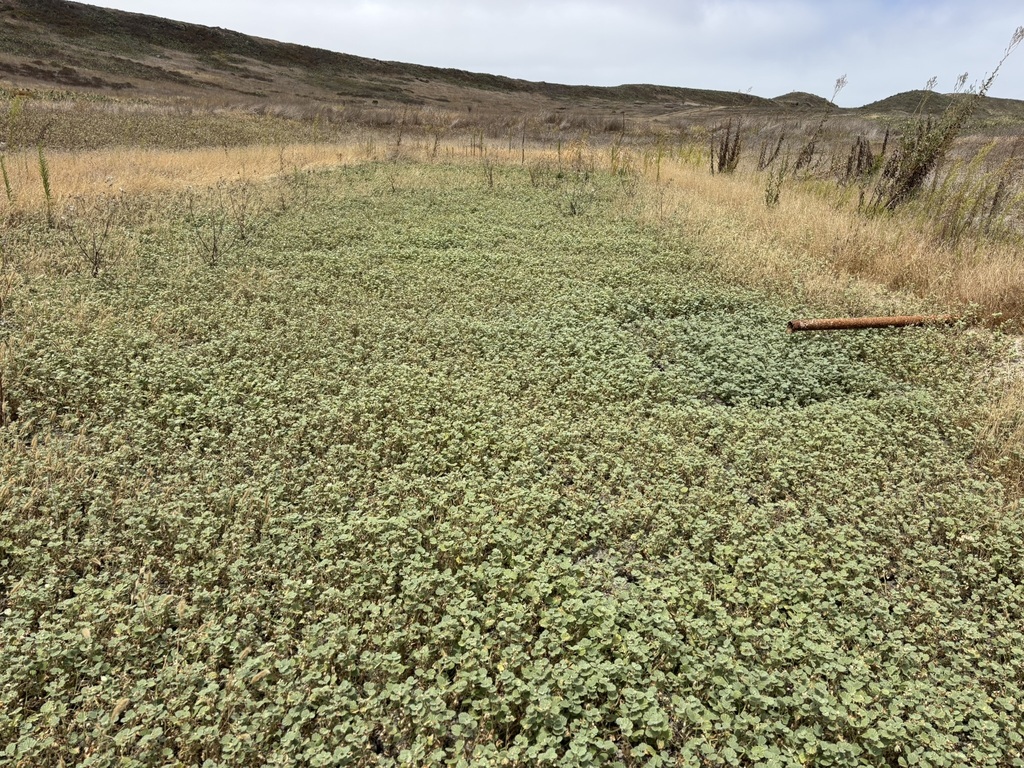
Alkali mallow is a herbaceous perennial with long, deep, creeping roots (rhizomes) that produce new shoots at intervals, forming patches many feet across. The stems are prostrate to ascending, up to about 16 inches long, so plants are usually only 4 to 12 inches tall. Top growth dies back in winter in colder areas and returns from the roots in spring.
Leaves
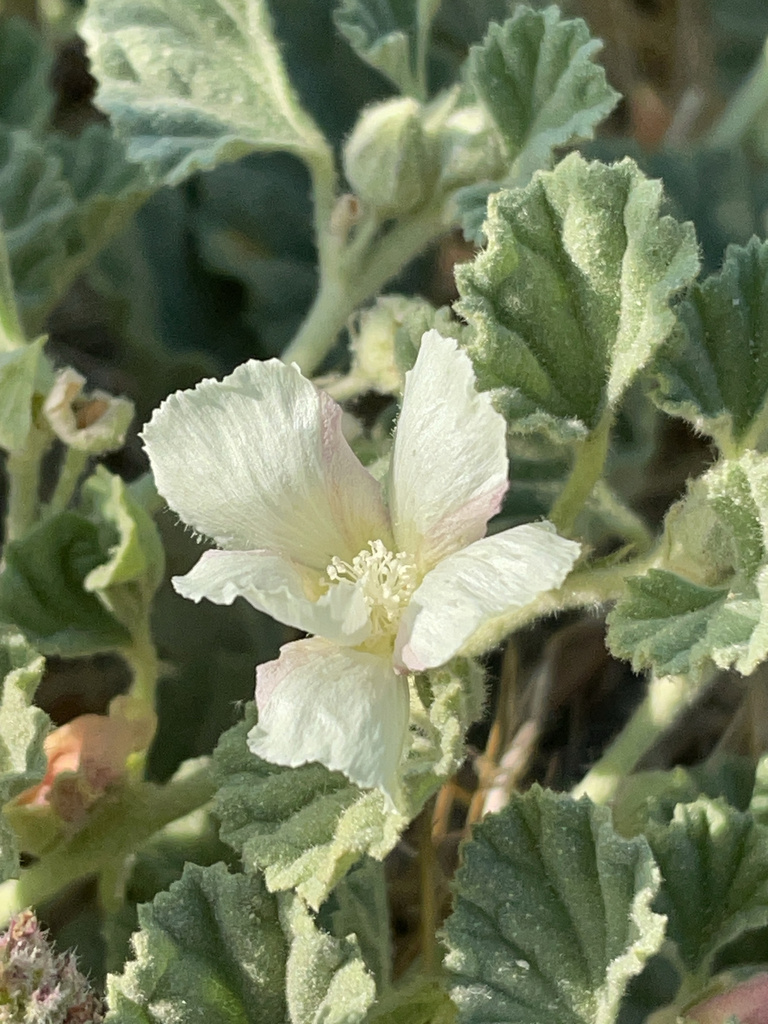
The leaves are alternate, about 1/2 to 1 1/2 inches long, broadly fan-shaped to kidney-shaped and often lopsided at the base, with shallowly toothed edges. They are gray-green to whitish and densely covered with star-shaped (stellate) and flattened, scale-like hairs that give the plant a scurfy texture. The leaf stalks are often about as long as the blades.
Flowers
From May to September (into October in mild areas), single flowers open on short stalks in the leaf axils. Each flower is about 3/4 to 1 1/4 inches across, with five broad, creamy white to pale yellow petals that may age to pinkish, and a central column of fused stamens typical of mallows. The bud is enclosed by a hairy, five-lobed calyx.
Fruit
The fruit is a flattened, disk-shaped schizocarp that breaks into about six to ten wedge-shaped segments, each with one seed. Plants growing in dense patches often set little seed and spread mainly by roots.
Look-alikes
Globemallows (Sphaeralcea), such as scarlet globemallow, grow in similar dry places but have orange to red flowers and more deeply lobed leaves. Common mallow (Malva neglecta), an introduced weed, has round, green leaves with only a few hairs and smaller white to pale pink flowers. Alkali mallow’s scurfy, gray leaves and creamy flowers are distinctive.
Quick Facts
| Scientific Name | Malvella leprosa |
| Family | Malvaceae (mallow family) |
| Plant Type | Herbaceous perennial; creeping, deep-rooted |
| Mature Height | 4–12 in |
| Mature Spread | Spreads indefinitely by roots |
| Growth Rate | Fast |
| Sun Exposure | Full sun |
| Water Needs | Low to medium; tolerates seasonal flooding |
| Soil Type | Alkaline or saline clay, silt or sand |
| Soil pH | Alkaline (about 7.0–9.0) |
| Bloom Time | May–September |
| Flower Color | Creamy white to pale yellow |
| Fall Color | None notable |
| Fruit | Disk-shaped schizocarp |
| Deer Resistant | Moderately; scurfy leaves are not favored |
| USDA Hardiness Zones | 5–10 |
Native Range
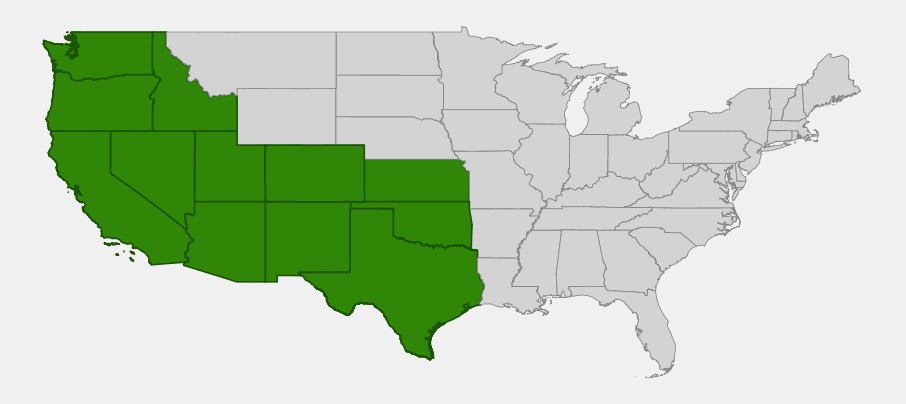
Alkali mallow is native in 12 western and south-central states, according to USDA PLANTS: Washington, Oregon, Idaho, California, Nevada, Utah, Arizona, Colorado, New Mexico, Kansas, Oklahoma and Texas. It also grows in northern and central Mexico and, in a classic example of a plant split between North and South America, in Argentina and Chile. It has been introduced to Australia, where it is regarded as a weed.
In the Northwest it grows east of the Cascades, in the sagebrush and alkali flats of central and eastern Washington and Oregon and southern Idaho; in Washington it is uncommon enough that the state Natural Heritage Program has it on a review list. It is widespread in California’s Central Valley, coastal valleys and southern California, across the Great Basin and the desert Southwest, and east into the High Plains of western Kansas, western Oklahoma and West Texas.
Typical habitats are alkaline and somewhat saline flats, playa and pond margins, floodplains, moist valley bottoms, grasslands and desert scrub, as well as ditches, roadsides, field edges, orchards and other disturbed ground, from near sea level to about 6,000 feet.
📋 Regional plant lists featuring Alkali Mallow: Idaho, Eastern Oregon & Eastern Washington · Nebraska, Kansas & Eastern Colorado · Utah & Western Colorado · Arizona & New Mexico · South & West Texas · California & Nevada
Growing & Care Guide
Be honest with yourself before planting alkali mallow. It is tough, attractive in a low-key way and well adapted to difficult alkaline ground, but its roots run deep and wide, and pulling or tilling only breaks them into pieces that sprout again. Plant it only where it can spread freely and will not escape into gardens or crop fields.
Light
Full sun. It tolerates very hot, open sites.
Soil & Water
It grows best in alkaline or mildly saline clay, silt or sand, including heavy soils that are wet in winter and dry in summer. Once established it is drought tolerant thanks to its deep roots, and it also tolerates seasonal flooding. Irrigation and rich soil make it spread even faster.
Planting Tips
Use it as a groundcover for alkali flats, saline pond margins, roadside and ditch restoration, or barren spots where little else grows. Keep it well away from vegetable gardens, lawns, orchards and farm fields. Root barriers must be deep to have any effect, so choosing the right site is the only reliable control.
Pruning & Maintenance
Little care is needed. Mowing or cutting the stems keeps patches low but does not reduce spreading. To remove unwanted plants, dig out as much root as possible and keep removing new shoots; repeated removal over several seasons is usually needed.
Propagation
Root cuttings and divisions root easily. Seed has a hard coat and germinates better after scarification (nicking or sanding the seed coat) and sowing in warm soil.
Landscape Uses
- Alkali flat restoration: one of few flowering plants for saline, alkaline ground
- Erosion control: deep roots hold bare soil
- Pond and playa margins: tolerates seasonal flooding and drought
- Wild areas: low, gray-green cover with creamy flowers all summer
- Pollinator habitat: long bloom for native bees in harsh sites
Wildlife & Ecological Value
On the alkaline flats and valley bottoms where it grows, alkali mallow is one of the few plants that flowers through the heat of summer.
For Pollinators
The flowers are visited by native bees, including specialist mallow bees (such as Diadasia species), as well as honey bees and other insects. Its long summer bloom is useful in harsh sites with few other flowers.
For Birds
Seeds are eaten by ground-feeding birds such as doves, quail and sparrows, and the low mats shelter insects that birds eat.
For Mammals
Rabbits and rodents may nibble the foliage, but the scurfy leaves are not a favored forage for livestock or deer.
Ecosystem Role
Its deep, spreading roots stabilize alkaline and saline soils on flats, floodplains and disturbed ground. Mallows host the caterpillars of several butterflies, including checkered-skippers and the painted lady, which may use alkali mallow among other members of the family.
Cultural & Historical Uses
The species was first described in the late 1700s by the Spanish botanist Casimiro Gómez Ortega as Malva leprosa, based on plants from South America. It has since been placed in Sida, Disella and other genera, and North American botanists long called it Sida hederacea, the ivy-leaved sida. Today it is placed in the small genus Malvella.
Alkali mallow is one of a number of plants with an amphitropical distribution, growing in the dry regions of both western North America and southern South America but not in the tropics between them. Botanists think such plants crossed the tropics long ago, probably with migrating birds.
In agriculture, alkali mallow has long been known as a stubborn weed of irrigated fields, including cotton, alfalfa and orchards in the West. Its deep roots and ability to resprout from root fragments make it hard to control by cultivation alone.
Frequently Asked Questions
Is alkali mallow native?
Yes. It is native across the western and south-central United States, as well as Mexico, Argentina and Chile. It is introduced in Australia.
Is alkali mallow invasive?
It is native, but it is aggressive. Its deep creeping roots spread it into large patches, and it is a common weed of irrigated fields and roadsides. Plant it only in wild or restoration sites where it can spread.
How do I get rid of alkali mallow?
Dig out as much root as possible and keep removing new shoots over several seasons. Tilling breaks the roots into pieces that can resprout.
Does alkali mallow tolerate salty soil?
Yes. It grows well in alkaline and somewhat saline soils, such as playa margins and alkali flats.
What color are alkali mallow flowers?
Creamy white to pale yellow, sometimes aging pinkish, about an inch across.

Looking for a nursery that carries Alkali Mallow?
Browse our native plant nursery directory: Arizona · California · Colorado · Idaho & Kansas · Nevada, New Mexico & Oklahoma · Oregon · Texas & Utah · Washington

