
Narrowleaf Mountain Trumpet (Collomia linearis)
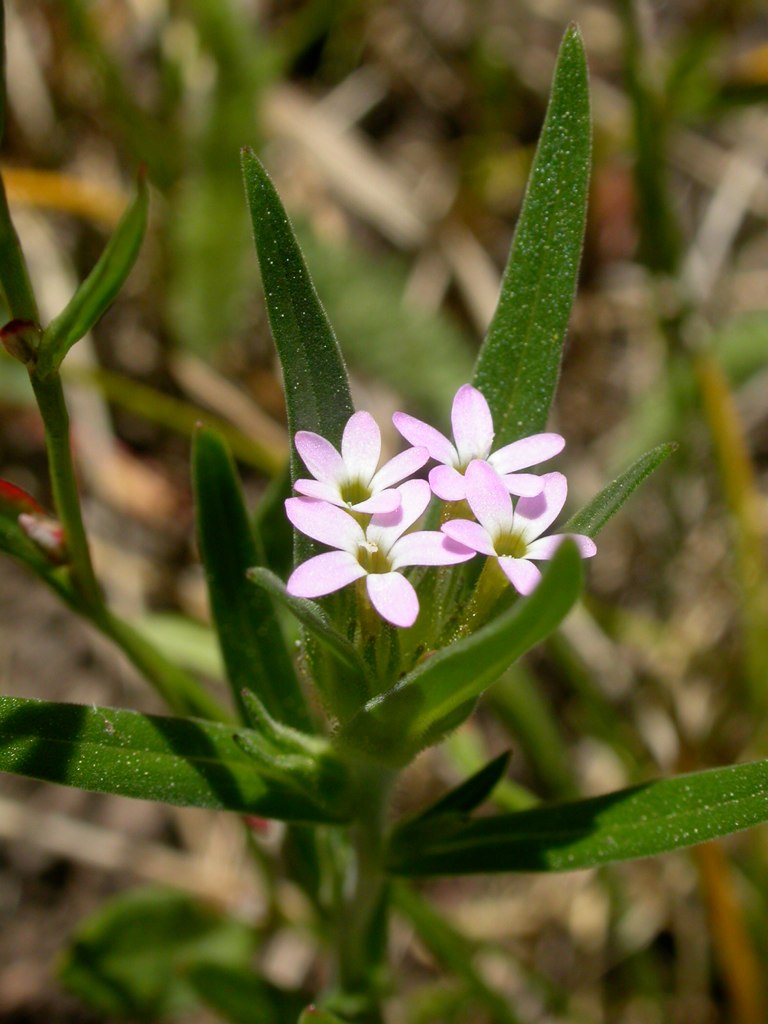
Collomia linearis, known as Narrowleaf Mountain Trumpet, tiny trumpet (the name used by USDA PLANTS) or slenderleaf collomia, is a small annual wildflower of western North America. It grows as a slender, upright stem 4 to 20 inches tall with narrow, pointed leaves, topped by a dense, leafy cluster of small pink, lavender or white trumpet-shaped flowers from late spring through summer.
It is a member of the phlox family (Polemoniaceae) and one of the most widespread annuals in the West, found from Alaska and the Yukon south to California, Arizona and New Mexico, and east across the northern Great Plains to Minnesota and Wisconsin. It thrives in open, sunny places: dry meadows, sagebrush flats, open pine forests, burned areas, gravel bars and roadsides, often appearing in large numbers after a disturbance such as fire.
Its seeds have a clever trick: when wet, the seed coat becomes sticky and releases fine, coiled threads that glue the seed to the soil. The plant has also spread well beyond its native range as a weed of railroads and disturbed ground in the eastern United States and Europe. This guide covers how to identify narrowleaf mountain trumpet, where it is native, and how to grow it in dry western meadow gardens.
Identification
Narrowleaf mountain trumpet is small but distinctive: a single, usually unbranched stem with narrow, alternate leaves, ending in a tight cluster of tiny trumpets nestled among leafy bracts.
Stems & Growth Habit
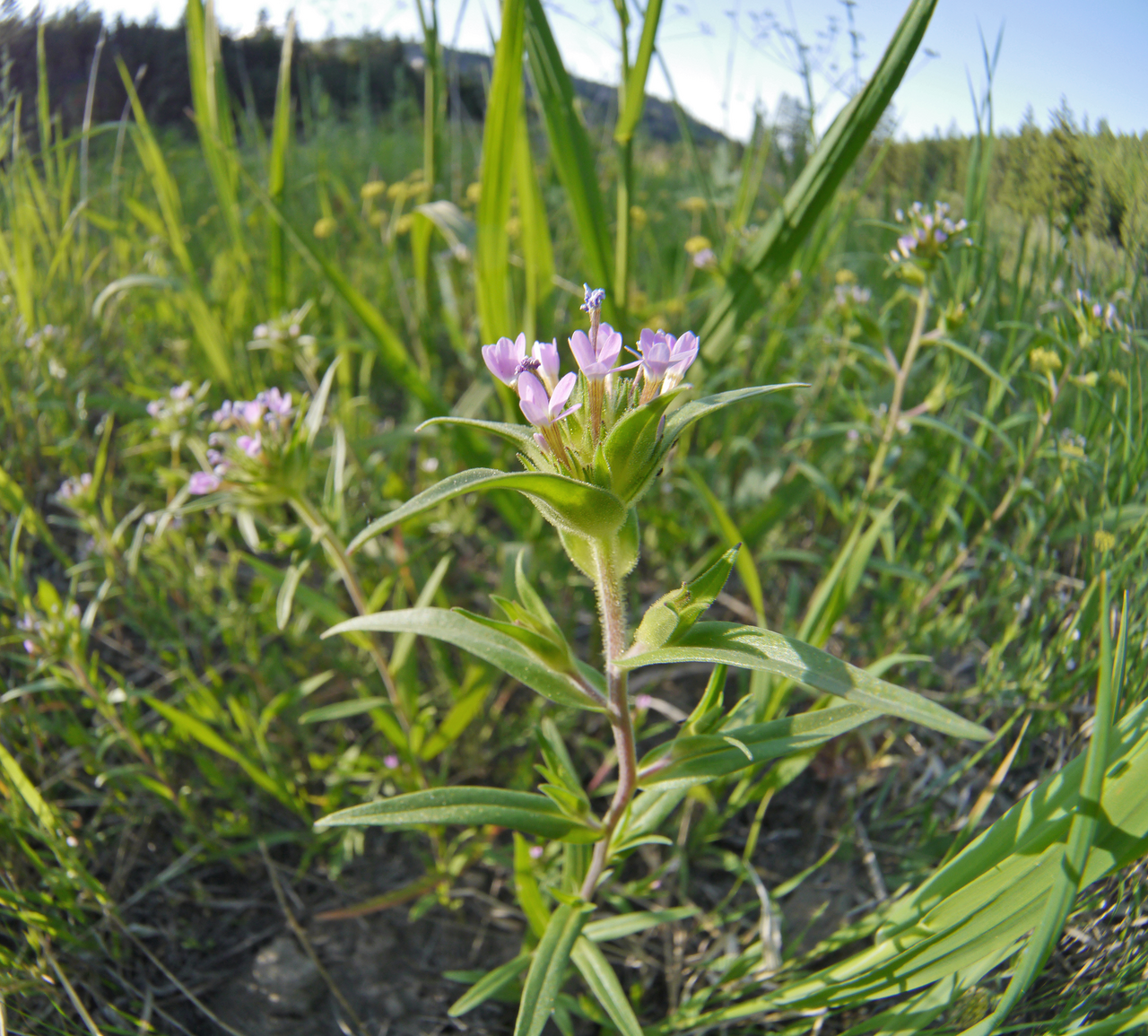
This annual usually grows as a single, upright stem 4 to 20 inches tall, sometimes branching near the top in larger plants. The stem is finely hairy, and the upper parts are often sticky with glandular hairs. Plants grow singly or in loose groups, and can be abundant in open, disturbed areas.
Leaves
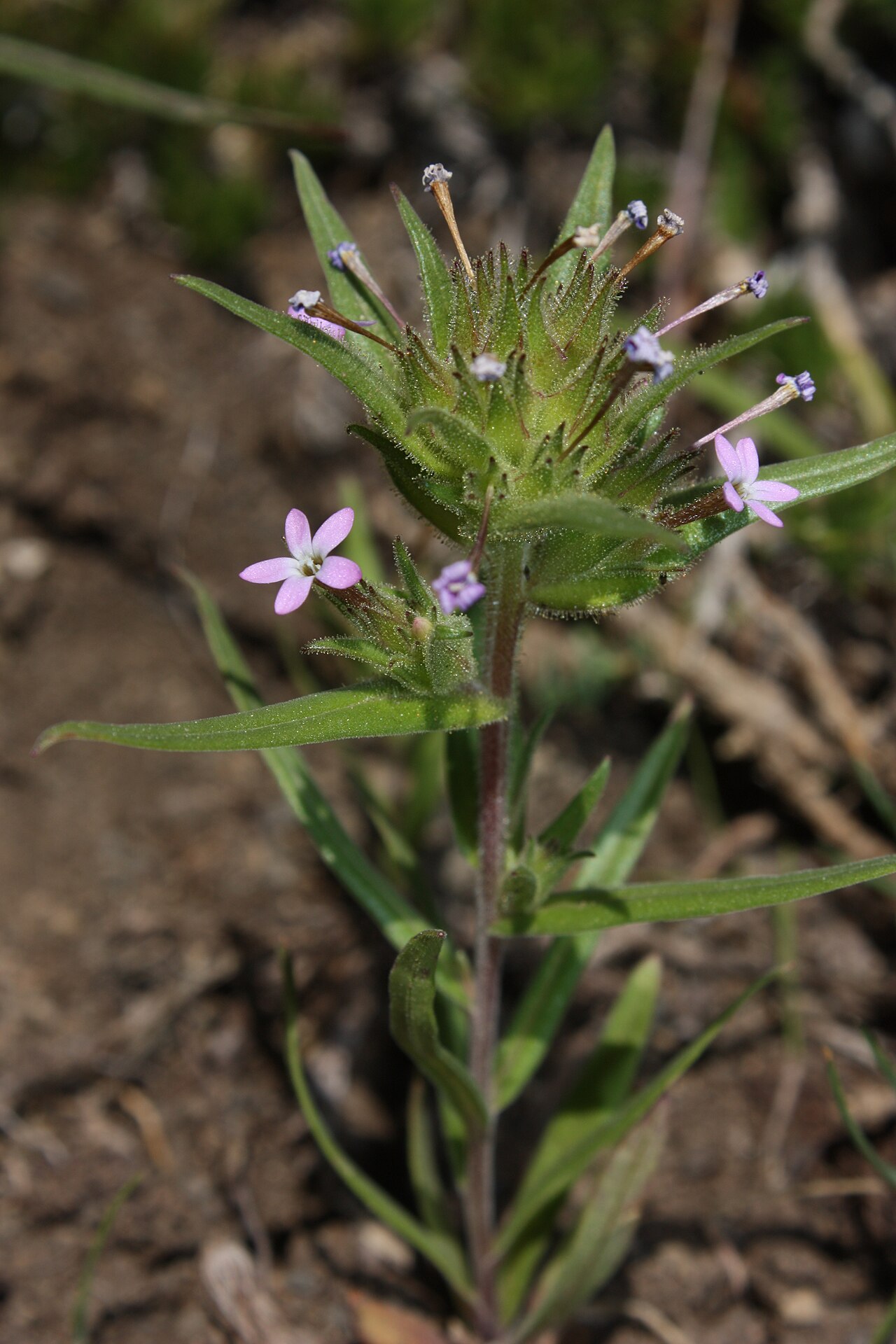
The leaves are alternate, narrowly lance-shaped to linear, about 1 to 2½ inches long, mostly stalkless, with smooth edges and pointed tips. They are often slightly hairy. The upper leaves and leafy bracts around the flower cluster are broader and more crowded.
Flowers
The flowers grow in a dense, rounded head at the top of the stem and sometimes in smaller clusters in the upper leaf axils. Each flower is a slender tube about ⅜ to ½ inch long, flaring into five small, rounded lobes about ¼ inch across. They are pink to lavender, sometimes nearly white. The calyx and bracts are glandular-hairy. Plants bloom from about May to August, depending on elevation and latitude.
Fruit & Seeds
Each flower produces a small, three-chambered capsule with one seed in each chamber. When wet, the seed coat becomes mucilaginous and releases tiny spiraling threads that help the seed stick to soil. After flowering, the bracts around the seed cluster enlarge and become conspicuous.
Look-alikes
Grand collomia (Collomia grandiflora) is a taller annual with larger, salmon to pale orange flowers. Variableleaf collomia (C. heterophylla) has toothed or lobed leaves and grows in western Oregon, Washington and California. Some gilias and phloxes are also similar but have different leaf shapes and flower arrangements.
Quick Facts
| Scientific Name | Collomia linearis |
| Family | Polemoniaceae (phlox family) |
| Plant Type | Annual herb |
| Mature Height | 4–20 in |
| Mature Spread | 2–6 in |
| Growth Rate | Fast |
| Sun Exposure | Full sun to light shade |
| Water Needs | Low to medium |
| Soil Type | Sandy, gravelly or loamy soils; tolerates disturbed ground |
| Soil pH | About 6.0–8.0 |
| Bloom Time | May–August |
| Flower Color | Pink to lavender, sometimes white |
| Fall Color | None; dies after setting seed |
| Fruit | Small three-chambered capsule with sticky seeds |
| Deer Resistant | Moderate |
| USDA Hardiness Zones | Annual; native across zones 2–9 |
Native Range
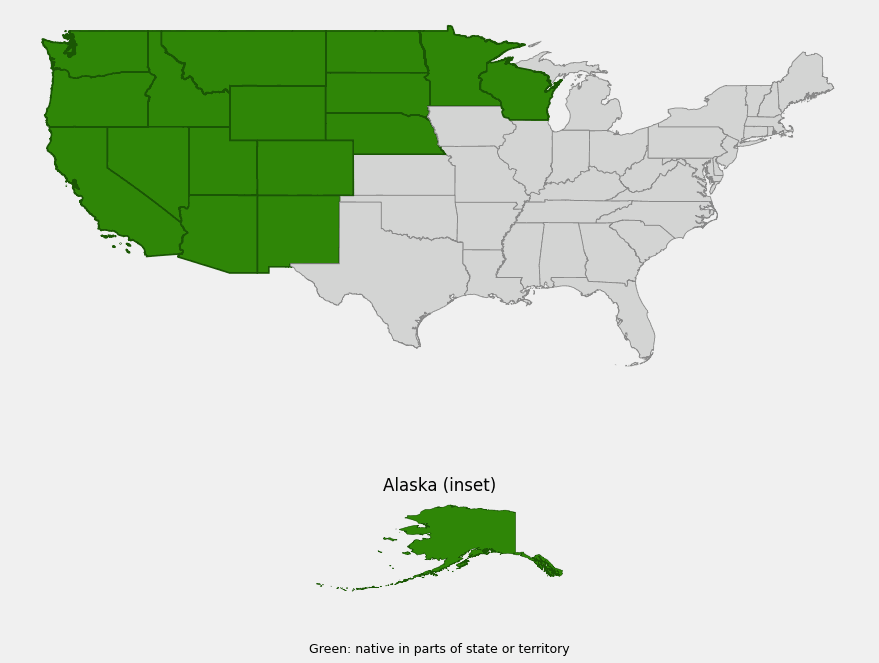
Narrowleaf mountain trumpet is native across much of western and northern North America. In the United States it is native from Alaska south through Washington, Oregon, Idaho, Montana and Wyoming to California, Nevada, Utah, Colorado, Arizona and New Mexico, and east across the northern Great Plains in North Dakota, South Dakota, Nebraska, Minnesota and Wisconsin. In Canada it is native from the Yukon and Northwest Territories south through British Columbia, Alberta, Saskatchewan and Manitoba to Ontario.
USDA PLANTS also lists it in several eastern states, but state floras and NatureServe treat it as introduced in New England, New York, New Jersey, Ohio, Indiana, Illinois, Iowa and Michigan, where it grows as a weed of railroads, fields and waste places; it is also not native in Pennsylvania or Missouri. Those states are left out of the native range on this page. In eastern Canada it is likewise introduced in Quebec and the Maritime provinces, and it has naturalized in parts of Europe.
Within its native range it is a plant of open places, from sagebrush steppe and dry meadows to open ponderosa pine and mixed conifer forests, aspen groves, gravelly streambanks, rocky slopes and subalpine meadows. It is especially common after fires and on disturbed soil, such as roadsides, trails and old fields, and it grows on both sides of the Cascades in Washington and Oregon.
📋 Regional plant lists featuring Narrowleaf Mountain Trumpet: Idaho, Eastern Oregon & Eastern Washington · Montana & Wyoming · Michigan, Wisconsin & Eastern Minnesota · Nebraska, Kansas & Eastern Colorado · Utah & Western Colorado · Arizona & New Mexico · Alaska · North Dakota, South Dakota & Western Minnesota · Western Oregon & Western Washington · California & Nevada
Growing & Care Guide
Narrowleaf mountain trumpet is an easy annual for western meadow and wildflower gardens. It grows quickly from seed, needs no care once it germinates, and reseeds itself in open, sunny spots. It is not a showy plant on its own, but in drifts it adds a haze of pink and lavender in early summer. Gardeners in the East should not plant it, since it is not native there and can naturalize as a weed.
Light
Full sun to light shade. It does best in open sites, such as meadows and the edges of open woods.
Soil & Water
It prefers well-drained sandy, gravelly or loamy soils and does well in poor soils. It needs moisture in spring to germinate and grow, then tolerates dry conditions as it flowers and sets seed. No fertilizer is needed.
Planting Tips
Sow seed directly where you want plants to grow, in fall or early spring, on bare or lightly disturbed soil. Rake it in lightly; the seeds attach themselves to the soil when wet. Mix it with other native annuals and perennial bunchgrasses in a meadow planting.
Pruning & Maintenance
No pruning is needed. Let plants set seed before removing them if you want them to return next year. Since it is an annual that needs open ground, it may fade out of a planting as perennials fill in unless some bare soil remains.
Propagation
It grows only from seed. Collect seed from dry capsules in late summer and sow it outdoors in fall, which gives it a natural cold period over winter. It germinates in spring and blooms the same year.
Landscape Uses
- Western meadow and wildflower gardens: drifts of small pink flowers in early to midsummer
- Post-fire and disturbed-site restoration: a quick-growing native annual that colonizes bare ground
- Pollinator gardens: nectar for small bees, butterflies and other insects
- Rock gardens and gravel beds: in dry, sunny, well-drained sites
- Natural areas: a widespread native annual of open western habitats
Wildlife & Ecological Value
Small as it is, narrowleaf mountain trumpet is a useful nectar plant and an early colonizer of bare ground in western landscapes.
For Pollinators
The narrow, tubular flowers are visited by small bees, butterflies, moths and flies, which reach the nectar at the base of the tube. The plant can also self-pollinate, which helps it produce seed even when insects are scarce.
For Birds
Seed-eating birds may feed on the small seeds, and the plant contributes to the diverse wildflower cover of open western habitats.
For Mammals
Deer, elk and livestock may graze it lightly along with other forbs, but it is not a major food source.
Ecosystem Role
As a fast-growing annual, it quickly colonizes bare soil after fires, floods and other disturbances. Its sticky seeds stay in place on bare ground, helping it establish where other plants have been removed. Its cover helps hold soil until perennials return.
Cultural & Historical Uses
The genus name Collomia comes from the Greek kolla, “glue,” referring to the sticky, mucilaginous seeds. The species name linearis refers to the narrow, linear leaves. It was first described by Thomas Nuttall from plants collected in the West.
Some Great Basin peoples, including the Gosiute, reportedly used the plant medicinally, such as in a poultice. These are historical uses and should not be tried without expert knowledge.
Narrowleaf mountain trumpet is one of many western annuals that spread east and overseas with the railroads, grain and wool shipments of the 1800s and 1900s. Its weedy eastern populations contrast with its role as a native wildflower in the West.
Frequently Asked Questions
Is narrowleaf mountain trumpet native?
Yes, in western and northern North America, from Alaska to New Mexico and east to Minnesota and Wisconsin. It is introduced in New England, New York, the Midwest east of Wisconsin and parts of Europe.
Is it an annual?
Yes. It germinates in spring, blooms in summer, sets seed and dies. It returns from seed.
What is tiny trumpet?
Tiny trumpet is another common name for Collomia linearis, and it is the name used by USDA PLANTS. It is also called slenderleaf collomia.
Where does it grow?
In open, sunny places: dry meadows, sagebrush, open pine forests, burned areas, gravel bars, roadsides and other disturbed ground.
Why are the seeds sticky?
When wet, the seed coat becomes mucilaginous and releases threads that glue the seed to the soil. This helps it stay in place on bare ground.

Looking for a nursery that carries Narrowleaf Mountain Trumpet?
Browse our native plant nursery directory: Alaska & Arizona · California · Colorado · Idaho · Minnesota & Montana · Nebraska, Nevada, New Mexico & North Dakota · Oregon · South Dakota & Utah · Washington · Wisconsin & Wyoming

