
Hairy Beardtongue (Penstemon hirsutus)
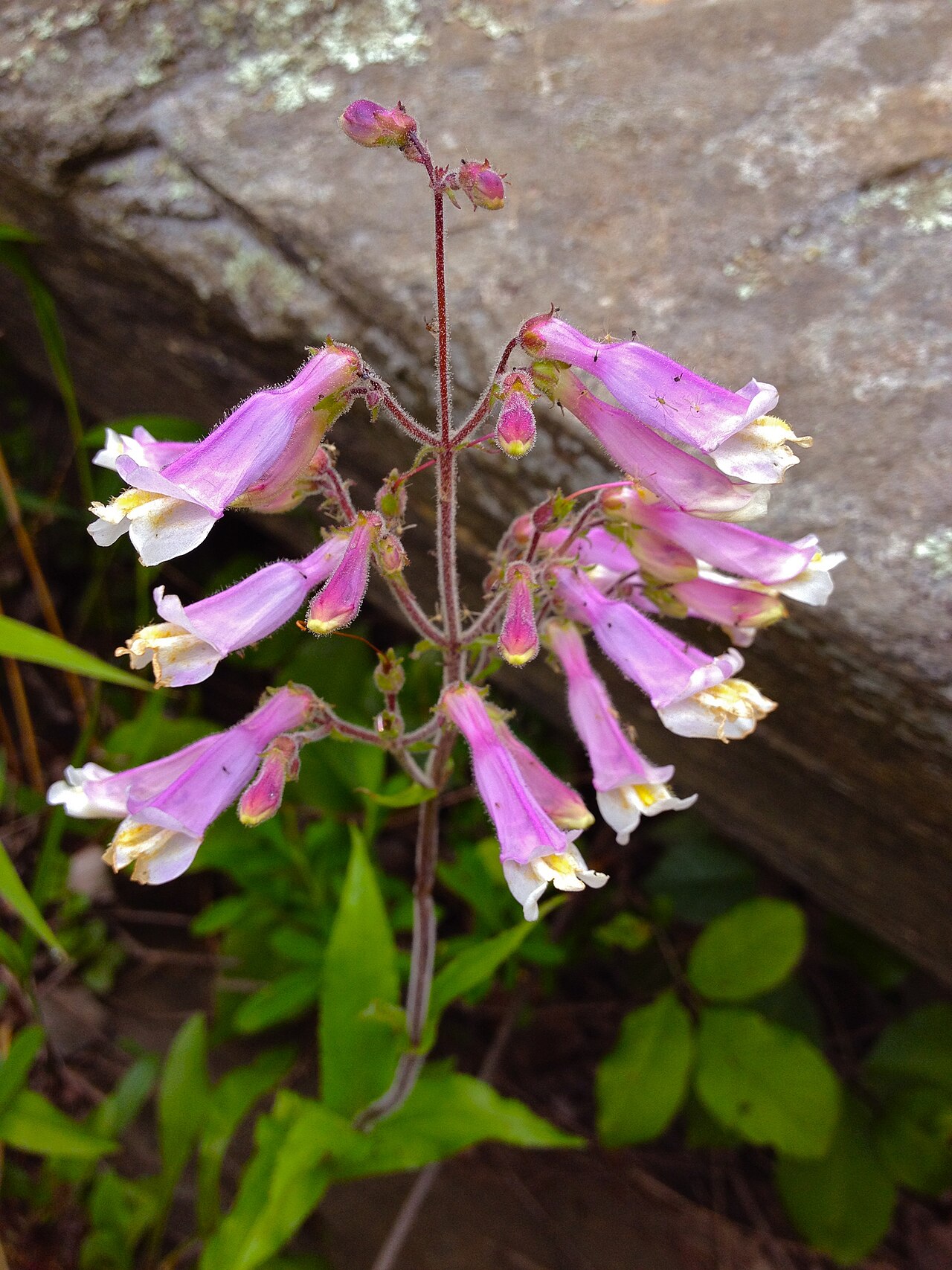
Penstemon hirsutus, known as Hairy Beardtongue or northeastern beardtongue, is a compact, early-summer wildflower of dry woods, rocky slopes, ledges and old fields in the northeastern and north-central United States and southeastern Canada. In late spring and early summer its fuzzy stems carry loose clusters of tubular, lavender to pinkish-violet flowers with white lips. Unlike most beardtongues, its flowers are almost closed at the mouth, so bees have to push their way in.
It belongs to the plantain family (Plantaginaceae), which now includes the penstemons once placed in the figwort family. The name “beardtongue” refers to the sterile fifth stamen (staminode), which in this species is densely bearded with yellow hairs and often sticks out of the flower like a small tongue. “Hairy” refers to the soft and glandular hairs on its stems and flower stalks.
Hairy beardtongue is one of the best penstemons for eastern gardens: it stays under 3 feet, tolerates dry, thin soil and part shade, and draws bumble bees and other native bees. It is rare at the edges of its range and is listed as endangered in Massachusetts, so grow nursery-propagated plants and leave wild ones in place. This guide covers how to identify it, where it grows and how to grow it.
Identification
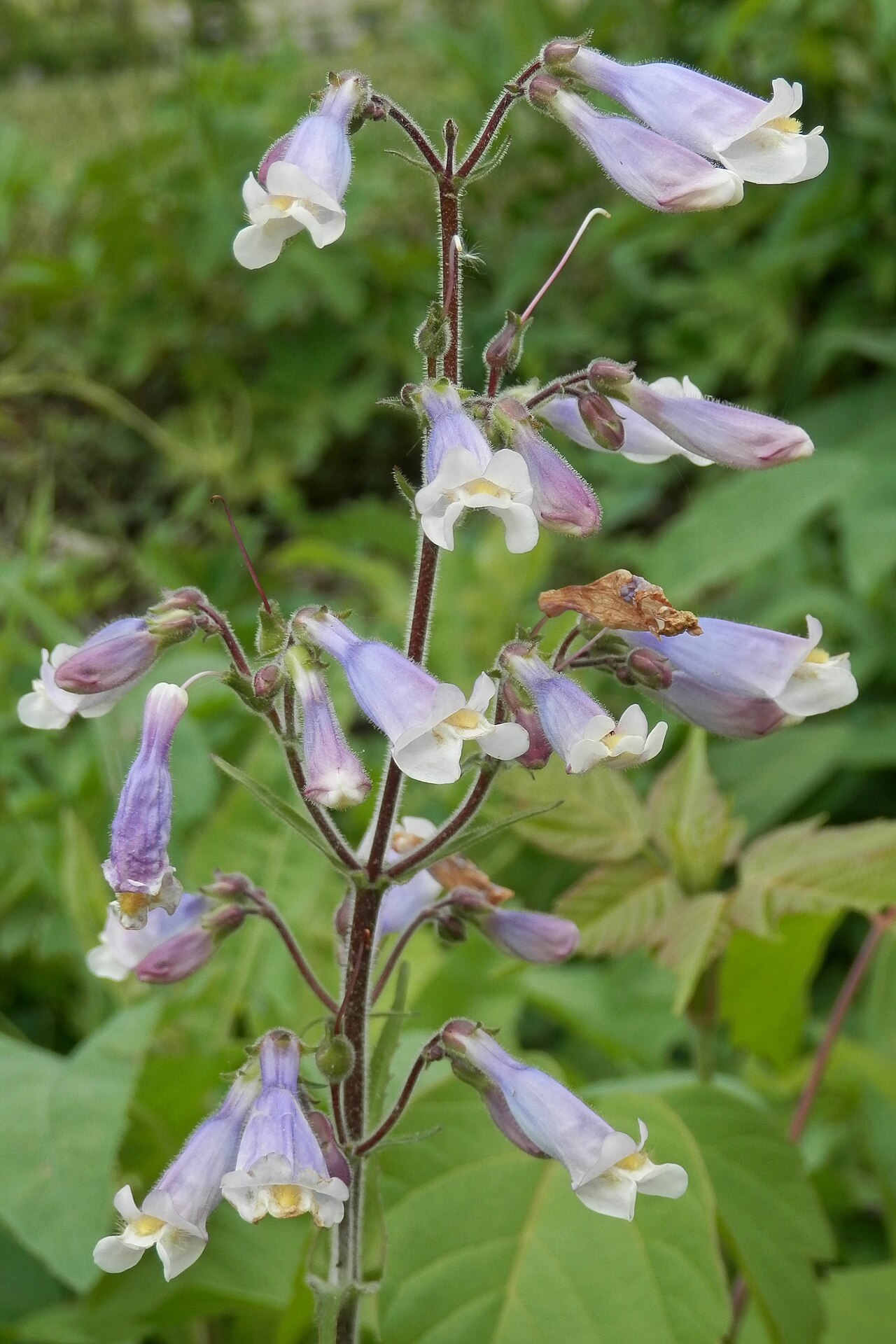
Hairy beardtongue is easiest to recognize in bloom by its lavender, white-lipped flowers whose throats are nearly closed by the raised lower lip, and by its hairy, often purplish stems.
Stems & Growth Habit
It is a short-lived to moderately long-lived perennial that forms a low clump with a basal rosette of leaves. Several upright flowering stems, usually 1 to 2½ feet tall, rise from the rosette in spring. The stems are often purplish and are covered with fine, spreading hairs, which become glandular and slightly sticky in the flower cluster.
Leaves
The basal leaves are oblong to lance-shaped with short stalks and often stay green or turn purplish through winter. The stem leaves are opposite, stalkless, lance-shaped and about 2 to 4½ inches long, with small, widely spaced teeth along the edges. They are smooth to slightly hairy.
Flowers
The flowers are borne in a loose, open, branched cluster at the top of the stem. Each flower is tubular, about ¾ to 1¼ inches long, pale lavender to pinkish violet on the outside with a white to pale lavender, two-lipped mouth. The lower lip has a raised, hairy ridge (palate) that nearly closes the throat. Inside, the bearded staminode is covered with golden-yellow hairs and often projects beyond the mouth. Hairy beardtongue blooms from about May to July.
Fruit & Seeds
Each flower forms a small, egg-shaped, pointed capsule that turns brown and splits in late summer, releasing many tiny, angular seeds. The dry stems and capsules often persist into winter.
Similar Species
Foxglove beardtongue (Penstemon digitalis) is taller, with larger, mostly white, open-mouthed flowers. Eastern smooth beardtongue (P. laevigatus) has smoother stems and open-throated flowers. Gray beardtongue (P. canescens) of the Appalachians has more purple, open flowers and grayish, downy leaves.
Quick Facts
| Scientific Name | Penstemon hirsutus (L.) Willd. |
| Family | Plantaginaceae (plantain family) |
| Plant Type | Herbaceous perennial wildflower |
| Mature Height | 1–2½ ft |
| Mature Spread | 1–1½ ft |
| Growth Rate | Moderate |
| Sun Exposure | Full sun to part shade |
| Water Needs | Low; dry to medium soil |
| Soil Type | Thin, rocky, sandy or loamy well-drained soils, including limestone |
| Soil pH | About 5.5–8.0 |
| Bloom Time | May–July |
| Flower Color | Pale lavender to pinkish violet with white lips |
| Fall Color | Basal leaves often turn purple to burgundy |
| Fruit | Small brown capsule with many tiny seeds |
| Deer Resistant | Moderately; seldom heavily browsed |
| USDA Hardiness Zones | 3–8 |
Native Range
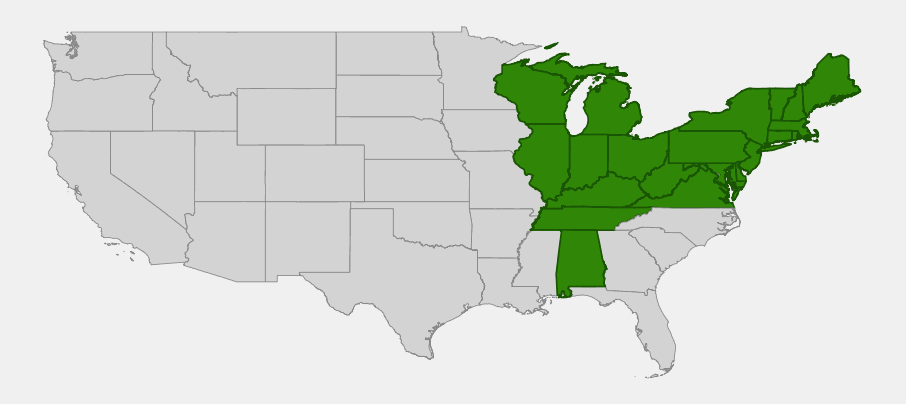
Hairy beardtongue is native to eastern North America. USDA PLANTS lists it in Alabama, Connecticut, Delaware, Illinois, Indiana, Kentucky, Maine, Maryland, Massachusetts, Michigan, New Hampshire, New Jersey, New York, Ohio, Pennsylvania, Rhode Island, Tennessee, Vermont, Virginia, West Virginia and Wisconsin, as well as the District of Columbia, and in Ontario and Quebec in Canada. Its core range runs from New York and Pennsylvania west through Ohio and Michigan to Wisconsin, with scattered populations south to Kentucky, Tennessee and northeastern Alabama.
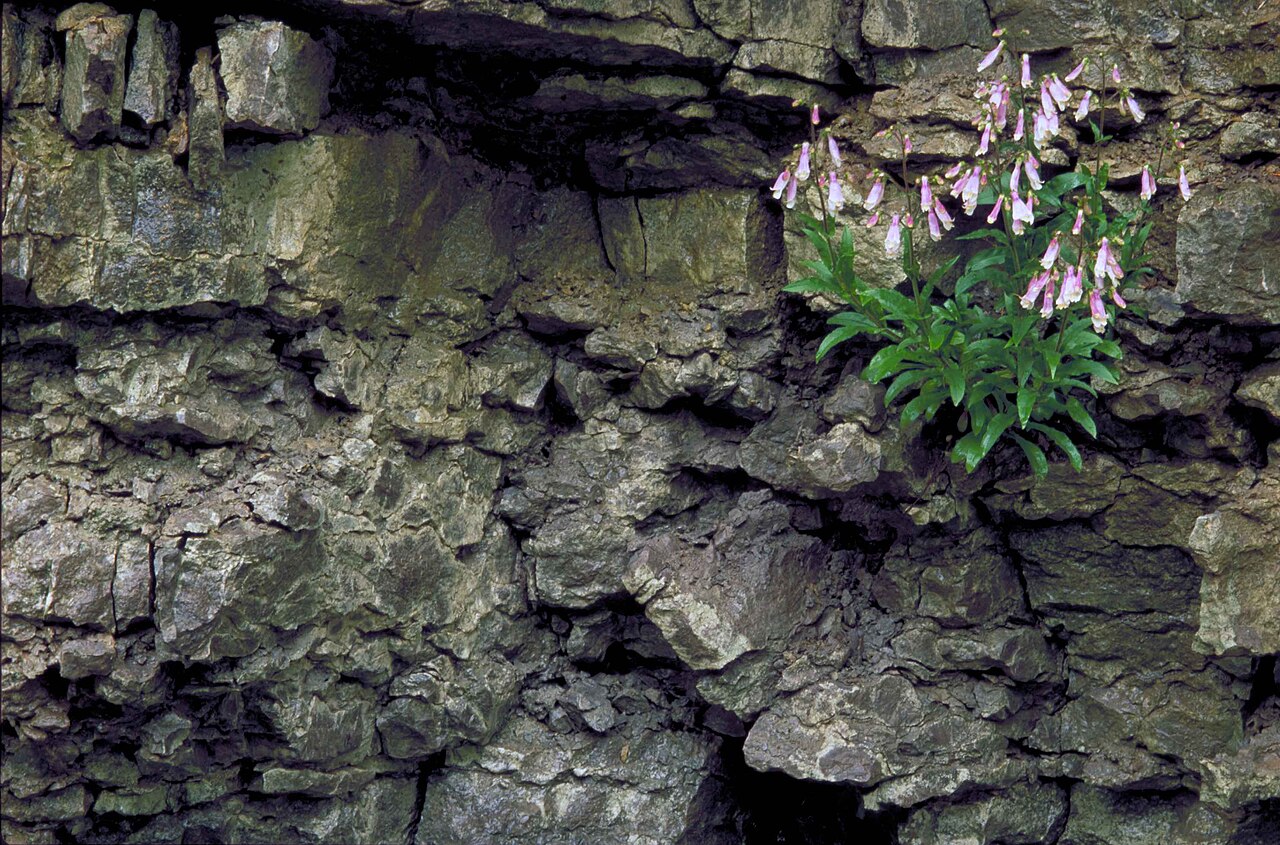
It grows in dry, open, often rocky places: dry oak woods and woodland edges, rocky slopes, bluffs and ledges, limestone and shale outcrops, river banks, old fields and roadsides. It favors thin, well-drained soils where taller plants are sparse, and it is often found on calcareous (limestone) soils.
It is uncommon to rare near the edges of its range. In New England it is listed as endangered in Massachusetts and ranked extremely rare in Rhode Island, and some northern New England populations may have escaped from gardens. Within its core range in New York, Pennsylvania, Ohio and the Great Lakes states it is more widespread.
📋 Regional plant lists featuring Hairy Beardtongue: Alabama, Georgia & Mississippi · Maryland, Virginia & West Virginia · Kentucky & Tennessee · Illinois, Iowa & Missouri · Ohio & Indiana · Michigan, Wisconsin & Eastern Minnesota · New York, Pennsylvania & Northern New Jersey · Delaware, Southern New Jersey & Long Island · Connecticut, Massachusetts & Rhode Island · New Hampshire, Maine & Vermont
Growing & Care Guide
Hairy beardtongue is an easy, adaptable native for sunny to lightly shaded gardens with average to dry, well-drained soil. It is offered by many native plant nurseries, and a dwarf selection, ‘Pygmaeus’, is popular in rock gardens. Choose nursery-propagated plants, especially in New England, where wild populations are rare.
Light
It flowers best in full sun to light shade. It tolerates part shade, such as the edge of a woodland or the east side of a building, but flowers less in deep shade.
Soil & Water
Plant it in well-drained soil: sandy, gravelly, rocky or average loam. It tolerates dry, thin and alkaline soils. Avoid heavy, wet clay, especially in winter, which can rot the crown. Water during establishment; once rooted it is drought tolerant.
Planting Tips
Plant in spring or early fall, about 12 to 18 inches apart. It suits rock gardens, dry slopes, the front of a border, and woodland edges with columbine and sedges. Give it good air circulation and avoid heavy mulch over the crown.
Pruning & Maintenance
Cut flower stems back after bloom if you want a tidy look, or leave some to drop seed. Like many penstemons it can be short-lived, but it often reseeds lightly to replace itself. It needs no fertilizer.
Propagation
Sow seed outdoors in fall, or give it about 60 days of cold, moist stratification before spring sowing; seeds need light, so press them onto the surface. Established clumps can be divided in early spring, and soft basal cuttings root readily.
Landscape Uses
- Rock gardens: compact, drought-tolerant, and at home in thin, rocky soil
- Pollinator gardens: early-summer nectar and pollen, especially for bumble bees
- Woodland edges: tolerates part shade and dry soil under open trees
- Dry slopes and banks: for thin, well-drained soils where lawn struggles
- Habitat restoration: in rocky openings, barrens and dry woods within its range
Wildlife & Ecological Value
Hairy beardtongue’s nearly closed flowers are built for strong bees, and it is an important early-summer flower for native pollinators in dry, open habitats.
For Pollinators
Bumble bees are the main pollinators, strong enough to push open the narrow throat and reach the nectar. Mason bees, other native bees and some specialist penstemon bees also visit, and hummingbirds occasionally take nectar.
For Birds
Small birds may eat some of the tiny seeds, but it is not a major bird food. Ruby-throated hummingbirds visit the flowers from time to time.
For Mammals
Deer and rabbits browse it only occasionally. Its hairy, somewhat bitter foliage is not a preferred food.
Ecosystem Role
It is part of the wildflower community of dry, open, rocky habitats such as limestone barrens, ledges and oak woodland edges, where it helps support early-summer pollinators between the spring ephemerals and the summer prairie flowers.
Cultural & Historical Uses
Carl Linnaeus first described this plant in 1753 as Chelone hirsuta, placing it with the turtleheads. Carl Ludwig Willdenow later moved it to Penstemon, a large North American genus of about 250 species, most of them in the West. Hairy beardtongue is one of the most northeastern members of the genus.
The genus name Penstemon is usually explained as “five stamens,” for the fifth, sterile stamen found in these flowers in addition to the four fertile ones. In hairy beardtongue that fifth stamen is especially showy, covered with golden hairs, which gives the plant and its relatives the name beardtongue.
Hairy beardtongue has long been grown in gardens in North America and Europe. The dwarf form ‘Pygmaeus’, only about 6 inches tall, is a favorite with rock gardeners, while the wild form is increasingly used in native plantings and pollinator gardens in the Northeast and Great Lakes region.
Frequently Asked Questions
Why is it called hairy beardtongue?
“Hairy” refers to the soft, partly glandular hairs on its stems and flower stalks. “Beardtongue” refers to the sterile fifth stamen, which is covered with golden hairs and sticks out of the flower like a bearded tongue.
When does hairy beardtongue bloom?
From about May to July, with the main bloom in late spring and early summer.
Does hairy beardtongue grow in shade?
It grows best in full sun to light shade and tolerates part shade at woodland edges, but it flowers less in deep shade.
Is hairy beardtongue rare?
It is common in parts of its core range but rare at the edges. It is listed as endangered in Massachusetts and is extremely rare in Rhode Island. Buy nursery-propagated plants and never dig wild ones.
Is hairy beardtongue good for pollinators?
Yes. Its flowers are especially important for bumble bees, which can push open the nearly closed throat, and they are also visited by other native bees and occasionally by hummingbirds.

Looking for a nursery that carries Hairy Beardtongue?
Browse our native plant nursery directory: Alabama · Connecticut & Delaware · Illinois & Indiana · Kentucky, Maine, Maryland, Massachusetts & Michigan · New Hampshire, New Jersey, New York & Ohio · Pennsylvania, Rhode Island, Tennessee, Vermont & Virginia · West Virginia & Wisconsin

