
Stiff-hair Sunflower (Helianthus hirsutus)
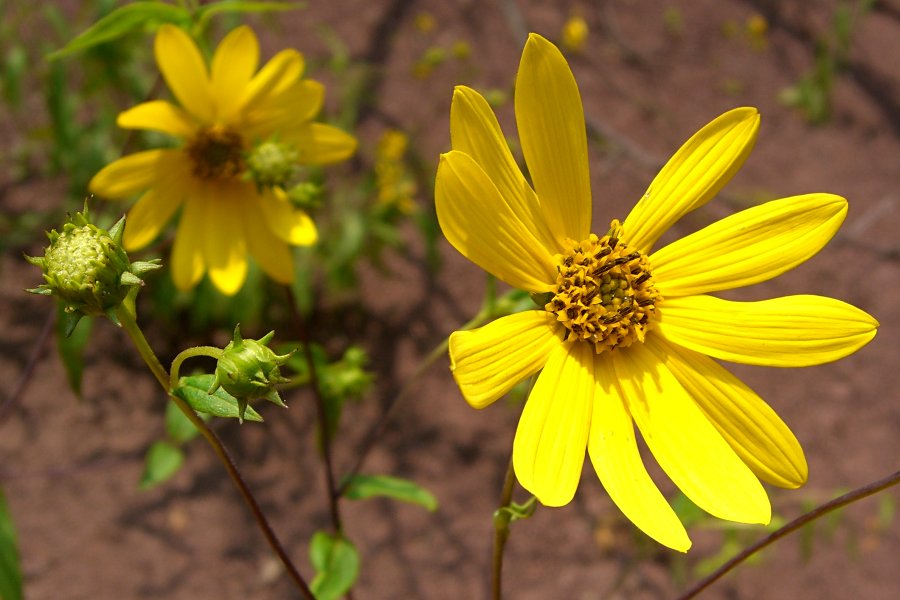
Helianthus hirsutus, known as Stiff-hair Sunflower, hairy sunflower or rough sunflower, is a native perennial sunflower of open woods, glades and prairies across the eastern half of the United States. It grows 2 to 6 feet tall, with rough, sandpapery leaves in opposite pairs and stems covered in stiff, bristly hairs, and from July into October it carries bright yellow, daisy-like flower heads 2 to 3 inches across.
It is one of the most widespread of the woodland and savanna sunflowers, at home on dry, rocky or sandy soils in light shade or full sun, from the Great Lakes to the Gulf Coast. Like many perennial sunflowers it spreads by rhizomes to form patches, which makes it useful for covering dry slopes and woodland edges but means it needs space in a small garden. The species name hirsutus means “hairy”.
This guide covers how to identify stiff-hair sunflower and separate it from similar sunflowers, where it grows, how to grow it in a sunny or partly shaded native garden, and its value to bees, butterflies and seed-eating birds.
Identification
Look for a 2- to 6-foot sunflower with stiff-bristly stems, opposite, lance-shaped leaves that are very rough on top and have short stalks, and several golden flower heads in late summer.
Growth Habit
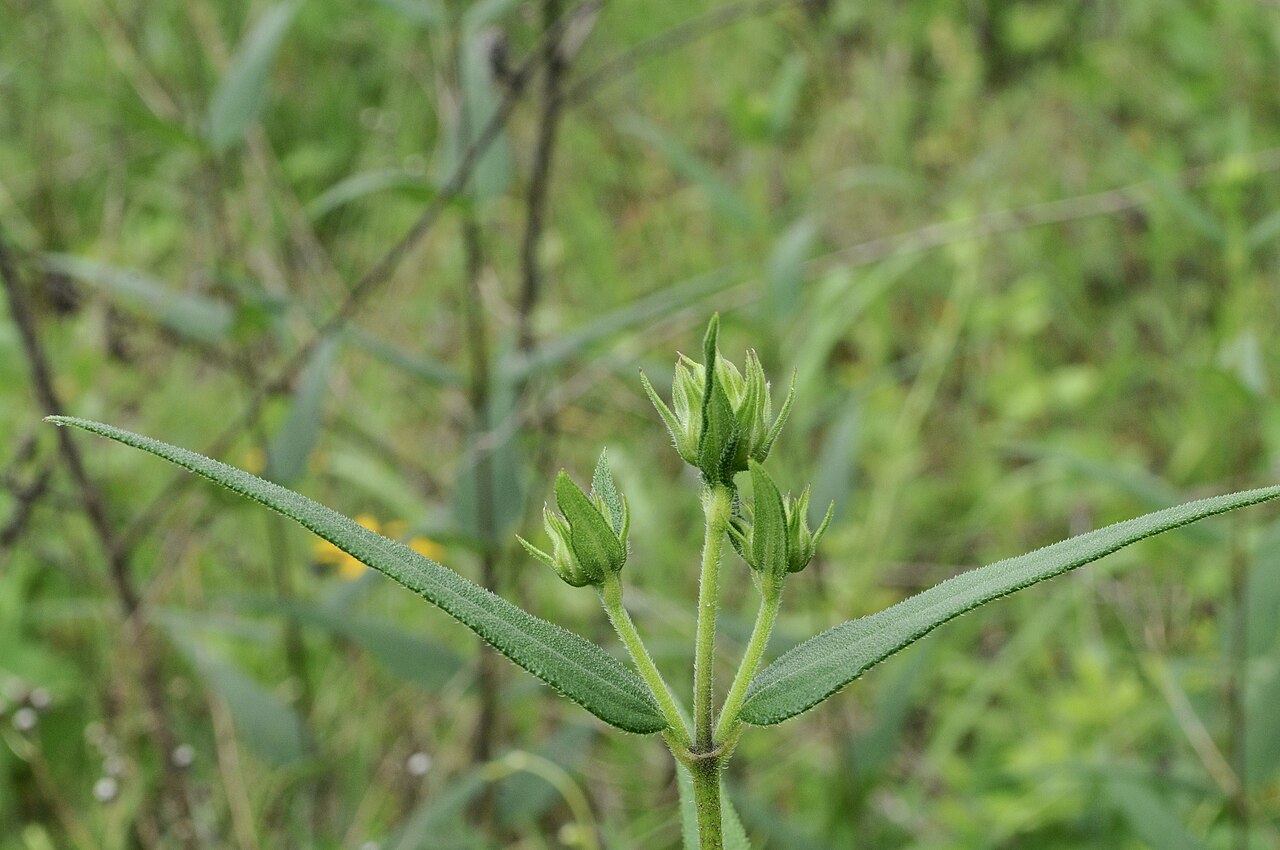
Stiff-hair sunflower is a clump-forming to colonial perennial that spreads by short rhizomes. Its stems are usually 2 to 6 feet tall, branched near the top, and covered with stiff, spreading hairs that feel bristly when you run your fingers up the stem.
Leaves
Leaves are mostly opposite, lance-shaped to narrowly oval, about 3 to 7 inches long, with three main veins from the base. They have short stalks (about 1/4 to 3/4 inch), and the upper surface is very rough, like sandpaper, while the underside is softly hairy.
Flowers
The flower heads are 2 to 3 inches across, with about 10 to 15 bright yellow ray florets around a yellow central disc. The green bracts below the head are narrow, hairy and often spread at the tips. Several heads are borne on each stem. Bloom time is July to October.
Fruit & Seeds
After flowering, the disc florets produce small, dark, wedge-shaped seeds (achenes), which ripen in fall and are eaten by many birds.
Look-alikes
Woodland sunflower (H. divaricatus) has smooth stems and leaves with almost no stalks that spread at right angles. Pale-leaved sunflower (H. strumosus) has smooth, often waxy stems and paler leaf undersides. Jerusalem artichoke (H. tuberosus) is taller, with broader, longer-stalked upper leaves that are often alternate, and it forms edible tubers. The rough, bristly stem combined with short-stalked, sandpapery leaves best identifies stiff-hair sunflower.
Quick Facts
| Scientific Name | Helianthus hirsutus Raf. |
| Family | Asteraceae (aster or sunflower family) |
| Plant Type | Rhizomatous herbaceous perennial |
| Mature Height | 2–6 ft |
| Mature Spread | 2–3 ft; slowly forms colonies |
| Growth Rate | Moderate to fast |
| Sun Exposure | Full sun to part shade |
| Water Needs | Low to moderate; drought tolerant once established |
| Soil Type | Dry to medium, sandy, rocky, loamy or clay soils |
| Soil pH | About 5.5–7.5 |
| Bloom Time | July–October |
| Flower Color | Yellow rays with a yellow disc |
| Fall Color | Foliage dries to tan-brown; seed heads persist |
| Fruit | Small dark achenes eaten by birds |
| Deer Resistant | Low to moderate; young growth is browsed |
| USDA Hardiness Zones | 4–9 |
Native Range
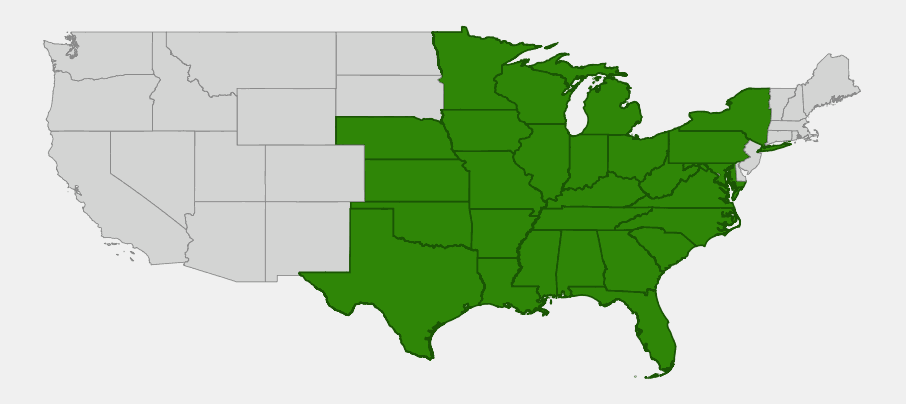
Stiff-hair sunflower is native to the eastern and central United States. USDA PLANTS lists it from Michigan, Wisconsin and Minnesota south to Florida, Louisiana and Texas, and west to Iowa, Nebraska, Kansas and Oklahoma, with records east to New York, Pennsylvania, Maryland and Virginia. A Connecticut record is treated by the Native Plant Trust (Go Botany) as introduced, so it is left off this page’s range, and the species is listed as introduced in Ontario.
It is most common in the Ozarks, the Interior Highlands, the Ohio and middle Mississippi valleys and the uplands of the Southeast, and it becomes scattered toward the northern and eastern edges of its range. In the Northeast and the upper Midwest it is mostly known from dry, open sites in the southern parts of those states.
It grows in dry, open oak and pine woods, savannas, glades, prairie edges, rocky bluffs, clearings, roadsides and old fields, generally at low to middle elevations below about 2,500 feet.
📋 Regional plant lists featuring Stiff-hair Sunflower: New York, Pennsylvania & Northern New Jersey · Delaware, Southern New Jersey & Long Island · Ohio & Indiana · Michigan, Wisconsin & Eastern Minnesota · Illinois, Iowa & Missouri · Nebraska, Kansas & Eastern Colorado · Kentucky & Tennessee · Maryland, Virginia & West Virginia · North & South Carolina · Alabama, Georgia & Mississippi · North & South Florida · Arkansas, Louisiana, Eastern Oklahoma & Eastern Texas · South & West Texas · North Dakota, South Dakota & Western Minnesota
Growing & Care Guide
Stiff-hair sunflower is a tough, easy native perennial for dry, sunny to lightly shaded sites, including woodland edges, slopes and meadow plantings. It is offered by native plant nurseries and seed suppliers in the Midwest and South. Give it room to spread, or contain it, since it forms patches over time.
Light
Full sun to part shade. It flowers best in sun but is one of the better sunflowers for the light shade of open woods and woodland edges.
Soil & Water
It grows in almost any well-drained soil, from sand and gravel to clay, and is drought tolerant once established. Avoid rich, constantly moist soil, which makes it floppy and aggressive. Water new plantings until they are established.
Planting Tips
Plant in spring or fall, spacing plants 2 to 3 feet apart. Use it in meadows, prairie plantings, dry woodland edges and on slopes where its spreading roots help hold the soil. Pair it with little bluestem, goldenrods, asters and blazing stars for late-season color.
Pruning & Maintenance
Cut stems back by about a third in late spring if you want shorter, bushier plants. Leave seed heads standing over winter for birds, and cut old stems down in late winter. Divide or pull spreading shoots every few years to keep it in bounds.
Propagation
Grow from seed sown outdoors in fall or given about 30 to 60 days of cold-moist stratification before spring sowing. Clumps can be divided in early spring. Rhizome cuttings also root easily.
Landscape Uses
- Meadows and prairie plantings: late-summer yellow flowers on a tough, drought-tolerant perennial
- Woodland edges and savanna gardens: one of the sunflowers that tolerates light shade
- Pollinator gardens: its flowers attract bees, butterflies and beneficial insects
- Bird gardens: fall seeds feed goldfinches and other seed-eating birds
- Erosion control on dry slopes: spreading rhizomes help hold soil
Wildlife & Ecological Value
Stiff-hair sunflower provides late-season nectar, pollen and seeds, and its foliage feeds the caterpillars of several native butterflies and moths.
For Pollinators
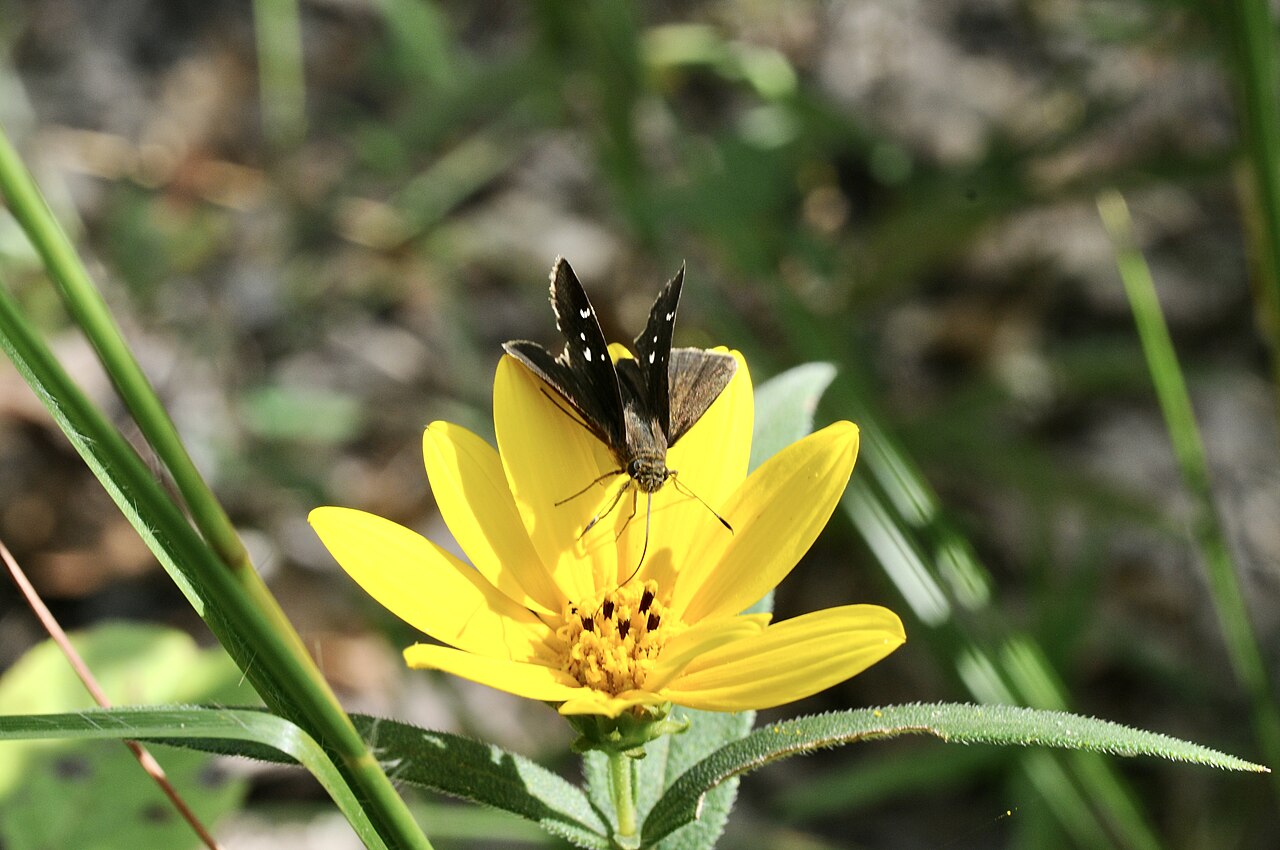
The flowers are visited by many native bees, including specialist sunflower bees, as well as bumble bees, butterflies such as skippers and fritillaries, and beneficial wasps and flies. Sunflowers are a host plant for the silvery checkerspot and bordered patch butterflies and for many moth caterpillars.
For Birds
American goldfinches, chickadees, sparrows and other seed-eating birds feed on the ripe seed heads in fall and winter. Leave the stems standing to provide this food.
For Mammals
Deer and rabbits browse young shoots and leaves. Small mammals eat fallen seeds.
Ecosystem Role
As a common sunflower of open woods, glades and savannas, it supports a large community of insects that specialize on sunflowers, and its rhizomes help stabilize dry, rocky soils.
Cultural & Historical Uses
The species was described by the naturalist Constantine Samuel Rafinesque in the nineteenth century. Its common names, stiff-hair, hairy and rough sunflower, all refer to the bristly stems and sandpapery leaves that set it apart from its smooth-stemmed relatives.
Perennial sunflowers such as this one are close relatives of the annual common sunflower and the Jerusalem artichoke, both native North American crops. Stiff-hair sunflower itself is not a food crop, but botanists have studied it for its seed oil, and a Native Plant Trust note reports that it had the highest seed oil concentration of thirteen sunflower species tested.
Today it is valued mainly as a dependable, low-care native perennial for dry meadows, savanna restoration and pollinator gardens, where it adds late-season yellow alongside goldenrods and asters.
Frequently Asked Questions
How do I tell stiff-hair sunflower from woodland sunflower?
Stiff-hair sunflower has bristly-hairy stems and leaves with short stalks. Woodland sunflower has smooth stems and leaves that are nearly stalkless and spread at right angles to the stem.
Where does stiff-hair sunflower grow?
It grows in dry open woods, savannas, glades, prairie edges and roadsides across the eastern and central United States, from Michigan and Minnesota south to Florida and Texas.
Does stiff-hair sunflower spread?
Yes, it spreads slowly by rhizomes to form patches. It is easy to control by pulling or dividing in spring, but give it room in a small bed.
Can stiff-hair sunflower grow in shade?
It tolerates part shade better than most sunflowers and is often found in open woods, though it blooms most heavily in sun.
When does stiff-hair sunflower bloom?
From July through October, providing late-season nectar for pollinators and fall seeds for birds.

Looking for a nursery that carries Stiff-hair Sunflower?
Browse our native plant nursery directory: Alabama & Arkansas · Florida & Georgia · Illinois, Indiana, Iowa & Kansas · Kentucky, Louisiana, Maryland, Michigan, Minnesota, Mississippi & Missouri · Nebraska, New York, North Carolina, Ohio & Oklahoma · Pennsylvania, South Carolina, Tennessee, Texas & Virginia · West Virginia & Wisconsin

