
Northern Arrowwood (Viburnum recognitum)
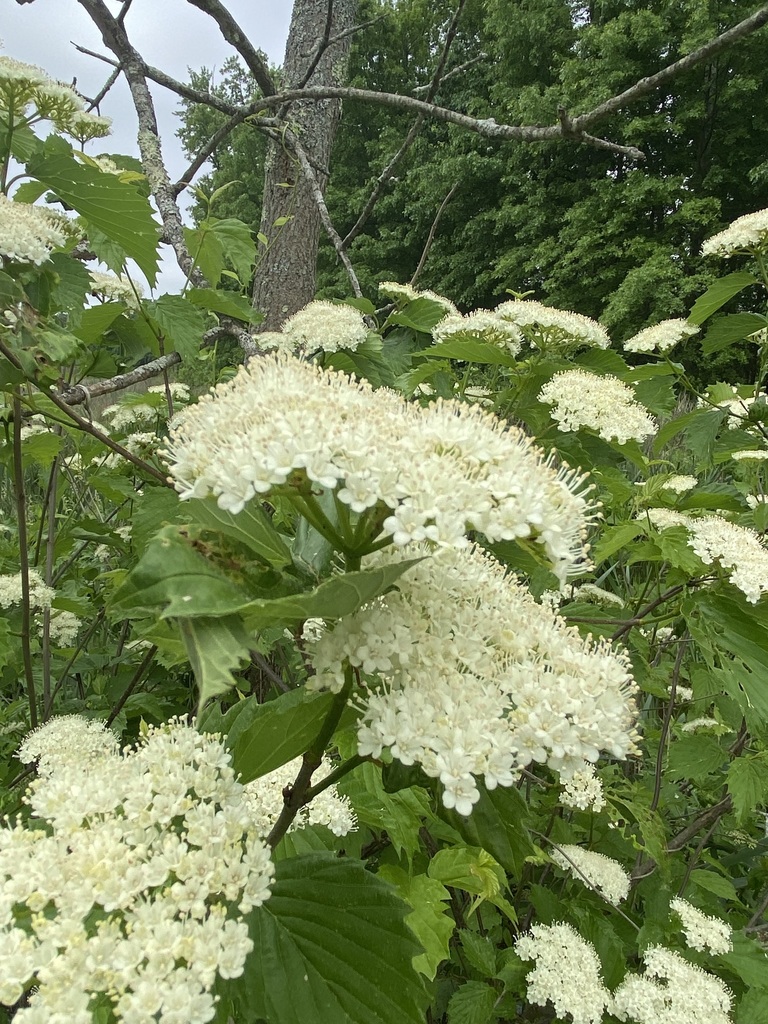
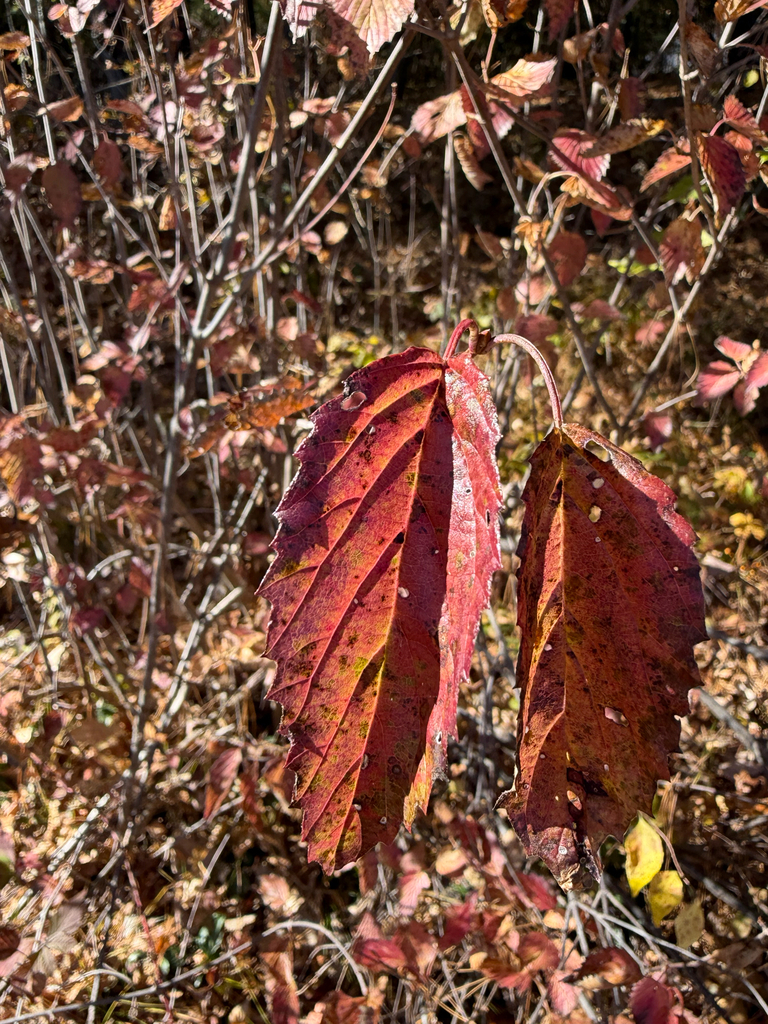
Viburnum recognitum, known as Northern Arrowwood or smooth arrowwood, is a tough, multi-stemmed deciduous shrub in the muskroot family (Adoxaceae, now often placed in Viburnaceae). It grows 6 to 12 feet tall (occasionally to 15) with straight, upright stems, opposite, coarsely toothed leaves, flat clusters of creamy white flowers in late spring, and blue-black berries in late summer that are eaten by many birds. In fall the leaves turn red, purple, orange or yellow.
Northern arrowwood belongs to the arrowwood (Viburnum dentatum) group, and many botanists treat it as a variety of arrow-wood viburnum (V. dentatum var. lucidum). USDA PLANTS and several regional floras keep it as a separate species, distinguished mainly by its smooth or nearly smooth leaves and twigs. It is the common arrowwood of the Northeast and Great Lakes, growing from New Brunswick and southern Ontario south to the Carolinas and Georgia, with scattered records farther south and west.
It grows in swamps, wet woods, stream banks, pond edges, thickets and moist forests, but it also tolerates drier upland soils, and it is one of the most adaptable native shrubs for gardens. Many plants sold in nurseries as arrowwood viburnum are actually this northern type. It is excellent for hedges, screens, rain gardens and wildlife plantings.
Identification
Look for a dense, upright shrub with very straight stems, opposite, oval leaves with large, regular teeth and straight veins, flat clusters of white flowers in late spring and blue-black berries in late summer.
Growth Habit
Northern arrowwood is a multi-stemmed shrub that grows 6 to 12 feet tall and about as wide, forming a rounded clump. It spreads slowly by suckers from the base, making thickets over time. Young stems are very straight and smooth, with gray-brown bark on older stems.
Leaves
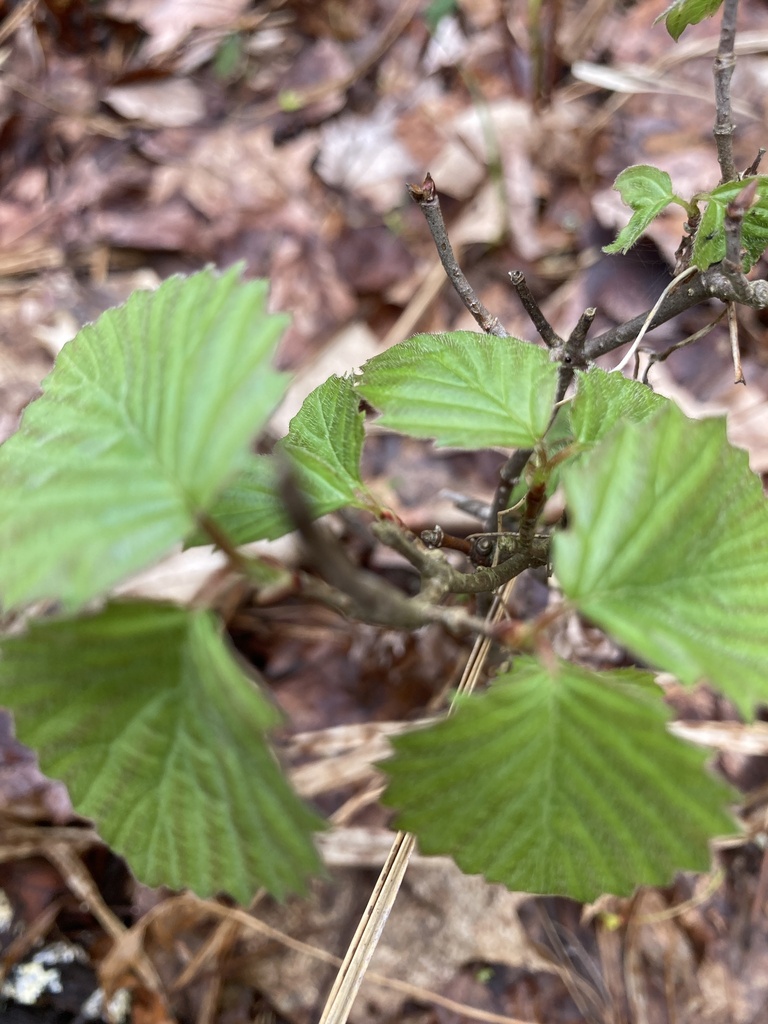
The leaves are opposite, oval to nearly round, 2 to 4 inches long, with coarse, regular teeth along the edges. The straight side veins run parallel and end in the teeth, a hallmark of the arrowwood group. In northern arrowwood the leaves are smooth and often shiny above and smooth or with only small tufts of hairs in the vein angles below, and the leaf stalks and twigs are smooth. In the related southern arrowwood (V. dentatum in the narrow sense) and downy arrowwood the undersides and twigs are noticeably hairy.
Flowers
Small, creamy white flowers grow in flat-topped or slightly domed clusters 2 to 4 inches across at the tips of the branches. Each flower is about 1/4 inch across, with five petals and five protruding stamens, giving the clusters a fuzzy look. Bloom is in May and June, after the leaves are fully out.
Fruit & Seeds
The fruit is a round to oval, blue-black drupe about 1/4 inch long, ripening in August and September, in clusters on red stalks. Each fruit contains a single grooved stone. The fruits are eaten quickly by birds, so they rarely last long.
Look-alikes
Arrow-wood viburnum in the narrow sense, a more southern plant, has hairy twigs and leaf undersides. Downy arrowwood is a smaller shrub of dry, rocky sites with short leaf stalks and soft, hairy leaves. Mapleleaf viburnum has three-lobed leaves. Dogwoods such as silky dogwood also have opposite leaves and white flowers, but their leaves have smooth edges and curving veins.
Quick Facts
| Scientific Name | Viburnum recognitum (syn. V. dentatum var. lucidum) |
| Family | Adoxaceae / Viburnaceae (muskroot or viburnum family) |
| Plant Type | Deciduous multi-stemmed shrub |
| Mature Height | 6–12 ft (occasionally to 15 ft) |
| Mature Spread | 6–10 ft |
| Growth Rate | Moderate to fast |
| Sun Exposure | Full sun to part shade |
| Water Needs | Moderate to high; tolerates wet soil and some drought |
| Soil Type | Moist to wet loam, sand or clay |
| Soil pH | Acidic to neutral (about 5.0–7.0) |
| Bloom Time | May–June |
| Flower Color | Creamy white |
| Fall Color | Red, purple, orange or yellow |
| Fruit | Blue-black drupes, August–September |
| Deer Resistant | Moderately; browsed when deer are abundant |
| USDA Hardiness Zones | 3–8 |
Native Range
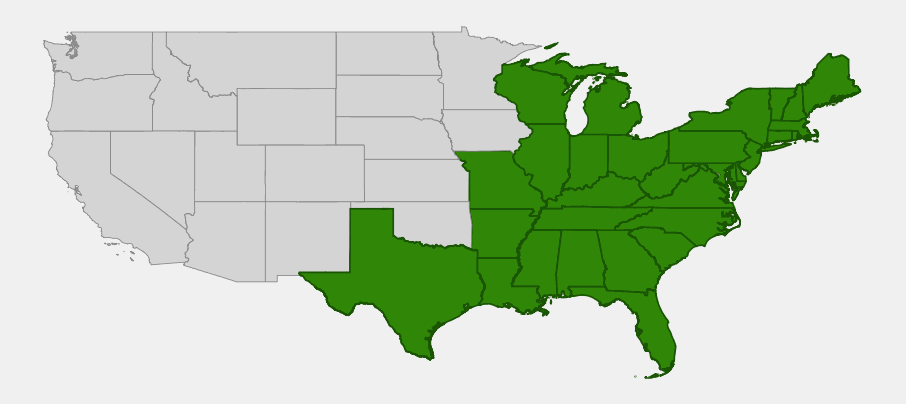
USDA PLANTS lists northern arrowwood as native in 30 states, from Maine and Vermont west to Wisconsin and Missouri and south to Georgia, Alabama, Mississippi, Louisiana, eastern Texas and Florida. In Canada it is native in New Brunswick and southern Ontario.
It is most common from New England and New York west through the Great Lakes states and south through the Mid-Atlantic and the Appalachians. Records from the Gulf states, Florida and Texas are scattered and outlying, and many southern botanists treat southern plants as part of the broader Viburnum dentatum complex.
It grows in swamps, wet woods, floodplains, stream and pond edges, shrub thickets, wet meadows and moist forests, and also on drier upland slopes and woodland edges. It is a frequent shrub of red maple swamps and the shrubby borders of marshes in the Northeast.
📋 Regional plant lists featuring Northern Arrowwood: New York, Pennsylvania & Northern New Jersey · Ohio & Indiana · Michigan, Wisconsin & Eastern Minnesota · Kentucky & Tennessee · Connecticut, Massachusetts & Rhode Island · New Hampshire, Maine & Vermont · Maryland, Virginia & West Virginia · Delaware, Southern New Jersey & Long Island · Illinois, Iowa & Missouri · Alabama, Georgia & Mississippi · North & South Florida · North & South Carolina · Arkansas, Louisiana, Eastern Oklahoma & Eastern Texas
Growing & Care Guide
Northern arrowwood is one of the easiest native shrubs to grow. It adapts to sun or shade and wet or average soil, and it needs little care beyond occasional thinning. It is widely available, often simply labeled arrowwood viburnum or Viburnum dentatum.
Light
Full sun to part shade. It flowers and fruits most heavily and has the best fall color in sun, but it grows well at the edge of woods and in light shade.
Soil & Water
It grows best in moist, acidic to neutral soil and tolerates wet, poorly drained sites, periodic flooding and heavy clay. Once established it also tolerates dry spells. Water regularly during the first summer.
Planting Tips
Plant it in spring or fall, 6 to 8 feet apart for a hedge or screen. For good fruit set, plant two or more plants from different sources, since viburnums produce more berries when cross-pollinated by another genetically different plant. It is a good choice for rain gardens, pond edges and low spots.
Pruning & Maintenance
Prune right after flowering if needed, removing a few of the oldest stems at the base to keep the shrub vigorous. Avoid shearing, which removes flower buds. Watch for the invasive viburnum leaf beetle, which can strip the leaves of arrowwoods in the Northeast and Great Lakes; prune out and destroy twigs with egg sites in winter.
Propagation
Softwood cuttings taken in late spring or early summer root easily. Seed must be cleaned and needs a warm period followed by a cold period, and it often takes two years to germinate. Suckers can also be dug and replanted from established plants.
Landscape Uses
- Hedges and screens: dense, upright growth to 10 feet or more
- Rain gardens and wet spots: tolerates wet, poorly drained soil
- Bird gardens: late-summer berries for migrating songbirds
- Pollinator gardens: late-spring flowers for bees and other insects
- Woodland edges and restoration: stabilizes stream banks and fills shrub layers
Wildlife & Ecological Value
Like other viburnums, northern arrowwood supports a wide range of wildlife, from pollinators in spring to fruit-eating birds in late summer.
For Pollinators
The flowers attract many native bees, flies, beetles and butterflies. Viburnums are host plants for the caterpillars of the spring azure butterfly and the hummingbird clearwing moth, among other moths.
For Birds
The blue-black fruits ripen in late summer and are eaten by bluebirds, catbirds, thrushes, robins, cardinals, woodpeckers and other birds, especially during fall migration. The dense shrub provides nesting sites and cover.
For Mammals
Deer browse the twigs and leaves, and rabbits browse young stems. Small mammals eat fallen fruit.
Ecosystem Role
Northern arrowwood forms dense thickets in wetlands and along streams, where its roots help hold soil and its fruit feeds birds. It is an important native shrub in places where invasive shrubs such as honeysuckles and buckthorns have replaced native understory.
Cultural & Historical Uses
The name arrowwood comes from the plant’s long, straight young stems, which Native Americans used to make arrow shafts.
The species name recognitum means “recognized” or “re-examined.” The American botanist Merritt Lyndon Fernald described it as a separate species in the 1940s, and botanists have debated ever since whether it should be a species or a variety of Viburnum dentatum.
The arrowwood complex is a classic example of a group in which species are hard to separate, because plants vary in hairiness, leaf shape and chromosome number across their range. For gardeners and wildlife, all of these arrowwoods are equally valuable native shrubs.
Frequently Asked Questions
Is northern arrowwood the same as arrowwood viburnum?
It is closely related. Some botanists treat northern arrowwood as a variety of arrowwood viburnum (Viburnum dentatum var. lucidum), while USDA PLANTS treats it as its own species. Many nursery plants sold as arrowwood viburnum are this northern type.
How can I tell northern arrowwood from southern arrowwood?
Northern arrowwood has smooth or nearly smooth twigs and leaf undersides. Southern arrowwood (V. dentatum in the narrow sense) is noticeably hairy on the twigs and leaf undersides.
Are northern arrowwood berries edible?
They are not poisonous, but they are small, seedy and not tasty. They are best left for the birds.
Does northern arrowwood grow in wet soil?
Yes. It grows naturally in swamps, wet woods and along streams, and it tolerates periodic flooding, but it also does well in average garden soil.
Why are the leaves on my arrowwood full of holes?
The most likely cause is the viburnum leaf beetle, an invasive insect that feeds heavily on arrowwoods. Prune out twigs with egg sites in winter and encourage natural predators.

Looking for a nursery that carries Northern Arrowwood?
Browse our native plant nursery directory: Alabama & Arkansas · Connecticut, Delaware, Florida & Georgia · Illinois & Indiana · Kentucky, Louisiana, Maine, Maryland, Massachusetts, Michigan, Mississippi & Missouri · New Hampshire, New Jersey, New York, North Carolina & Ohio · Pennsylvania, Rhode Island, South Carolina, Tennessee, Texas, Vermont & Virginia · West Virginia & Wisconsin

