
Pinewoods Lousewort (Pedicularis semibarbata)
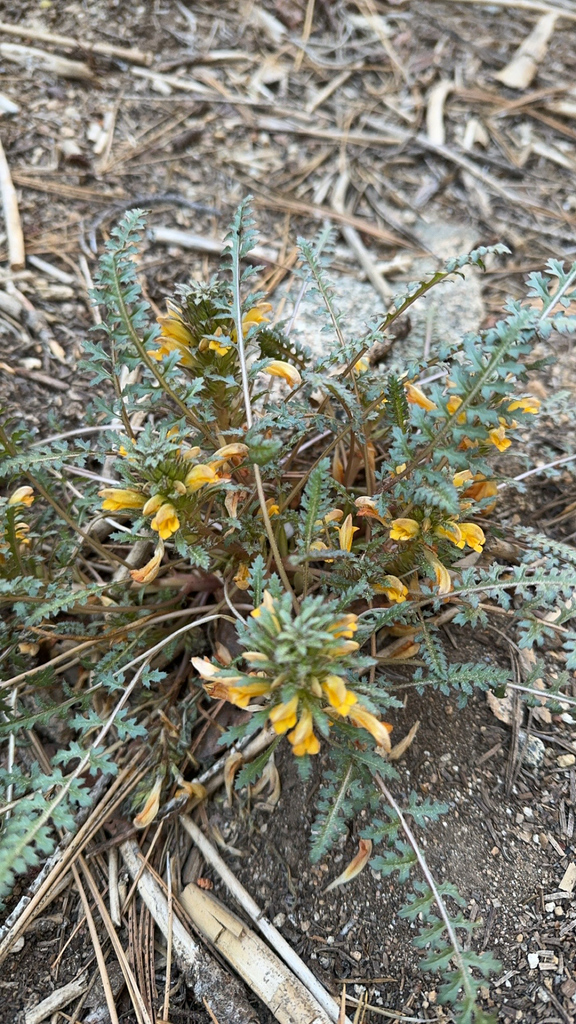
Pedicularis semibarbata, known as Pinewoods Lousewort, is a small, low-growing wildflower of the dry conifer forests of California, Nevada and southern Oregon. It forms a flat rosette, only 2 to 6 inches tall, of finely divided, fern-like leaves, often tinged gray, bronze or purple. In late spring and early summer, short clusters of yellow, hooded flowers appear tucked among the leaves, so the plant often looks like a small fern with yellow flowers hiding in it.
Louseworts (Pedicularis) belong to the broomrape family (Orobanchaceae), and like their relatives the paintbrushes and owl’s clovers, they are root hemiparasites. They make their own food by photosynthesis, but their roots also attach to the roots of nearby plants and draw water and nutrients from them. This lifestyle is one reason pinewoods lousewort is almost never seen in gardens.
As its name suggests, pinewoods lousewort grows mainly in open forests of ponderosa pine, Jeffrey pine, lodgepole pine and red and white fir, from the Sierra Nevada, Cascades and Klamath region to the mountains of southern California and the Great Basin ranges of Nevada. This page focuses on how to identify it, where to see it and its ecology. The plant cannot realistically be grown from nursery stock, and wild plants should never be dug up.
Identification
Pinewoods lousewort is easy to overlook because it is so low. Its fern-like rosette lying flat on pine needles, with yellow flowers set right among the leaves, is distinctive among western wildflowers.
Rosette & Leaves
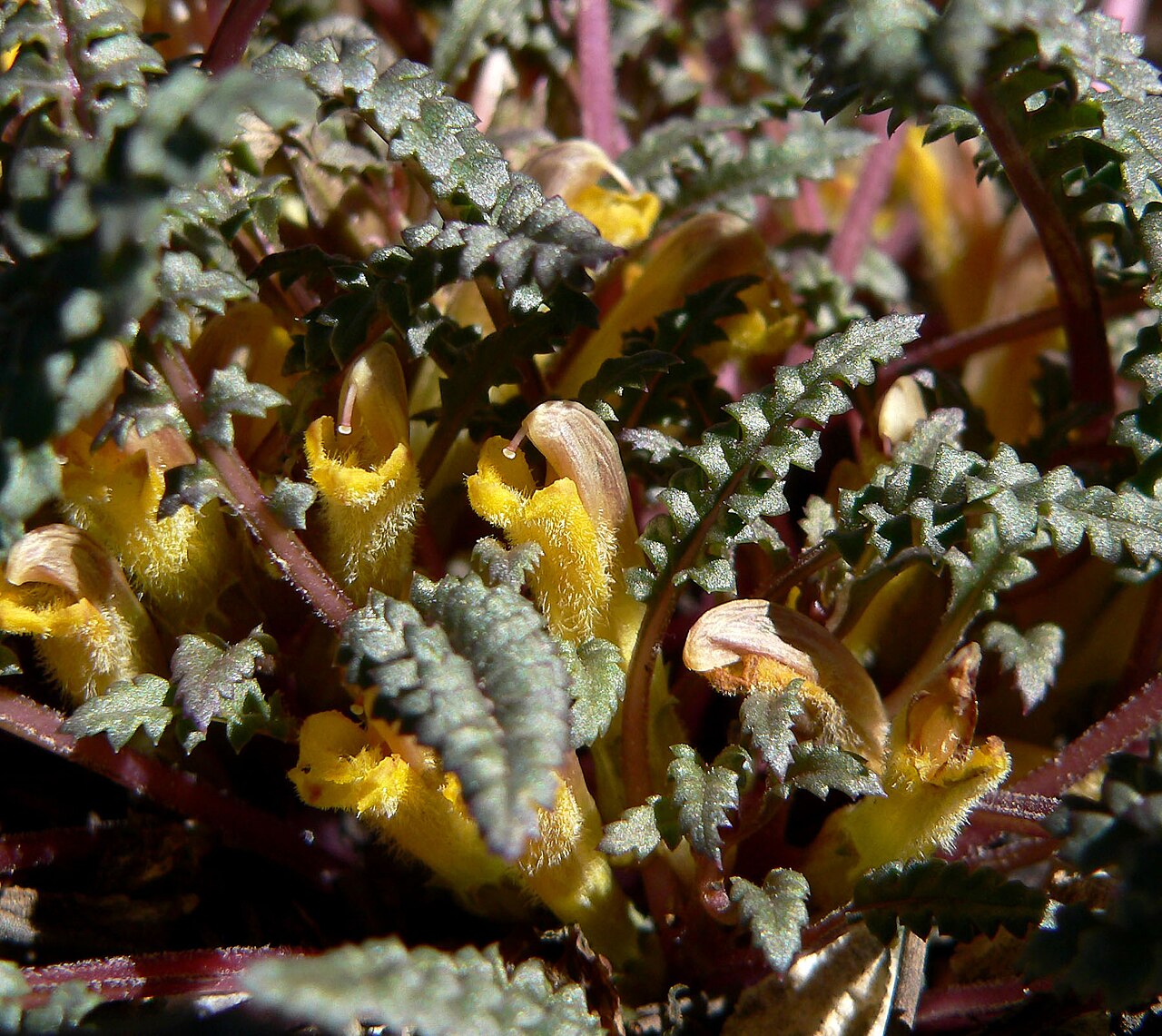
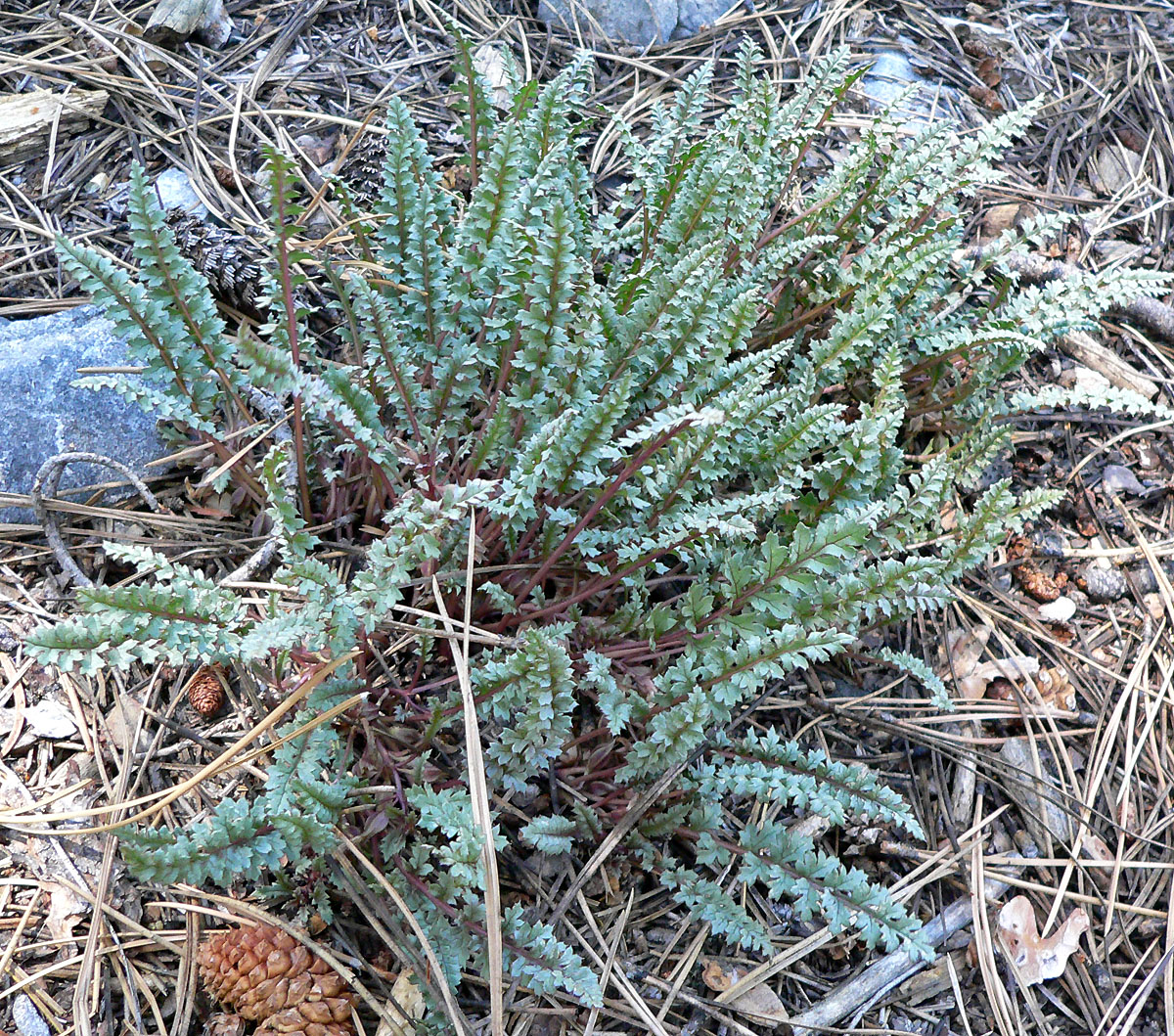
The plant has almost no visible stem. The leaves rise from the root crown in a spreading rosette, each about 2 to 6 inches long, on a slender, often reddish stalk. They are pinnately divided into many small, toothed or lobed segments, giving them a ferny or lacy look. They are often grayish-green and finely hairy, and frequently tinged bronze, red or purple, especially early in the season.
Flowers
The flowers are borne in short, dense clusters on stalks that barely rise above the leaves. Each flower is about ¾ inch long and two-lipped. The upper lip (galea) is hood-like and curved, and the lower lip is three-lobed and spreading. Flowers are usually pale to bright yellow, sometimes with purplish or reddish tips on the hood. The name semibarbata, “half-bearded,” refers to the short hairs on parts of the flower and calyx. Bloom time is generally May through July, depending on elevation and snowmelt.
Fruit & Seeds
The fruit is a small, flattened, asymmetrical capsule that splits open in summer to release a few seeds. The seeds fall near the parent plant, and seedlings must find suitable host roots nearby to thrive.
Subspecies
Two subspecies are often recognized. The widespread subsp. semibarbata covers most of the range. Subsp. charlestonensis is limited to the Spring Mountains of southern Nevada, an isolated range near Las Vegas that is home to many unique plants.
Look-alikes
Other western louseworts, such as Sickletop Lousewort (Pedicularis racemosa), Elephant’s Head (P. groenlandica) and Bracted Lousewort (P. bracteosa), have leafy stems and flower spikes held well above the leaves. Pinewoods lousewort is the only common lousewort in its range whose flowers sit down among a flat rosette of leaves.
Quick Facts
| Scientific Name | Pedicularis semibarbata A. Gray |
| Family | Orobanchaceae (broomrape family; formerly Scrophulariaceae) |
| Plant Type | Low herbaceous perennial; root hemiparasite |
| Mature Height | 2–6 in |
| Mature Spread | 4–10 in (rosette) |
| Growth Rate | Slow |
| Sun Exposure | Part shade to full sun (open forest) |
| Water Needs | Low to moderate; moist after snowmelt, dry by late summer |
| Soil Type | Dry, well-drained sandy, gravelly or granitic forest soils with needle litter |
| Soil pH | About 5.5–7.0 |
| Bloom Time | May–July |
| Flower Color | Yellow, sometimes tipped purplish or reddish |
| Fall Color | Leaves may turn bronze or purplish; dies back in fall |
| Fruit | Small flattened capsule |
| Deer Resistant | Unknown; not a notable deer food |
| USDA Hardiness Zones | 5–8 (in the wild) |
Native Range
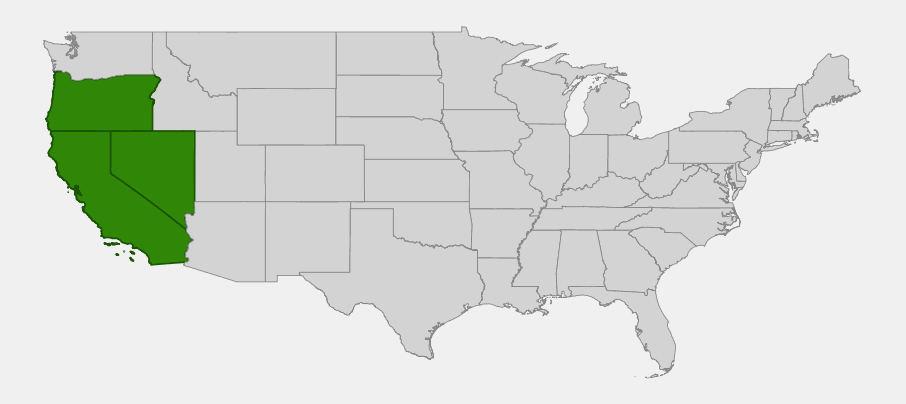
Pinewoods lousewort is native to three western states. USDA PLANTS records it in California, Nevada and Oregon. It is most widespread in California, where it grows throughout the Sierra Nevada and the southern Cascades, in the Klamath region and the higher North Coast Ranges, and in the Transverse and Peninsular Ranges of southern California, including the San Bernardino and San Jacinto Mountains.
In Nevada it grows in the Sierra Nevada border region near the California line, and in a separate population in the Spring Mountains near Las Vegas, where subsp. charlestonensis occurs. In Oregon it reaches the southern part of the state, mainly in the conifer forests east of the Cascade crest in the Klamath Basin region, at the northern edge of its range.
It grows in dry, open conifer forests at montane to subalpine elevations, typically under ponderosa pine, Jeffrey pine, sugar pine, lodgepole pine, white fir and red fir. It favors well-drained sandy or granitic soils covered with needle litter, often in partial shade, and it flowers soon after the snow melts.
📋 Regional plant lists featuring Pinewoods Lousewort: California & Nevada
Growing & Care Guide
Pinewoods lousewort is not a garden plant. As a root hemiparasite, it depends on connections to the roots of nearby host plants, and it is adapted to the specific soils, snowpack and forest conditions of western mountains. It is essentially never offered by nurseries, and wild plants should never be dug up, since they almost always die when moved. The best way to enjoy it is to look for it in the forest.
Light
In the wild it grows in the dappled light of open pine and fir forests, in clearings and along forest edges. It rarely grows in dense shade or in fully exposed sites away from trees.
Soil & Water
It grows in loose, well-drained sandy or granitic soils with a layer of needle litter. These soils are moist from snowmelt in spring and early summer and dry out by late summer, when the plant has finished flowering and setting seed.
Planting Tips
Do not try to transplant it from the wild. Its roots are attached to host plants, and moving it breaks those connections. If you live in its range, the best way to support it in your landscape is to protect existing native forest floor vegetation and needle litter, avoid soil disturbance, and keep native trees and shrubs that can act as hosts.
Pruning & Maintenance
Where it already grows on your property, leave it alone. Avoid raking away all the needle litter, trampling, and herbicides in forest understories. Wildfire fuel reduction work can be planned to avoid heavy soil disturbance in patches where it grows.
Propagation
Louseworts are very difficult to propagate. Seeds need suitable host plants nearby to grow beyond the seedling stage, and specialists who grow them typically sow seed together with a host plant in a pot. For home gardeners and restoration projects, protecting existing habitat is far more effective than trying to propagate it.
Landscape Uses
- Wildflower viewing: a distinctive early-summer flower of pine and fir forests
- Forest understory conservation: an indicator of intact, undisturbed forest floor
- Botanical education: a good example of a hemiparasitic plant
- Photography: its ferny rosette and yellow flowers are striking up close
- Pollinator habitat: supports bumble bees in mountain forests
Wildlife & Ecological Value
Pinewoods lousewort is a small but interesting member of western mountain forest communities.
For Pollinators
Like most louseworts, its hooded flowers are pollinated mainly by bumble bees, which can push into the flower and are dusted with pollen. Early in the season, when snow has just melted, it is one of the forest floor flowers available to queen bumble bees starting new colonies.
For Birds
It is not a significant food plant for birds. Birds that forage on the forest floor may find insects around the rosettes.
For Mammals
Its low rosettes are not an important forage plant, though they may be nibbled by small mammals. Its main value to wildlife is as part of the diverse forest floor plant community.
Ecosystem Role
As a root hemiparasite, pinewoods lousewort draws some water and nutrients from neighboring plants. Hemiparasites can influence the plant communities around them by slightly weakening their hosts, which may give other species more room. Its presence is generally a sign of relatively intact forest understory.
Cultural & Historical Uses
The name lousewort comes from an old European belief that livestock grazing in pastures with Pedicularis would become infested with lice. The genus name comes from the Latin pediculus, meaning louse. The belief has no basis in fact, but the name has stuck for the whole genus.
Pinewoods lousewort was described by the American botanist Asa Gray in the 19th century. The species name semibarbata means “half-bearded,” referring to the partial covering of hairs on the flower.
There are no well-documented food or medicinal uses for pinewoods lousewort. Some louseworts have been used by Indigenous peoples in traditional medicine, but there is little specific record for this species. It is best appreciated as a wildflower of western forests.
Frequently Asked Questions
Is pinewoods lousewort a parasite?
It is a root hemiparasite. It has green leaves and makes its own food through photosynthesis, but its roots also attach to the roots of nearby plants to take some water and nutrients.
Can I grow pinewoods lousewort in my garden?
Realistically, no. It depends on host plants and forest conditions, and it is not sold by nurseries. Wild plants should never be dug up, since they rarely survive being moved. Enjoy it in the wild instead.
Where can I see pinewoods lousewort?
Look on the floor of dry, open pine and fir forests in the Sierra Nevada, southern Cascades, Klamath region and southern California mountains, in the Spring Mountains of Nevada, and in southern Oregon, usually soon after snowmelt.
When does pinewoods lousewort bloom?
Generally from May to July, depending on elevation and how early the snow melts.
Why is it called lousewort?
The name comes from an old European belief that livestock grazing among Pedicularis plants would get lice. The genus name is from the Latin pediculus, louse.

Looking for a nursery that carries Pinewoods Lousewort?
Browse our native plant nursery directory: California · Nevada · Oregon

