
Mountain Phlox (Phlox latifolia)
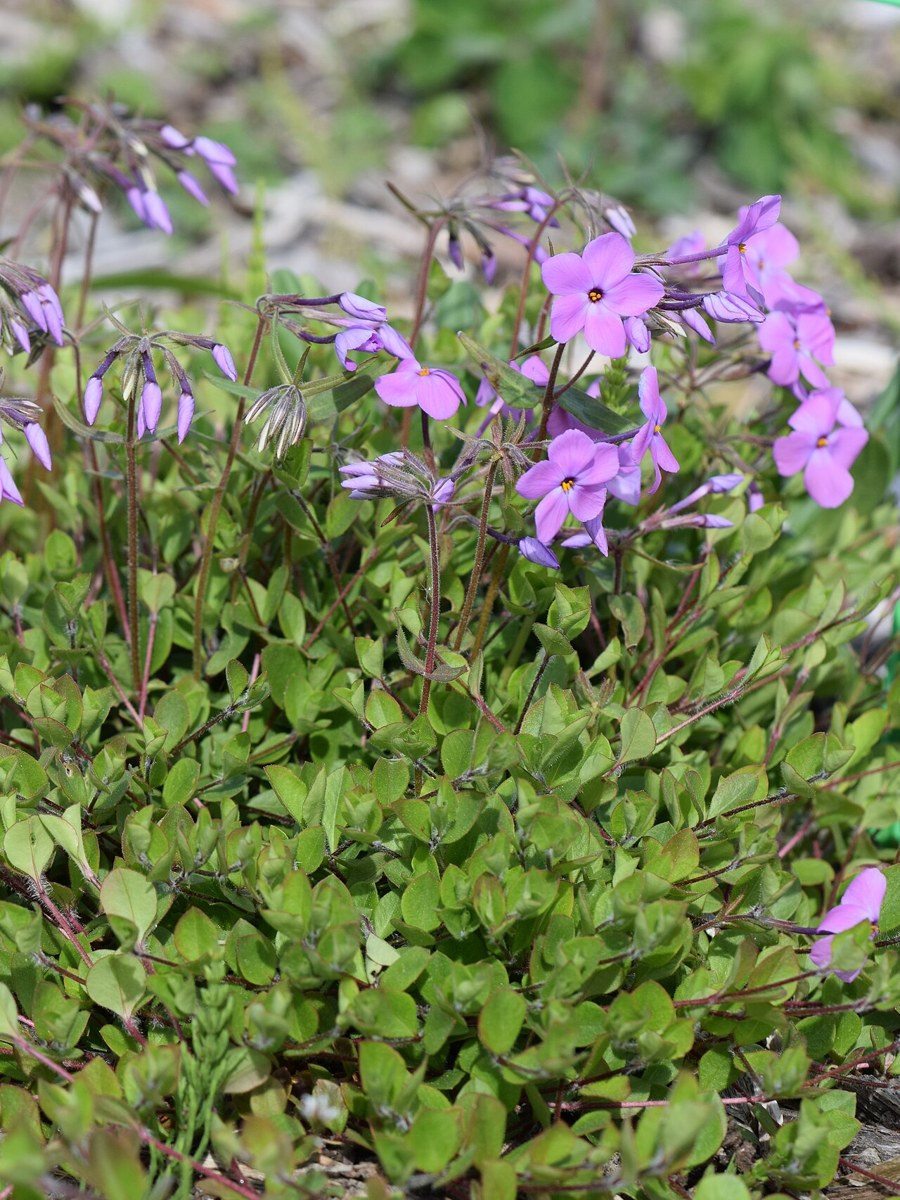
Phlox latifolia, the Mountain Phlox (also called wide-flower phlox and, in older books, Phlox ovata), is a low, upright perennial wildflower of the central and southern Appalachians and the nearby Piedmont. In late spring and early summer it sends up stems 1 to 2 feet tall topped with loose, rounded clusters of five-petaled flowers in clear pink, rose or reddish-purple. Below the flowering stems, short leafy shoots and broad, oval leaves form a loose clump that stays low through the rest of the season.
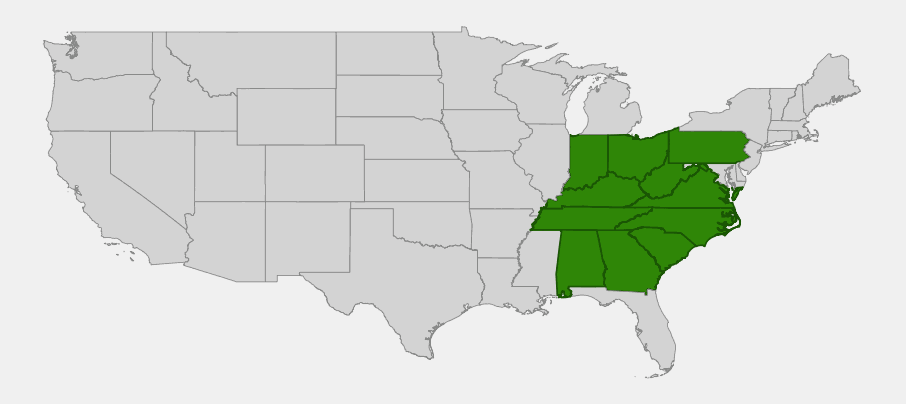
In the wild, mountain phlox grows in open, rocky woods, on wooded slopes and bluffs, along woodland edges and road banks, and in grassy openings, usually where the soil drains well and gets some sun for part of the day. Its core range runs along the Blue Ridge and the Appalachian ranges from Virginia and West Virginia south through western North Carolina, eastern Tennessee and upstate South Carolina into northern Georgia and Alabama, with scattered, uncommon populations north into Pennsylvania, Ohio, Indiana and Kentucky.
For gardeners, mountain phlox fills the gap between the spring-blooming woodland phloxes and the tall summer phlox of July and August. It is shorter and earlier than summer phlox (Phlox paniculata), handles drier soil, and is a dependable nectar plant for butterflies, skippers and long-tongued bees. Despite the name, it is not native to New York, the Adirondacks or New England; northern gardeners who want a native phlox for those states should look at the species listed in the FAQ below.
Identification
Mountain phlox belongs to a group of closely related “smooth phloxes” that includes Carolina phlox (Phlox carolina) and smooth phlox (Phlox glaberrima). Botanists have shuffled names within this group for two centuries, so the same plant may be sold or labeled as Phlox ovata, Phlox latifolia or even as a form of Phlox carolina. The combination of a low, clump-forming habit, broad oval lower leaves and relatively few pairs of leaves on each flowering stem points to mountain phlox.
Stems & Habit
Plants form a loose clump of short, leafy, non-flowering shoots, from which upright flowering stems rise in late spring. The flowering stems are usually 1 to 2 feet tall (occasionally a bit taller in rich soil), unbranched below the flower cluster, and often reddish or purplish. Only a few pairs of leaves grow on each flowering stem, so the stems look rather bare compared with the leafy stems of summer phlox. The clump spreads slowly outward and does not run aggressively.
Leaves
The leaves are opposite, smooth-edged and broad for a phlox: the lowest ones are oval to elliptic and may be 1 to 3 inches long, broadest near the middle or toward the base and often narrowing to a short stalk. Leaves higher on the flowering stem become smaller, narrower and stalkless. They are mostly smooth and medium to dark green, without the strong side veins of summer phlox.
Flowers
Flowers open from about May into June, depending on elevation. Each flower has a slender tube about three-quarters of an inch long that flares into five flat, rounded petal lobes, making a flower roughly 3/4 to 1 inch across. Colors range from pale pink and rose to deep magenta or reddish purple; white forms are uncommon. The flowers are grouped in a loose, flat-topped to rounded cluster at the tip of each stem, and the slender green calyx with pointed teeth wraps the base of each tube.
Fruit & Seeds
After flowering, each blossom forms a small, oval, three-chambered capsule that dries and splits in summer, flinging a few small seeds a short distance from the plant. The capsules are easy to miss, and plants spread more by their slowly widening clumps than by seed in most gardens.
Quick Facts
| Scientific Name | Phlox latifolia (syn. Phlox ovata in older sources) |
| Family | Polemoniaceae (Phlox) |
| Plant Type | Herbaceous perennial wildflower |
| Mature Height | 1–2 ft in flower |
| Mature Spread | 1–1.5 ft (clumps widen slowly) |
| Growth Rate | Moderate |
| Sun Exposure | Full sun to part shade |
| Water Needs | Dry to medium; well-drained soil |
| Soil Type | Rocky, sandy or loamy soils; good drainage essential |
| Soil pH | Slightly acidic to near neutral |
| Bloom Time | May – June (later at high elevations) |
| Flower Color | Pink, rose, magenta or reddish purple; rarely white |
| Fall Color | None of note |
| Fruit | Small dry capsules, summer |
| Deer Resistant | No (deer and rabbits browse phlox) |
| USDA Hardiness Zones | 5–8 |
Native Range
Mountain phlox is a plant of the southern and central Appalachians and the Piedmont at their feet. It is most frequent in the Blue Ridge and the upper Piedmont of Virginia and North Carolina, and it continues southwest through the mountains and foothills of eastern Tennessee, upstate South Carolina and northern Georgia into north and central Alabama. West Virginia’s populations sit mostly along its eastern mountain counties.
North and west of that core it becomes scarce. In Pennsylvania, Ohio, Indiana and Kentucky it is known from scattered counties and is considered rare at the edge of its range; state natural heritage programs track some of these populations. It does not occur naturally in New York, New Jersey, Maryland’s coastal plain, New England or anywhere west of the Mississippi River. Plants found in gardens outside this range are cultivated, not wild.
Typical habitat is open, often rocky, dry to moderately moist woodland: oak and oak–hickory forests, wooded bluffs and ledges, thin woods over mafic or calcium-rich rock, woodland borders and old road banks. It favors places where the canopy is broken enough to let in a few hours of sun, and it often disappears from sites where forests grow dense and shady or where deer browsing is heavy.
📋 Regional plant lists covering Mountain Phlox’s native range: Maryland, Virginia & West Virginia · North Carolina & South Carolina · Kentucky & Tennessee · Georgia, Alabama & Mississippi · Ohio & Indiana · New York, Pennsylvania & Northern New Jersey
Growing & Care Guide
Mountain phlox is an easy perennial in the right spot: give it sharp drainage, some sun and protection from deer, and it will bloom reliably for years with almost no care. It is a good choice for the front of a sunny border, a rock garden or the bright edge of a woodland garden.
Light
Plants bloom best in full sun to light shade. In the hottest parts of its range, a site with morning sun and afternoon shade keeps the foliage fresher through summer. In deeper shade the stems stretch, flowering drops off and the clump slowly fades, so avoid planting it under a dense canopy.
Soil & Water
Good drainage matters more than fertility. Mountain phlox grows naturally in thin, rocky or gravelly soils, and it does well in sandy loam, rocky slopes and raised beds. Heavy clay that stays wet in winter is the main cause of failure, because the crowns rot. Water new plants through their first summer; established clumps tolerate dry spells well, although a deep soak during long droughts keeps the leaves from browning early.
Planting Tips
Plant nursery-grown plants in spring or early fall, setting the crown at soil level and spacing plants about 12 to 18 inches apart for a loose drift. Mulch lightly with fine shredded leaves or gravel rather than a thick bark layer, which can hold moisture against the crowns. Grouping three or more plants gives a stronger show of color than a single clump.
Pruning & Maintenance
After flowering you can cut the faded flower stems back to the leafy base to tidy the plant; leaving a few allows some seed to form. Mountain phlox is generally less troubled by powdery mildew than summer phlox, especially in sunny sites with good air movement. The biggest threat in most gardens is browsing: deer and rabbits readily eat phlox stems and flower buds, so protect plants with fencing or repellents where deer are common.
Propagation
Divide established clumps in early spring or early fall, keeping several shoots and a good piece of root with each division. Stem cuttings taken from non-flowering shoots in late spring root readily in a moist, sandy mix. Seed is less practical because the capsules eject their few seeds as they ripen; if you want to try, bag a few developing capsules with fine mesh and sow the seed outdoors in fall.
Landscape Uses
- Sunny borders and cottage gardens, bridging the gap between spring bulbs and summer perennials
- Rock gardens and dry slopes with well-drained, gravelly soil
- Woodland edges with mountain laurel, flame azalea and fire pink
- Butterfly gardens alongside butterfly weed and whorled tickseed
- Native phlox collections with woodland phlox, creeping phlox and summer phlox for flowers from April to September
Wildlife & Ecological Value
Like other phloxes, mountain phlox is built for long-tongued pollinators: its nectar sits at the bottom of a narrow tube that only insects with long mouthparts can reach.
For Pollinators
Butterflies are the main visitors, including swallowtails, fritillaries, sulphurs and many skippers, along with day-flying hummingbird clearwing moths. Long-tongued bees such as bumble bees and some mason and digger bees also work the flowers. Ruby-throated hummingbirds may also stop at the flowers, as they do at other native phloxes.
For Birds
Mountain phlox is not a significant seed source for birds, but the insects that feed on and pollinate it help support songbirds raising young in late spring.
For Mammals
White-tailed deer, rabbits and groundhogs browse the tender stems and buds. In heavily browsed forests, phloxes are among the first wildflowers to decline, which is one reason the species has become scarce at the edges of its range.
Ecosystem Role
Mountain phlox is part of the diverse herb layer of open, rocky oak woodlands and woodland edges, habitats that depend on periodic disturbance such as fire, windthrow or thin soils to stay open. Where those openings shrink, plants like mountain phlox decline, so it is a useful indicator of healthy, light-filled woodland.
Cultural & Historical Uses
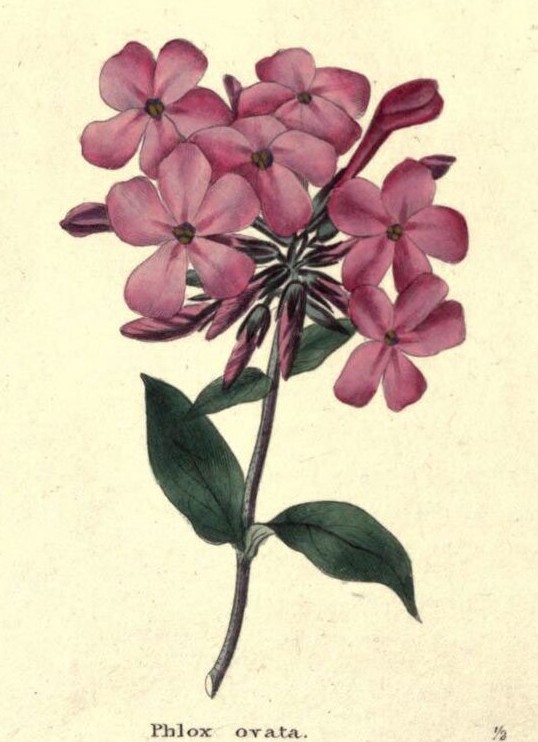
Mountain phlox has been grown in European gardens since at least the early 1800s. Under the name Phlox ovata it appeared in British garden books of that era, where it was admired for its large, bright flowers on low stems, as in the hand-colored plate shown above.
Its naming history is tangled. Modern references, including the USDA PLANTS Database and the work of phlox specialist James Locklear, use André Michaux’s name Phlox latifolia for the Appalachian mountain phlox, while older field guides and many nursery labels still call it Phlox ovata. Because the closely related Carolina phlox has also been sold under some of the same names, it is worth knowing both names, and checking the plant itself, when shopping.
Today the plant is valued mostly by native-plant gardeners and rock-garden growers in the Mid-Atlantic and Southeast. It is not a food or herbal plant, and there is no reason to collect it from the wild; buy nursery-propagated plants, especially in the northern states where wild populations are rare.
Frequently Asked Questions
Is mountain phlox native to New York?
No. Mountain phlox (Phlox latifolia) grows wild from Pennsylvania, Ohio and Indiana south through the Appalachians to Georgia and Alabama, but not in New York or New England. New York gardeners who want native phlox can choose woodland phlox for spring shade, moss phlox for dry, sunny ground, or spotted phlox and summer phlox for later color.
What color are mountain phlox flowers?
Usually pink, rose, magenta or reddish purple, sometimes with a slightly darker eye. White plants occur but are uncommon. Mountain phlox does not have yellow flowers; a yellow-flowered plant sold under this name is a different species.
When does mountain phlox bloom?
Mostly in May and June. It flowers after woodland phlox and creeping phlox and before summer phlox, which makes it useful for keeping color going in a sunny native border.
What is the difference between mountain phlox and summer phlox?
Mountain phlox is shorter (usually 1 to 2 feet), blooms in late spring, has broad oval lower leaves and only a few leaf pairs on each flowering stem. Summer phlox grows 3 to 5 feet tall, has many pairs of long, strongly veined leaves and blooms in mid to late summer in large pyramidal clusters.
Is mountain phlox deer resistant?
No. Deer and rabbits browse phlox readily, often nipping the buds just before they open. Use fencing, cages or repellents in areas with heavy deer pressure.

Looking for a nursery that carries Mountain Phlox?
Browse our native plant nursery directory: Alabama · Georgia · Indiana · Kentucky · Ohio & North Carolina · Pennsylvania, Virginia, South Carolina & Tennessee · West Virginia

