
Native Stonecrops (Sedum)
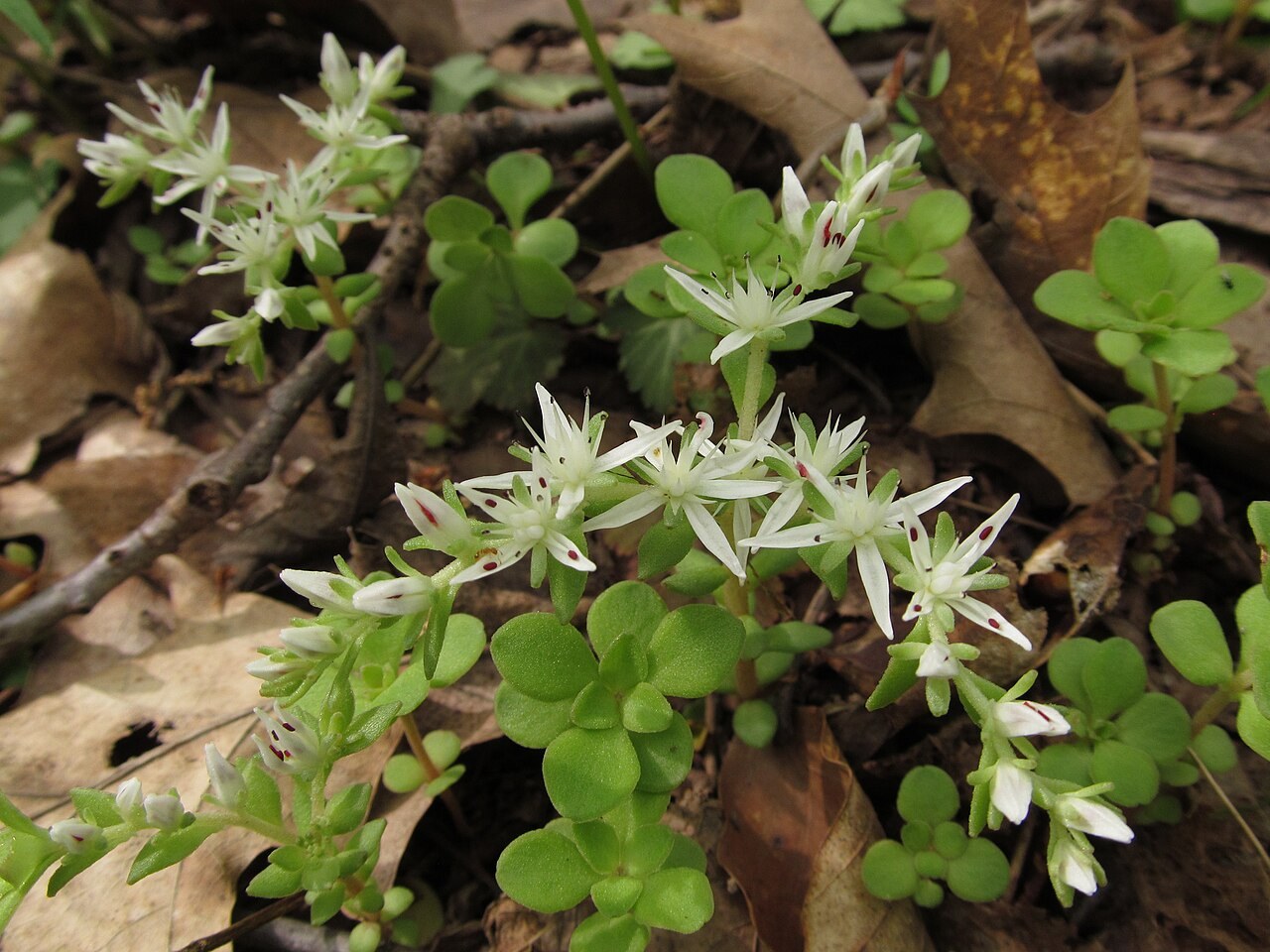
Sedums, or stonecrops, are some of the most popular ground covers in American gardens: tough, succulent, drought-proof and happy in the thin soil between paving stones or on a green roof. But most sedums sold in garden centers, such as goldmoss stonecrop, two-row stonecrop and its ‘Dragon’s Blood’ and ‘Voodoo’ cultivars, white stonecrop and ‘Autumn Joy’, come from Europe and Asia. Behind them is a large, overlooked group of native stonecrops, from the white-starred woodland stonecrop of eastern forests to the golden spearleaf stonecrop of Rocky Mountain rock outcrops and the silvery rosettes of Pacific Coast bluffs.
Roughly 30 species of Sedum are native to the United States (an approximate count; botanists split and lump some western species differently). They are joined by a few close relatives that were long included in Sedum and are still sold and described as sedums: the roseroots and queen’s crown (Rhodiola) and Allegheny stonecrop (Hylotelephium telephioides). This guide covers all of these native stonecrops, how to grow them, and how to tell them apart from the non-native garden sedums.
The West is the center of native sedum diversity, especially California, Oregon and Washington. In the East, the natives are fewer but distinctive, and include some of the only sedums that thrive in shade. Several states, including Minnesota, Wisconsin, Michigan, Iowa and Florida, have no native Sedum at all; there, every stonecrop in a nursery is a garden introduction.
Identification
Stonecrops belong to the stonecrop family, Crassulaceae, the same family as hens-and-chicks and the western dudleyas. They are succulents that store water in fleshy leaves, which lets them grow on rock, gravel and sand where other plants dry out.
Leaves & Stems
Leaves are thick, juicy and smooth, and range from flat and rounded (woodland stonecrop, Pacific stonecrop) to spoon-shaped, lance-shaped or nearly cylindrical and worm-like (wormleaf stonecrop). Many western species form tight rosettes and spread by short creeping stems, building mats a few inches tall. The foliage of many species blushes red or purple in sun, cold or drought. Woodland stonecrop is named ternatum because its leaves are often arranged in whorls of three.
Flowers
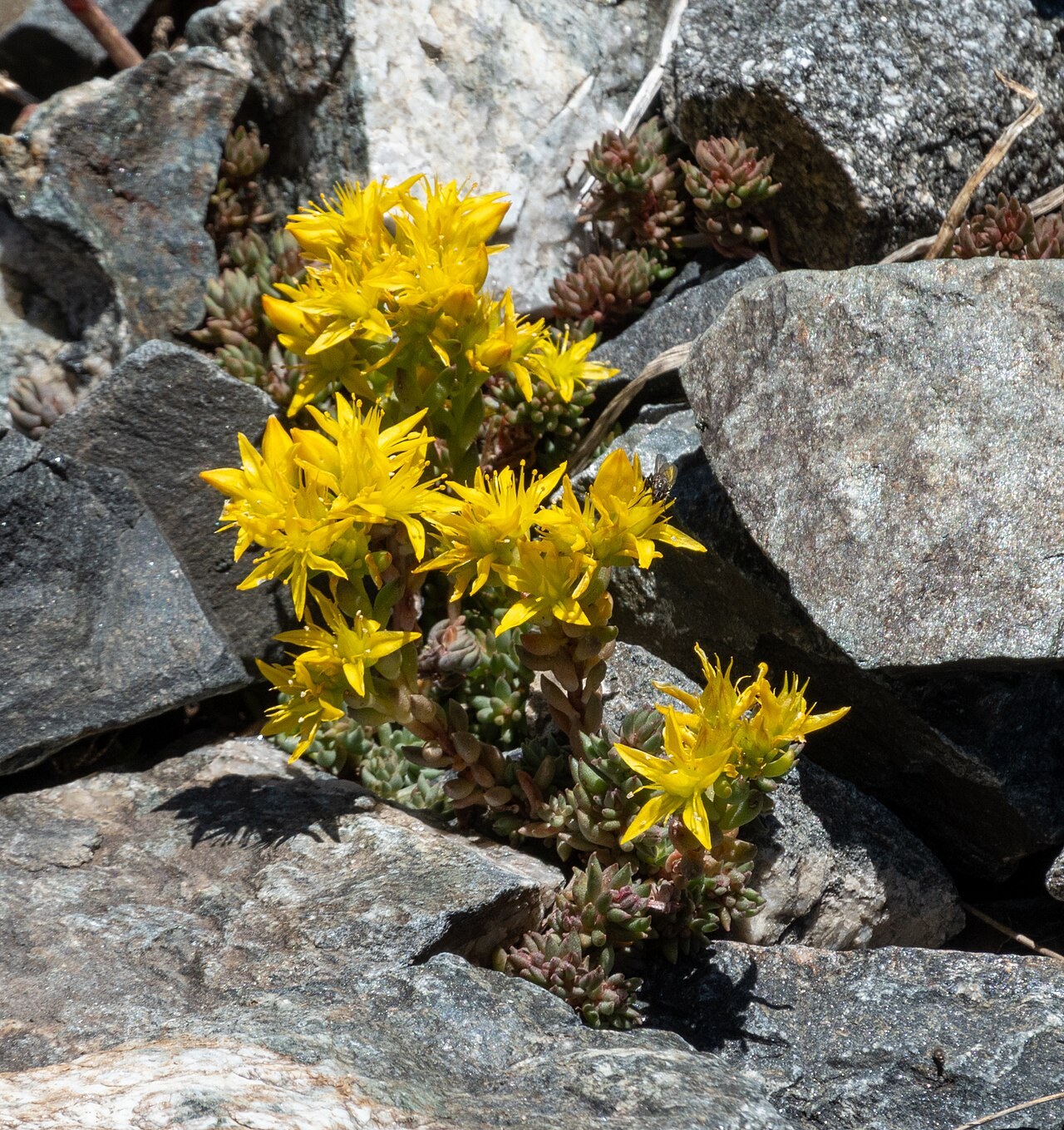
Sedum flowers are small, star-shaped and usually have five pointed petals (four in some species) and twice as many stamens, held in flat or branched clusters above the leaves. Most western natives bloom bright yellow in summer. Eastern woodland stonecrop and widow’s cross bloom white to pale pink in spring and early summer, and the roseroots carry dense heads of yellow, dark red or pink flowers. Allegheny stonecrop and the garden ‘Autumn Joy’ types have broad, domed heads of tiny pinkish flowers in late summer.
Fruit & Seeds
Each flower forms a cluster of small, pointed follicles, often spreading in a star shape, that split to release tiny, dust-like seeds. Many stonecrops also root easily from broken stems and fallen leaves, which is how they spread among rocks.
Quick Facts
| Scientific Name | Sedum L. (genus); related native Rhodiola and Hylotelephium |
| Family | Crassulaceae (Stonecrop) |
| US-Native Species | Roughly 30 Sedum (approximate), plus 3 native Rhodiola and Allegheny stonecrop |
| Growth Forms | Low succulent mats and rosettes; upright clumps in roseroots and Allegheny stonecrop |
| Life Cycle | Mostly perennial; a few annuals or biennials (e.g. widow’s cross) |
| Mature Height | Usually 2–8 in; roseroots and Allegheny stonecrop to about 12–18 in |
| Sun Exposure | Full Sun for most western species; Part Shade to Shade for woodland stonecrop |
| Water Needs | Low; needs excellent drainage |
| Soil Type | Rock crevices, gravel, sand, thin soil over limestone or granite |
| Bloom Time | Spring (eastern woodland species) to summer (most western species) |
| Flower Color | Yellow, white, pink or dark red |
| Wildlife Value | Bees, flies and butterflies; caterpillar host for Parnassian and some elfin butterflies |
| Deer Resistant | Moderately; deer and rabbits sometimes nibble |
| USDA Hardiness Zones | Varies by species; about 2–9 across the group |
Native Range
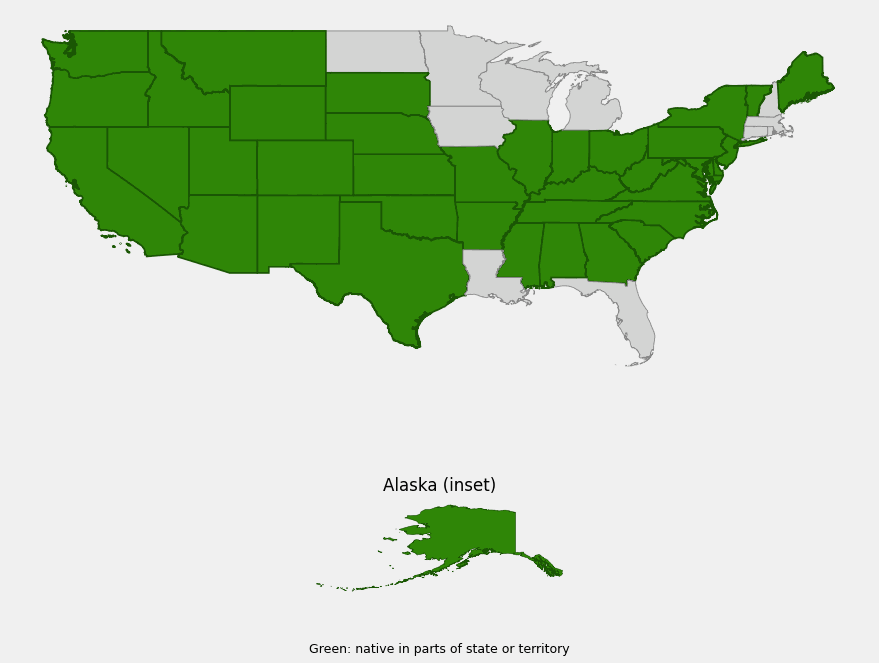
Native stonecrops grow in about 40 states, but where they grow depends heavily on rock. In the West, from the Rockies to the Pacific, sedums are among the most common plants of cliffs, talus slopes, granite domes, lava flows and alpine fell-fields. California, Oregon and Washington have the richest variety, including many species restricted to particular mountain ranges or serpentine soils. Spearleaf stonecrop ranges across nearly the entire West, from Alaska and Washington to Arizona, New Mexico and the Black Hills of South Dakota, with a rare outpost in northwestern Nebraska.
In the East, native sedums follow limestone, shale and granite. Woodland stonecrop grows on shaded, rocky slopes and stream banks from New York and New Jersey to Georgia and west to Missouri and Arkansas. Widow’s cross and yellow stonecrop grow on limestone glades and rocky prairies in the south-central states, from Tennessee and Kentucky to Kansas, Oklahoma and Texas. Cliff stonecrop is a specialty of shale cliffs in Virginia, West Virginia, Maryland and North Carolina, and the tiny annual elf orpine and granite stonecrop grow on the granite flatrocks of the Georgia and Carolina Piedmont.
Roseroot (Rhodiola rosea) reaches the Northeast on sea cliffs in Maine and on rare inland cliffs in Vermont, New York, Pennsylvania and North Carolina, which is why those states appear on the map even though they have few or no true Sedum. States shown in gray, including Minnesota, Wisconsin, Michigan, Iowa, North Dakota, Louisiana, Florida and most of southern New England, have no native stonecrops. Sedums growing wild there, often goldmoss stonecrop on sandy roadsides, are garden escapes.
📋 Regional plant lists covering native stonecrop country: Western Oregon & Washington · Idaho, Eastern Oregon & Eastern Washington · California & Nevada · Montana & Wyoming · Utah & Western Colorado · Arizona & New Mexico · Alaska · North Dakota, South Dakota & Western Minnesota · Nebraska, Kansas & Eastern Colorado · Arkansas, Louisiana, Eastern Oklahoma & Eastern Texas · Illinois, Iowa & Missouri · Ohio & Indiana · Kentucky & Tennessee · Georgia, Alabama & Mississippi · North Carolina & South Carolina · Maryland, Virginia & West Virginia · New York, Pennsylvania & Northern New Jersey · New Hampshire, Maine & Vermont
Native Species
These are the native stonecrops gardeners most often meet in the wild or find at native plant nurseries. Follow the links for full growing guides.
Wild or woodland stonecrop (Sedum ternatum) is the native sedum of the eastern deciduous forest. It forms low mats of round, light-green leaves and covers itself with starry white flowers in April and May. Unlike most sedums it grows in part to full shade, on mossy rocks, stream banks and woodland slopes. It’s the best native choice for the “creeping sedum” and shady stonecrop ground covers described in our New York, Maryland and Minnesota articles, although in Minnesota it is outside its native range.
Widow’s cross (Sedum pulchellum) is a winter annual or biennial of limestone cedar glades and rocky ground in the south-central states. Its flower stems spread in four directions like the arms of a cross and carry rows of pink to white stars in late spring.
Yellow stonecrop (Sedum nuttallianum) is a tiny annual of sandstone and granite outcrops in the Ozarks and southern Plains, from Missouri and Kansas to Arkansas, Oklahoma and Texas, painting rock pavements yellow in spring.
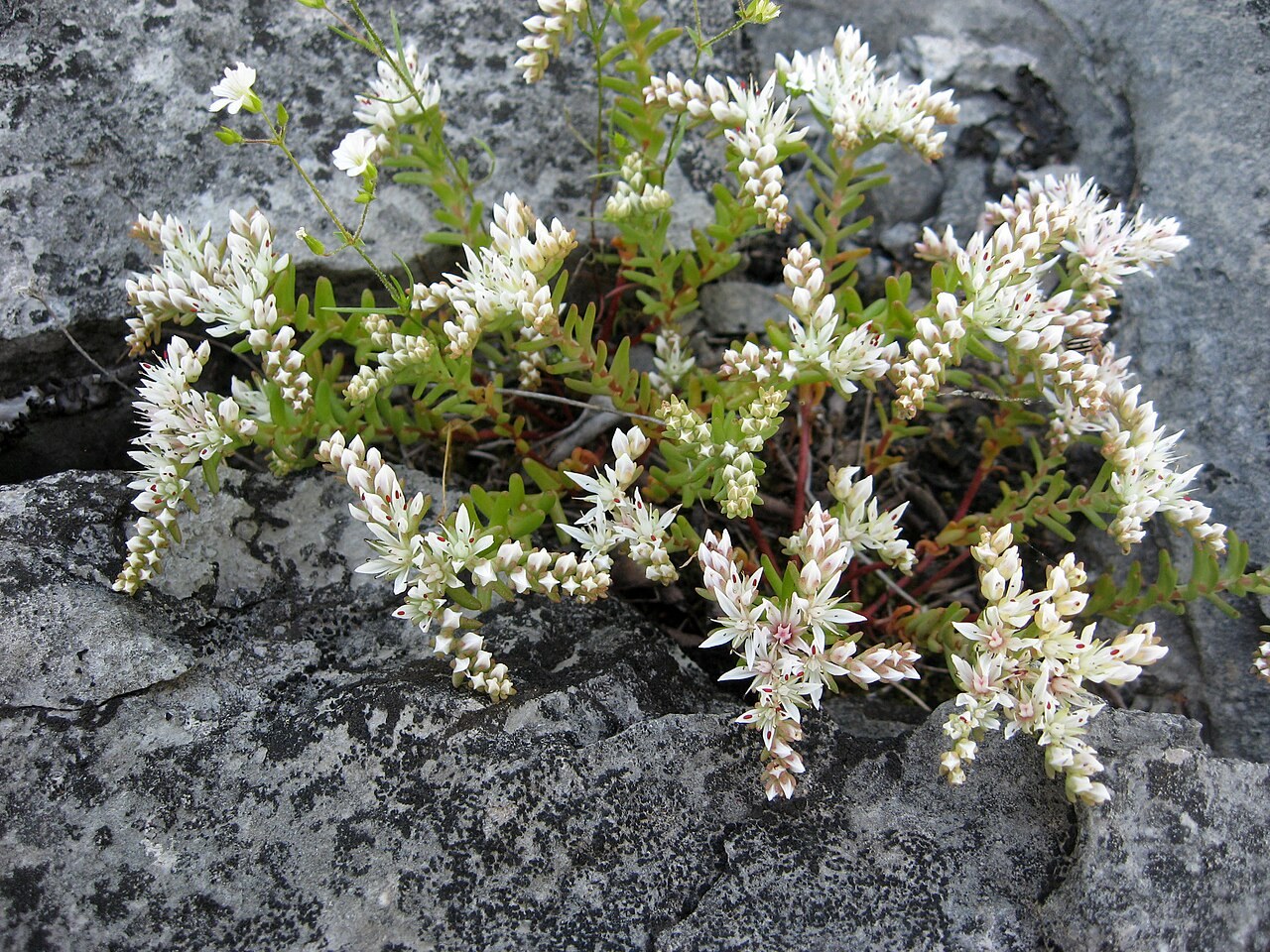
Cliff stonecrop (Sedum glaucophyllum) forms bluish rosettes on shale cliffs and rock outcrops in the central Appalachians of Virginia, West Virginia, Maryland and North Carolina, with white flowers in late spring. It is often confused with woodland stonecrop but has narrower, waxy blue-green leaves.
Spearleaf stonecrop (Sedum lanceolatum) is the most widespread western native, growing on rocky slopes from sagebrush country to above treeline across the Rockies, Great Basin and Cascades. It has small, pointed, often reddish leaves and bright yellow flowers in summer. It’s the most likely identity of the “Utah sedum” and Colorado sedums in our state articles.
Wormleaf stonecrop (Sedum stenopetalum) has narrow, nearly cylindrical leaves and yellow flowers on rocky, dry slopes of the interior Northwest and northern Rockies, from Washington, Oregon and northern California to Idaho, Montana, Wyoming and the Black Hills.
Pacific or broadleaf stonecrop (Sedum spathulifolium) makes flat, frosted-blue rosettes on coastal bluffs and mountain rocks from California to Washington. It’s one of the best native sedums for rock gardens and green roofs in the Pacific states and is the host plant of the endangered San Bruno elfin butterfly.
Oregon stonecrop (Sedum oreganum) has glossy, spoon-shaped leaves that turn bright red in sun, with yellow summer flowers, on coastal cliffs and rocky slopes of Oregon, Washington and northern California.
Spreading stonecrop (Sedum divergens) forms carpets of bead-like green-to-red leaves in the Cascades and Olympics and north into Alaska, with bright yellow summer flowers.
Sierra stonecrop (Sedum obtusatum) grows in granite crevices of the Sierra Nevada and southern Cascades in California, Nevada and Oregon, with rosettes of round-tipped leaves and pale-yellow to cream flowers.
Orpine stonecrop (Sedum debile) is a small Great Basin species of rocky mountain slopes in Utah, Nevada, Idaho and Oregon, with rounded leaves and yellow flowers.
Elf orpine (Sedum smallii, often called Diamorpha smallii) is a tiny red annual that grows in shallow depressions on the granite flatrocks of the Georgia, Alabama and Carolina Piedmont, turning the outcrops crimson in early spring.
Roseroots and queen’s crown (Rhodiola) are upright stonecrops with fleshy leaves crowded on unbranched stems and dense flower heads. Western roseroot or ledge stonecrop (Rhodiola integrifolia) has dark red flowers on alpine rocks across the West and Alaska. Queen’s crown (Rhodiola rhodantha) carries pink flower spikes in wet alpine meadows of the southern Rockies. Roseroot (Rhodiola rosea) grows on Atlantic sea cliffs and rare inland cliffs in the Northeast. Our yellow sedum profile covers the yellow-flowered stonecrops of Alaska, including roseroot.
Allegheny stonecrop (Hylotelephium telephioides) is the native cousin of ‘Autumn Joy’: an upright, blue-leaved plant of Appalachian rock outcrops, with domed heads of pale pink flowers in late summer. It’s the best native substitute for showy garden sedums in the mid-Atlantic and Appalachian states.
Non-Native Look-Alikes
Most sedums sold for ground cover, rock gardens and green roofs are Eurasian. Several spread readily from broken stems and seed, and a few have become problems in natural areas.
- Goldmoss stonecrop or biting stonecrop (Sedum acre): Tiny, bright-green, cone-shaped leaves and brilliant yellow flowers in early summer. Native to Europe, it has escaped across much of the US and can carpet sandy roadsides, dunes and rock outcrops, crowding out native plants. Its sap is peppery and acrid.
- Two-row stonecrop (Sedum spurium, now often Phedimus spurius): Flat, scalloped leaves and pink to red flowers, from the Caucasus. ‘Dragon’s Blood’, ‘Voodoo’ and ‘Fuldaglut’ are cultivars. It spreads by trailing stems and occasionally escapes.
- White stonecrop (Sedum album): Small, cylindrical green or bronze leaves and white flowers, from Europe and North Africa. A common green-roof plant that also escapes to rocky ground.
- Tasteless stonecrop (Sedum sexangulare): Very similar to goldmoss stonecrop but with leaves in neat six-sided rows. Also European.
- Stringy stonecrop (Sedum sarmentosum): Narrow leaves in whorls of three on long trailing stems, with yellow flowers. From East Asia, it escapes into moist woods and stream banks in the East, where it is easily mistaken for native woodland stonecrop. Check the flowers: woodland stonecrop is white, stringy stonecrop is yellow.
- ‘Angelina’ and blue spruce stonecrops (Sedum rupestre, sold as S. reflexum): Needle-like gold or blue leaves, European. ‘Turkish Delight’ is a red-leaved cultivar of two-row stonecrop.
- Showy stonecrop and ‘Autumn Joy’ (Hylotelephium spectabile and hybrids with H. telephium): Upright stonecrops with broad heads of pink flowers in late summer, from East Asia and Europe. Native Allegheny stonecrop is the closest native equivalent.
A note for Minnesota and Upper Midwest gardeners: no stonecrop is native to Minnesota, so a stonecrop ground cover there will always be an introduced plant. Choose a non-spreading clump-former rather than goldmoss stonecrop, or use native low ground covers from our Michigan, Wisconsin & Eastern Minnesota and Dakota lists.
Growing & Care Guide
Light
Most western native stonecrops, along with widow’s cross, yellow stonecrop and Allegheny stonecrop, need full sun, or bright light with afternoon shade in hot regions. Woodland stonecrop is the exception: it grows best in part to full shade and scorches in hot afternoon sun.
Soil & Water
Drainage matters more than anything else. Plant stonecrops in gravelly, sandy or rocky soil, in rock-wall crevices, between paving stones, or in a raised bed amended with grit. Rich, wet garden soil rots most species, especially western natives, which need dry winters or very sharp drainage in humid climates. Woodland stonecrop likes humus-rich soil that stays slightly moist, over rock or along a shady path. Once established, sun-loving species need water only in long droughts.
Planting Tips
Plant in spring or early fall. Set small plants or rooted cuttings 6 to 12 inches apart for a mat, and top-dress with fine gravel rather than wood mulch, which holds moisture against the stems. On green roofs, native options include spearleaf, Pacific and Oregon stonecrops in the West and woodland stonecrop in shaded eastern settings.
Pruning & Maintenance
Stonecrops need little care. Trim off spent flower stalks if you like a tidy look, pull out weeds while they are small, and divide crowded mats every few years. Avoid fertilizer, which makes plants floppy and short-lived.
Propagation
Stonecrops root very easily. Lay stem pieces on moist sandy soil and they will root within a few weeks. Clumps can be divided in spring. Seed is tiny and should be surface-sown and kept just moist.
Landscape Uses
- Rock gardens and stone walls with spearleaf, Pacific, Oregon or cliff stonecrop
- Shady woodland ground cover under trees with woodland stonecrop, woodland phlox and wild columbine
- Green roofs and gravel gardens with regionally native species
- Between pavers and along paths, where low mats tolerate light foot traffic
- Xeriscape and dry slopes with sulfur buckwheat and plains pricklypear in the West
- Glade and outcrop plantings with widow’s cross and fameflower
Wildlife & Ecological Value
For Pollinators
The starry flowers offer easy nectar and pollen to small native bees, syrphid flies, beetles and butterflies. Mass-flowering mats of spearleaf or woodland stonecrop can buzz with insects on a sunny day.
Butterfly Host Plants
Native stonecrops are caterpillar hosts for some specialized butterflies. Spearleaf and wormleaf stonecrops feed the caterpillars of the Rocky Mountain Parnassian (Parnassius smintheus), a white, red-spotted butterfly of western mountains. Pacific stonecrop is a host plant of the federally endangered San Bruno elfin (Callophrys mossii bayensis) near San Francisco, and other subspecies of Moss’s elfin use native stonecrops elsewhere along the Pacific coast.
For Birds & Mammals
Stonecrops are not a major food for birds or mammals, though deer and rabbits nibble the succulent leaves in places.
Ecosystem Role
Stonecrops are pioneers on bare rock. With mosses and lichens, they trap dust and organic matter in cracks and on rock surfaces, slowly building the thin soil other plants need. On eastern glades and granite outcrops, native annual stonecrops are part of specialized plant communities with many rare species, and these sites deserve protection from trampling and off-road vehicles.
Cultural & Historical Uses
The name “stonecrop” is old English, referring to plants that crop up on stones and walls. “Sedum” comes from the Latin sedere, to sit, describing the way the plants sit on rocks and roofs. In Europe, houseleeks and stonecrops were traditionally grown on roofs, a habit that has returned in modern green-roof design.
Roseroot (Rhodiola rosea) has a long history in Arctic and northern European folk traditions; its cut roots smell faintly of roses, giving the common name. Some Alaska Native communities used the leaves of roseroot as a traditional food. These uses are historical and cultural, not a recommendation to harvest wild plants, which are slow-growing and rare in much of the lower 48.
Native stonecrops have only recently become common in the nursery trade. Growing them instead of European goldmoss or two-row stonecrop keeps aggressive escapes out of nearby rock outcrops and supports the specialist butterflies that depend on native species.
Frequently Asked Questions
Are sedums native to the US?
Many are. Roughly 30 Sedum species are native to the United States, most of them in the West. However, the sedums most often sold, including goldmoss, two-row (‘Dragon’s Blood’, ‘Voodoo’), white stonecrop and ‘Autumn Joy’, are from Europe and Asia.
What is “Utah sedum”?
There is no species called Utah sedum. The most common native stonecrop in Utah is spearleaf stonecrop (Sedum lanceolatum), a mat-forming species with yellow summer flowers. Orpine stonecrop and western roseroot also grow wild in Utah’s mountains. ‘Voodoo’, ‘Turkish Delight’ and the reflexed “blue spruce” sedums are non-native garden selections.
Is there a native sedum for shade?
Yes: woodland stonecrop (Sedum ternatum), native from New York to Georgia and west to Missouri and Arkansas, grows in part to full shade in humus-rich, rocky soil. Most other sedums need sun.
Is any sedum native to Minnesota?
No. Minnesota, Wisconsin, Michigan and Iowa have no native stonecrops, so any stonecrop sold there is introduced. If you grow one, choose a clumping type rather than goldmoss stonecrop, which can escape onto sandy roadsides.
Are stonecrops invasive?
Goldmoss stonecrop (Sedum acre) and stringy stonecrop (Sedum sarmentosum) are the main escapes, spreading into sandy ground, rocky natural areas and woodland stream banks. Native stonecrops, grown in their own region, are part of the local plant community.

Looking for a nursery that carries Native Stonecrops?
Browse our native plant nursery directory: Alabama, Alaska, Arizona & Arkansas · California · Colorado, Delaware & Georgia · Idaho, Illinois, Indiana & Kansas · Kentucky, Maine, Maryland, Mississippi, Missouri & Montana · Nebraska, Nevada, New Jersey, New Mexico, New York, North Carolina, Ohio & Oklahoma · Oregon · Pennsylvania, South Carolina, South Dakota, Tennessee, Texas, Utah, Vermont & Virginia · Washington · West Virginia & Wyoming

