
Native Morning Glories (Ipomoea)
“Morning glory” is one of the most familiar flower names in American gardens, but the vines usually sold under that name, the blue ‘Heavenly Blue’, the purple and pink common morning glory and the red-flowered cypress vines, are not native to the United States. They come from Mexico, Central America and the tropics, and some have become stubborn agricultural weeds here. Yet the genus Ipomoea also includes a surprising number of genuinely native species, from the big white-and-purple wild potato vine of eastern woods edges to the shrubby pink bush morning glory of the Great Plains and the purple beach morning glory that binds Gulf Coast dunes.
This guide covers the native morning glories: what they look like, where they grow wild, how to grow them and how to tell them apart from the non-native garden and weedy morning glories. Roughly 25 to 30 Ipomoea species are native to the United States, including Hawaii, with the greatest variety in Florida, Texas and the desert Southwest. Nearly as many more have been introduced from other parts of the world.
If you came here from one of our state vine or ground-cover articles, the short version is this: in the Southeast, Texas, the southern Midwest, the Great Plains and the Southwest, you can grow a native morning glory instead of an imported one. In New England (outside Connecticut), Minnesota, Wisconsin, Washington, Oregon, Utah and California, no morning glory is native, and the ones sold there are all introduced annuals. Gardeners in those states have other native vines to choose from, and we point to some below.
Identification
All morning glories belong to the bindweed family, Convolvulaceae. Most native species are twining vines that wrap counterclockwise around stems, fences and other supports, but some trail along the ground or across sand, and one grows as a rounded bush.
Flowers
The classic morning glory flower is a funnel or trumpet made from five fused petals, often with a faint five-pointed star pattern pressed into the open face. Colors among the natives include white with a purple or wine-red throat (wild potato vine), plain white or pale pink (whitestar), pink to lavender with a darker center (bush morning glory, saltmarsh morning glory, tievine, beach morning glory), and scarlet with a narrow tube (scarlet creeper, Trans-Pecos morning glory). Most open early in the morning and wilt by afternoon, though moonflower opens at dusk. Inside, the stigma is rounded or two-lobed into little balls, a small detail that separates Ipomoea from the related bindweeds (Calystegia and Convolvulus), whose stigmas are split into two slender or flattened lobes.
Leaves
Leaves are alternate and usually heart-shaped, but several native species have distinctive shapes: three-lobed in tievine and whitestar, fiddle-shaped (narrowed in the middle) on some wild potato vine leaves, arrowhead-shaped in saltmarsh morning glory, notched like a goat’s footprint in beach morning glory (pes-caprae means “goat’s foot”), and narrow and grass-like in bush morning glory. Cut stems of many species ooze a milky sap.
Roots & Fruit
Several perennial natives grow from enormous tuberous roots. Wild potato vine and bush morning glory are famous for roots that can be as thick as a person’s leg and weigh many pounds, which is how they survive drought, fire and winter. The fruit is a round capsule holding two to six hard, often dark seeds. The seeds of morning glories should be treated as toxic (see the FAQ below).
Quick Facts
| Scientific Name | Ipomoea L. (genus) |
| Family | Convolvulaceae (Bindweed / Morning Glory) |
| US-Native Species | Roughly 25–30 (approximate), plus about as many introduced |
| Growth Forms | Twining vines, trailing beach runners, and one shrubby species (bush morning glory) |
| Life Cycle | Annuals and long-lived perennials; many perennials have large tuberous roots |
| Mature Size | Vines typically 6–15 ft long; bush morning glory about 2–4 ft tall |
| Sun Exposure | Mostly Full Sun; a few tolerate Part Shade |
| Water Needs | Average to dry for most; saltmarsh morning glory likes moist soil |
| Soil Type | Sandy, loamy or rocky soils with good drainage; beach species need sand |
| Bloom Time | Late spring to fall, varying by species |
| Flower Color | White, pink, lavender, purple, or scarlet |
| Wildlife Value | Specialist morning glory bees, bumblebees, hummingbirds, sphinx moths |
| Toxicity | Seeds are toxic to people and pets; do not eat any part of wild plants |
| Deer Resistant | Variable; foliage is often browsed |
| USDA Hardiness Zones | Varies by species; perennials range from about zone 4 (bush morning glory) to zones 9–11 (tropical Florida species) |
Native Range
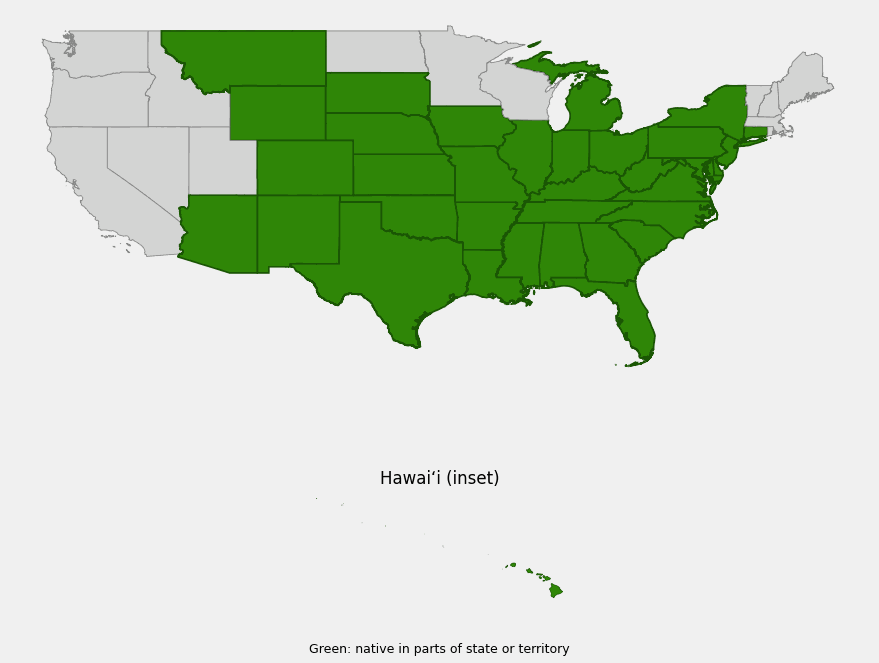
Native morning glories occur in about three dozen states, but the number of species falls off sharply to the north and west. The richest areas are peninsular Florida, the Gulf Coast and Texas, where tropical species such as moonflower, scarlet creeper, saltmarsh morning glory and the two beach morning glories reach their northern limits. In the Southwest, Arizona, New Mexico and west Texas host a separate set of desert and mountain species that flower with the summer monsoon rains.
Farther north, the choice narrows to a few hardy species. Wild potato vine and whitestar reach north to southern New York, Pennsylvania, Ohio, Michigan, Illinois and Iowa, and wild potato vine has a few rare native outposts in Connecticut. Bush morning glory is the native morning glory of the Great Plains, from Texas and New Mexico north to Colorado, Nebraska, South Dakota, Wyoming and southeastern Montana. In Hawaii, native species include pōhuehue, the Hawaiian form of beach morning glory, and the blue-flowered koali ʻawa (Ipomoea indica).
No Ipomoea is native to Maine, New Hampshire, Vermont, Massachusetts, Rhode Island, Minnesota, Wisconsin, North Dakota, Idaho, Washington, Oregon, Utah, Nevada or California, so those states are gray on the map. Morning glories found growing wild there are escapes from gardens or farm fields. In Massachusetts, for example, scattered wild potato vine and whitestar populations are treated as introduced.
📋 Regional plant lists covering native morning glory country: New York, Pennsylvania & Northern New Jersey · Delaware, Southern New Jersey & Long Island · Maryland, Virginia & West Virginia · North Carolina & South Carolina · Georgia, Alabama & Mississippi · Arkansas, Louisiana, Eastern Oklahoma & Eastern Texas · South & West Texas · Kentucky & Tennessee · Ohio & Indiana · Illinois, Iowa & Missouri · Nebraska, Kansas & Eastern Colorado · Montana & Wyoming · Arizona & New Mexico · Hawaii
Native Species
These are the native morning glories gardeners are most likely to meet or be able to buy. Click through for full growing guides where we have them.
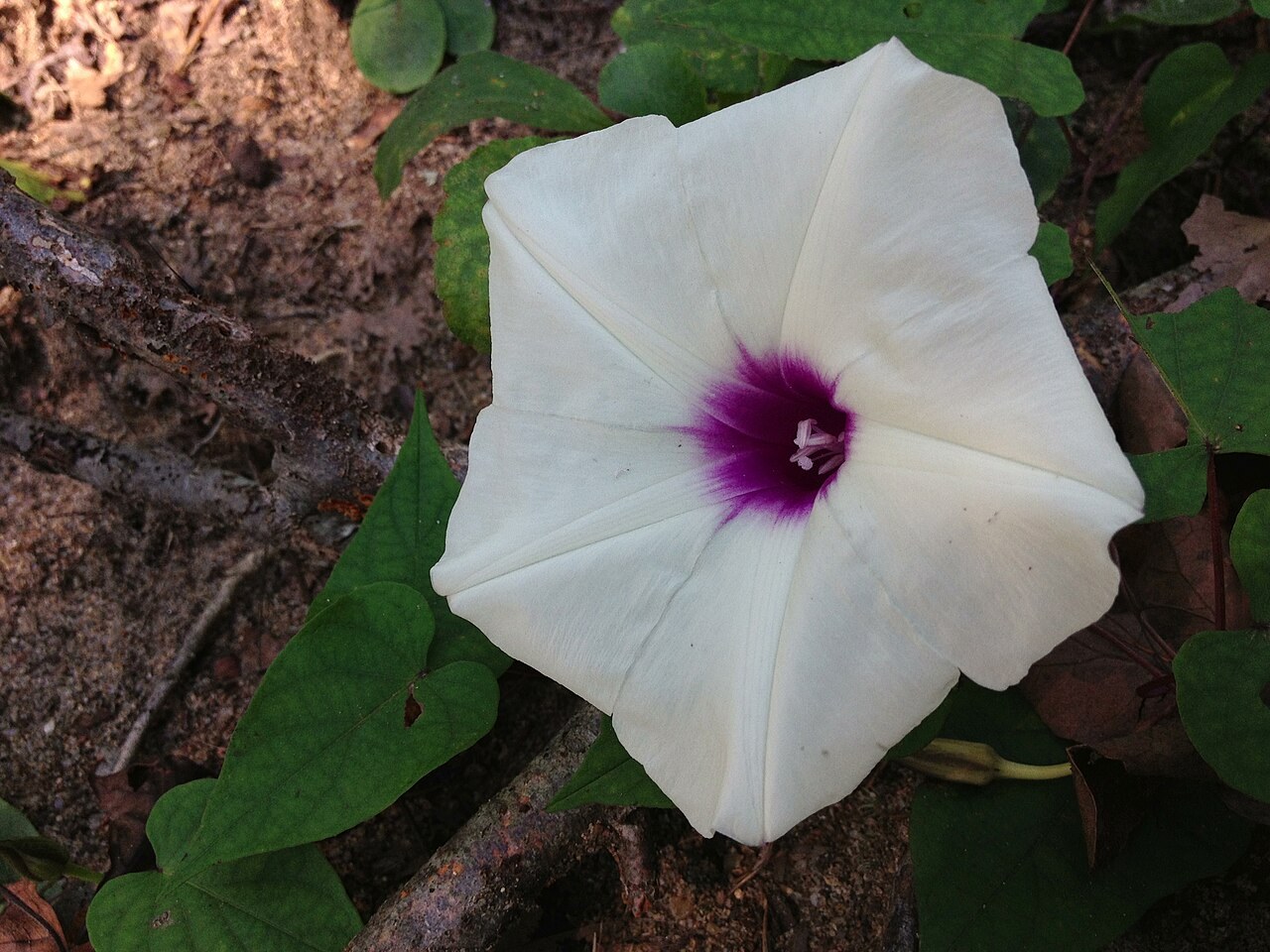
Wild potato vine, or man of the earth (Ipomoea pandurata) is the big native morning glory of the East, found from southern New York and Michigan to Florida and Texas. Its 2- to 3-inch white flowers have a deep wine-purple throat and open from June into September. The vine dies back each winter to a huge tuberous root and returns every spring, so it’s a true perennial even in zone 5. Give it a fence or shrub to climb in full sun and leave it in place, since the root resents disturbance.
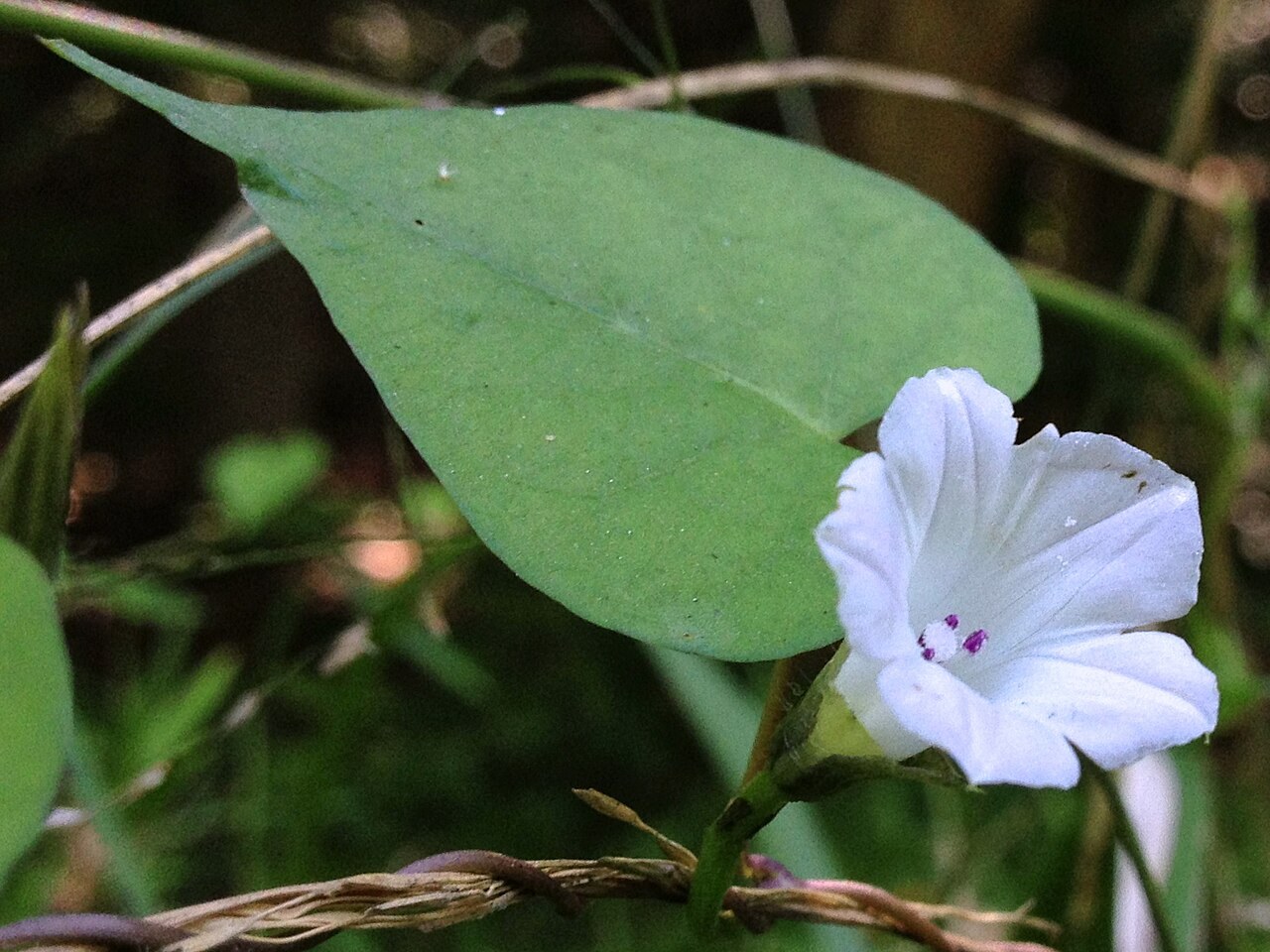
Whitestar or small white morning glory (Ipomoea lacunosa) is a native annual of fields, ditches and stream banks from Pennsylvania and New Jersey to Florida, west to Kansas and Texas. Its white (rarely pale pink) flowers are under an inch across, and the leaves are heart-shaped or three-lobed. It is modest in the garden and can be weedy in crop fields, but it is a good, small-scale native for a sunny meadow edge.
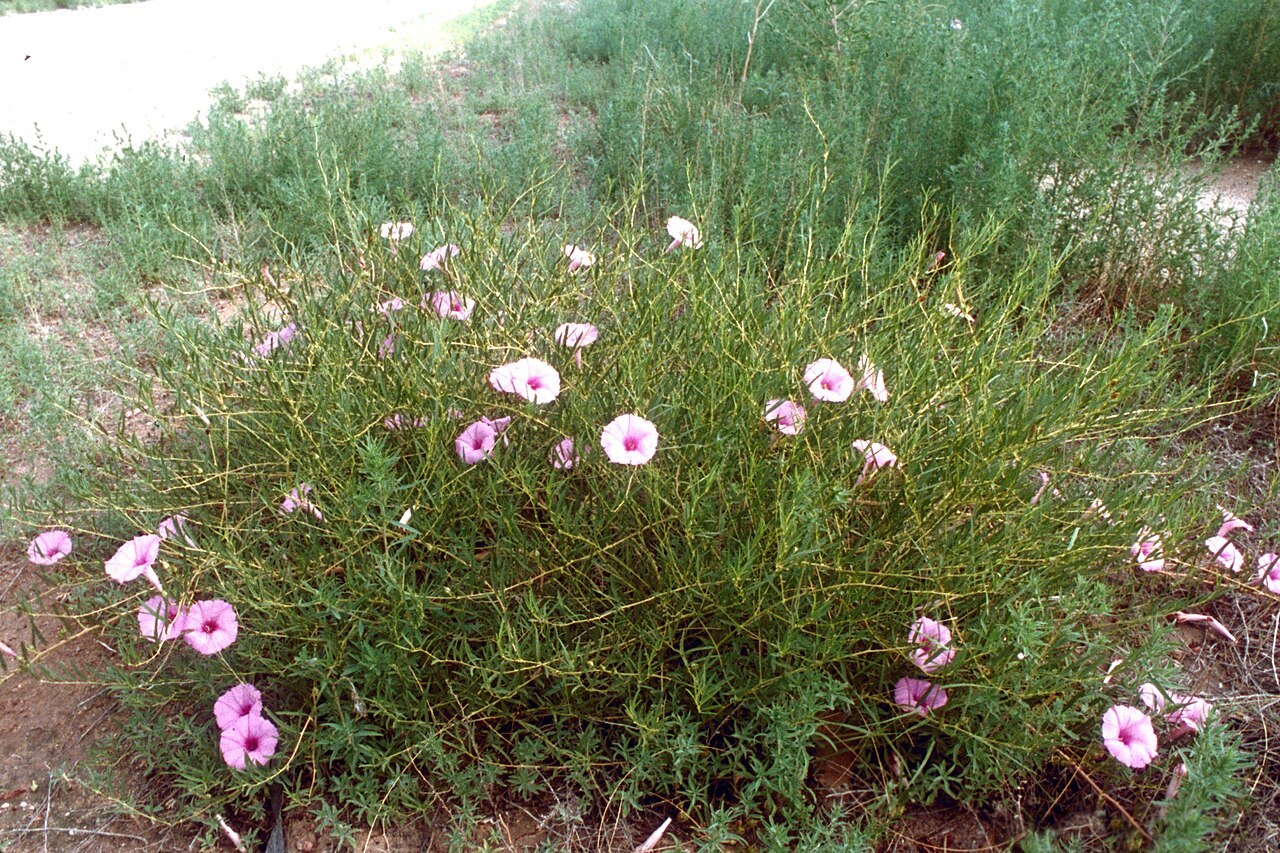
Bush morning glory (Ipomoea leptophylla) does not climb at all. It forms a rounded, grassy-looking clump about 2 to 4 feet tall and wide with narrow, linear leaves and 2- to 3-inch pink to lavender-pink flowers with a darker center in early summer. It grows on sandy and dry prairies and roadsides from Texas and New Mexico north to South Dakota, Wyoming and southeastern Montana, surviving drought on a massive root. It’s one of the best morning glories for the Colorado and Plains gardeners who arrive from our ground-cover articles.
Beach morning glory or railroad vine (Ipomoea pes-caprae) runs across beaches and foredunes along the Gulf and southern Atlantic coasts, and in Hawaii as pōhuehue. Its thick, notched leaves and bright pink-purple flowers make it a top choice for coastal ground cover and dune stabilization.
Fiddle-leaf beach morning glory (Ipomoea imperati) shares the same beaches but has white flowers with a yellow throat and smaller, fleshy, often fiddle-shaped leaves. It’s native from the Carolinas to Florida and along the Gulf to Texas.
Saltmarsh morning glory (Ipomoea sagittata) climbs through grasses at the edges of brackish and freshwater marshes and moist ditches along the coastal plain from North Carolina to Texas. It has slender arrowhead-shaped leaves and large rose-pink flowers. It’s one of the few native morning glories for wet soil.
Tievine (Ipomoea cordatotriloba) is a perennial southern vine with three-lobed or heart-shaped leaves and lavender-pink flowers with a darker throat, found from North Carolina to Florida and west to Arkansas and Texas. It covers fences and thickets quickly in summer and fall.
Scarlet creeper (Ipomoea hederifolia) is a fast annual vine with small, bright red, tubular flowers that hummingbirds love. It is native from Florida and Georgia west to Texas and New Mexico. It looks a lot like the non-native red morning glory, and the two are often confused.
Trans-Pecos morning glory (Ipomoea cristulata) is the Southwest’s red-flowered annual vine, native to Arizona, New Mexico and west Texas, where it twines through shrubs and grasses after summer rains. Its deeply lobed leaves and scarlet tubular flowers attract hummingbirds.
Moonflower (Ipomoea alba) opens huge, fragrant white flowers at dusk, pollinated by sphinx moths. In the United States it is native only in Florida (plus Puerto Rico and the U.S. Virgin Islands). Elsewhere it’s grown as an annual from seed.
Beach moonflower (Ipomoea violacea) is a night-blooming white morning glory of coastal hammocks and beach thickets in south Florida and the Caribbean.
Crestrib morning glory (Ipomoea costellata) is a small, delicate annual of the desert Southwest, from Arizona and New Mexico to west Texas, with finely divided leaves and little pale lavender to pink flowers. It’s a common sight in grasslands after monsoon rains.
A note on Mexican morning glory. Mexican morning glory (Ipomoea tricolor), the parent of ‘Heavenly Blue’ and many other popular blue cultivars, comes from Mexico and Central America. USDA PLANTS treats it as introduced everywhere in the lower 48 states, so it is not a US native. We include it here because so many of our vine articles describe it as “morning glory.” See the look-alikes section below.
Non-Native Look-Alikes
Most morning glories sold in seed racks and many growing wild along fences and in crop fields are introduced. Several reseed so heavily that they are classed as serious weeds, so they are worth recognizing.
- Common or tall morning glory (Ipomoea purpurea): The old-fashioned purple, pink, magenta or white morning glory with heart-shaped leaves and hairy stems, native to Mexico and Central America. It is introduced across most of the country and is a major weed of corn, cotton and soybean fields in the South and Midwest. Its hard seeds stay viable in soil for years, so a few plants can seed an area for a decade.
- Japanese morning glory (Ipomoea nil): The parent of the large Japanese and ‘Scarlett O’Hara’ types. It is a tropical American species long bred in Asia, which is where garden strains come from. USDA PLANTS lists it as native in the lower 48, but most southeastern floras treat wild US plants as weedy escapes, and garden seed is not a native strain.
- Mexican morning glory (Ipomoea tricolor): Sky-blue ‘Heavenly Blue’, ‘Flying Saucers’ and ‘Pearly Gates’ types, native to Mexico and Central America and introduced in the US. Its seeds are especially high in toxic alkaloids.
- Ivyleaf morning glory (Ipomoea hederacea): Blue to purple flowers and three-lobed leaves on hairy vines, introduced and a common field weed in the East and Midwest. It is easily mistaken for native tievine or whitestar; look at the sepals, which are long, hairy and curled back at the tip in ivyleaf.
- Red morning glory or redstar (Ipomoea coccinea): Small scarlet trumpets with an orange-yellow throat on a fast annual vine. USDA PLANTS treats it as introduced, although some regional floras consider it native in the Southeast. It is certainly not native to Minnesota or the Upper Midwest, where it is grown only as an annual. In the South and Southwest, native scarlet creeper and Trans-Pecos morning glory are equivalents for hummingbirds.
- Cypress vine (Ipomoea quamoclit) and cardinal climber (Ipomoea × multifida): Red star-shaped flowers on vines with feathery or deeply cut leaves. Cypress vine is tropical American and introduced. Cardinal climber is a garden hybrid. Both self-sow in the South.
- Sweet potato vine (Ipomoea batatas): The ornamental chartreuse and purple-leaved container plants are sweet potato cultivars of tropical origin, not native.
- Field bindweed (Convolvulus arvensis): Not a true morning glory but often called “wild morning glory.” It has small white to pink flowers and arrowhead leaves and is a deep-rooted Eurasian weed listed as noxious in many states. Don’t confuse it with native whitestar or saltmarsh morning glory.
Where you want a native vine instead of an imported morning glory, check your regional list for climbers native to your area. In much of the East and South, coral honeysuckle gives red trumpets for hummingbirds, and in the Southeast and lower Midwest purple passionflower is a showy summer vine. Hedge false bindweed (Calystegia sepium), a close relative with white or pink morning-glory flowers, is native across most of the country, but it spreads aggressively by rhizomes and is best left to wild edges.
Growing & Care Guide
Light
Nearly all morning glories bloom best in full sun, at least six hours a day. Wild potato vine and tievine will grow at sunny woodland edges with some afternoon shade but flower less. Moonflower and the beach moonflower open at night, so plant them where you’ll see them in the evening.
Soil & Water
Native morning glories prefer well-drained soil of average or low fertility. Rich soil and fertilizer produce lots of leaves and few flowers. Bush morning glory, crestrib and Trans-Pecos morning glory need lean, dry, sandy or gravelly soil and rot in wet clay. Beach morning glories want pure sand and salt spray. Saltmarsh morning glory is the exception and grows best in moist to wet ground.
Planting Tips
Morning glory seeds have hard coats. Nick each seed with a file or nail clipper, or soak it overnight in warm water, then sow directly outdoors after the soil warms in late spring, about half an inch deep. Seedlings dislike root disturbance, so sow in place or in deep pots. For tuberous perennials like wild potato vine and bush morning glory, plant young container plants rather than large dug roots and choose the spot carefully: the roots go deep, and the plants are very hard to move later.
Pruning & Maintenance
Give twining species a fence, trellis, string or open shrub to climb. Cut perennial vines to the ground after frost kills the tops. Annual species, both native and non-native, can self-sow; if you don’t want seedlings, pull the vines before the round capsules dry and split in fall.
Propagation
Seed is the standard method for all species. Collect capsules when they turn tan and papery, dry them, and store the seeds cool and dry. Perennial species can also be grown from stem cuttings taken in early summer.
Landscape Uses
- Fence and trellis cover with wild potato vine, tievine or scarlet creeper
- Hummingbird gardens with scarlet creeper or Trans-Pecos morning glory
- Dune and beach-front ground cover with beach morning glory and fiddle-leaf beach morning glory
- Dry prairie and xeriscape plantings with bush morning glory
- Moon gardens with moonflower in Florida or as an annual elsewhere
- Rain-garden and marsh-edge plantings on the coast with saltmarsh morning glory
Wildlife & Ecological Value
For Pollinators
Morning glories support several specialist bees that collect pollen from little else. The southeastern morning glory bee (Melitoma taurea) gathers Ipomoea pollen and nests in clay banks, and the large bee Cemolobus ipomoeae specializes on wild potato vine. Bumblebees, carpenter bees and long-horned bees also crawl deep into the flowers. White night-blooming moonflowers are pollinated by sphinx moths.
For Birds
Red-flowered natives, scarlet creeper and Trans-Pecos morning glory, are classic hummingbird flowers, with narrow tubes and nectar sized for hummingbird bills. Twining vines also give small birds cover and perches along fencerows.
For Insects & Other Wildlife
Morning glory leaves feed tortoise beetles, including the shiny golden tortoise beetle, and the caterpillars of the pink-spotted hawk moth (sweet potato hornworm). Deer and rabbits browse the tender foliage of many species.
Ecosystem Role
Beach morning glories are pioneer plants on the open sand of upper beaches and foredunes. Their long runners trap blowing sand and help build and hold dunes, including on beaches used by nesting sea turtles. Perennial inland species, with their deep storage roots, survive fire, drought and grazing on prairies and in pine-oak woodlands.
Cultural & Historical Uses
Several native morning glories have huge starchy roots, and their history is tied to those roots. Early accounts describe Native American peoples of the East roasting the roots of wild potato vine, and Plains peoples are recorded using the roots of bush morning glory as an emergency food. These roots are bitter and purgative unless prepared in the traditional way, and the sweet potato is the only Ipomoea grown as a food crop.
The common names of wild potato vine, “man of the earth” and “man root,” both refer to its huge buried root, which can be roughly the size and shape of a human body part and is famously hard to dig out. Bush morning glory carries similar names, such as manroot, for the same reason.
In Mexico, the seeds of some tropical morning glories, including Ipomoea tricolor, were used in Indigenous religious ceremonies for their mind-altering alkaloids. Those same alkaloids are why morning glory seeds are dangerous to eat today. In Hawaii, pōhuehue vines were part of traditional life on the shore, and the plant remains a valued native for coastal restoration.
Frequently Asked Questions
Are morning glories native to the United States?
Some are. Roughly 25 to 30 Ipomoea species are native to the US, but the most common garden morning glories (Ipomoea purpurea, I. nil strains and I. tricolor) are introduced from tropical America and Asia. Native choices include wild potato vine in the East, bush morning glory in the Plains and beach morning glory on southern coasts.
Are morning glories poisonous?
The seeds of many morning glories contain toxic ergot-type alkaloids and can cause vomiting, confusion and other serious symptoms in people. Pets that chew vines or seeds can also be sickened. Keep seed packets and seed heads away from children and animals.
Is morning glory invasive?
Common morning glory and ivyleaf morning glory are serious, self-sowing weeds of farm fields across the South and Midwest, and some states regulate their seed. Native species can also self-sow, but they are part of the local flora. Field bindweed, often called wild morning glory, is a separate genus and a listed noxious weed in many states.
Which morning glory is native to Texas?
Texas has more native species than almost any other state, including wild potato vine and tievine in the east, saltmarsh and beach morning glories on the coast, scarlet creeper, bush morning glory in the Panhandle, and Trans-Pecos and crestrib morning glories in the west. The blue ‘Heavenly Blue’ types are Mexican introductions.
Is there a native morning glory for Minnesota, Washington or Utah?
No. No Ipomoea species is native to those states, so any morning glory sold there is an introduced annual. Grow it with care to limit self-seeding, or choose a native vine from our regional lists instead.

Looking for a nursery that carries Native Morning Glories?
Browse our native plant nursery directory: Alabama, Arizona & Arkansas · Colorado, Connecticut, Delaware, Florida, Georgia & Hawaii · Illinois, Indiana, Iowa & Kansas · Kentucky, Louisiana, Maryland, Michigan, Mississippi, Missouri & Montana · Nebraska, New Jersey, New Mexico, New York, North Carolina, Ohio & Oklahoma · Pennsylvania, South Carolina, South Dakota, Tennessee, Texas & Virginia · West Virginia & Wyoming

