
Native Cypresses (Cupressus and Hesperocyparis)
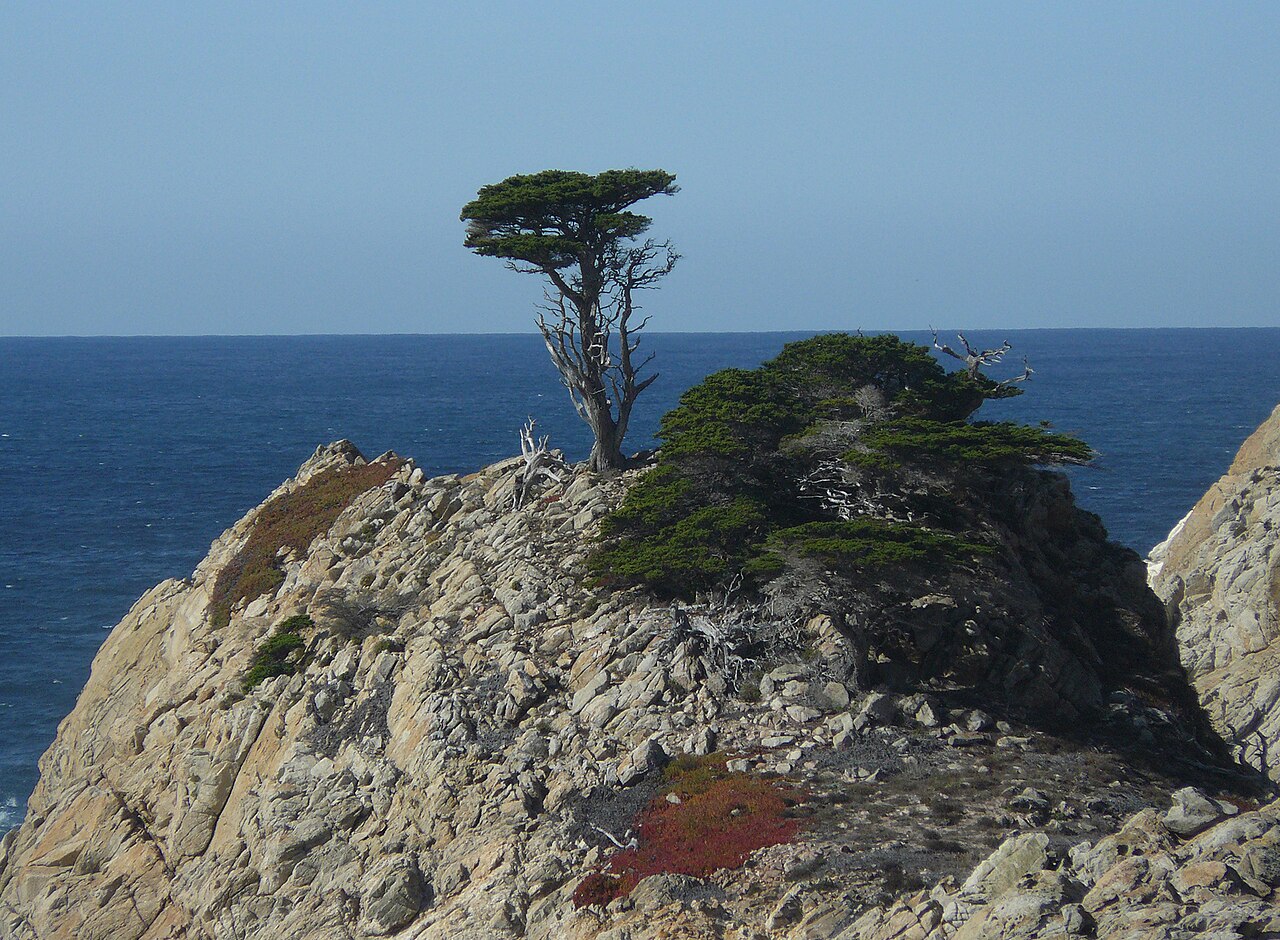
True cypresses are evergreen conifers of the cypress family (Cupressaceae) with tiny, scale-like leaves and round, woody cones. The Old World species remain in the genus Cupressus, while botanists now place the New World species in their own genus, Hesperocyparis (“western cypress”). You will still see the native trees sold and described under Cupressus, which is why both names appear on this page. Around 10 or 11 species are native to the United States, almost all of them in California, plus Arizona cypress in the Southwest.
Our native cypresses are an unusual group. Most grow in small, isolated groves, often on serpentine soils, coastal bluffs or fire-prone mountain slopes, and several are rare. The famous Monterey cypress grows wild only on two headlands near Carmel, yet it has been planted along coasts around the world. Arizona cypress, the most widespread species, ranges from Arizona and New Mexico into the Chisos Mountains of west Texas and northern Mexico, and it is the native cypress most often grown in gardens across the South.
If you reached this page from our conifer guide, note that “cypress” is used for several very different trees. In the eastern U.S., the “cypress” of swamps and rivers is bald cypress, a deciduous conifer that drops its needles every fall; it is not a true cypress. True cypresses are evergreen and keep each leaf for several years. Leyland cypress, the fast hedge tree of eastern suburbs, is a garden hybrid, and Italian cypress is a Mediterranean import. This guide explains the differences and helps you find the right native tree for your region.
Identification
True cypresses are easy to separate from other conifers by their foliage, their cones and the way the branchlets are arranged.
Foliage
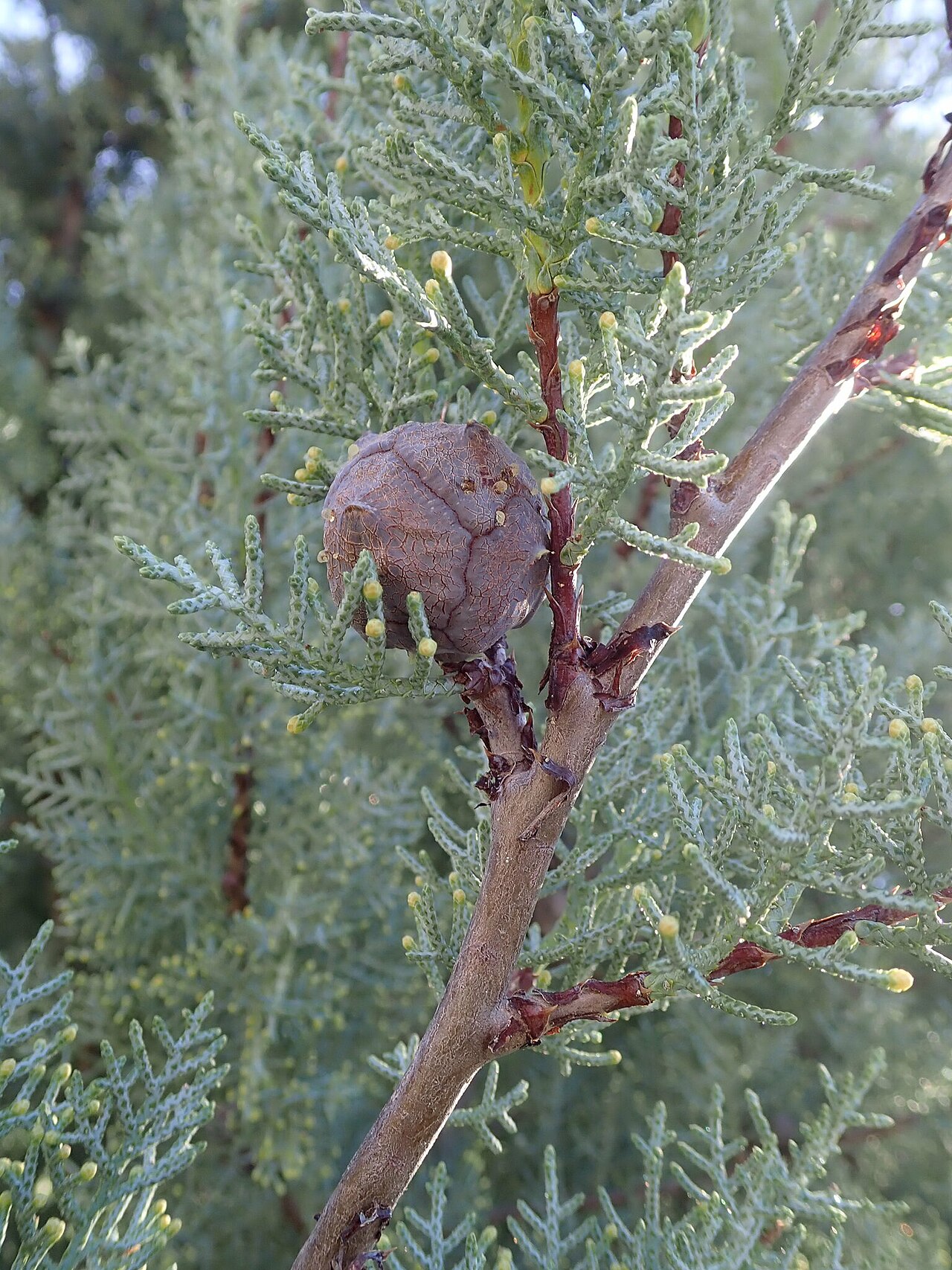
Mature leaves are tiny scales, about 1/16 inch long, pressed tightly against the twig in four ranks so that each branchlet looks like a braided cord. Unlike the flat, fern-like sprays of false cypresses and arborvitae, cypress branchlets branch in all directions, giving the foliage a fuller, three-dimensional look. Many species, including Arizona and Piute cypress, have a small resin gland on the back of each scale that may show a white dot of resin, and the foliage is aromatic when crushed. Color ranges from bright green (Monterey, MacNab) to striking blue-gray (smooth forms of Arizona cypress). Seedlings and vigorous shoots have short, sharp, needle-like juvenile leaves.
Cones
Seed cones are round and woody, roughly 1/2 to 1 1/2 inches across, made of 4 to 12 shield-shaped (peltate) scales that fit together like a soccer ball, each with a small point or boss in the center. They take two years to mature. In most native species the cones stay closed on the tree for years and open after fire releases the seeds (they are “serotinous”), so older trees carry many gray, weathered cones. Pollen cones are tiny and yellowish, at the branch tips in late winter and spring.
Bark & Form
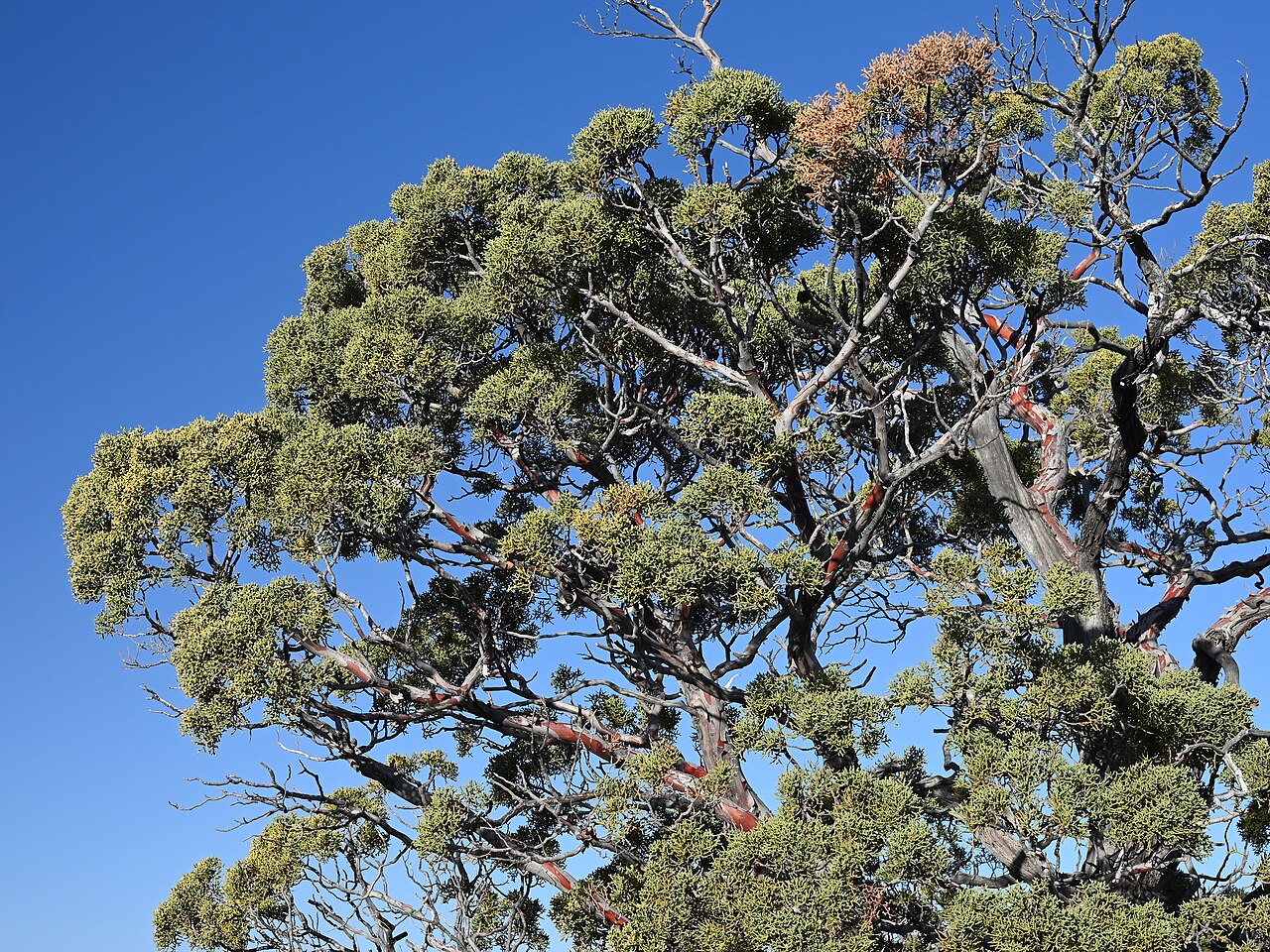
Bark is fibrous and gray-brown in Monterey, Gowen and Sargent cypresses, but smooth and peeling, revealing red, cherry-brown or purplish layers, in smooth Arizona cypress, Tecate cypress, Cuyamaca cypress and Modoc cypress. Shape varies with site. In shelter, Monterey cypress grows into a symmetrical pyramid when young; on windy headlands it becomes flat-topped and contorted. On poor serpentine or pygmy-forest soils, Sargent, MacNab and Gowen cypresses may stay shrubby and only a few feet tall.
Telling Cypress from Lookalikes
junipers have similar scale leaves but bear berry-like, fleshy cones. False cypresses (Chamaecyparis) and arborvitae (Thuja) have flattened foliage sprays and small cones. Bald cypress has soft, flat, feathery needles that turn rusty orange and fall in autumn, and its cones are round but break apart when ripe.
Quick Facts
| Scientific Name | Hesperocyparis (New World cypresses; formerly Cupressus) |
| Family | Cupressaceae (Cypress) |
| U.S. Native Species | About 10–11, depending on classification |
| Plant Type | Evergreen coniferous trees and large shrubs |
| Mature Height | 10–40 ft for most; Arizona cypress 30–60 ft; Monterey cypress to about 80 ft |
| Mature Spread | 10–40 ft (Monterey cypress wider on windy coasts) |
| Growth Rate | Moderate to fast when young |
| Sun Exposure | Full Sun |
| Water Needs | Low; drought tolerant once established |
| Soil Type | Well-drained; many species on rocky, serpentine or volcanic soils |
| Soil pH | Slightly acidic to alkaline (about 6.0–8.0) |
| Bloom Time | Pollen shed late winter – spring |
| Flower Color | None (conifer); small yellowish pollen cones |
| Fall Color | None (evergreen) |
| Fruit | Round woody cones 1/2–1 1/2 in, often staying closed until fire |
| Deer Resistant | Yes, generally |
| USDA Hardiness Zones | About 6–10 (Arizona and Modoc cypress hardiest) |
Native Range
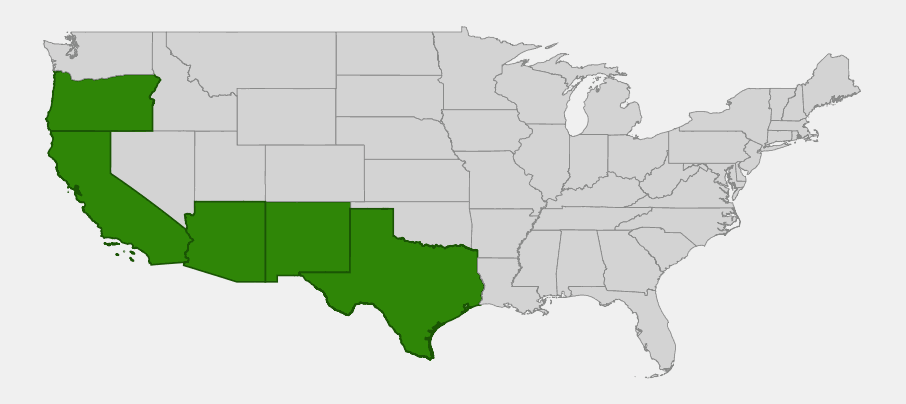
Native cypresses grow wild in only five states: California, Oregon, Arizona, New Mexico and Texas. California is the center of diversity, with nine or ten species, most of them restricted to a handful of groves. Monterey and Gowen cypress grow on the Monterey Peninsula; Mendocino cypress in the pygmy forests of the Mendocino coast; Santa Cruz cypress in the Santa Cruz Mountains; Sargent and MacNab cypress on serpentine and volcanic soils in the Coast Ranges and Sierra Nevada foothills; Piute cypress in the southern Sierra; and Tecate and Cuyamaca cypress in the mountains of San Diego and Orange counties.
Modoc cypress grows in a few scattered groves in northeastern California and the Siskiyou Mountains of southwestern Oregon, making it the only cypress native to Oregon. Arizona cypress is the only widespread species, growing in canyons and on mountain slopes in central and southeastern Arizona and southwestern New Mexico, with a small native population in the Chisos Mountains of Big Bend in west Texas.
Arizona cypress and Monterey cypress are widely planted far outside these areas, for example in the Southeast, Utah and Nevada, and Monterey cypress has naturalized along parts of the California coast beyond its two native groves. Those planted and escaped trees are not counted as native here. No true cypress is native to the eastern United States; the eastern “cypresses” are bald cypress and pond cypress (Taxodium).
📋 Regional plant lists covering native cypress country: California & Nevada · Western Oregon & Washington · Arizona & New Mexico · South & West Texas
Native Species
These are the true cypresses native to the United States. Every species with a full Plant Native profile is linked. Many of them are rare, so buy nursery-grown plants and never collect from wild groves.
Arizona Cypress (Hesperocyparis arizonica, syn. Cupressus arizonica)
The most widespread and most planted native cypress, 30–60 ft, native to canyons and mountain slopes of Arizona, New Mexico, west Texas and northern Mexico. Smooth-barked forms (sometimes called C. glabra) have peeling cherry-red bark and blue-gray foliage; cultivars such as ‘Carolina Sapphire’ and ‘Blue Ice’ are popular in the Southeast and Southwest as screens and Christmas trees. Very drought and heat tolerant.
Monterey Cypress (Hesperocyparis macrocarpa, syn. Cupressus macrocarpa)
Native only to Point Lobos and Cypress Point near Carmel, California, where it grows on wind-swept granite headlands. A fast-growing tree, 40–80 ft, that becomes picturesque and flat-topped by the sea. It is one parent of Leyland cypress. Planted inland in hot climates it often succumbs to cypress canker.
Gowen Cypress (Hesperocyparis goveniana, syn. Cupressus goveniana)
A small tree or shrub of acidic, nutrient-poor soils in Monterey County, sometimes only a few feet tall in pygmy forest. Listed as federally threatened. Closely related Mendocino cypress (H. pygmaea, treated by some botanists as a variety of Gowen cypress) grows in the famous pygmy forests of the Mendocino coast.
Santa Cruz Cypress (Hesperocyparis abramsiana)
Known from only a few groves on sandstone and granitic soils in the Santa Cruz Mountains. Federally listed as threatened. Bright green foliage and fire-dependent, closed cones.
Sargent Cypress (Hesperocyparis sargentii, syn. Cupressus sargentii)
The most widespread California cypress, growing on serpentine soils in the Coast Ranges from Mendocino County to Santa Barbara County. On good sites it reaches 30–50 ft; on harsh serpentine it may be a dwarf shrub.
MacNab Cypress (Hesperocyparis macnabiana, syn. Cupressus macnabiana)
A bushy, many-stemmed small tree, 15–30 ft, of serpentine and volcanic chaparral in the northern Coast Ranges, Sierra Nevada foothills and southern Cascades. Its foliage has a strong, pleasant fragrance.
Modoc Cypress (Hesperocyparis bakeri, syn. Cupressus bakeri)
Also called Baker cypress, a tree of lava flows and serpentine in northeastern California and the Siskiyou Mountains of southwestern Oregon. Reddish, flaking bark. It grows at higher, colder sites than other California cypresses and is among the most cold-hardy.
Piute Cypress (Hesperocyparis nevadensis, syn. Cupressus nevadensis)
Restricted to the Piute Mountains and nearby slopes in Kern County, at the southern end of the Sierra Nevada. Gray-green, glandular foliage; closely related to Arizona cypress.
Tecate Cypress (Hesperocyparis forbesii)
A small tree, 15–30 ft, with glossy, peeling red bark, found on a few mountains in Orange and San Diego counties and northern Baja California. It depends on fire to open its cones, but too-frequent fires kill young trees before they bear seed. It is the only host of the rare Thorne’s hairstreak butterfly.
Cuyamaca Cypress (Hesperocyparis stephensonii)
One of the rarest conifers in North America, known from a single area in the Cuyamaca Mountains of San Diego County, much of which burned in the 2003 Cedar Fire. Smooth red bark and blue-gray foliage like Arizona cypress, with which it is sometimes combined.
Non-Native Look-Alikes
Most of the “cypresses” planted in American yards are not native, and several trees called cypress are not true cypresses at all.
Leyland cypress (× Cuprocyparis leylandii) is a hybrid between Monterey cypress and Alaska cedar (Nootka cypress) that arose in a garden in Wales in the late 1800s. It is the fast-growing hedge and screen tree of the eastern and southern suburbs. Because it is a garden hybrid it is not native anywhere. It grows 3 ft a year when young but is shallow-rooted, short-lived in hot, humid climates and prone to Seiridium canker, Botryosphaeria canker and bagworms. Native alternatives for screening include eastern red cedar in the East and Arizona cypress in the South and Southwest.
Italian cypress (Cupressus sempervirens), the tall, pencil-thin column of Mediterranean landscapes, is native to southern Europe and western Asia. It is widely planted in California, Arizona, Texas and the Southeast. It is not invasive, but it supports little native wildlife and is prone to spider mites and canker in many U.S. climates.
Bald cypress and pond cypress (Taxodium) are native to swamps and rivers of the Southeast and lower Mississippi Valley. They are in the same family as true cypresses but are deciduous, with soft, feathery needles that turn rusty orange and drop each fall, and they produce “knees” in wet soil. See our profiles of bald cypress and pond cypress. This deciduous habit may be what our conifer guide means when it says the leaves “fall off” after a few years.
False cypresses (Chamaecyparis) include Atlantic white cedar of East Coast bogs and Port Orford cedar of Oregon and California, both native, and the many Japanese hinoki and sawara cypress cultivars sold in garden centers. They have flat sprays of foliage and small cones. See our guide to native false cypresses.
Growing & Care Guide
Native cypresses are tough, drought-tolerant trees for sunny, well-drained sites. The main challenges are matching the species to your climate and avoiding canker diseases.
Light
All cypresses need full sun. In shade they become thin and lose their lower branches.
Soil & Water
Plant cypresses in well-drained soil; they tolerate rocky, poor, alkaline and serpentine soils but not soggy ground. Water deeply every week or two during the first one or two summers. Once established, Arizona cypress and most California species need little or no supplemental water in their native regions, and overwatering, especially with lawn sprinklers, invites root rot and cankers. Monterey cypress does best in the cool, foggy coastal climate it evolved in; inland, heat and drought stress make it vulnerable to cypress canker.
Planting Tips
Plant small container-grown trees in fall or early winter in mild-winter areas, or in spring where winters are cold. Space screening trees 8 to 15 ft apart, and give specimens room: many cypresses spread 20 ft or more with age. Arizona cypress is the best choice for the Southwest, Texas and the Southeast; Monterey cypress for the immediate California coast; and Modoc or Arizona cypress for colder interior sites.
Pruning & Maintenance
Prune lightly, if at all. Like most conifers, cypresses will not resprout from bare, leafless wood, so never cut back into old stems. Remove dead or cankered branches promptly with clean tools, cutting well below the infection. Avoid wounding trunks with mowers and string trimmers, which opens entry points for canker fungi.
Propagation
Native cypresses are grown from seed. Collect closed cones and heat them gently in a warm, dry place until the scales open, or wait for them to open naturally; a few weeks of cold, moist stratification improves germination. Cultivars are propagated by cuttings or grafting.
Landscape Uses
- Windbreaks and screens in dry, sunny regions, with Arizona cypress in place of Leyland cypress
- Coastal windbreaks in central and northern California, with Monterey cypress
- Fire-adapted native gardens and restoration in California chaparral (local species only)
- Specimen trees for their sculptural form, peeling bark and blue-gray color
- Xeriscapes in the Southwest and Texas
- Christmas trees, especially Arizona cypress in the South
Wildlife & Ecological Value
Native cypress groves are small, but they support distinctive wildlife, including one butterfly found nowhere else.
For Pollinators
Cypresses are wind-pollinated. Their most famous insect partner is Thorne’s hairstreak, a small butterfly whose caterpillars feed only on Tecate cypress, mainly on Otay Mountain in San Diego County. Other hairstreaks and many moths feed on cypress foliage, and the dense crowns shelter overwintering insects.
For Birds
Dense, evergreen cypress foliage provides year-round shelter and nesting sites for songbirds, owls and hawks. On the California coast, groves of Monterey cypress serve as roosts for herons, egrets and other birds, and seed-eaters such as finches occasionally feed on seeds from opening cones.
For Mammals
Cypress foliage is rarely browsed by deer. Squirrels and wood rats gnaw open cones for seeds, and thickets give cover to small mammals in chaparral and canyon habitats.
Ecosystem Role
Most native cypresses are fire-adapted. Their closed cones open after a fire kills the parent trees, releasing seeds onto the freshly burned ground. This works only if fires come at the right intervals: too frequent, and young trees burn before they produce cones; too rare, and old groves decline without regeneration. Changing fire patterns are a key threat to Tecate, Cuyamaca, Santa Cruz and other rare cypresses.
Cultural & Historical Uses
The Lone Cypress, a Monterey cypress clinging to a granite outcrop at Pebble Beach, is one of the most photographed trees in America and has been a symbol of the Monterey Peninsula for well over a century. In the late 1800s and early 1900s, California ranchers and farmers planted Monterey cypress as windbreaks along the coast, and the species was exported to New Zealand, Australia, Britain and elsewhere, where it became a common shelterbelt and timber tree.
Arizona cypress wood is durable and resistant to decay, and in the Southwest it was used locally for fence posts, mine timbers and fuel. Today Arizona cypress is grown commercially as a Christmas tree in the southeastern U.S., where its blue-gray, lemony-scented foliage is popular.
Several native cypresses carry the names of botanists and horticulturists of the 1800s and early 1900s: Gowen, Sargent, MacNab and Baker. Many of these groves are now protected in state parks, reserves and national forests, and botanic gardens grow seedlings as insurance against wildfire losses.
Frequently Asked Questions
Are cypress trees native to the United States?
Yes, but only in the West and Southwest. About 10 or 11 true cypresses (Hesperocyparis, formerly Cupressus) are native to California, southwestern Oregon, Arizona, New Mexico and west Texas. The “cypress” of eastern swamps is bald cypress, a native deciduous conifer in a different genus.
Is Leyland cypress native?
No. Leyland cypress is a garden hybrid between Monterey cypress and Alaska (Nootka) cypress that originated in Wales. It is widely planted for privacy hedges but is prone to cankers and bagworms and is not native anywhere.
Do cypress trees lose their leaves?
True cypresses are evergreen; each scale leaf lasts several years and is shed gradually without the tree ever looking bare. Bald cypress and pond cypress, which are not true cypresses, drop all their needles every fall.
What is the best native cypress for a privacy screen?
In the Southwest, Texas and the Southeast, Arizona cypress is the most reliable native choice. On the cool California coast, Monterey cypress grows quickly. In colder climates, consider native junipers instead.
Are native cypresses endangered?
Several are rare. Gowen cypress and Santa Cruz cypress are federally listed as threatened, and Cuyamaca, Piute and Tecate cypress are known from only a few sites. Buy nursery-grown trees and do not collect seed or cones from wild groves.

Looking for a nursery that carries native cypresses?
Browse our native plant nursery directory: Arizona · California · New Mexico · Oregon · Texas

