
Native Larches (Larix)
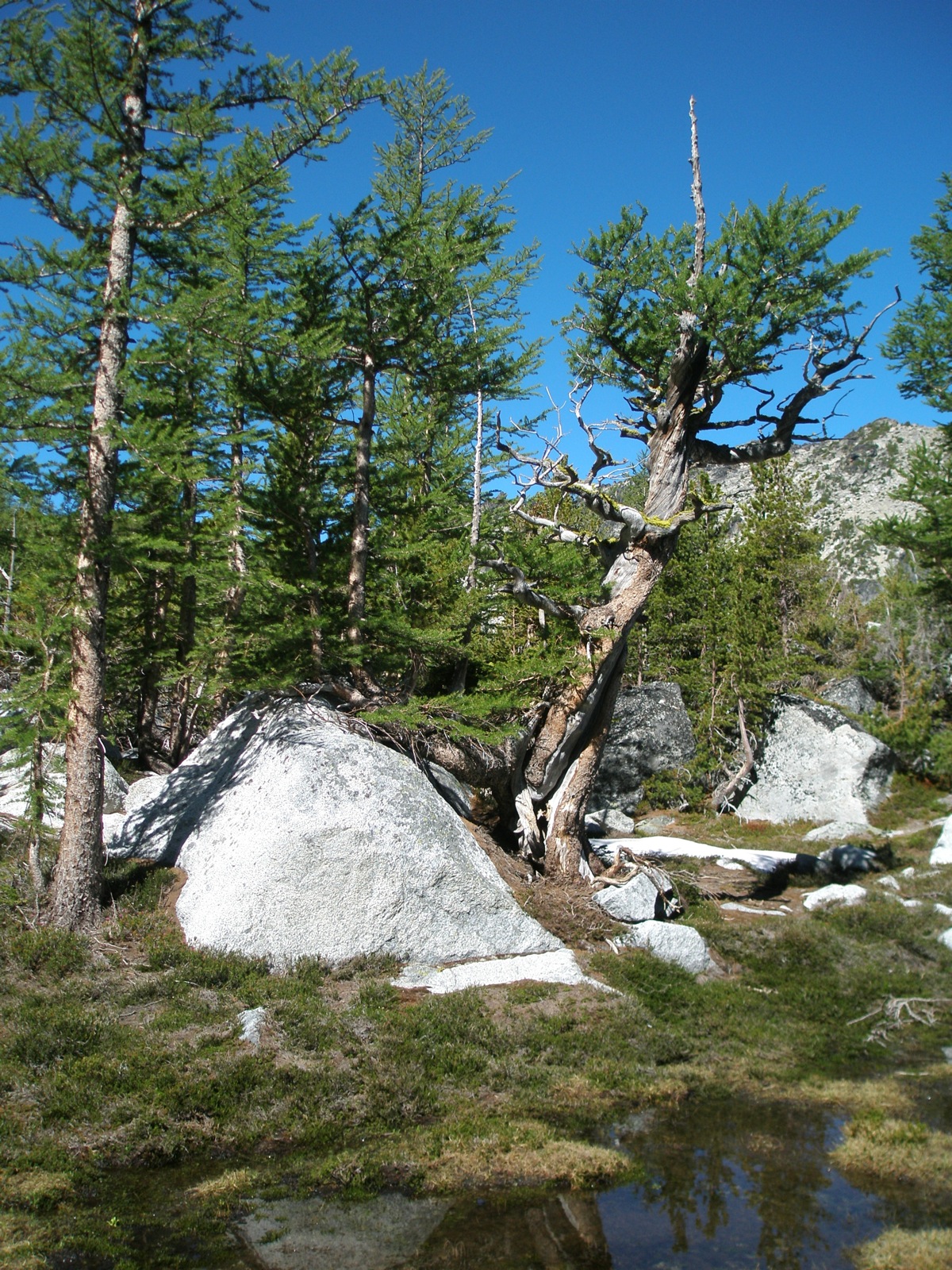
Larches are the conifers that break the rules. Trees of the genus Larix in the pine family (Pinaceae) bear cones and needles like pines and spruces, but every fall their needles turn butter-yellow to gold and drop, leaving the trees bare until spring. There are roughly 10 to 14 larch species around the cold forests of the Northern Hemisphere, and three are native to the United States: tamarack (American larch), western larch and subalpine larch.
Our conifer article is right that larches are deciduous conifers of the boreal forest, but they are not only Canadian or Siberian trees. Tamarack grows in bogs and swamps from Alaska across Minnesota, Wisconsin and Michigan to New England, with scattered southern outposts as far as Illinois, Ohio, Maryland and West Virginia. Western larch, the world’s largest larch, towers 100 to 180 feet in the mountain forests of Montana, Idaho, eastern Washington and northeastern Oregon. Subalpine larch grows at treeline in the northern Cascades and Rockies.
For gardeners in cold climates, larches offer something no other native conifer does: soft, feathery, bright green foliage in spring, golden fall color and an open winter silhouette that lets in sunlight. They grow fast and are very cold-hardy, but they need room, full sun and the right soil moisture. This guide explains how to identify the three natives, where each grows, and how they differ from the European and Japanese larches common in plantations and parks.
Identification
A larch in late fall or winter is sometimes mistaken for a dead pine. In other seasons, the needle arrangement and the small upright cones make it easy to recognize.
Needles
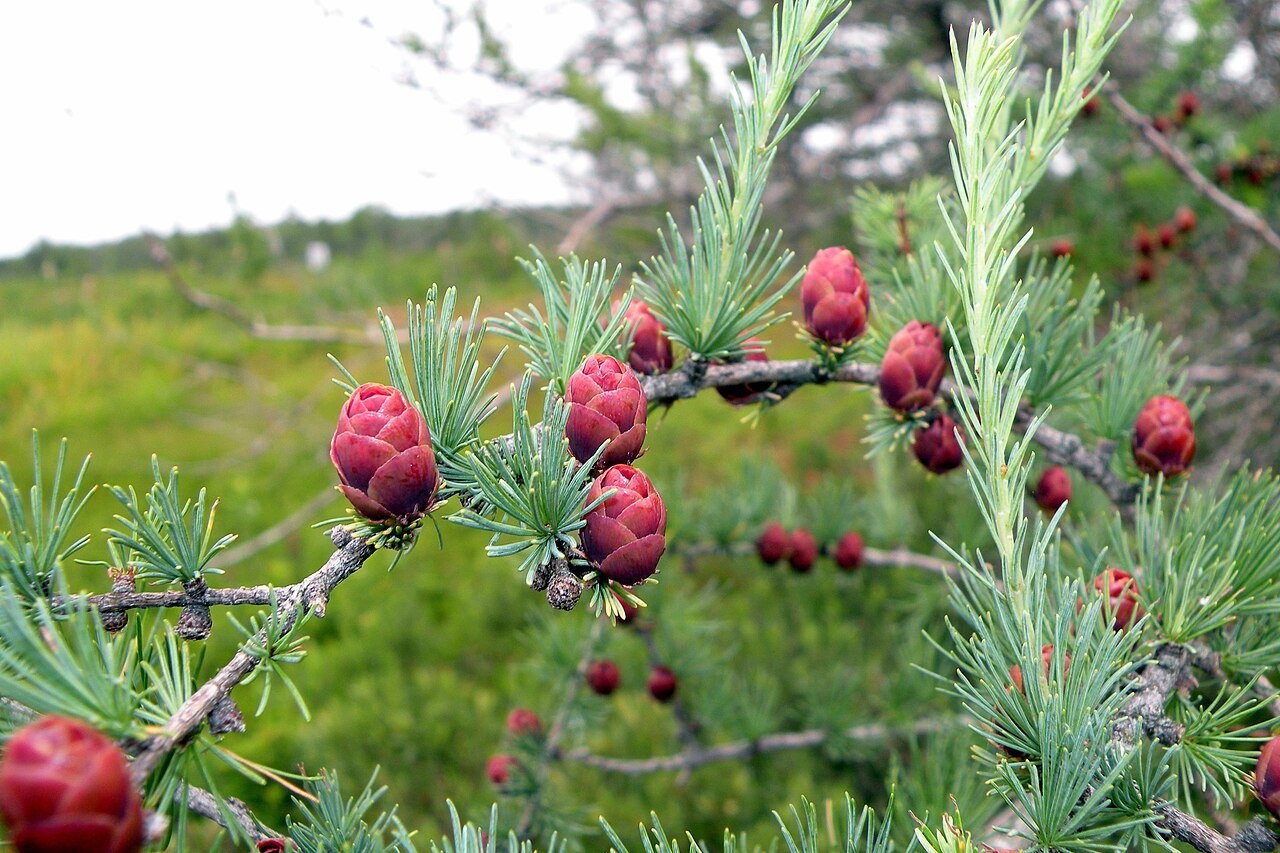
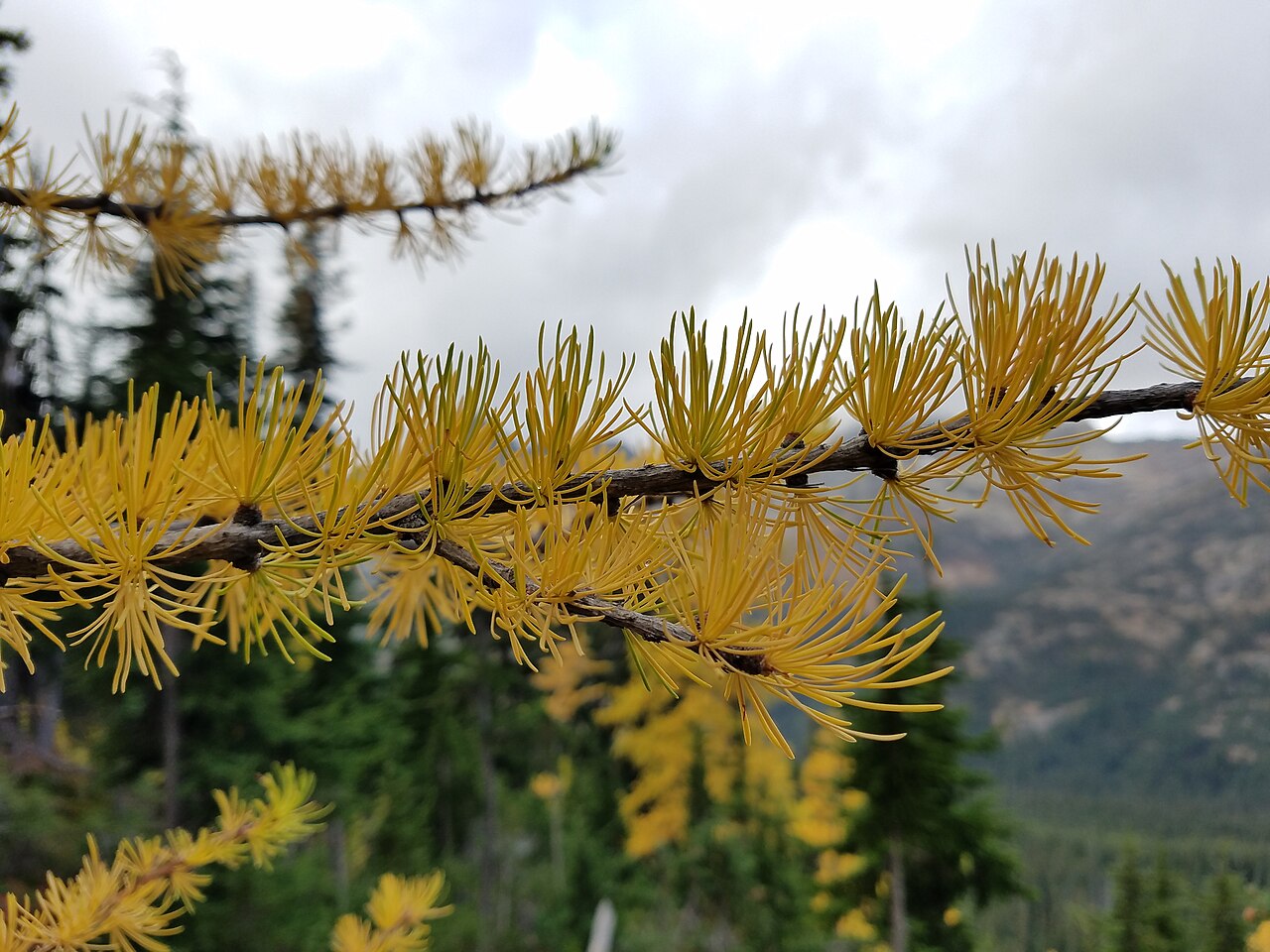
Larch needles are soft, slender and flexible, about 3/4 to 1 3/4 inches long, and grow in two ways. On new shoots they are single and spirally arranged. On older twigs they grow in dense tufts of 10 to 40 from short, knobby spur shoots, like little green paintbrushes. In fall they turn yellow to gold and drop. No other native conifer has needles in tufts that fall each year; bald cypress, the other deciduous native conifer, has flat needles in two rows along slender branchlets.
Cones
Seed cones stand upright on the branches. They are small and rounded, about 1/2 to 1 1/2 inches long, and often bright red or purple when young, ripening to brown in their first fall. In western and subalpine larch, pointed bracts stick out between the cone scales; in tamarack the cones are tiny, about 1/2 to 3/4 inch, with few scales and no visible bracts. Old cones often stay on the branches for years.
Bark & Twigs
Tamarack bark is thin, gray to reddish brown and flaky. Western larch has some of the thickest bark of any North American conifer, up to about 6 inches on old trees, cinnamon-red and deeply furrowed into plates, which protects it from fire. Subalpine larch twigs are covered in woolly hairs, a quick way to separate it from western larch where the two meet.
Shape
Young larches form narrow, open pyramids with horizontal or slightly drooping branches. Western larch grows a tall, straight, branch-free trunk and a short, open crown. Subalpine larch is shorter and often irregular or wind-shaped at treeline. Tamarack is usually 40 to 80 feet tall, smaller and spindly in wet bogs.
Quick Facts
| Scientific Name | Larix (genus) |
| Family | Pinaceae (Pine) |
| U.S. Native Species | 3 (tamarack, western larch, subalpine larch) |
| Plant Type | Deciduous coniferous trees |
| Mature Height | 30–80 ft (tamarack, subalpine larch); 100–180 ft (western larch) |
| Mature Spread | 15–35 ft (narrow, open crowns) |
| Growth Rate | Fast when young |
| Sun Exposure | Full Sun (very shade intolerant) |
| Water Needs | Wet to moist (tamarack); moderate (western and subalpine larch) |
| Soil Type | Peat, muck and wet mineral soil (tamarack); deep, well-drained mountain soils (western larch) |
| Soil pH | Acidic to neutral (about 4.0–7.0); tamarack tolerates alkaline fens |
| Bloom Time | Pollen shed in spring as needles emerge |
| Flower Color | None (conifer); young cones red to purple |
| Fall Color | Yellow to gold, then needles drop |
| Fruit | Small upright cones 1/2–1 1/2 in, brown when ripe |
| Deer Resistant | Moderately |
| USDA Hardiness Zones | 1–6 (tamarack 2–5; western larch 4–7; subalpine larch 3–6) |
Native Range
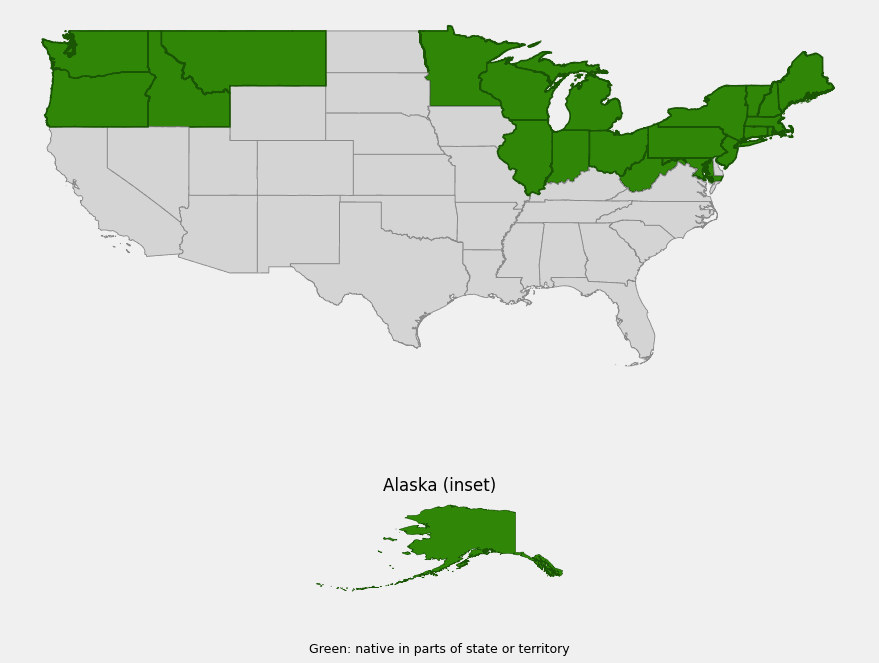
Larches grow wild in 22 states. tamarack has one of the widest ranges of any North American conifer: it stretches across Alaska and nearly all of Canada and dips into the U.S. in Minnesota, Wisconsin, Michigan, New York, Pennsylvania, New Jersey and New England. Farther south it survives in scattered, often rare, glacial-relict bogs and fens in northern Illinois, Indiana and Ohio, and in the Cranesville Swamp area on the Maryland–West Virginia border.
western larch grows in the inland Northwest: western Montana, northern Idaho, the eastern slopes of the Cascades in Washington and the Blue and Wallowa Mountains of northeastern Oregon, extending into southern British Columbia. It favors cool, moist mountain slopes between about 2,000 and 7,000 feet and is often the first tree to regrow after fire.
subalpine larch is a tree of the high country, growing at treeline, roughly 5,500 to 8,000 feet, in the North Cascades and Enchantments of Washington and in the Bitterroot Mountains on the Idaho–Montana border, as well as in the Canadian Rockies. No larch is native to the Southeast, the Great Plains, the Southwest or California.
📋 Regional plant lists covering native larch country: Alaska · Michigan, Wisconsin & Eastern Minnesota · Dakotas & Western Minnesota · Illinois, Iowa & Missouri · Ohio & Indiana · New York, Pennsylvania & North Jersey · Southern New England · Northern New England · Maryland, Virginia & West Virginia · Idaho & Eastern Oregon/Washington · Montana & Wyoming
Native Species
Three larches are native to the United States, and each has a full Plant Native profile.
American Larch or Tamarack (Larix laricina)
The larch of the North and East, 40–80 ft tall, with tiny 1/2- to 3/4-inch cones and short needles in tufts of 10 to 20. It is famous for growing in sphagnum bogs and swamps where few trees survive, but it also grows well on moist upland soils in gardens. Extremely cold-hardy (to zone 2) and fast-growing. Also called hackmatack and eastern larch. Its main pests are the larch sawfly and the eastern larch beetle.
Western Larch (Larix occidentalis)
The largest larch in the world, often 100–180 ft tall with a straight trunk 4 ft or more thick on old trees, native to the mountains of Montana, Idaho, eastern Washington, northeastern Oregon and southern British Columbia. Thick, fire-resistant bark lets old trees survive fires that kill their neighbors, and its seedlings flourish on burned ground. Golden fall color lights up whole mountainsides in October. An important timber tree.
Subalpine Larch (Larix lyallii)
A smaller, slow-growing larch, 30–80 ft, of rocky slopes at treeline in the North Cascades, Enchantments and Bitterroot Mountains. Its twigs are woolly, its needles four-sided and blue-green, and its cones have long purple bracts. Every autumn hikers crowd high trails in Washington to see the brief gold display. It is rarely grown outside its alpine habitat.
Non-Native Look-Alikes
Several non-native larches are planted in parks, campuses, forestry plantations and large gardens in the Northeast, Midwest and Northwest. They look very similar to tamarack but are larger trees with larger cones.
European larch (Larix decidua), native to the Alps and Carpathian Mountains of central Europe, is the most common planted larch in the eastern U.S. It grows 70–100 ft with drooping branchlets and cones about 1 to 1 1/2 inches long whose scales are straight-edged and pressed tightly together. It was planted for timber and windbreaks from the 1800s on and has escaped locally from plantations in the Northeast, though it is not considered a serious invader. Weeping and dwarf forms such as ‘Pendula’ are sold as ornamentals.
Japanese larch (Larix kaempferi), from the mountains of central Japan, has bluish-green needles, reddish twigs and cones whose scale tips curl backward so that the cone looks like a small wooden rose. It grows fast and was widely used in forestry plantations in the Northeast and Great Lakes states. Dunkeld larch (L. × marschlinsii), a hybrid of European and Japanese larch, is also planted for timber.
To tell them from tamarack, look at the cones: tamarack cones are only 1/2 to 3/4 inch long with 12 to 25 scales, while European and Japanese larch cones are about twice as long with many more scales. In the West, native western larch is the only larch of mountain forests; plantings of European or Japanese larch there are rare.
Two other deciduous conifers cause confusion. Golden larch (Pseudolarix amabilis) from China has similar tufts of needles that turn orange-gold, but its cones fall apart when ripe, and it belongs to a different genus. Dawn redwood (Metasequoia, also from China) and our native bald cypress lose their needles too, but their needles are flat and arranged in two rows, never in tufts.
Growing & Care Guide
Larches are fast, tough trees for cold climates, as long as they get full sun and enough moisture. They are not good choices for hot, dry, or shaded sites.
Light
All larches need full sun. They are among the most shade-intolerant trees in North America; in the wild, young larches cannot grow under other trees and quickly die if shaded.
Soil & Water
Tamarack is one of the best trees for wet, poorly drained or boggy ground, including acidic peat and soggy clay, but it also grows well in ordinary moist garden soil. It dislikes hot, dry sites and drought, especially when young. Western larch prefers deep, moist, well-drained mountain soils and does best in climates with cold winters and dry summers like those of the inland Northwest. Both need consistent water during establishment.
Planting Tips
Plant small, container-grown or balled trees in early spring before buds open, or in fall after needles drop. Give them room: even tamarack spreads 15 to 30 ft and grows 1 to 2 ft a year when young. Larches are best in cold climates (roughly zones 2 to 6); in hot, humid summers south of their range they struggle. Do not be alarmed when your new tree turns yellow and drops its needles in fall: it is not dying.
Pruning & Maintenance
Larches need little pruning; remove dead, crossing or damaged branches in late winter while the trees are bare. Watch tamarack for larch sawfly, whose caterpillars can defoliate trees in early summer, and for larch casebearer. Healthy trees usually recover from defoliation, but repeated outbreaks plus drought can open the way for the eastern larch beetle.
Propagation
Larches are grown from seed. Collect cones in early fall before they open, dry them to release the seeds, and sow in spring after 30 to 60 days of cold, moist stratification. Seedlings grow quickly in full sun. Cuttings are difficult; cultivars are usually grafted.
Landscape Uses
- Wet, boggy yards and rain gardens in the North, where tamarack thrives and few other trees will
- Pond and lake edges with red osier dogwood, winterberry and sedges
- Fall color in conifer plantings dominated by evergreen pines, spruces and firs
- Bonsai, for which tamarack’s small needles and cones are ideal
- Reforestation and fire recovery in the inland Northwest with western larch
- Wildlife plantings in northern bogs and woodlands
Wildlife & Ecological Value
Larches support a surprisingly rich community of wildlife, especially in northern bogs and western mountain forests.
For Pollinators
Larches are wind-pollinated. Their foliage feeds the caterpillars of many moths, including several specialists, and the native larch sawfly. Dead and dying larches, especially old western larches, host wood-boring beetles that in turn feed woodpeckers.
For Birds
Crossbills, pine siskins and chickadees eat larch seeds, and spruce grouse feed on tamarack needles and buds. Large, old western larches, often hollowed by heart rot, are among the most important nesting trees in inland Northwest forests for pileated woodpeckers, other woodpeckers, owls and cavity-nesting ducks. Tamarack bogs host nesting warblers, such as Connecticut and palm warblers, and other boreal birds.
For Mammals
Snowshoe hares browse tamarack seedlings, porcupines eat the inner bark, and red squirrels harvest the cones. Deer and moose use larch swamps for cover.
Ecosystem Role
Tamarack is a pioneer of bogs and fens, colonizing floating sphagnum mats and wet meadows and helping turn open wetlands into forested swamps. Western larch is a fire-adapted pioneer: its thick bark helps old trees survive fire, and its seedlings grow rapidly in the sunny, ash-covered openings that fires create. In both cases the yearly needle drop adds nutrient-rich litter to the forest floor.
Cultural & Historical Uses
The name “tamarack” comes from an Algonquian language, as does the other common name, “hackmatack.” Indigenous peoples of the northern forests used tamarack in many ways, including its wood for fuel and its tough, flexible roots for lashing.
In the 1700s and 1800s, shipbuilders in New England and the Maritime Provinces prized tamarack “knees,” the naturally curved section where a large root meets the trunk, for bracing the hulls of wooden ships. The wood is heavy, strong and rot-resistant, and it was also used for railroad ties, posts and poles.
Western larch is one of the most important timber trees of the inland Northwest, valued for flooring, framing and poles, and it is prized as firewood for its high heat. In recent years, the fall pilgrimage, nicknamed “larch madness,” to see golden subalpine larches has become a popular tradition among hikers in the Washington Cascades.
Frequently Asked Questions
Why is my larch turning yellow and losing its needles?
If it is fall, this is normal. Larches are deciduous conifers: they turn gold and drop all their needles every autumn and grow new ones in spring. Yellowing in summer, however, can signal drought stress or insect damage.
Which larches are native to the United States?
Three: tamarack or American larch (Larix laricina) in Alaska, the Great Lakes states and the Northeast; western larch (L. occidentalis) in the inland Northwest; and subalpine larch (L. lyallii) at treeline in Washington, Idaho and Montana.
How tall do larches grow?
Tamarack usually reaches 40 to 80 ft, subalpine larch 30 to 80 ft, and western larch 100 to 180 ft, making it the tallest larch in the world. European larch, a common planted species, reaches about 70 to 100 ft.
Can I grow a larch in a wet yard?
Yes. Tamarack is one of the best native trees for wet, boggy or poorly drained soil in cold climates, provided it gets full sun. It also grows in ordinary moist garden soil.
How can I tell native tamarack from European larch?
Check the cones. Tamarack cones are tiny, about 1/2 to 3/4 inch, with few scales. European larch cones are 1 to 1 1/2 inches long with many tightly pressed scales, and Japanese larch cones have scale tips that curl back like a rose.

Looking for a nursery that carries native larches?
Browse our native plant nursery directory: Alaska · Connecticut · Idaho, Illinois & Indiana · Massachusetts, Maryland, Maine, Michigan, Minnesota & Montana · New Hampshire, New Jersey, New York & Ohio · Oregon · Pennsylvania, Rhode Island & Vermont · Washington · Wisconsin & West Virginia

