
Native Prickly Pears (Opuntia)
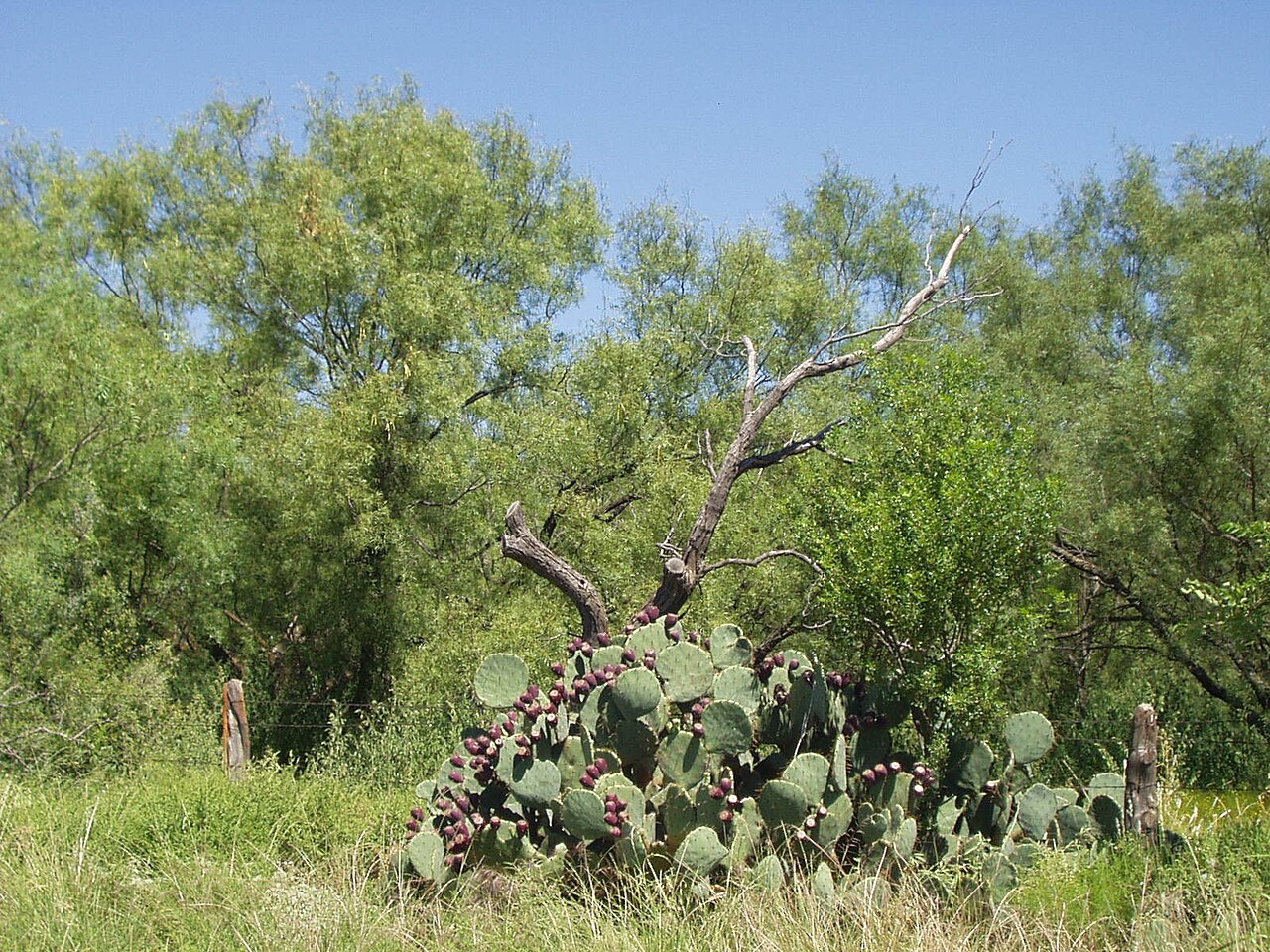
Prickly pears are the flat-padded cacti of the genus Opuntia in the cactus family (Cactaceae). Their jointed stems are made of flattened pads, botanically called cladodes, studded with spines and tiny barbed bristles, and in spring they bloom with large, silky, cup-shaped flowers in yellow, orange, pink, red or magenta. The fruits, called tunas, ripen red, purple or yellow. There are roughly 150 to 200 species in the Americas, and somewhere around 30 to 40 are native to the United States, depending on how botanists divide them.
Texas is prickly pear country. Texas prickly pear and its relatives cover rangeland from the Rio Grande to the Red River, and the prickly pear is the official state plant of Texas. West Texas adds purple prickly pear and tulip prickly pear, and the coast has its own low, sprawling species. But prickly pears are not only desert plants. eastern prickly pear grows on sand prairies, dunes and rocky outcrops from Massachusetts and Minnesota to Florida, and brittle prickly pear reaches farther north than any other cactus, into western Canada.
As our Texas article notes, prickly pears vary in growth habit, flower color and pad color: some form low mats, others grow into upright shrubs or small trees, and pads range from bright green to blue-green or purple. That variety makes them some of the most useful native plants for hot, dry, low-maintenance landscapes. This guide covers the main native species, how to grow and handle them safely, and how to tell them from non-native cacti such as the Indian fig.
Identification
Prickly pears are easy to recognize as a group. Telling species apart can be hard, because they vary greatly and hybridize readily, so look at growth form, pad size and color, spines and flowers together.
Pads
The stems are made of flattened, jointed pads, usually oval to round, from about 2 inches long (creeping cactus, brittle prickly pear) to more than 12 inches (Engelmann and Texas prickly pears). Pads are green, blue-green or gray-green and in some species, especially purple prickly pear, turn purple in cold or drought. In winter, northern species shrivel and lie flat, then plump up again in spring.
Spines & Glochids
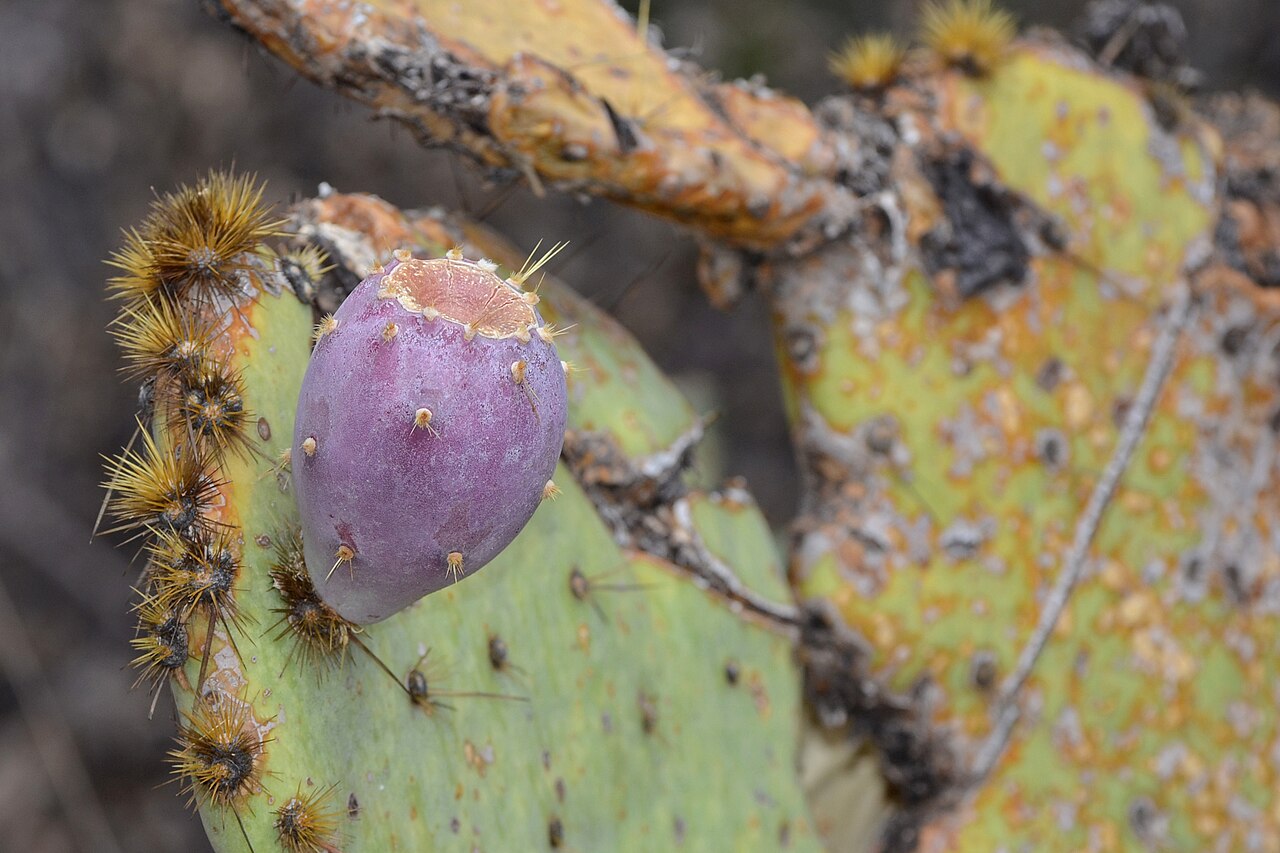
Each pad is dotted with areoles, small raised cushions that bear two kinds of armor. Some areoles have rigid spines, up to 3 inches long, white, yellow, brown or reddish-black depending on species; others have few or no spines. Every areole also bears glochids, tufts of tiny, barbed, hair-like bristles that detach at the slightest touch and lodge in skin. Beavertail cactus looks spineless but is covered in glochids. Glochids are the single most reliable mark of the opuntias.
Flowers
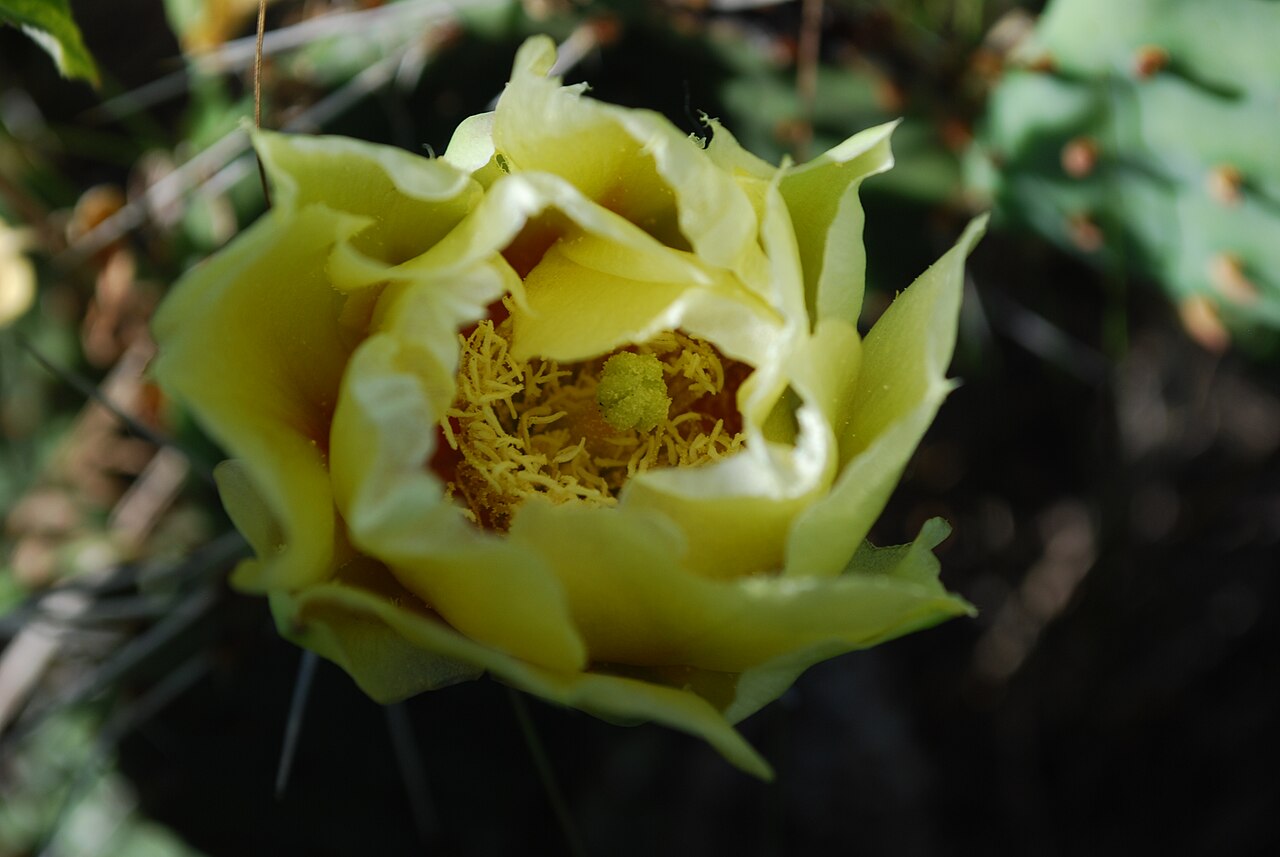
Flowers are large, 2 to 4 inches across, with many silky petals and a mass of yellow stamens that close around a visiting bee when touched. Most U.S. species have yellow flowers, often with a red or orange center; beavertail has magenta flowers, and some populations of plains and tulip prickly pear bloom pink, red or apricot. Each flower lasts only a day or two, usually in late spring or early summer.
Fruit
The fruit is a fleshy, barrel-shaped berry, 1 to 3 inches long, that ripens from green to red, purple or yellow in late summer and fall. It carries areoles with glochids, contains many hard seeds and has a juicy, sweet pulp in the larger species. Dry, spiny-fruited species such as plains prickly pear have little pulp.
Quick Facts
| Scientific Name | Opuntia (genus) |
| Family | Cactaceae (Cactus) |
| U.S. Native Species | About 30–40, depending on classification |
| Plant Type | Perennial cacti: low mats, spreading clumps or upright shrubs |
| Mature Height | Under 1 ft (eastern, brittle, creeping) to 3–7 ft (Engelmann, Texas, pancake) |
| Mature Spread | 1 ft to 10 ft or more (clumps expand slowly) |
| Growth Rate | Slow to moderate |
| Sun Exposure | Full Sun |
| Water Needs | Very low; drought tolerant |
| Soil Type | Sand, gravel, rocky or caliche soils; must drain well |
| Soil pH | Slightly acidic to alkaline (about 6.0–8.5) |
| Bloom Time | Spring – early summer |
| Flower Color | Yellow (often red-centered), orange, pink, red, magenta |
| Fall Color | Pads of some species turn purple in cold or drought |
| Fruit | Fleshy or dry berries (tunas), red, purple or yellow, late summer – fall |
| Deer Resistant | Mostly; javelina and deer eat pads and fruit in drought |
| USDA Hardiness Zones | 3–11 (plains and brittle prickly pear hardy to zone 3; eastern to zone 4) |
Native Range
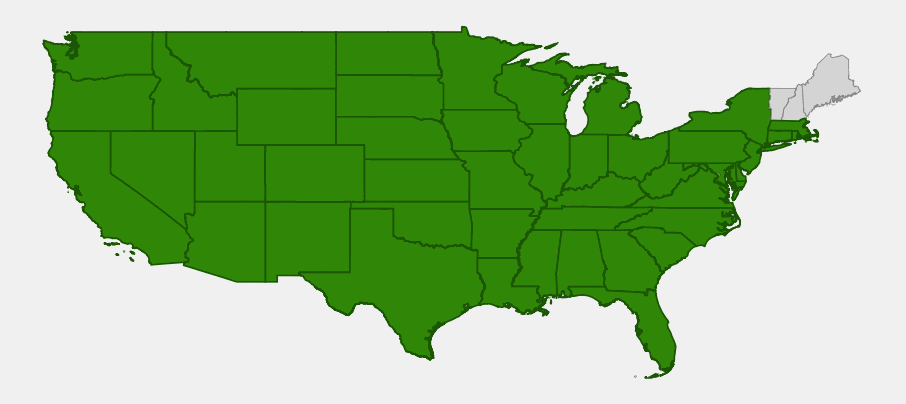
Native prickly pears grow wild in 45 of the lower 48 states, missing only from northern New England. The greatest diversity is in Texas, New Mexico, Arizona and southern California, where a dozen or more species may grow in a single region, from the low-desert beavertail and Engelmann prickly pears to the high-plateau plains and tulip prickly pears.
On the Great Plains, plains prickly pear and twistspine prickly pear range from Texas north through Kansas, Nebraska and the Dakotas into Montana and Canada. Brittle prickly pear grows from eastern Washington and Oregon across the northern Rockies and Plains to Minnesota and Wisconsin, with scattered populations farther east, and it reaches the Peace River region of northern British Columbia and Alberta. In the East, eastern prickly pear grows on sand prairies, oak barrens, dunes, rock outcrops and shale barrens from Minnesota, Wisconsin and Michigan to Massachusetts and south to Florida and Texas. Along the southeastern coast, creeping cactus and erect prickly pear grow on beach dunes and shell mounds.
Prickly pears are absent as natives from Maine, New Hampshire and Vermont, as well as Alaska. Hawaii has prickly pears, but they are introduced, mainly the Indian fig and its relatives, and have become weedy in dry leeward areas.
📋 Regional plant lists covering native prickly pear country: South & West Texas · Arkansas, Louisiana, Eastern Oklahoma & East Texas · Arizona & New Mexico · California & Nevada · Utah & Western Colorado · Nebraska, Kansas & Eastern Colorado · Dakotas & Western Minnesota · Montana & Wyoming · Idaho & Eastern Oregon/Washington · Illinois, Iowa & Missouri · Michigan, Wisconsin & Eastern Minnesota · Ohio & Indiana · Kentucky & Tennessee · Georgia, Alabama & Mississippi · North & South Carolina · Maryland, Virginia & West Virginia · New York, Pennsylvania & North Jersey · Delaware, South Jersey & Long Island · Southern New England
Native Species
These are the most widespread and most garden-worthy prickly pears native to the United States. Every species with a full Plant Native profile is linked. Names follow common usage; botanists often lump or split these species differently.
Texas Prickly Pear (Opuntia lindheimeri, syn. O. engelmannii var. lindheimeri)
The big, sprawling prickly pear of central and south Texas, 3–6 ft tall and spreading wider, with large green to blue-green pads, yellow to orange-red flowers and deep purple fruit. It covers Texas rangeland and is the most familiar of the prickly pears honored as the Texas state plant. A variety with long, narrow pads, cow’s tongue prickly pear, is popular in gardens.
Engelmann’s Prickly Pear (Opuntia engelmannii)
A large, shrubby prickly pear, 3–7 ft, of deserts and grasslands from west Texas to Arizona and southern California. Round, gray-green pads with white to yellow spines, yellow flowers and juicy purple-red fruit. One of the best sources of edible tunas among U.S. natives.
Purple Prickly Pear (Opuntia macrocentra)
A striking West Texas, New Mexico and Arizona species, 2–3 ft, whose round pads turn deep violet in winter and drought. Long, dark spines and yellow flowers with a red center. A favorite for desert gardens.
Tulip Prickly Pear (Opuntia phaeacantha)
Also called brown-spined prickly pear, a widespread, variable, sprawling species of the Southwest and southern Plains, from California and Utah to Texas and Kansas. Yellow flowers, often with red centers, and brownish spines. Hardy and adaptable.
Plains Prickly Pear (Opuntia polyacantha)
The cactus of the Great Plains and Intermountain West, from Texas to Montana and the Dakotas and west to Washington and Nevada. A low, spiny mat, under 1 ft, with yellow, pink or apricot flowers and dry, spiny fruit. Hardy to zone 3.
Brittle Prickly Pear (Opuntia fragilis)
A tiny, mat-forming cactus with small, rounded or cylindrical joints that break off at a touch and root where they fall. It grows on rock outcrops and sand from the Pacific Northwest to the Great Lakes and is the northernmost cactus in the world. Pale yellow flowers are produced sparingly.
Eastern Prickly Pear (Opuntia humifusa)
The only widespread cactus of the eastern U.S., a low, sprawling plant under 1 ft with bright green pads, few spines and showy yellow flowers, sometimes red-centered. Native on sandy and rocky ground from Massachusetts and Minnesota to Florida and Texas. Hardy to zone 4 and easy in a dry, sunny garden.
Florida Prickly Pear (Opuntia austrina)
A prickly pear of sandhills, scrub and dunes in Florida and the southeastern coastal plain, often treated as part of eastern prickly pear. Yellow flowers and a thickened, tuberous root system.
Creeping Cactus (Opuntia pusilla)
Also called cockspur prickly pear, a low, creeping cactus of coastal dunes and sandy fields from North Carolina to Florida and west along the Gulf to Texas. Its small joints detach easily and its sharp, barbed spines are notorious for piercing shoes.
Coastal Prickly Pear (Opuntia littoralis)
A sprawling prickly pear of coastal sage scrub and bluffs in southern California, 1–3 ft, with yellow flowers and red-purple fruit. Important in coastal habitats for nesting cactus wrens.
Beavertail Cactus (Opuntia basilaris)
A low desert cactus of the Mojave and Sonoran Deserts in California, Nevada, Arizona and Utah, with flat, gray-blue to purplish pads that lack long spines and brilliant magenta flowers in spring. Its glochids are fine and plentiful, so handle with care.
Pancake Prickly Pear (Opuntia chlorotica)
An upright, tree-like prickly pear, 3–7 ft, with a short trunk and round, yellowish-green pads. Native to rocky slopes in Arizona, New Mexico, Nevada, Utah and southeastern California.
Non-Native Look-Alikes
Several prickly pears and other cacti in American gardens come from Mexico, Central America or South America. Some are harmless; others have become invasive outside the Americas or in Hawaii.
Indian fig (Opuntia ficus-indica) is a large, tree-like prickly pear, 10–15 ft, with big, nearly spineless pads and yellow-orange flowers. It is a domesticated plant of Mexican origin, grown for millennia for its edible pads (nopales) and fruit (tunas), and it is the prickly pear sold in grocery stores. It is widely planted and naturalized in California and the Southwest and has become invasive in South Africa, Australia, the Mediterranean and Hawaii. In the U.S. it can be told from natives by its size, its smooth spineless pads and its long cultivation history around old homesteads and missions.
Bunny ears (Opuntia microdasys), a small Mexican species with velvety pads covered in dense golden or white glochid dots and no long spines, is a common houseplant and desert-garden plant. Its glochids are especially irritating.
The cactus moth (Cactoblastis cactorum), a South American insect once used to control invasive prickly pears in Australia, arrived in Florida in 1989 and has since spread along the Gulf Coast. Its caterpillars hollow out pads and can kill native prickly pears. Report orange-and-black striped caterpillars or tunneled, collapsing pads to your state agriculture department, especially in Florida, Alabama, Mississippi, Louisiana and Texas.
Chollas (Cylindropuntia) are close relatives of prickly pears with round, cylindrical stem joints instead of flat pads, such as jumping cholla and teddy bear cholla. They are native to the Southwest and have sheathed spines that cling fiercely. They are not prickly pears, though they were once in the same genus.
Growing & Care Guide
Prickly pears are among the easiest native plants to grow in hot, sunny, dry spots. The main rules are drainage, sun and careful handling.
Light
Plant prickly pears in full sun. In shade they grow lanky, flower poorly and become prone to rot.
Soil & Water
Good drainage is essential. Prickly pears thrive in sand, gravel, rocky ground, caliche and poor soil, and they rot in heavy, wet clay or under lawn sprinklers. On clay, plant them on a raised berm or slope amended with gravel. Water lightly after planting until the pads root in. After that, desert and plains species need no supplemental water except in prolonged drought, and eastern prickly pear needs only rainfall. In humid regions, avoid mulching around the base with wood chips, which hold moisture; use gravel instead.
Planting Tips
Prickly pears are easiest to start from single pads. Cut or snap off a healthy pad, let the cut end dry and callus for one to two weeks in a shaded, dry spot, then set it upright about one-third deep in dry, gritty soil. Water lightly after a week. Rooted plants can be set out from spring to early summer. Plant well away from paths, play areas and pool decks; spread clumps 3 to 6 ft apart for large species.
Pruning & Maintenance
Remove pads by cutting at the joint with a long knife and handling them with kitchen tongs, folded newspaper or thick leather gloves. Wear eye protection when cutting large plants. To remove glochids from skin, press duct tape or a layer of white glue over the area, let it dry and peel it off. Watch for cochineal scale, a white, cottony insect on the pads; hose it off or prune infested pads. In the Gulf states, watch for cactus moth damage.
Propagation
Propagate prickly pears from pads, as above, or from seed. Seeds need cleaning from the pulp and germinate best after a few weeks of cold, moist stratification and warm temperatures; seedlings are slow, taking several years to bloom.
Landscape Uses
- Xeriscapes and desert gardens with agaves, yuccas, sotol and native grasses
- Rock gardens and sand prairies in the East and Midwest with eastern prickly pear
- Security plantings under windows and along property lines
- Wildlife habitat for nesting birds, bees and desert animals
- Fire-resistant landscaping, since the succulent pads burn poorly
- Edible gardens for nopales and tunas from large species
Wildlife & Ecological Value
Prickly pears are keystone plants in deserts and grasslands, providing food, water and shelter to an enormous range of animals.
For Pollinators
The large flowers attract bees, especially specialist cactus bees in the genera Diadasia and Lithurgopsis that depend on cactus pollen, as well as bumble bees, sweat bees and beetles. The stamens are touch-sensitive: when a bee lands, they curl inward around it, coating it in pollen. Prickly pear pads also host the cochineal insect and the native cactus bugs and longhorn beetles that live only on cacti.
For Birds
Cactus wrens, curve-billed thrashers and doves nest in and under prickly pear clumps, where the spines deter predators; in coastal southern California, the declining coastal population of cactus wrens depends on prickly pear and cholla thickets. Many birds, including quail, thrashers, woodpeckers and mockingbirds, eat the fruit and seeds.
For Mammals
Javelina, deer, coyotes, foxes, raccoons, wood rats, ground squirrels and desert tortoises eat the pads and fruit, which provide both food and water in dry seasons. Pack rats often build their nests among prickly pear clumps, where the spines protect them.
Ecosystem Role
Prickly pears stabilize sandy and rocky soils, provide protected microsites where other plants and seedlings can establish, and serve as emergency food and water for wildlife during droughts. Their fruit-eating animals disperse the seeds widely.
Cultural & Historical Uses
Prickly pears have fed people in the Americas for thousands of years. The pads, called nopales, and the fruits, called tunas, remain staples in Mexican and Southwestern cooking. The large-fruited native species of Texas and the Southwest were also gathered by Indigenous peoples. If you harvest from your own plants, remove all spines and glochids first, by burning, scraping or peeling with tongs and gloves.
The prickly pear holds a central place in Mexican history and identity: the national coat of arms shows an eagle perched on a nopal cactus, recalling the legend of the founding of Tenochtitlan. The cochineal insect that lives on prickly pear pads was the source of a brilliant red dye prized in Aztec times and later exported to Europe, where it colored textiles, paintings and, famously, British military coats.
In Texas, ranchers have long used prickly pear as emergency cattle feed during droughts, burning off the spines with propane “pear burners.” The Texas Legislature named the prickly pear cactus the official state plant in 1995, a fitting recognition of a plant that defines so much of the state’s landscape.
Frequently Asked Questions
Are prickly pears native to Texas?
Yes. Texas has more native prickly pears than almost any other state, including Texas prickly pear, Engelmann prickly pear, purple prickly pear, tulip prickly pear and creeping cactus. The prickly pear is the official state plant of Texas.
Is prickly pear fruit edible?
Yes. The ripe fruit (tunas) of native prickly pears and the young pads (nopales) are edible after the spines and glochids are carefully removed. The fruit of larger species such as Engelmann and Texas prickly pear is sweetest; small, dry-fruited species have little pulp. Always wear gloves and use tongs.
How do I remove prickly pear glochids from my skin?
Do not rub the area. Use tweezers for larger bristles, then apply duct tape or a layer of white school glue, let it dry, and peel it off to lift the tiny glochids. Wash with soap and water afterward.
Can prickly pears grow in cold climates?
Several can. Plains prickly pear and brittle prickly pear are hardy to about zone 3, and eastern prickly pear to zone 4, as long as they have excellent drainage and full sun. Winter wetness, not cold, is the usual killer.
Is Indian fig cactus native?
No. The Indian fig (Opuntia ficus-indica) is a domesticated plant of Mexican origin. It is widely grown and has naturalized in California, but it is not a U.S. native and has become invasive in Hawaii and other parts of the world.

Looking for a nursery that carries native prickly pears?
Browse our native plant nursery directory: Alabama, Arkansas & Arizona · California · Colorado, Connecticut, Delaware, Florida & Georgia · Iowa, Idaho, Illinois, Indiana & Kansas · Kentucky, Louisiana, Massachusetts, Maryland, Michigan, Minnesota, Missouri, Mississippi & Montana · North Carolina, North Dakota, Nebraska, New Jersey, New Mexico, Nevada, New York, Ohio & Oklahoma · Oregon · Pennsylvania, Rhode Island, South Carolina, South Dakota, Tennessee, Texas, Utah & Virginia · Washington · Wisconsin, West Virginia & Wyoming

