
Native Sages (Salvia)
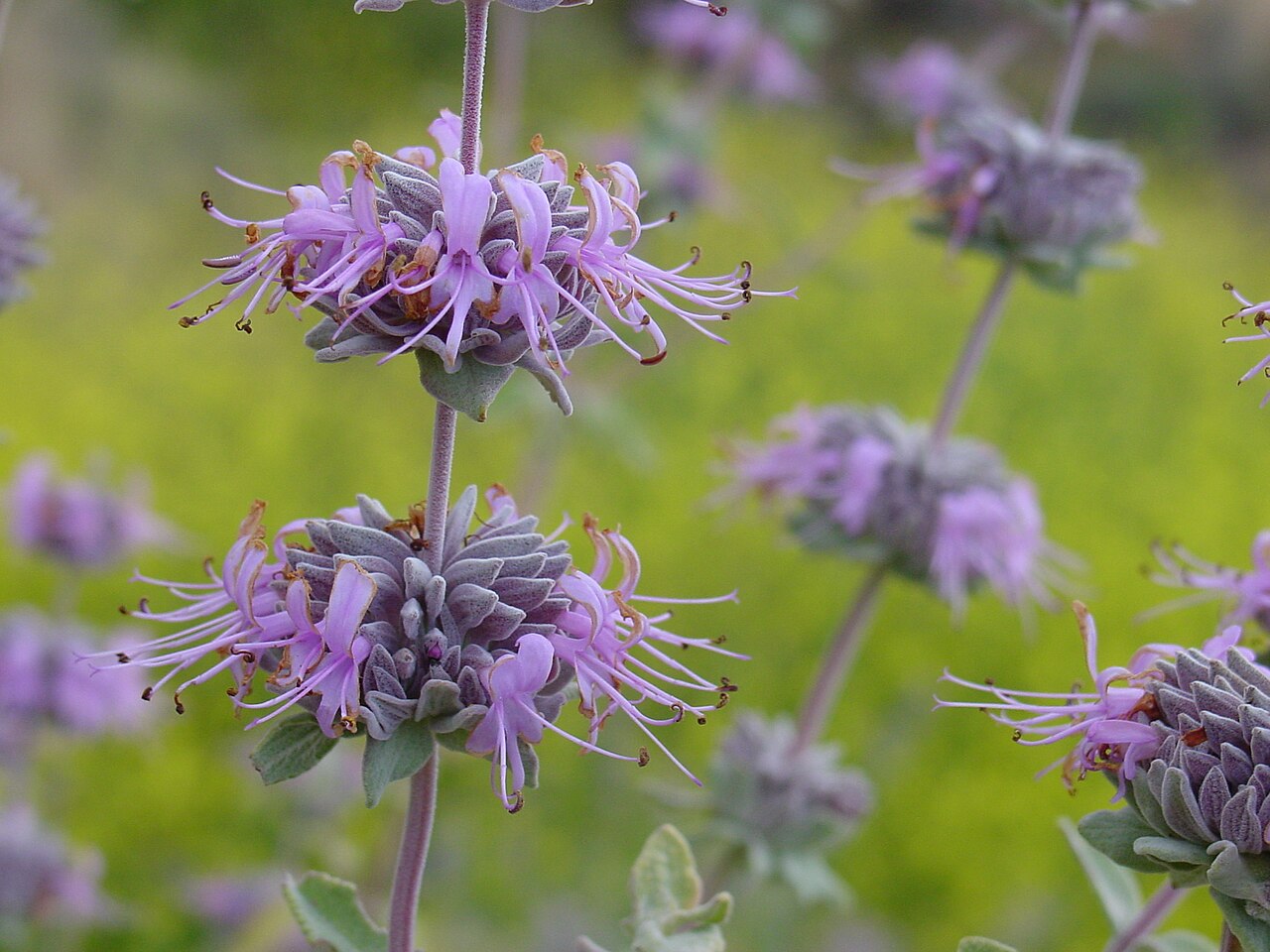
Sages are members of the genus Salvia, the largest group in the mint family (Lamiaceae), with somewhere around 900 to 1,000 species worldwide. Several dozen of them are native to the United States, from low spring wildflowers in eastern lawns and woodlands to the silvery, intensely fragrant shrubs that cover California hillsides. Like other mints, sages have square stems, opposite leaves and two-lipped flowers, and most have aromatic foliage.
The richest sage country in the U.S. is California, the desert Southwest and Texas. California alone has close to 20 native species, including white sage, black sage, purple sage and Cleveland sage, the backbone of coastal sage scrub and chaparral. Texas adds hummingbird favorites such as autumn sage and cedar sage. East of the Plains the choice is smaller: lyreleaf sage, azure blue sage and, along the southern coastal plain, scarlet sage.
If you came here from a heading that simply says “Salvia” or “Sage,” this guide sorts out which sages are actually native to your region and which popular garden salvias are imports. That matters more than you might expect. In Colorado, for example, the only widespread native is the modest annual lanceleaf sage, and the salvias in most Front Range gardens come from Texas, the Mojave, Mexico or Europe. In California, by contrast, native sages are among the best shrubs you can plant for bees and hummingbirds. Keep in mind too that “sage” is a loose common name: sagebrush, Texas sage (cenizo) and Jerusalem sage are not salvias at all.
Identification
You can recognize most sages by a combination of mint-family traits and one special flower mechanism. Crush a leaf and you will usually smell the plant before you can name it.
Stems & Growth Form
Sages have square stems and opposite leaves, like other mints. Native species range from annuals a few inches tall (desert chia) and ground-hugging perennials (creeping sage, cedar sage) to upright perennials 3 to 5 feet tall (azure blue sage) and woody shrubs 3 to 6 feet tall and wide (white, black, purple and Cleveland sages). The western shrub sages become woody at the base and are partly summer-deciduous, dropping some leaves in drought.
Leaves
Leaves are simple and usually aromatic, with a texture that ranges from smooth and glossy to felted or pebbly. Many dry-country species are coated in fine hairs that make them gray, silvery or nearly white: white sage and purple sage are the best examples. Eastern lyreleaf sage keeps its leaves in a flat basal rosette; they are lobed like an old-fashioned lyre and often tinged purple along the veins, especially in winter.
Flowers
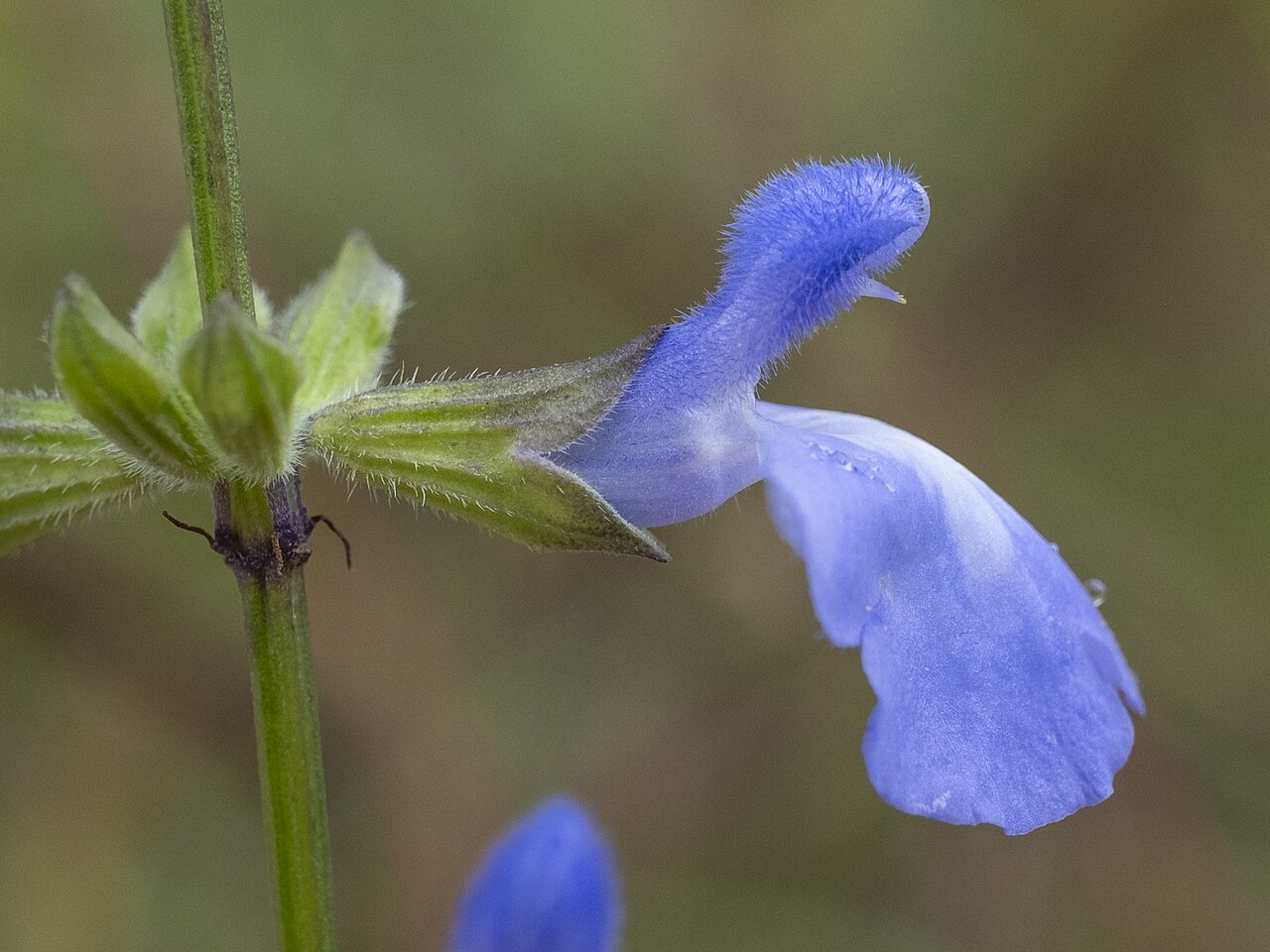
Sage flowers are two-lipped tubes. The upper lip forms a hood over the stamens and style; the lower lip is a landing platform. In most species only two stamens are functional, and they work as a hinged lever: when a bee pushes into the flower, the lever tips the pollen-bearing anthers down onto its back. Flowers are borne in whorls stacked along the stem, sometimes so tight that they form ball-like clusters (purple, black and Cleveland sages). Colors run from scarlet and magenta (bird-pollinated species with long, narrow tubes) to blue, violet, lavender and white (bee-pollinated species with broad lower lips).
Fruit & Seeds
Each flower produces up to four small nutlets inside the persistent calyx. In some species, including desert chia, the seeds become gelatinous when wet, the same trait that makes commercial chia (Salvia hispanica, a Mexican species) useful in food.
Quick Facts
| Scientific Name | Salvia (genus) |
| Family | Lamiaceae (Mint) |
| U.S. Native Species | Several dozen; the most in California, Texas and the Southwest |
| Plant Type | Annuals, herbaceous perennials and evergreen to semi-deciduous shrubs |
| Mature Height | From under 1 ft (cedar sage, creeping sage) to 6 ft (white and black sage) |
| Mature Spread | 1–6 ft, depending on species |
| Growth Rate | Fast |
| Sun Exposure | Full Sun for most; Part Shade for cedar, hummingbird and lyreleaf sages |
| Water Needs | Low for western shrub sages; average for eastern species |
| Soil Type | Well-drained sand, gravel, loam or limestone; few tolerate wet clay |
| Soil pH | Slightly acidic to alkaline (about 6.0–8.0) |
| Bloom Time | Early spring (lyreleaf, hummingbird) to fall (azure blue, autumn, mountain sage) |
| Flower Color | Blue, violet, lavender, white, pink, magenta, scarlet |
| Fall Color | None; western shrubs are evergreen or partly summer-deciduous |
| Fruit | Four small nutlets per flower, held in the dry calyx |
| Deer Resistant | Yes, generally (aromatic foliage) |
| USDA Hardiness Zones | About 4–11 across the genus; check the individual species |
Native Range
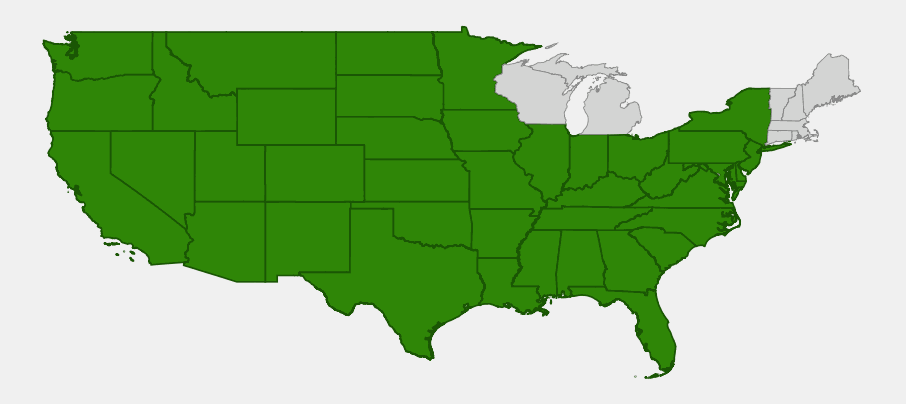
Native sages grow wild in about 40 of the lower 48 states. The western half of the country has the greatest number of species: California’s coastal sage scrub, chaparral and deserts; the Great Basin and Mojave Desert, home to Great Basin sage; the mountains and deserts of Arizona and New Mexico; and Texas, where Hill Country and Trans-Pecos species meet those of the coastal plain.
Across the Great Plains the most widespread native is lanceleaf sage (Salvia reflexa), a small annual of disturbed prairie ground from Montana and the Dakotas south to Texas and Arizona. Azure blue sage grows in prairies and open pinelands from Nebraska and Kansas east to the Southeast. In the East, lyreleaf sage is common in meadows, open woods and lawns from southern New York and Pennsylvania to Florida and west to Illinois, Missouri and Texas, and nettleleaf sage (Salvia urticifolia) grows in dry woods of the Southeast and southern Appalachians.
Several northern states have no native sage. Michigan, Wisconsin, Vermont, New Hampshire, Maine and Massachusetts have only escaped garden or roadside salvias, and lyreleaf sage reaches its northern limit around New York City; we have left Connecticut and Rhode Island off the map because records there are few and uncertain. Alaska and Hawaii have no native Salvia. Lanceleaf sage and azure blue sage also turn up as introductions in parts of the Midwest outside their native range.
📋 Regional plant lists covering native sage country: California & Nevada · Arizona & New Mexico · South & West Texas · Utah & Western Colorado · Idaho & Eastern Oregon/Washington · Montana & Wyoming · Nebraska, Kansas & Eastern Colorado · Dakotas & Western Minnesota · Arkansas, Louisiana, Eastern Oklahoma & East Texas · Illinois, Iowa & Missouri · Ohio & Indiana · Kentucky & Tennessee · Maryland, Virginia & West Virginia · New York, Pennsylvania & North Jersey · Delaware, South Jersey & Long Island · North & South Carolina · Georgia, Alabama & Mississippi
Native Species
These are the most important and most gardened sages native to the United States. Every species with a full Plant Native profile is linked, starting with the eastern and central species and moving west.
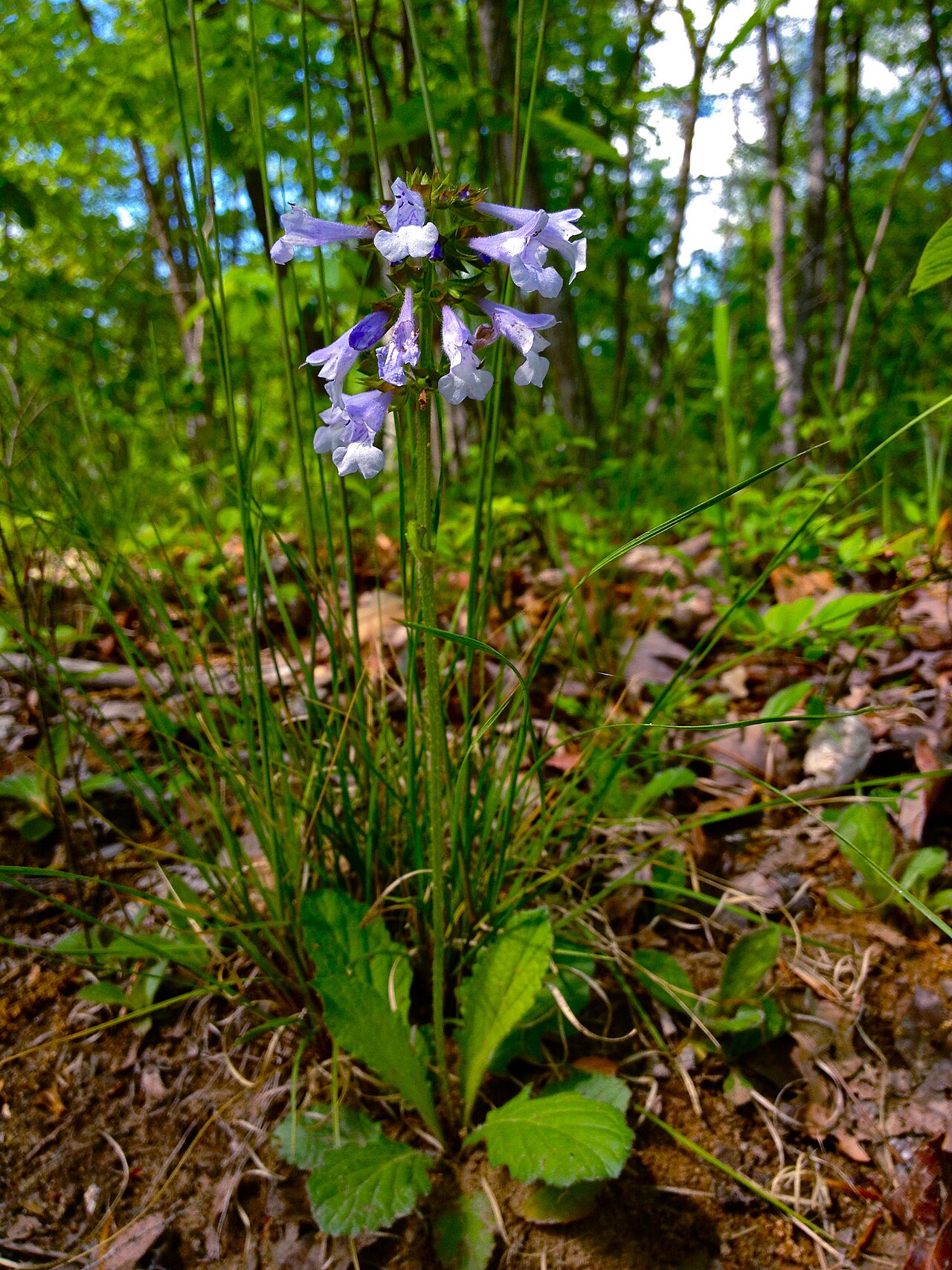
Lyreleaf Sage (Salvia lyrata)
The common native sage of the East and South, from southern New York to Florida and west to Illinois, Missouri, Oklahoma and Texas. A flat, evergreen rosette of lobed, often purple-veined leaves sends up 1- to 2-foot spikes of pale blue-violet flowers in spring. It thrives in sun or light shade and spreads by seed, which makes it a fine groundcover for informal areas and a lawn “weed” to some gardeners.
Azure Blue Sage or Pitcher Sage (Salvia azurea var. grandiflora, syn. S. pitcheri)
A tall prairie perennial, 3–5 ft, with narrow leaves and sky-blue flowers from late summer into fall. Native from Nebraska and Kansas south to Texas and east through the Southeast. It tends to flop in rich soil; grow it lean, cut it back by half in early summer, or let it lean on grasses.
Scarlet Sage (Salvia coccinea)
Also called tropical sage, a short-lived perennial or reseeding annual of the southern coastal plain from South Carolina to Florida and west to Texas. Bright red, narrow tubular flowers on 1- to 3-ft stems bloom from spring to frost and are a reliable hummingbird plant. Pink and white forms are sold as ‘Coral Nymph’ and ‘Snow Nymph’.
Mealycup Sage (Salvia farinacea)
A Texas and New Mexico perennial, 2–3 ft, with blue-violet flowers in long spikes and grayish, mealy-looking calyxes. Its cultivars, such as ‘Victoria Blue’, are among the most common bedding salvias in the country, usually grown as annuals in the North.
Autumn Sage (Salvia greggii)
A small, twiggy shrub, 2–3 ft, native to the Edwards Plateau and Trans-Pecos of Texas and northern Mexico. Red, pink, coral or white flowers appear from spring until frost, with the heaviest show in fall. One of the toughest hummingbird plants for hot, dry gardens; it is widely planted in Colorado and the Southwest, well outside its native range.
Cedar Sage (Salvia roemeriana)
A low, shade-loving perennial, about 1 ft tall, native mainly to central and west Texas, where it grows under junipers and oaks on limestone. Rounded, scalloped leaves and slender red flowers in spring make it one of few native salvias for dry shade.
Mountain Sage (Salvia regla)
A shrubby sage of the Chisos Mountains in Big Bend National Park and the mountains of Mexico. It grows 3–6 ft and produces orange-red flowers in late summer and fall, just in time for migrating hummingbirds.
Shrubby Blue Sage (Salvia ballotiflora)
An aromatic, gray-green shrub, 2–4 ft, of the South Texas brush country, Edwards Plateau and Trans-Pecos. Small blue-violet flowers appear in flushes after rain. Extremely drought tolerant and seldom browsed by deer.
Texas Sage (Salvia texana)
A low perennial, under 1 ft, of central Texas prairies and limestone openings, with deep blue-purple flowers in spring. Do not confuse it with the shrub also sold as “Texas sage,” cenizo (Leucophyllum frutescens), which is in the figwort family, not a salvia.
White Sage (Salvia apiana)
The signature shrub of southern California’s coastal sage scrub, 3–5 ft, with silvery-white leaves and arching flower stalks up to 6 ft tall carrying white flowers flecked with lavender. Native to southern California and Baja California. Wild stands are being stripped for the smudge-stick trade, so grow your own from a nursery rather than buying wild-harvested bundles.
Cleveland Sage (Salvia clevelandii)
A rounded shrub, 3–5 ft, from the chaparral of San Diego County and northern Baja California. It is perhaps the most fragrant of all native sages, with whorls of rich blue-violet flowers in late spring. It is a parent of popular garden selections such as ‘Allen Chickering’ and ‘Winifred Gilman’.
Purple Sage (Salvia leucophylla)
A gray-leaved shrub, 3–5 ft, of coastal sage scrub in central and southern California. Pink-lavender flower whorls in spring. Low, spreading forms such as ‘Point Sal’ make a tough groundcover for slopes.
Black Sage (Salvia mellifera)
The most widespread shrub sage of the California coast, 3–6 ft, with dark green, wrinkled leaves and pale blue to white flowers in tight whorls. The species name means “honey-bearing”: it is one of the state’s great bee plants and a source of sage honey.
Hummingbird Sage (Salvia spathacea)
A spreading perennial, 1–3 ft, that grows in the shade of oaks in the California Coast Ranges. Big, sticky, fruit-scented leaves and magenta flower whorls in late winter and spring. It spreads by underground stems and is one of the best native groundcovers for dry shade in California.
Great Basin Sage (Salvia dorrii)
Also called desert sage or purple sage, a compact silvery shrub, 1–2.5 ft, of the Great Basin and Mojave Desert from eastern Washington and Oregon to Idaho, Nevada, Utah, eastern California and Arizona. Blue-violet flowers among purple bracts in late spring. A superb plant for xeriscapes in the Intermountain West, but it rots in heavy or irrigated soil.
More native sage profiles: Desert Chia (Salvia columbariae) · Creeping Sage (Salvia sonomensis) · Littlewoman (Salvia serotina)
Other native sages without a profile yet include lanceleaf sage (Salvia reflexa), a small, pale blue-flowered annual of the Great Plains and the West, and the one sage native to Colorado over most of the state; nettleleaf sage (Salvia urticifolia) of southeastern woodlands; and Mojave sage (Salvia pachyphylla), a silvery, rose-bracted shrub of desert mountains in California, Nevada and Arizona that is popular in Colorado and New Mexico xeriscapes.
Non-Native Look-Alikes
Most salvias sold at garden centers are not native to the United States. None of the common ones are major invasive plants in gardens, but a few weedy relatives are regulated in the West, and several plants called “sage” are not salvias at all.
Culinary sage (Salvia officinalis) is the kitchen herb, a low Mediterranean shrub with gray-green, pebbly, oblong leaves and violet-blue flowers in early summer. Greek sage (Salvia fruticosa), from the eastern Mediterranean, has fuzzy, often three-lobed leaves and is harvested and sold as dried culinary sage. Neither escapes much in the U.S.
Clary sage (Salvia sclarea) is a Mediterranean and central Asian biennial with large, wrinkled, hairy leaves and tall branched spikes of pale lilac and white flowers with showy pinkish bracts. It is grown for its fragrant oil and has escaped in parts of the West; Washington lists it as a noxious weed. Its relative Mediterranean sage (Salvia aethiopis), a woolly-leaved biennial with white flowers, is a listed noxious weed of rangeland in several western states, including Colorado, Oregon and Washington. If you see a big, felted, gray rosette in a Colorado pasture, it is more likely Mediterranean sage than anything native.
Woodland sage (Salvia nemorosa), from Europe and western Asia, is the familiar “perennial salvia” of borders, with dense spikes of violet-blue flowers in cultivars such as ‘Caradonna’ and ‘East Friesland’. It is hardy, drought tolerant and loved by bees, but it is not native anywhere in North America. Russian sage, long known as Perovskia atriplicifolia and now placed in Salvia as S. yangii, is a central Asian subshrub with lavender haze-like flowers that is planted throughout Colorado and the West.
Mexican bush sage (Salvia leucantha), with velvety purple and white flower spikes in fall, and pineapple sage (Salvia elegans), with scarlet fall flowers and pineapple-scented leaves, come from Mexico and Central America. Both are tender perennials in zones 8 and warmer and are grown as annuals elsewhere. They attract hummingbirds, but native autumn sage, scarlet sage or mountain sage offer similar color and season in the South and Southwest.
Finally, several “sages” belong to other genera: big sagebrush and other sagebrushes are Artemisia (aster family), Texas sage or cenizo is Leucophyllum, and Jerusalem sage is Phlomis. They share the gray, aromatic look but not the two-lipped sage flower.
Growing & Care Guide
Native sages fall into two groups for gardeners: tough, drought-adapted species from the West and Texas that want sun, sharp drainage and little water, and eastern species that take ordinary garden soil and moisture. Grow each the way it grows in the wild and most are easy.
Light
Most sages flower best in full sun. The western shrub sages, autumn sage, azure blue sage and Great Basin sage want at least six hours of direct sun. A few are shade plants: hummingbird sage grows under oaks in California, cedar sage under junipers and oaks in Texas, and lyreleaf sage in open eastern woods. These three are the sages to try in dappled or part shade.
Soil & Water
Drainage is the key to growing western sages. White, black, purple, Cleveland and Great Basin sages are adapted to dry summers and quickly rot in heavy, irrigated soil. Plant them in sand, gravel or decomposed granite, on a slope or berm if your soil is clay, and stop regular watering after the first year; in coastal California they need little or no summer water once established. Texas species tolerate alkaline, rocky limestone soils and occasional summer water. Lyreleaf, azure blue and scarlet sages take average garden soil and moisture, though all prefer it on the lean side.
Planting Tips
Plant western shrub sages in fall or winter, when cool weather and seasonal rain help roots establish. Plant eastern and Texas perennials in spring or fall. Space shrubs 4 to 6 ft apart; they look best as loose, open mounds and suffer when crowded. Avoid rich compost and fertilizer, which produce floppy, short-lived plants.
Pruning & Maintenance
Shear spent flower stalks after bloom to keep plants tidy, but leave some on western sages and lanceleaf sage if you want seeds for birds. Cut California shrub sages back lightly (by about a third) in fall; avoid cutting deep into bare old wood, which may not resprout. Cut autumn sage back by half in late winter. Pinch or cut azure blue sage in early summer to keep it upright. Few pests trouble sages; root rot from overwatering is the most common cause of death.
Propagation
Most native sages grow easily from fresh seed sown in fall or late winter; some benefit from a few weeks of cold, moist stratification. Shrub species root readily from softwood or semi-hardwood cuttings taken in spring or early summer. Hummingbird sage and creeping sage can be divided.
Landscape Uses
- Waterwise and xeriscape gardens in the West: white, black, purple, Cleveland, Great Basin and Mojave sages
- Hummingbird gardens: scarlet, autumn, cedar, mountain and hummingbird sages
- Erosion control on dry slopes in California, with purple sage, black sage and creeping sage
- Prairie and meadow plantings with azure blue sage and lyreleaf sage
- Dry shade under oaks: hummingbird sage (California) and cedar sage (Texas)
- Pollinator borders, where native sages replace European woodland sage
Wildlife & Ecological Value
Sages are among the most valuable pollinator plants in the West and Southwest, and their seeds and cover matter to wildlife wherever they grow.
For Pollinators
Blue, violet and white sages are classic bee flowers. Bumble bees, carpenter bees, digger bees and many solitary bees work them heavily, and the lever-like stamens dust each visitor with pollen. California’s black and white sages are major honey plants. Red and magenta sages, with long, narrow tubes and little landing space, are pollinated mainly by hummingbirds; autumn sage, scarlet sage and mountain sage are important fall nectar sources for migrating hummingbirds in Texas and the Southwest.
For Birds
The small nutlets are eaten by quail, sparrows, towhees, finches and other seed-eating birds, especially on the West Coast, where shrub sages are a major part of coastal sage scrub. California gnatcatchers and wrentits nest and forage in sage scrub dominated by these shrubs.
For Mammals
The strong-smelling foliage is seldom eaten by deer or rabbits, which is why sages are popular in deer country. Seeds are gathered by small rodents, and sage scrub shelters wood rats, mice and the many reptiles of southern California’s foothills.
Ecosystem Role
In California, native shrub sages are defining species of coastal sage scrub, one of the most reduced habitats in the country, and they recover quickly after fire from seed and root crowns. Elsewhere, native sages add late-season bloom to prairies and fill dry, rocky openings where few other wildflowers grow.
Cultural & Historical Uses
The name Salvia comes from the Latin salvere, “to be well,” reflecting the long reputation of culinary sage in European herbal traditions. Native American peoples used native sages too. Several California tribes ground the seeds of desert chia and other sages into a nutritious meal and mixed them with water to make a drink; this use of chia is well documented in the history of the region.
White sage has a special place in the ceremonies of many southern California tribes, who burn the leaves for cleansing and prayer. Its sudden popularity as a commercial smudge product has led to illegal harvesting from public lands, and tribal and conservation groups ask buyers to avoid wild-collected white sage. Growing it in your own garden is the respectful alternative.
Native sages also have a long history in Southwestern and Texas gardens. Autumn sage, mealycup sage and scarlet sage were among the first native wildflowers bred into garden cultivars, and California nurseries have selected dozens of named forms of black, purple and Cleveland sage for drought-tolerant landscapes.
Frequently Asked Questions
Which sages are native to Colorado?
Very few. Lanceleaf sage (Salvia reflexa), a small annual with pale blue flowers, is the widespread native sage of Colorado’s plains and foothills. Salvias commonly planted in Colorado gardens, such as autumn sage, Mojave sage, woodland sage and Russian sage, are native to Texas, the Mojave Desert, Europe or Asia. Sagebrush (Artemisia) is native to Colorado but is not a true sage.
What are the best native sages for California gardens?
For sunny, dry slopes: white sage, black sage, purple sage and Cleveland sage, along with hybrid selections such as ‘Allen Chickering’. For shade under oaks: hummingbird sage. For a groundcover: creeping sage. All need good drainage and little summer water once established.
Is Russian sage a native salvia?
No. Russian sage, now classified as Salvia yangii, comes from central Asia. It is drought tolerant and widely planted in the West, but it is not native to North America.
Are native sages deer resistant?
Generally yes. The aromatic, often hairy leaves are unpalatable to deer and rabbits. Young transplants may still be nibbled, so protect them for the first season.
Are sages safe to touch and eat?
Native sages are not known as poisonous plants, and the leaves are safe to handle. Culinary sage is the herb grown for cooking; native sages are grown for wildlife and beauty. If you are curious about traditional uses, treat them as history rather than as instructions.

Looking for a nursery that carries native sages?
Browse our native plant nursery directory: Alabama, Arizona & Arkansas · California · Colorado, Delaware, Florida & Georgia · Idaho, Illinois, Indiana, Iowa & Kansas · Kentucky, Louisiana, Maryland, Minnesota, Mississippi, Missouri & Montana · Nebraska, Nevada, New Jersey, New Mexico, New York, North Carolina, North Dakota, Ohio & Oklahoma · Oregon · Pennsylvania, South Carolina, South Dakota, Tennessee, Texas, Utah & Virginia · Washington · West Virginia & Wyoming

