
Native Eryngos and Sea Hollies (Eryngium)
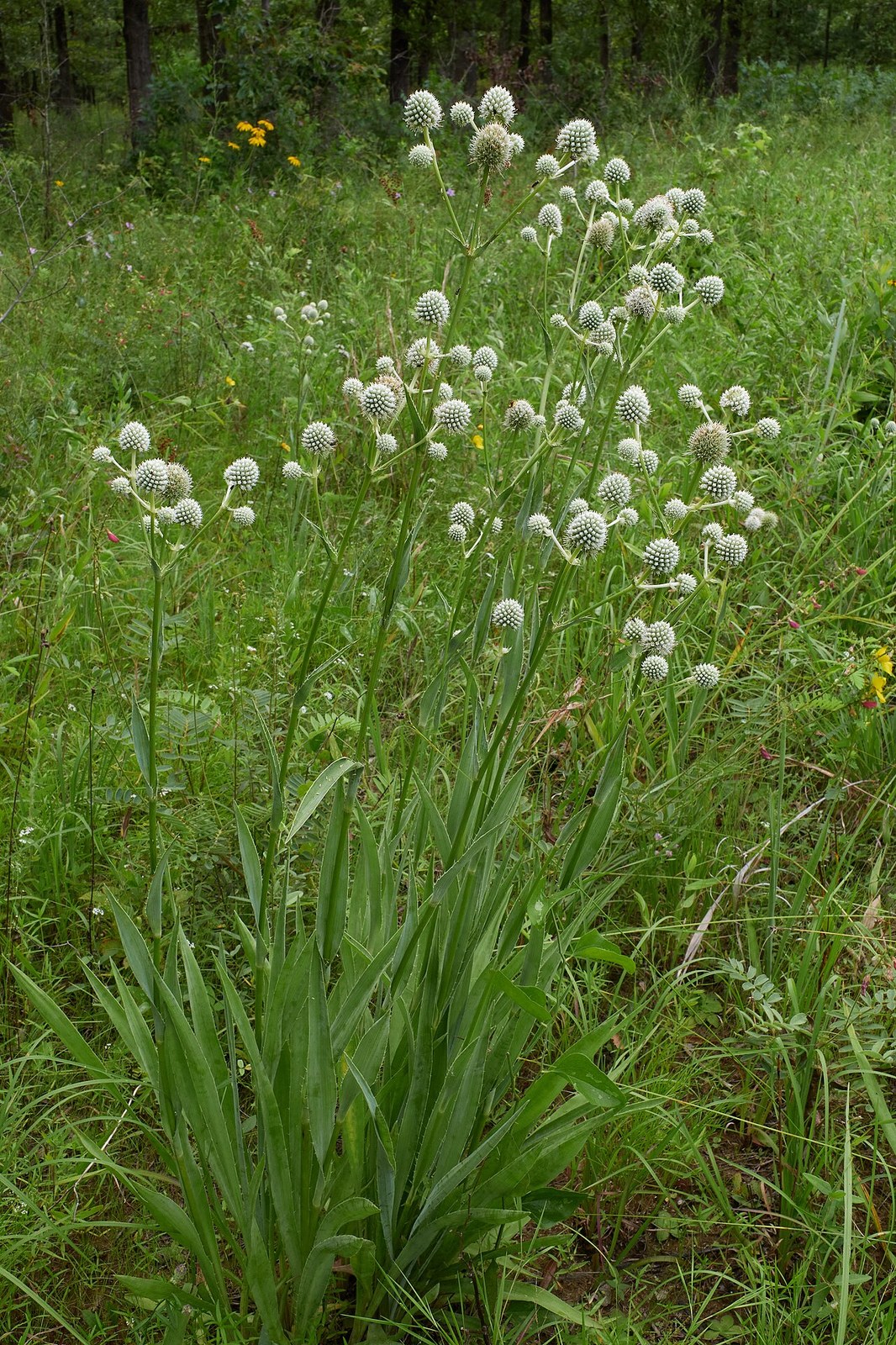
Eryngos (genus Eryngium) are spiny members of the carrot family with flowers packed into tight, round or cone-shaped heads, each head set on a collar of stiff, often sharp bracts. In Europe, the showy blue species are called sea hollies, and those European sea hollies are what most garden centers sell. The United States also has its own eryngos, roughly 30 native species, from the tall, yucca-leaved rattlesnake master of Midwestern prairies to small “coyote thistles” of western wet meadows and vernal pools and the purple Leavenworth’s eryngo of the southern Plains.
That difference matters if you are choosing plants for a native pollinator garden. The big, metallic-blue sea hollies usually recommended for perennial borders, such as flat sea holly (Eryngium planum), giant sea holly (E. giganteum) and alpine sea holly (E. alpinum), are native to Europe and western Asia, not North America. They are attractive, deer-resistant plants that bees love, but they are not native. In the Pacific Northwest, the native eryngos are low wetland plants that look quite different from the garden sea hollies.
This guide covers the main native species, where each grows, how to tell them apart from the European sea hollies, and which ones make good garden plants. Note that eryngos are not true thistles or hollies; the spiny leaves and bracts just make them look that way.
Identification
Eryngos are easy to recognize as a group by their flower heads: dozens of tiny flowers packed into a dense, rounded or egg-shaped head, sitting on a ring of stiff, pointed bracts. They are related to carrots and parsley, but their leaves are usually spiny or bristle-edged and their flowers are not in the usual flat-topped umbels of the family.
Leaves
Leaf shape varies more than anything else in the genus. Rattlesnake master and marsh rattlesnake master have long, narrow, parallel-veined leaves like a yucca or iris, with soft spines or bristles along the edges. Western coyote thistles often have hollow, rush-like or lance-shaped leaves at the base, sometimes with lobed or spiny stem leaves. Leavenworth’s eryngo and Wright’s eryngo have deeply cut, spiny leaves that look like thistle leaves.
Flowers
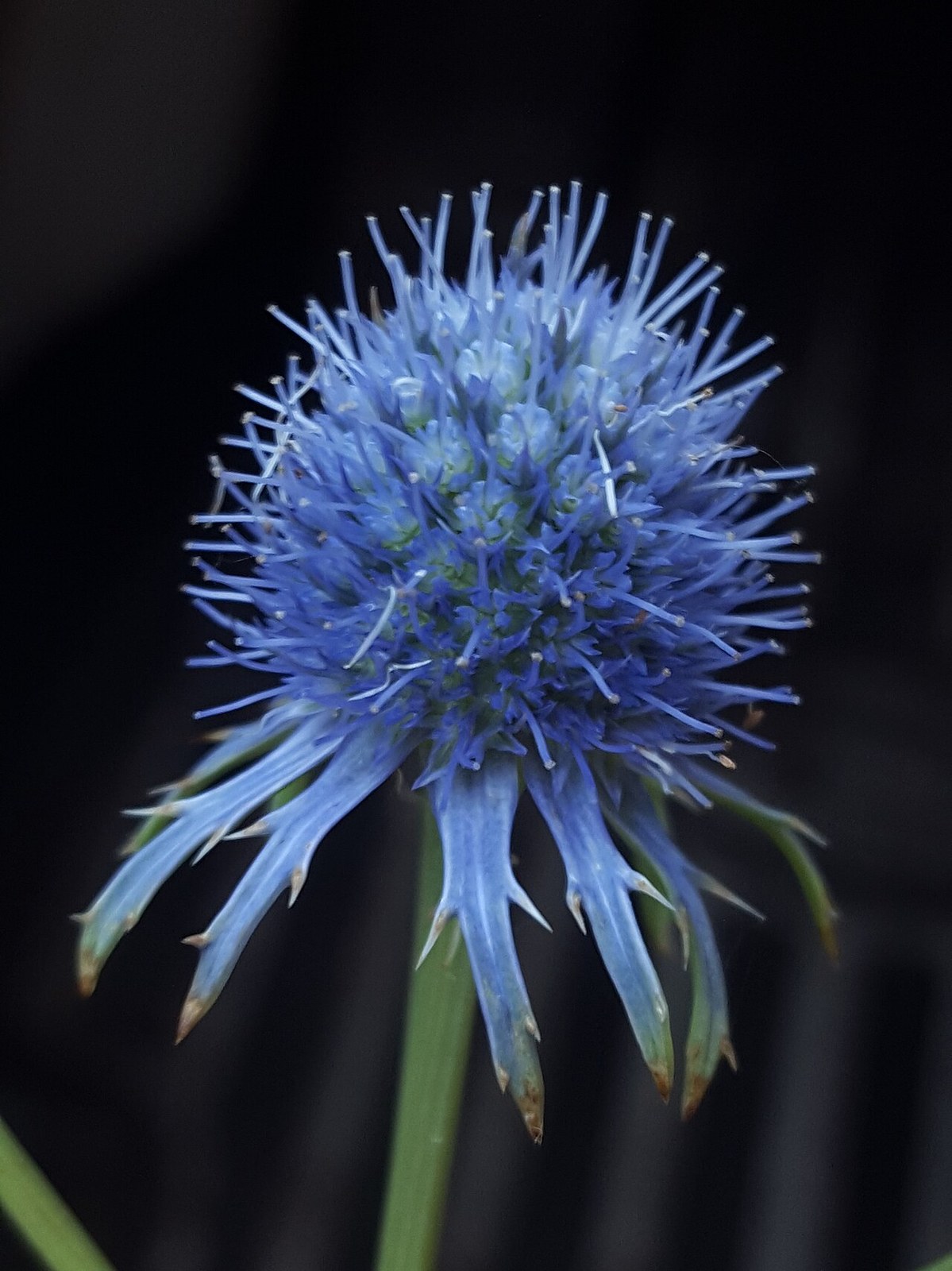
Each head is made up of many tiny five-petaled flowers, each with its own small, stiff bract between the flowers, which gives the heads their bristly look. Colors range from greenish white (rattlesnake master) and pale blue or blue-gray (most coyote thistles and marsh rattlesnake master) to deep purple (Leavenworth’s eryngo). Native species mostly bloom from midsummer to fall. The ring of bracts beneath the head is usually green or silvery in natives, and much showier and more colorful in the European sea hollies.
Fruit & Seeds
The fruit is a small, dry, scaly or bumpy seed pair, typical of the carrot family. Heads dry on the stem and hold their shape into winter, and many species, especially Leavenworth’s eryngo, dry beautifully for arrangements.
Growth Habit
Most native eryngos are perennials with a stout taproot, but a few are annuals, including Leavenworth’s eryngo. Heights range from creeping eryngo, which hugs the ground, to rattlesnake master and marsh rattlesnake master, which can send up flower stalks 4 to 6 feet tall.
Quick Facts
| Genus | Eryngium |
| Family | Apiaceae (Carrot family) |
| U.S. Native Species | Roughly 30, with the most species in California, Texas and the Southeast (about 250 species worldwide) |
| Growth Forms | Perennial and annual herbs with spiny leaves and dense, round flower heads |
| Mature Height | From a few inches (creeping eryngo) to 4–6 ft (rattlesnake master, marsh rattlesnake master) |
| Sun Exposure | Full Sun |
| Water Needs | Dry to wet, depending on species; many are wetland or vernal pool plants |
| Soil Type | Prairie loam and clay (rattlesnake master); wet sands, mud and seasonal pools (coyote thistles) |
| Bloom Time | Mostly June – October |
| Flower Color | Greenish white, pale blue, blue-gray or purple |
| Fruit | Small, dry, scaly seeds; heads persist into winter |
| Wildlife Value | Excellent for bees, wasps, beetles, flies and butterflies; host plant for black swallowtail and a rare borer moth |
| Deer Resistant | Yes; the spiny foliage is seldom eaten |
| USDA Hardiness Zones | About 3–9 for rattlesnake master; varies by species |
Native Range
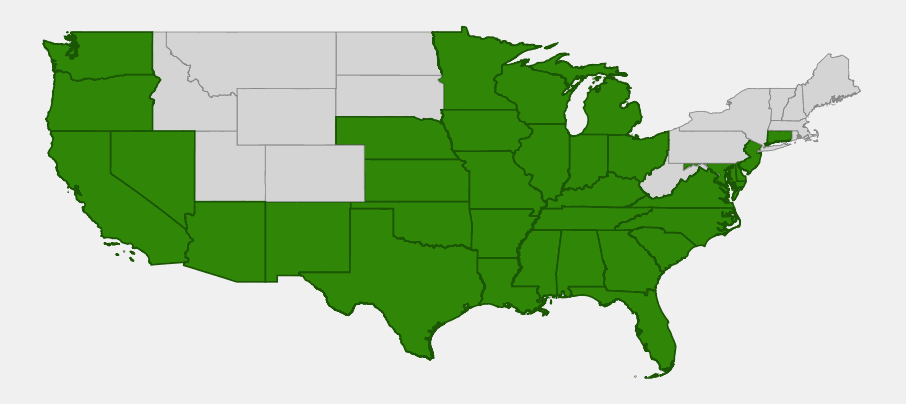
Native eryngos grow in two main regions. In the East and Midwest, rattlesnake master ranges across the tallgrass prairie and open woodlands from Minnesota, Wisconsin and Michigan south to Texas and Florida, and east to Ohio, Virginia and the Carolinas, with rare outposts in Connecticut and New Jersey. Marsh rattlesnake master, blueflower eryngo, Baldwin’s eryngo and creeping eryngo grow in the wet pine savannas and coastal plain of the Southeast, from New Jersey to Florida and Texas. Texas and the southern Plains have additional species, including Leavenworth’s eryngo in Kansas, Oklahoma and Texas.
The West has its own set. California is a center of diversity for the genus, with more than a dozen species of coyote thistle in vernal pools, wet meadows and coastal marshes, several of them federally listed as endangered. In Oregon and Washington, the native species are Oregon coyote thistle (Eryngium petiolatum) of Willamette Valley wet prairies and vernal pools, jointed coyote thistle (E. articulatum) of marshes and wet meadows, and Modoc eryngo (E. alismifolium), a rare species of seasonally wet flats in southeastern Oregon, northeastern California and northern Nevada. Wright’s eryngo and Chiricahua Mountain eryngo grow in the mountains of Arizona and New Mexico.
No eryngo is native to New England north of Connecticut, New York, Pennsylvania, West Virginia, the northern Rockies or the northern Great Plains. European sea hollies are grown in gardens across all of these areas, and flat sea holly and field eryngo have escaped in a few places, but they are introduced plants. The map below shows states where at least one Eryngium is native.
📋 Regional plant lists covering native eryngo country: Western Oregon & Washington · California & Nevada · Arizona & New Mexico · South & West Texas · Arkansas, Louisiana, E. Oklahoma & E. Texas · Nebraska, Kansas & Eastern Colorado · Illinois, Iowa & Missouri · Michigan, Wisconsin & Eastern Minnesota · Ohio & Indiana · Kentucky & Tennessee · Maryland, Virginia & West Virginia · Delaware, Southern NJ & Long Island · North & South Carolina · Georgia, Alabama & Mississippi
Native Species
These are the most widespread and garden-worthy native eryngos, plus several western species worth knowing. Names with links go to our full plant profiles.
Rattlesnake Master (Eryngium yuccifolium)
The most widely grown native eryngo. It forms a clump of stiff, blue-green, yucca-like leaves 1 to 3 feet long, with soft bristles along the edges, and sends up branched stalks 3 to 5 feet tall topped with round, greenish-white, golf-ball-sized heads from July to September. It is a classic tallgrass prairie plant from Minnesota to Texas and Florida, and one of the best native plants for attracting a wide variety of pollinators. It is long-lived, drought tolerant and stands up all winter.
Marsh Rattlesnake Master (Eryngium aquaticum)
A taller relative of wet places, reaching 2 to 6 feet, with long, narrow leaves and branched clusters of pale blue to blue-white heads in late summer and fall. It grows in freshwater and brackish marshes, wet pine savannas and ditches on the Atlantic and Gulf Coastal Plain from New Jersey to Florida. Its blue heads are the closest native match to the look of European sea hollies, and it does well in rain gardens and pond edges.
Leavenworth’s Eryngo (Eryngium leavenworthii)
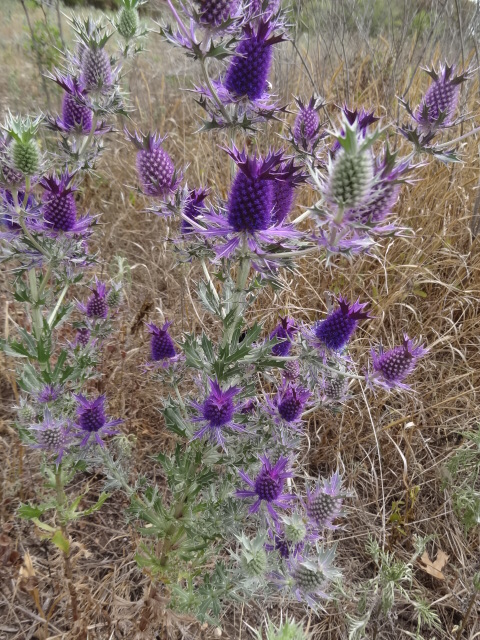
An annual of the southern Great Plains, found in prairies and rocky limestone soils of Kansas, Oklahoma and Texas. Plants grow 1 to 3 feet tall with spiny, deeply cut leaves and egg-shaped heads that turn vivid purple, along with their bracts, in late summer and fall. It reseeds readily in dry, sunny sites and is a strong butterfly plant. Dried stems keep their purple color.
Vasey’s Coyote Thistle (Eryngium vaseyi)
A California endemic of vernal pools, swales and wet grasslands in the Central Valley and surrounding foothills. Plants are low and spreading with spiny heads and bracts, and they flower as the pools dry in late spring and summer. Like other coyote thistles, it is best grown in vernal pool restorations rather than ordinary garden beds.
Oregon Coyote Thistle (Eryngium petiolatum)
The native eryngo most Oregon gardeners can find. It grows in seasonally wet prairies and vernal pools of the Willamette Valley and western Oregon, reaching southwestern Washington, where it is rare. It forms low rosettes of narrow leaves and branching stems up to about 2 feet tall with small, blue-gray to greenish heads in summer. It is a useful plant for wet prairie restorations and rain gardens and is visited by native bees.
Jointed Coyote Thistle (Eryngium articulatum)
A perennial of marshes, wet meadows and pond edges in California and southern Oregon, and rare in Washington. It has hollow, jointed basal leaves and blue to purple-tinged heads on branched stems 1 to 3 feet tall in summer.
Modoc Eryngo (Eryngium alismifolium)
A small, rare eryngo of seasonally flooded flats and meadows in southeastern Oregon, northeastern California and northern Nevada, with lance-shaped basal leaves and small, bristly heads.
Blueflower Eryngo (Eryngium integrifolium)
A slender perennial of wet pine savannas and bogs in the Southeast, from the Carolinas to Florida and Texas, with undivided, toothed leaves and small, blue heads in fall.
Creeping Eryngo (Eryngium prostratum)
A tiny, mat-forming perennial with small, cylindrical blue heads, found in moist, open ground and ditches across the Southeast and north into Missouri and Kentucky. It is more often noticed in lawns and wet roadsides than planted.
Wright’s Eryngo (Eryngium heterophyllum)
A spiny perennial of mountain meadows and grasslands in southern Arizona, southern New Mexico, West Texas and Mexico, with silvery-blue heads in late summer.
Rare and Protected Species
Several native eryngos are federally listed as endangered, including wedgeleaf eryngo (Eryngium cuneifolium) of Florida’s Lake Wales Ridge, San Diego button-celery (E. aristulatum var. parishii) of Southern California vernal pools, and Loch Lomond coyote thistle (E. constancei) of a few vernal pools in Lake and Sonoma counties, California. Do not collect these plants or their seed.
Non-Native Look-Alikes
Nearly every “sea holly” in the garden trade is from Europe, North Africa or western Asia. They are not invasive in most of the US, but they are not native, and a few have escaped locally.
- Flat sea holly (Eryngium planum), from central and eastern Europe and central Asia. Clusters of many small, steel-blue heads on blue stems 2 to 3 feet tall, with broad, toothed, undivided basal leaves. It is the most commonly sold sea holly and has escaped and naturalized in a few northern states and Canadian provinces.
- Giant sea holly or Miss Willmott’s ghost (Eryngium giganteum), from the Caucasus and Iran. A short-lived biennial with large, silvery-white bract collars around pale green heads. It self-seeds in gardens.
- Alpine sea holly (Eryngium alpinum), from the Alps and Balkans. Large, cone-shaped blue heads framed by a soft, lacy, feathery blue collar.
- True sea holly (Eryngium maritimum), a coastal plant of European beaches with silvery, holly-like leaves. Rare in American gardens.
- Hybrid sea hollies such as Eryngium × zabelii and E. × tripartitum, and field eryngo (E. campestre), a European weed naturalized in a few places in the eastern US.
- Culantro (Eryngium foetidum), a tropical American herb grown for cooking and naturalized in Florida and Hawaii.
Quick tips: if the plant is sold as “sea holly” with intense blue heads and a large, colorful, spiny or lacy collar, it is almost certainly European. Rattlesnake master has long, yucca-like leaves and white heads; marsh rattlesnake master has blue heads but narrow, grass-like leaves; western coyote thistles are low wetland plants with small heads.
Growing & Care Guide
Light
All eryngos need full sun. In shade they flop and flower poorly. Rattlesnake master tolerates a few hours of light shade in open woodland gardens, but its best performance is in open prairie conditions.
Soil & Water
Match the species to the site. Rattlesnake master and Leavenworth’s eryngo prefer average to dry, well-drained soil and tolerate clay, rocky ground and drought once their taproots are established. Rich, wet soil makes rattlesnake master tall and floppy. Marsh rattlesnake master, Oregon coyote thistle, jointed coyote thistle and blueflower eryngo need moist to wet soil, including sites that flood in winter and dry out in summer.
Planting Tips
Eryngos have deep taproots and dislike being moved, so plant small container plants or sow seed where you want the plants. Space rattlesnake master about 18 to 24 inches apart. In Oregon and western Washington, plant Oregon coyote thistle in low, seasonally wet spots or rain gardens along with camas and tufted hairgrass. Leavenworth’s eryngo is an annual; let some heads drop seed so it returns.
Pruning & Maintenance
Leave the dried heads standing through winter for structure and for insects that overwinter in the stems, then cut stalks back in early spring. Native eryngos need no fertilizer and are rarely bothered by pests or diseases. Deer and rabbits avoid them.
Propagation
Grow native eryngos from seed. Rattlesnake master seed needs 60 days or more of cold, moist stratification, so sow it outdoors in fall or stratify it in the refrigerator before spring sowing. Seedlings may take two or three years to bloom. Coyote thistles also benefit from fall sowing in moist soil.
Landscape Uses
- Prairie and meadow plantings: rattlesnake master, Leavenworth’s eryngo
- Pollinator gardens in sunny, well-drained beds: rattlesnake master
- Rain gardens, pond edges and wet meadows: marsh rattlesnake master, Oregon and jointed coyote thistle
- Vernal pool and wet prairie restoration in the West: coyote thistles
- Dried arrangements and winter interest: rattlesnake master and Leavenworth’s eryngo
Wildlife & Ecological Value
For Pollinators
Native eryngos are pollinator magnets. Rattlesnake master’s heads attract an unusually wide range of visitors: native bees, honey bees, wasps, beetles, flower flies and butterflies. Studies of prairie plants often rank it among the most visited species. Leavenworth’s eryngo is heavily visited by butterflies and bumblebees, and western coyote thistles support small native bees in wet prairies and vernal pools.
For Butterflies and Moths
As members of the carrot family, eryngos can serve as larval host plants for black swallowtail caterpillars. Rattlesnake master is the only known host plant of the rattlesnake-master borer moth (Papaipema eryngii), a rare prairie moth whose caterpillars bore into the plant’s roots. Protecting large populations of rattlesnake master in prairie remnants helps this moth survive.
For Birds and Mammals
Seeds are eaten by some ground-feeding birds, and the dense, spiny clumps offer cover. The stiff, prickly leaves discourage deer, rabbits and livestock.
Ecosystem Role
Rattlesnake master is a conservative prairie species, meaning it is usually found in high-quality, little-disturbed prairie and is a sign of a healthy remnant. Coyote thistles are characteristic plants of vernal pools and wet prairies, two of the most threatened habitats on the West Coast.
Cultural & Historical Uses
Rattlesnake master’s name comes from a nineteenth-century belief that its root could treat rattlesnake bites. There is no evidence it works, and it should not be used for snakebite; get emergency medical care instead. The tough leaf fibers of rattlesnake master were used by Native Americans to weave sandals, bags and cordage; fragments of rattlesnake master fiber have been found in archaeological sites.
In Europe, true sea holly (Eryngium maritimum) roots were candied as a sweet in the seventeenth and eighteenth centuries, and sea hollies became popular in Victorian gardens. The giant sea holly’s nickname, Miss Willmott’s ghost, comes from the English gardener Ellen Willmott, who was said to scatter its seeds secretly in other people’s gardens.
In the American West, coyote thistles were noticed by early botanists as typical plants of the vernal pools that once covered much of California’s Central Valley and the Willamette Valley. Most of those wetlands have been lost to farming and development, which is why several coyote thistles are now rare.
Frequently Asked Questions
Is sea holly native to Oregon?
The blue garden sea hollies are not; they come from Europe and Asia. Oregon’s native eryngos are Oregon coyote thistle, jointed coyote thistle and the rare Modoc eryngo, which are low plants of wet prairies, marshes and vernal pools with small blue-gray heads.
What is the best native alternative to garden sea holly?
In the East and Midwest, rattlesnake master for dry, sunny beds and marsh rattlesnake master for wet spots. In Kansas, Oklahoma and Texas, Leavenworth’s eryngo. In western Oregon and Washington, Oregon coyote thistle for rain gardens and wet meadows.
Is rattlesnake master the same as sea holly?
They are in the same genus, Eryngium, but rattlesnake master is a North American prairie species with yucca-like leaves and white flower heads, while “sea holly” usually refers to European species with blue heads.
Are eryngos deer resistant?
Yes. Their spiny leaves and bracts make them unappealing to deer and rabbits, which is one reason both native and European species are popular in gardens.
Do sea hollies spread or become invasive?
Native eryngos stay in clumps or reseed modestly. Flat sea holly and giant sea holly can self-seed in gardens, and flat sea holly has naturalized in a few northern areas, but none is currently a major invasive in the US.

Looking for a nursery that carries native eryngos?
Browse our native plant nursery directory: Alabama, Arizona & Arkansas · California · Connecticut, Delaware, Florida & Georgia · Illinois, Indiana, Iowa & Kansas · Kentucky, Louisiana, Maryland, Michigan, Minnesota, Mississippi & Missouri · Nebraska, Nevada, New Jersey, New Mexico, North Carolina, Ohio & Oklahoma · Oregon · South Carolina, Tennessee, Texas & Virginia · Washington · Wisconsin

