
Native Silverbells (Halesia)
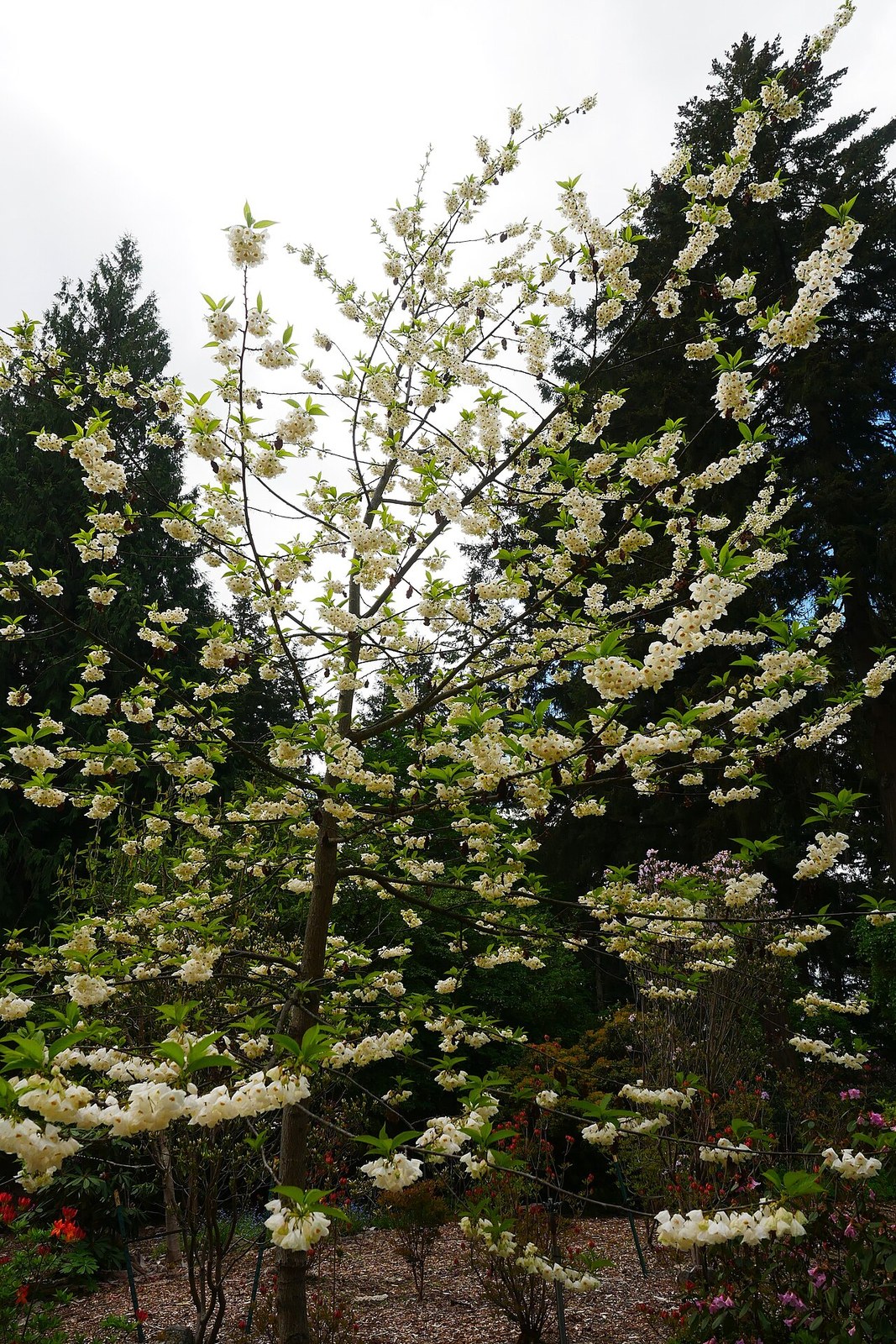
Silverbells (genus Halesia) are small to medium deciduous trees of southeastern forests, famous for the white, bell-shaped flowers that hang in rows beneath their branches in April and May. After the flowers come curious dry fruits with two or four papery wings. Silverbells are one of the most graceful native flowering trees for shady yards and woodland edges, and they are grown in gardens far beyond their wild range.
The genus has three species native to the United States. Mountain silverbell (Halesia tetraptera) is a tall tree of the southern Appalachians, Carolina silverbell (H. carolina) a smaller tree of the southeastern Piedmont and Coastal Plain, and two-wing silverbell (H. diptera) a small tree of the Gulf Coastal Plain. Botanists have disagreed for years about how to split the first two, so nursery labels often call any four-winged silverbell “Carolina silverbell.” The only other member of the genus, Halesia macgregorii, grows in southeastern China and is rarely seen in American gardens.
If you came here from a list of ornamental trees for New Jersey, note that silverbells are not native to New Jersey or anywhere else in the Northeast. They grow wild from southern Ohio, West Virginia and Virginia southward. They are hardy and widely planted in New Jersey, New York and New England, where they are a good choice for a southeastern native tree, but they are not part of the local wild flora there.
Identification
Silverbells are easy to recognize in spring, when no other native tree has rows of hanging white bells along last year’s twigs. In other seasons, look for the winged fruits that hang on the branches into winter and the striped young bark.
Bark & Stems
Young bark is smooth, gray-brown and marked with pale vertical streaks or stripes. On older trees it breaks into flat, scaly ridges and plates. Mountain silverbell can become a tall, straight-trunked forest tree; Carolina and two-wing silverbells usually branch low into several trunks.
Leaves
Leaves are alternate, simple, elliptic to oval, 3 to 7 inches long, with fine, shallow teeth and a pointed tip. They emerge as the trees bloom and turn a soft yellow in fall, sometimes early. Two-wing silverbell’s leaves are often wider and more coarsely toothed than those of the other two species.
Flowers
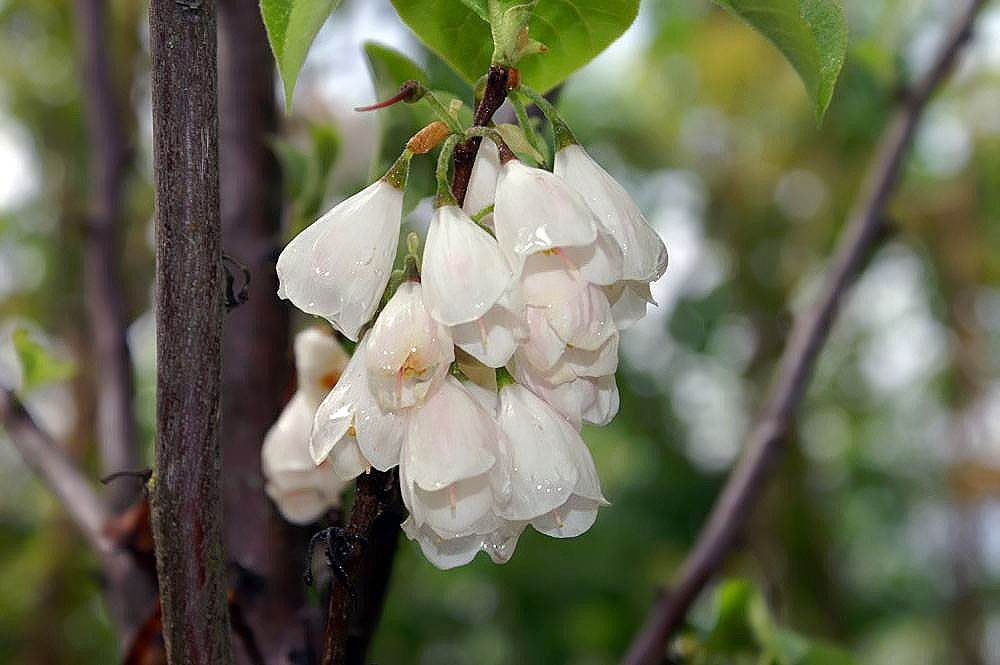
Flowers hang in clusters of two to five from the previous year’s twigs in April and early May, about the same time as eastern redbud. Each is about ½ to 1 inch long, usually pure white, occasionally pale pink. In mountain and Carolina silverbell, the four petals are fused into a bell with short lobes. In two-wing silverbell, the petals are split almost to the base, so the flowers look more open and star-like. The variety magniflora of two-wing silverbell has especially large flowers.
Fruit & Seeds
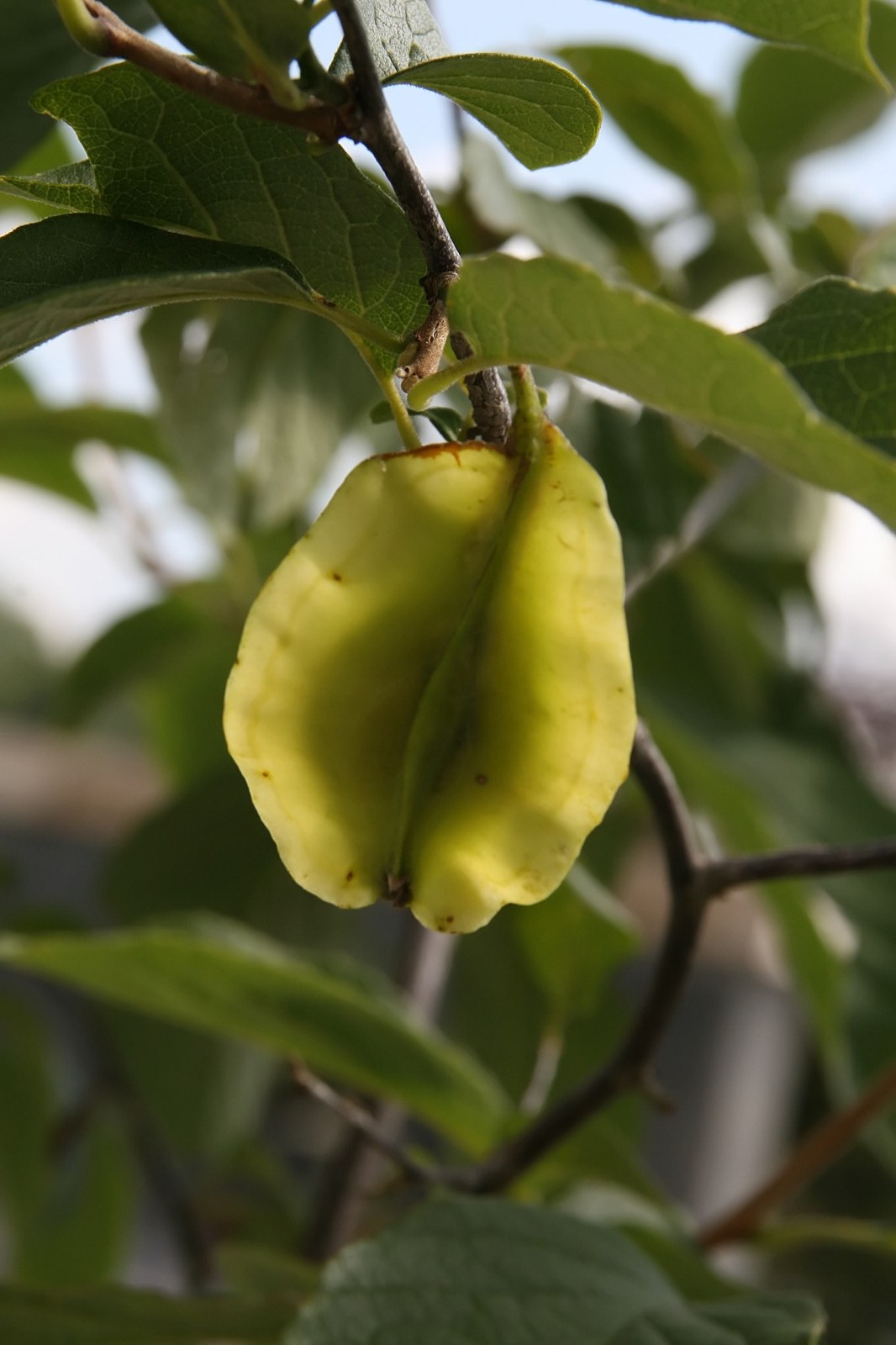
The fruit is the easiest way to tell the species apart. Mountain and Carolina silverbells have dry, oblong fruits 1 to 2 inches long with four papery wings running lengthwise. Two-wing silverbell has flatter fruits with two broad wings. Fruits ripen green in late summer, turn tan to brown, and hang on the tree well into winter. Each holds one to three hard seeds.
Quick Facts
| Genus | Halesia |
| Family | Styracaceae (Storax family) |
| U.S. Native Species | 3: mountain, Carolina and two-wing silverbell (one more species in China) |
| Growth Forms | Deciduous understory and canopy trees; large shrubs |
| Mature Height | About 15–30 ft for Carolina and two-wing silverbell; 30–40 ft in gardens and up to 80 ft or more for mountain silverbell in Appalachian forests |
| Mature Spread | About 15–35 ft |
| Growth Rate | Moderate |
| Sun Exposure | Part Shade to Full Sun |
| Water Needs | Average to moist; not drought tolerant |
| Soil Type | Rich, moist, well-drained loam |
| Soil pH | Acidic (about 5.0–6.5) |
| Bloom Time | April – May |
| Flower Color | White, occasionally pale pink |
| Fall Color | Yellow |
| Fruit | Dry, papery fruits with four wings (two in two-wing silverbell), hanging into winter |
| Deer Resistant | Moderately; seldom heavily browsed |
| USDA Hardiness Zones | About 5–9 (mountain silverbell to zone 4 with protection) |
Native Range
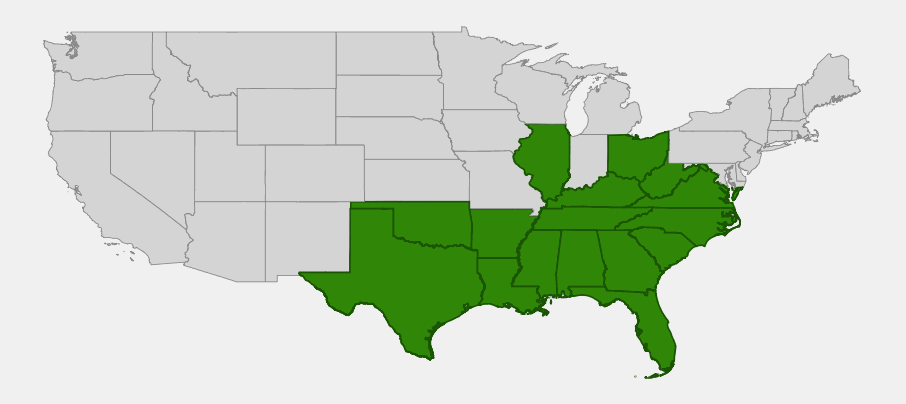
Mountain silverbell is a tree of the southern Appalachians and nearby uplands. It is common in moist coves and along streams in the Great Smoky Mountains and Blue Ridge, where it can be a canopy tree 80 feet tall, and its range extends north to West Virginia and southern Ohio and west through Kentucky and Tennessee to southern Illinois, the Ozarks of Arkansas and southeastern Oklahoma.
Carolina silverbell in the narrow sense is a smaller tree of the southeastern Piedmont and Coastal Plain, from the Carolinas and Georgia to northern Florida and Alabama. Two-wing silverbell grows along streams, in floodplain forests and on moist slopes of the Coastal Plain from South Carolina and Georgia through northern Florida, Alabama, Mississippi and Louisiana to Arkansas and eastern Texas.
Silverbells are not native to New Jersey, Pennsylvania, Maryland, New York, New England or the Midwest north of southern Illinois and Ohio, though they are commonly planted in all those places. Plantings in the Northeast sometimes self-seed nearby, but these are garden escapes, not native populations. The map below shows states where at least one silverbell is native.
📋 Regional plant lists covering native silverbell country: Maryland, Virginia & West Virginia · North & South Carolina · Georgia, Alabama & Mississippi · Kentucky & Tennessee · Ohio & Indiana · Illinois, Iowa & Missouri · Arkansas, Louisiana, E. Oklahoma & E. Texas
Native Species
These are the three silverbells native to the United States. Each name links to our full plant profile.
Mountain Silverbell (Halesia tetraptera)
The largest silverbell and the one most often planted. In the coves of the Great Smoky Mountains it can grow 80 feet or taller with a straight trunk, though garden trees usually reach 30 to 40 feet with a rounded or pyramidal crown. It has four-winged fruits and bell-shaped flowers ¾ to 1 inch long. It is the hardiest silverbell, grown successfully as far north as New England and the Great Lakes. Mountain silverbell is often sold as Halesia carolina or H. monticola, and some botanists still treat it as a variety of Carolina silverbell. Pink-flowered selections such as ‘Arnold Pink’ and var. rosea are available.
Carolina Silverbell (Halesia carolina)
In the strict sense, a smaller tree or large shrub, usually 15 to 30 feet tall, of the southeastern Piedmont and Coastal Plain, with smaller flowers (about ½ inch long) and four-winged fruits. It is sometimes called little silverbell. It is a fine understory tree for moist, partly shaded gardens in the Southeast, where it tolerates heat better than mountain silverbell. In the broad sense used by many nurseries and older books, “Carolina silverbell” includes mountain silverbell too.
Two-wing Silverbell (Halesia diptera)
A small tree of the Gulf Coastal Plain, usually 20 to 30 feet tall, often with several trunks. Its white flowers are divided nearly to the base into four petals, giving a more open, fringed look, and its flat fruits have two wings instead of four. It blooms a week or two later than the other silverbells and grows well in heat and humidity. The variety magniflora, from northern Florida, Georgia and Alabama, has the largest flowers of any silverbell and is the form most often found in nurseries.
Related Native Snowbells (Styrax)
The closest native relatives of silverbells are the snowbells in the same family. American snowbell (Styrax americanus) is a shrub of southeastern swamps and stream banks with star-shaped white flowers, and bigleaf snowbell (Styrax grandifolius) is a small tree of southeastern woods with large, round leaves and fragrant flowers in drooping racemes. Both have round, unwinged fruits.
Non-Native Look-Alikes
Silverbells have few close look-alikes, but several Asian trees in the same family are sold for similar hanging white flowers.
- Japanese snowbell (Styrax japonicus), from Japan, Korea and China. A small tree with smaller, glossy leaves and white, star-shaped, slightly fragrant flowers that hang on long stalks in late May and June, after silverbells finish. Its fruits are round and gray-green, without wings. It is widely planted and self-seeds readily; it has naturalized in some eastern woodlands and is watched as a potential invasive.
- Fragrant snowbell (Styrax obassia), from Japan, Korea and China. Large, round leaves and long, drooping clusters of fragrant white flowers.
- Epaulette tree (Pterostyrax hispida), from Japan and China. Long, hanging panicles of creamy, fringed flowers in early summer and bristly, ribbed fruits.
- Chinese silverbell (Halesia macgregorii), from southeastern China. The only Asian silverbell, with smaller flowers and four-winged fruits. It is very rarely grown in the US.
The simplest test is the fruit: only silverbells have dry, papery fruits with two or four long wings. Snowbells have round, unwinged fruits.
Growing & Care Guide
Light
Silverbells are naturally understory and woodland-edge trees. They grow well in part shade, especially in the South, where afternoon shade protects them from heat. In cooler climates they also grow in full sun if the soil stays moist, and they flower more heavily with more light.
Soil & Water
Give silverbells rich, moist, well-drained, acidic soil with plenty of organic matter, like a forest cove or stream bank. They do poorly in alkaline soil, where leaves turn yellow between the veins (chlorosis), and in hot, dry, compacted sites. Water deeply during dry spells, especially in the first few years, and keep a layer of leaf or bark mulch over the roots. Two-wing silverbell tolerates wetter soils and periodic flooding better than the others.
Planting Tips
Plant container or balled-and-burlapped trees in spring or fall. Silverbells look best where you can see the flowers from below, such as on a slope above a path, next to a patio, or at the edge of a woodland. They pair well with native rhododendrons, azaleas, ferns and spring ephemerals. Allow 20 to 30 feet of space for mountain silverbell.
Pruning & Maintenance
Silverbells need little pruning. Prune right after flowering, since next year’s flowers form on this year’s growth. You can train a young tree to a single trunk or let it grow as a multi-stemmed small tree. They have few pest or disease problems.
Propagation
Silverbell seeds have complex dormancy and usually need a warm period followed by a cold period; seeds sown outdoors in fall may take two springs to germinate. Softwood cuttings taken in late spring root fairly well with rooting hormone and are how named selections are propagated.
Landscape Uses
- Specimen flowering tree for small yards and partly shaded sites
- Woodland gardens and naturalistic plantings under taller oaks and pines
- Stream banks and moist slopes within the native range
- Native alternative to Japanese snowbell and other Asian flowering trees
- Pollinator gardens for early bees
Wildlife & Ecological Value
For Pollinators
Silverbell flowers open in mid-spring and are visited by bumblebees, honey bees and other bees for nectar and pollen. Because the flowers hang downward, they are especially suited to bumblebees, which can cling upside down.
For Birds
The trees host moth caterpillars that feed nesting songbirds, and their dense branching provides nesting sites. The dry fruits are not a major bird food.
For Mammals
Squirrels and other rodents eat silverbell seeds, often after the fruits fall in late winter. Deer browse young trees occasionally but rarely damage established ones.
Ecosystem Role
In the southern Appalachians, mountain silverbell is a characteristic tree of rich cove hardwood forests, growing with yellow buckeye, sugar maple, tulip tree and basswood. Two-wing silverbell is part of the understory of Coastal Plain floodplain and slope forests.
Cultural & Historical Uses
The genus is named for Stephen Hales, an eighteenth-century English clergyman and scientist known for early experiments on how plants move water. Silverbells were sent from the Carolinas to English gardens in the mid-1700s and were among the first American flowering trees grown in Europe, where they are still admired.
Old names for silverbells include “snowdrop tree” and “opossum wood.” The wood is light and fine-grained but was never commercially important. The rich coves of the Great Smoky Mountains hold some of the largest silverbells on record.
Today silverbells are valued mostly as ornamental trees. They are recommended by many arboreta and native-plant societies as one of the best small native flowering trees for the eastern United States.
Frequently Asked Questions
Is silverbell native to New Jersey?
No. Silverbells grow wild from southern Ohio, West Virginia and Virginia south to Florida and west to Oklahoma and Texas. They are hardy and often planted in New Jersey, but they are not part of New Jersey’s native flora.
What is the difference between Carolina and mountain silverbell?
Mountain silverbell is a larger tree of the Appalachians with larger flowers; Carolina silverbell in the strict sense is a smaller tree of the Piedmont and Coastal Plain with smaller flowers. Both have four-winged fruits, and nurseries often sell both as “Carolina silverbell.”
How big does a silverbell tree get?
In gardens, most silverbells reach 20 to 40 feet tall and 15 to 35 feet wide. Wild mountain silverbells in Appalachian coves can exceed 80 feet.
Can silverbells grow in full sun?
Yes, in cooler climates and moist soil. In the hot South, they do best with afternoon shade. They do not tolerate drought or alkaline soil.
When do silverbells bloom?
In April and early May, as the leaves are emerging, at about the same time as eastern redbud. Two-wing silverbell blooms a little later than the others.

Looking for a nursery that carries native silverbells?
Browse our native plant nursery directory: Alabama & Arkansas · Florida & Georgia · Illinois · Kentucky, Louisiana & Mississippi · North Carolina, Ohio & Oklahoma · South Carolina, Tennessee, Texas & Virginia · West Virginia

