
Estuary Beggarticks (Bidens hyperborea)
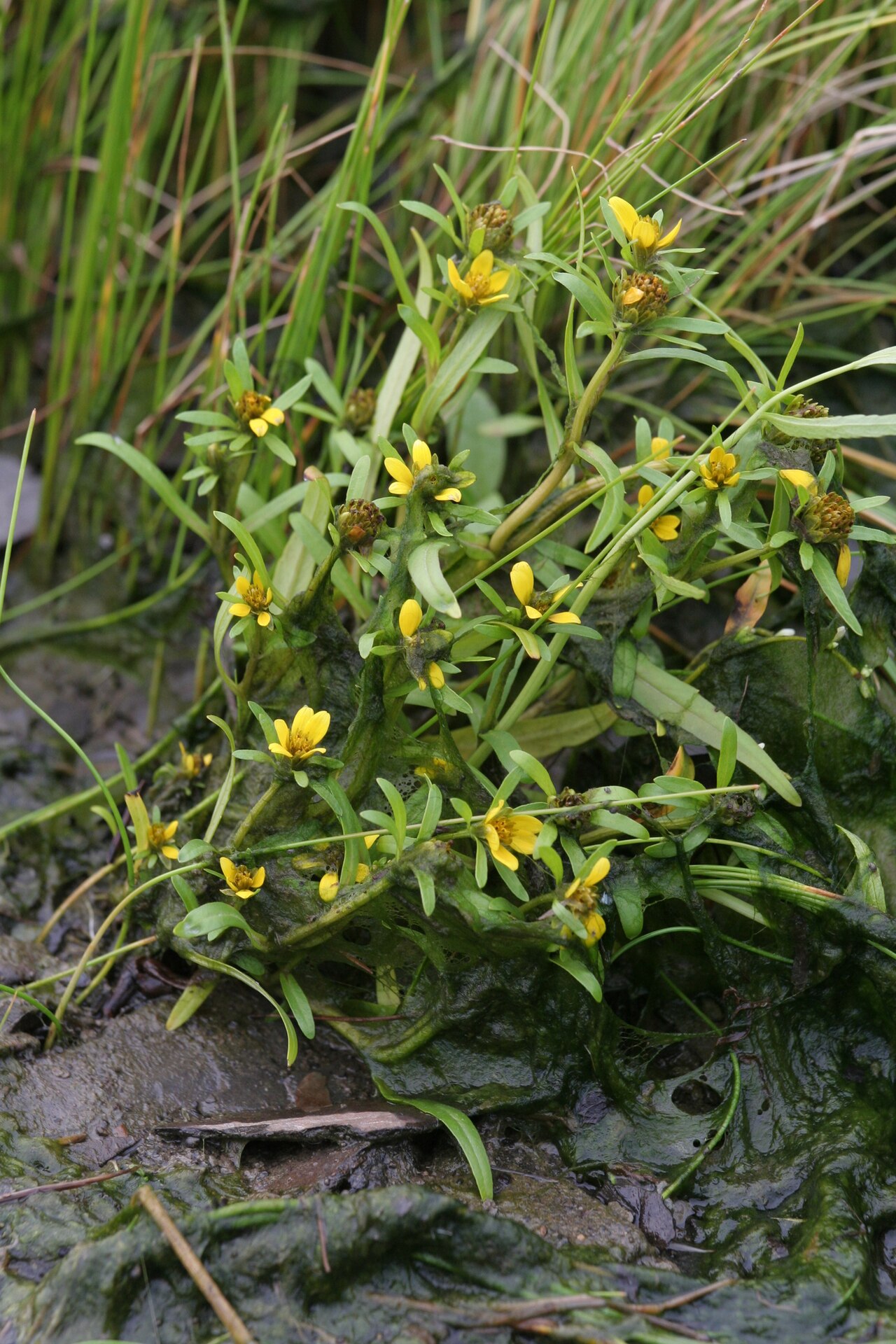
Bidens hyperborea, known as Estuary Beggarticks, northern beggarticks or estuary bur-marigold, is a small annual sunflower-family plant that lives in one of the most demanding habitats on the continent: the muddy and gravelly shores of tidal rivers where fresh water meets the sea. Twice a day the tide floods its stems, and twice a day it drains away. In late summer and fall the plants open small yellow flower heads only a few inches above the mud.
It is a northern plant, as its Latin name says. Hyperborea refers to the “land beyond the north wind” of Greek legend, and the species ranges from the estuaries of Maine and Massachusetts north to the St. Lawrence River, the Gulf of St. Lawrence and the shores of James Bay. In the United States it is rare. Maine holds most of the remaining populations, Massachusetts lists it as Endangered, and in New Hampshire it is known only from historical records.
Estuary beggarticks is not a garden plant, and there is no nursery trade for it. This page is an identification and appreciation guide: how to tell it from the more common beggarticks it grows with, where to look for it, and why freshwater tidal marshes, and the rare plants that depend on them, deserve protection.
Identification
Estuary beggarticks belongs to a group of yellow-flowered, opposite-leaved Bidens that are notoriously hard to tell apart, and it often grows within a few feet of its relatives. It is also very variable: plants on open tidal mud can flower when only a few inches tall, while sheltered plants may reach two feet. Fruit characters are the most reliable way to separate it.
Stems & Habit
An erect or sprawling annual, usually 4 to 12 inches tall but occasionally reaching about 28 inches. Stems are smooth, often reddish or purplish, and branch from near the base on vigorous plants. The plant grows from seed each spring and dies in fall after fruiting, so populations depend entirely on seed surviving the winter in the tidal mud.
Leaves
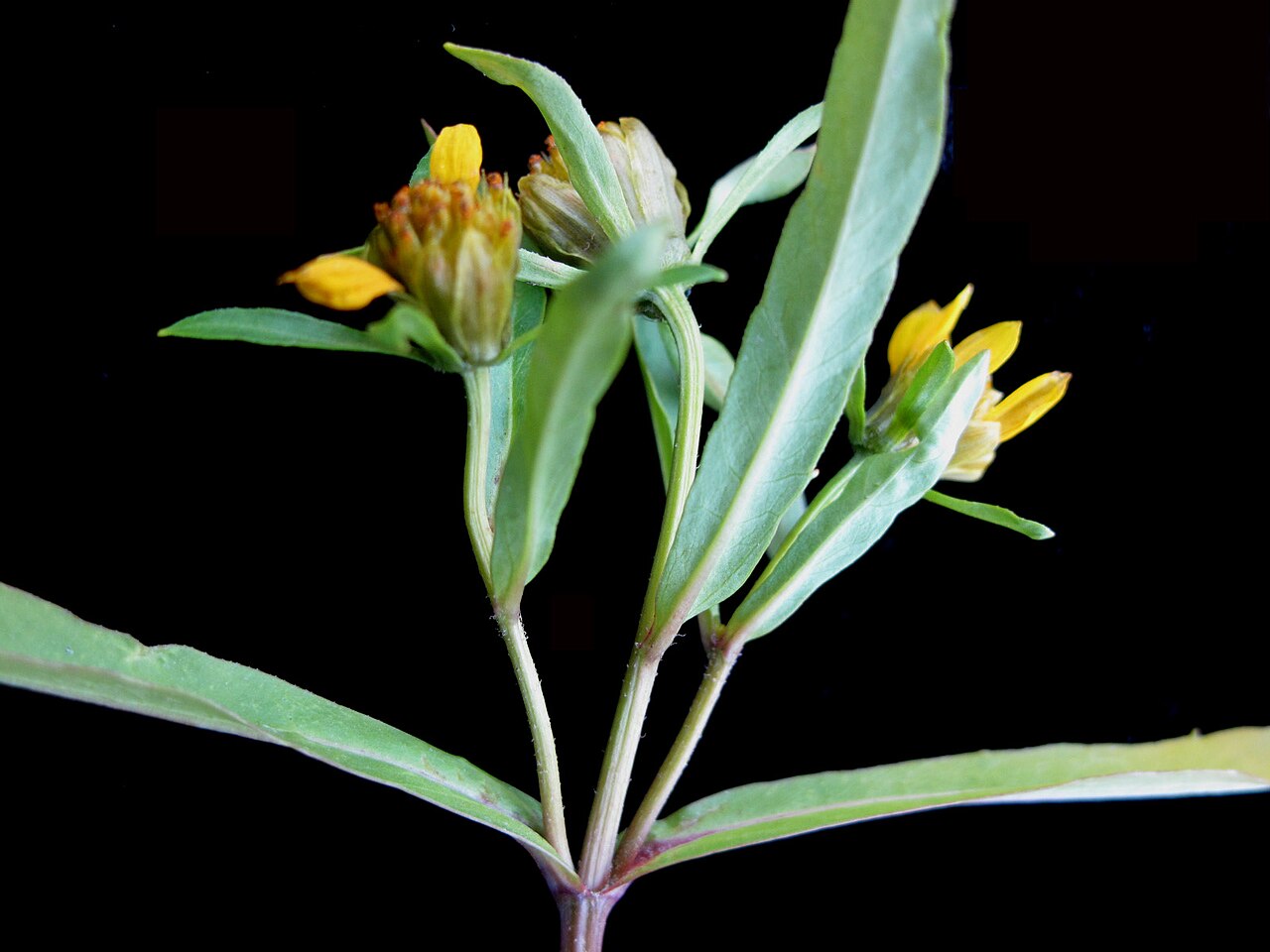
The leaves are opposite, simple and narrow: oblanceolate to linear, usually ¾ to 1½ inches long and well under half an inch wide, though they can reach about 4 inches on large plants. The edges may be smooth or sparsely toothed, and the base tapers to a winged stalk or attaches directly to the stem. Unlike the related Eaton’s beggarticks (B. eatonii), which often has divided leaves, estuary beggarticks always has undivided leaves.
Flower Heads
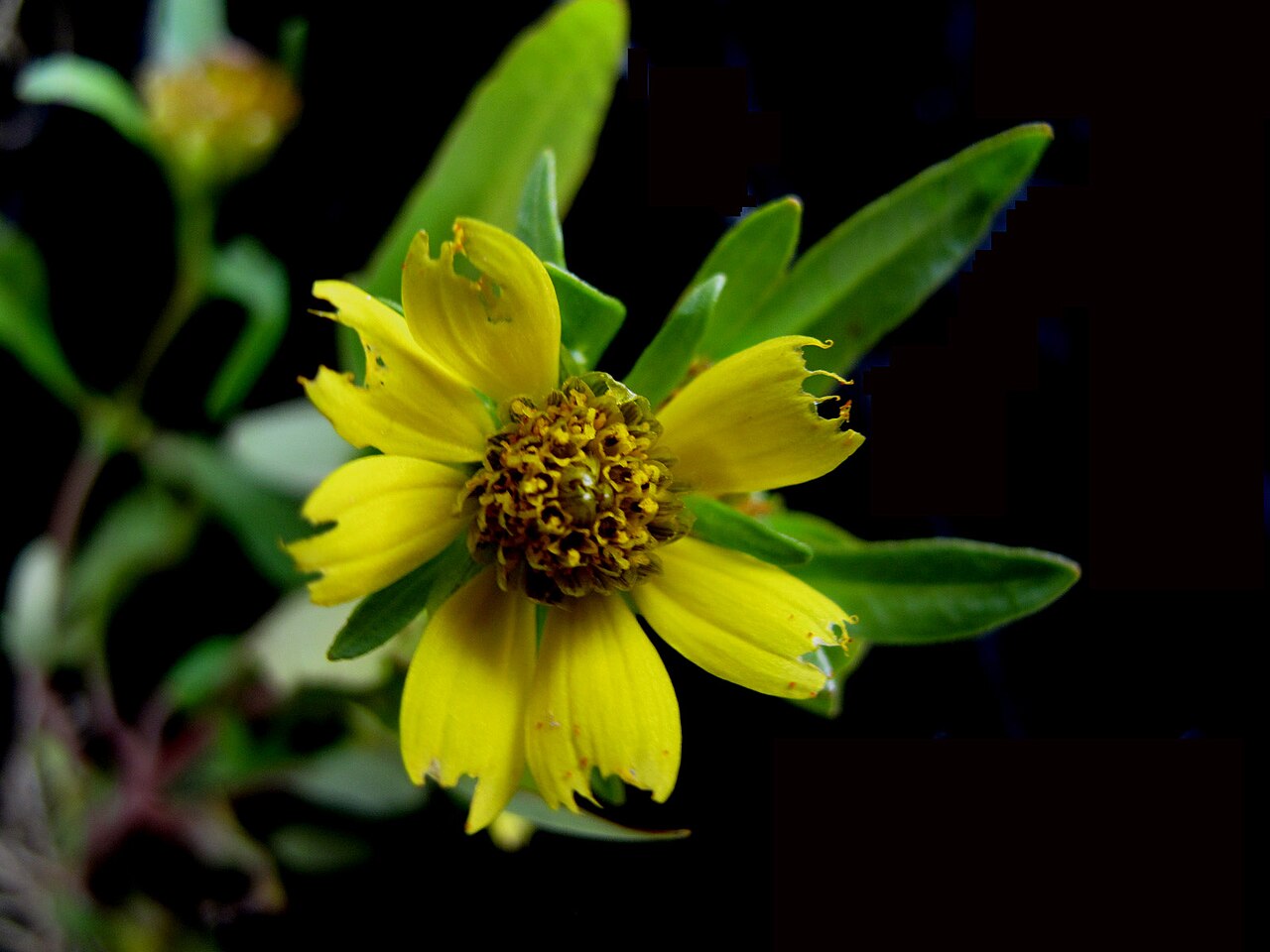
The flower heads stand erect, one to three at the end of each branch on stalks up to about 2½ inches long. Each head is about ⅓ inch across at the base of the disk and is wrapped in two rows of bracts: an inner row of 6 to 8 oblong, yellow-tipped bracts, and an outer row of 2 or 3 (occasionally more) narrow, leafy bracts that are often longer than the head. Heads may have no ray flowers at all, or 3 to 7 short, pale yellow rays up to about ½ inch long around 15 to 30 or more yellow to orange-tipped disk flowers. It blooms from August into October.
Fruit & Seeds
The fruits (cypselae, often called achenes) are flattened, narrowly wedge-shaped, dark and finely striped with 5 to 17 conspicuous lines. Each carries up to four stiff awns with backward-pointing barbs, the “beggar’s ticks” that cling to fur, feathers and clothing. The fruiting heads stay upright.
Two common look-alikes, nodding beggarticks (B. cernua) and smooth beggarticks (B. laevis), have larger disks (about ½ to 1 inch across in fruit) that nod as the seeds ripen, and their fruits lack the conspicuous stripes. Botanists have also recorded hybrids between estuary beggarticks and nodding beggarticks, so some plants are intermediate.
Quick Facts
| Scientific Name | Bidens hyperborea (syn. B. colpophila; several varieties now merged) |
| Family | Asteraceae (aster or sunflower family) |
| Plant Type | Annual herb of freshwater and brackish tidal shores |
| Mature Height | 4–12 in typical; occasionally to about 28 in |
| Mature Spread | 3–10 in |
| Growth Rate | Fast (completes its life cycle in one season) |
| Sun Exposure | Full sun |
| Water Needs | Very high; flooded and drained by the tide twice daily (wetland status OBL) |
| Soil Type | Tidal mud, sand and gravel on estuary shores |
| Soil pH | Not well documented; tolerates fresh to slightly brackish water |
| Bloom Time | August–October |
| Flower Color | Yellow rays (sometimes absent); yellow to orange disk |
| Fall Color | None; plants die after setting seed |
| Fruit | Flattened, striped cypsela with up to 4 barbed awns |
| Deer Resistant | Not applicable; grows on tidal shores rarely visited by deer |
| USDA Hardiness Zones | Not cultivated; annual of cold-temperate to subarctic estuaries |
Native Range
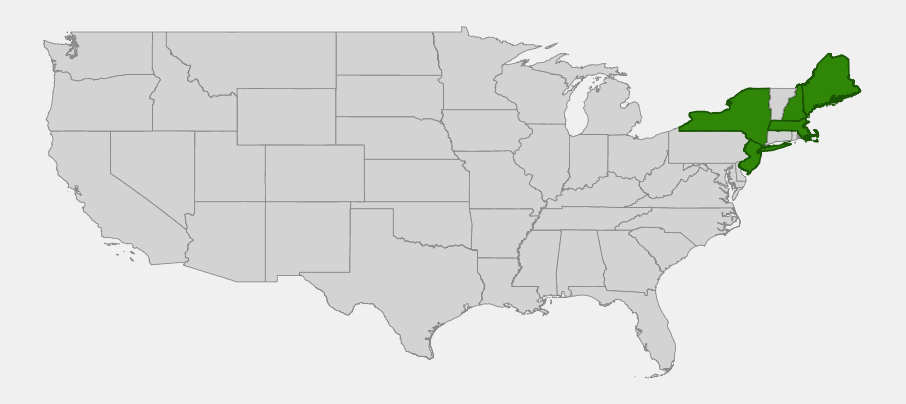
Estuary beggarticks is a plant of northeastern North America. In Canada it grows along the St. Lawrence River and its estuary in Quebec, around the Gulf of St. Lawrence to the Northumberland Strait in New Brunswick and Nova Scotia, and on the rivers that drain into James Bay in Ontario and Quebec. In the United States, USDA PLANTS records it from Maine, New Hampshire, Massachusetts, New York and New Jersey. Maine has by far the most occurrences, mostly at the mouths of rivers such as the Kennebec.
The U.S. records outside Maine are few or historical. Massachusetts has only a couple of remaining sites in Essex and Plymouth counties, and the species is historically known from the Merrimack River. In New Hampshire it has not been confirmed in recent decades. The New York and New Jersey records are outlying ones: an early 19th-century collection from the Hackensack Meadowlands of New Jersey was identified as this species, and recent assessments suggest that reports from the Hudson River estuary may be misidentifications of related beggarticks.
The botanist Norman Fassett suggested that this patchy distribution dates from the end of the last ice age, when meltwater from the retreating ice sheet created huge brackish estuaries along the coast. As the meltwater diminished and the sea grew saltier, the species was left stranded in the river mouths that still offered the right mix of fresh water and tide. Ice scour, flooding and moving sediment keep these shores open, which suits a short-lived annual.
📋 Regional plant lists featuring Estuary Beggarticks: New Hampshire, Maine & Vermont · Connecticut, Massachusetts & Rhode Island · New York, Pennsylvania & Northern New Jersey · Delaware, Southern New Jersey & Long Island
Growing & Care Guide
Estuary beggarticks is not grown in gardens, and it would be almost impossible to imitate its habitat: daily tidal flooding with fresh to slightly brackish water, shifting mud, and no competition from taller plants. Because it is rare or imperiled in every U.S. state where it occurs, seed and plants should never be collected from the wild. The notes below describe the conditions it needs so that landowners, restoration teams and naturalists can recognize and protect them.
Light
It needs full sun. It grows on open, low-lying mud and gravel where taller marsh plants cannot establish because of tidal scour and ice. Where cattails, reeds or shrubs close in, it disappears.
Soil & Water
Its home is the intertidal zone of estuaries, where river water dominates but the tide still rises and falls. It tolerates slightly brackish water but not full seawater. Changes in sediment, water quality or tidal flow (from dams, dredging, filling or shoreline hardening) can eliminate a population even when the plants themselves are never touched.
Planting Tips
Do not plant it. If you manage a tidal shoreline within its range, the best help is to leave open mud flats and gravel shores alone, avoid armoring the bank, and keep invasive common reed (Phragmites australis) from taking over. Restoration plantings of rare estuary plants should be left to state natural heritage programs and their partners.
Pruning & Maintenance
None in the usual sense. In natural areas, the most useful maintenance is controlling invasive plants that shade the upper edge of the tidal zone and reducing trampling and boat wake erosion at known sites.
Propagation
It reproduces only by seed. Barbed fruits are carried by water, ice, waterfowl and other animals, and they germinate on newly exposed mud the following spring. Seed banking for conservation is done by botanical institutions under permit and is not a home-gardening project.
Landscape Uses
- Field botany and plant identification: a classic challenge among the beggarticks for anyone learning New England and Maritime estuary flora
- Estuary conservation: a sensitive indicator of healthy freshwater tidal shores that still have natural tides, sediments and water quality
- Shoreline stewardship: a reason to protect undeveloped mud and gravel shores rather than armoring them
- Nature study and photography: late-season yellow flowers on the tide flats from August into October
- Native alternatives for gardens: gardeners who want a beggarticks can grow the widespread nodding beggarticks in a wet, sunny spot instead
Wildlife & Ecological Value
Estuary beggarticks is small and seasonal, but it is part of a specialized community of intertidal plants that occurs nowhere else. Freshwater tidal marshes are among the most productive and the most threatened wetlands of the Northeast.
For Pollinators
Like other beggarticks, it offers pollen and nectar in small, open flower heads that are easy for short-tongued visitors to reach. The Xerces Society lists the species as having special value to native bees. Because it blooms from late summer into fall, it adds a late food source on the tidal shore when many upland flowers have finished.
For Birds
Beggarticks seeds are eaten by ducks and other waterfowl and by sparrows and other seed-eating birds, and the barbed fruits travel on feathers. Estuary shores where it grows are also feeding grounds for migrating shorebirds, herons and rails.
For Mammals
Muskrats and other marsh mammals move through its habitat, and the barbed fruits hitch rides in fur. The plant itself is of minor food value to mammals.
Ecosystem Role
As an annual of open tidal mud, it colonizes ground cleared by ice scour and flooding, helping to bind fresh sediment until perennial marsh plants take over. Its decline is linked to the damming of rivers, the filling of marshes, siltation, pollution and invasive plants, and botanists treat intertidal specialists like this one as sensitive indicators of estuary health.
Cultural & Historical Uses
The species was named in 1901 by the American botanist Edward Lee Greene from specimens that James Melville Macoun had collected at James Bay and originally identified as nodding beggarticks. In 1915 Merritt Lyndon Fernald and Harold St. John described Bidens colpophila from the mouth of the Kennebec River in Maine, and in 1918 Fernald concluded it was the same species. Several varieties were later named for local forms, but most current authorities do not recognize them.
The genus name Bidens is Latin for “two teeth,” after the pair of barbed awns on the fruits of many species, and the common name “beggarticks” comes from the way those fruits cling to clothing like ticks. The French Canadian name is bident hyperboréal.
Today estuary beggarticks is a conservation concern in New England. Go Botany (Native Plant Trust) lists it as Endangered in Massachusetts (state rank S1), Endangered and historical in New Hampshire (SH), and Special Concern in Maine (S3). NatureServe ranks it globally as Apparently Secure (G4) because it remains more common in Quebec, but it is critically imperiled in Ontario and imperiled in Nova Scotia.
Frequently Asked Questions
Is estuary beggarticks rare?
In the United States, yes. It is listed as Endangered in Massachusetts and New Hampshire and as a species of Special Concern in Maine, and it is known only from historical or outlying records in New York and New Jersey. It is more secure in Quebec.
Can I grow estuary beggarticks in my garden?
No. It depends on daily tidal flooding in fresh to slightly brackish estuaries and is not sold by nurseries. Never collect seed or plants from the wild. For a wet, sunny garden spot, nodding beggarticks is a widespread native alternative.
How do I tell it from nodding beggarticks?
Estuary beggarticks has smaller flower heads that stay upright in fruit, and its flattened fruits have 5 to 17 conspicuous stripes. Nodding beggarticks has larger heads that bend downward as the seeds ripen, and its fruits lack the stripes.
Why is it called beggarticks?
The fruits carry barbed awns that cling to fur, feathers and clothing like ticks. This lets birds, mammals and people spread the seeds.
When does estuary beggarticks bloom?
From August into October. Look for it at low tide on the muddy and gravelly shores of tidal rivers, especially in Maine.

Looking for a nursery that carries Estuary Beggarticks?
Browse our native plant nursery directory: Maine & Massachusetts · New Hampshire, New Jersey & New York

