
Fir Clubmoss (Huperzia selago)
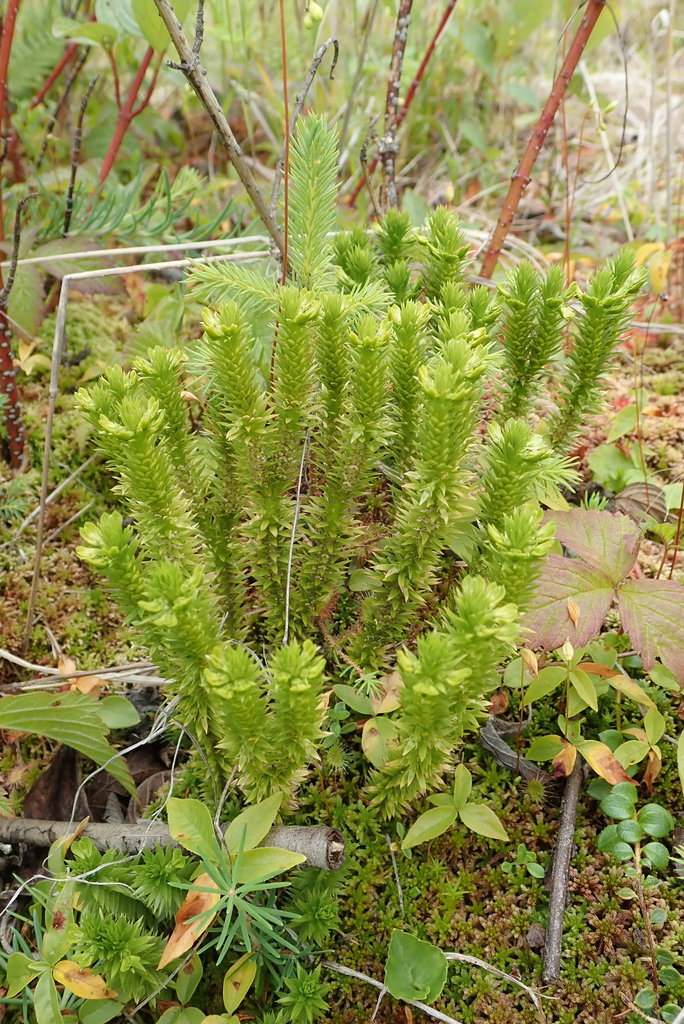
Huperzia selago, Fir Clubmoss, also called northern firmoss, is a small, evergreen, spore-bearing plant of cool northern forests, shores and bogs. It forms tight clumps of upright shoots, usually 3 to 6 inches tall, that branch evenly from the base and are clothed in short, stiff, needle-like leaves, so each tuft looks like a cluster of tiny fir trees. Unlike the familiar running clubmosses, it has no creeping stems along the ground.
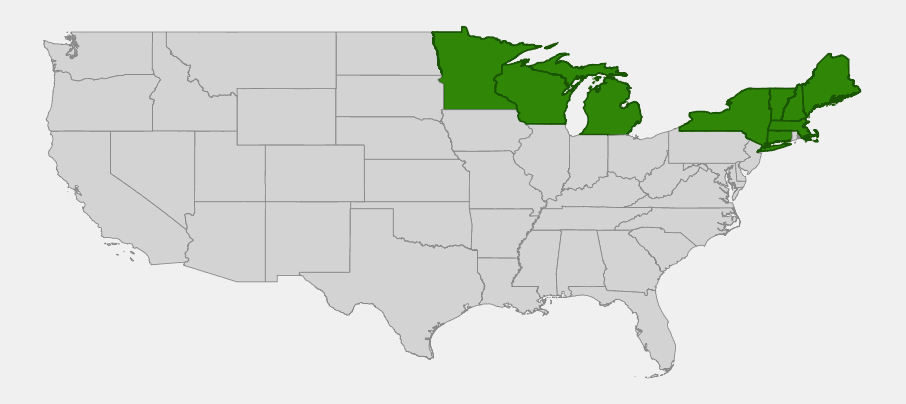
Fir clubmoss is not a moss, but a lycophyte, a member of an ancient group of vascular plants that predates the ferns and seed plants. Like its relatives it produces spores, and it also reproduces by tiny detachable buds called gemmae. In the United States, USDA PLANTS records it from the Great Lakes states (Minnesota, Wisconsin and Michigan), New York and New England, and it is widespread across Canada and northern Eurasia.
Its name in North America is complicated, because botanists have divided what was once a single circumboreal “Huperzia selago” into several species. This page follows USDA PLANTS, which treats H. selago as the lowland, boreal firmoss and lists the alpine mountain firmoss (H. appressa) separately. Fir clubmoss cannot be bought or transplanted, so this guide is about identifying it, understanding the split, and where to see it.
Identification
Fir clubmoss belongs to the firmosses (Huperzia), which differ from other clubmosses in having no creeping horizontal stems and no cone-like strobili. The spore cases sit at the bases of ordinary leaves along the shoots. Its closest relatives in the Northeast are shining clubmoss and mountain firmoss.
Shoots
The shoots are upright or slightly curved, usually 3 to 6 inches tall (rarely to 8 inches), and fork several times at the base so the plant forms a dense clump. Each shoot is about the same thickness from bottom to top. In fir clubmoss the shoots often show yearly constrictions, with zones of shorter leaves marking each season’s growth.
Leaves
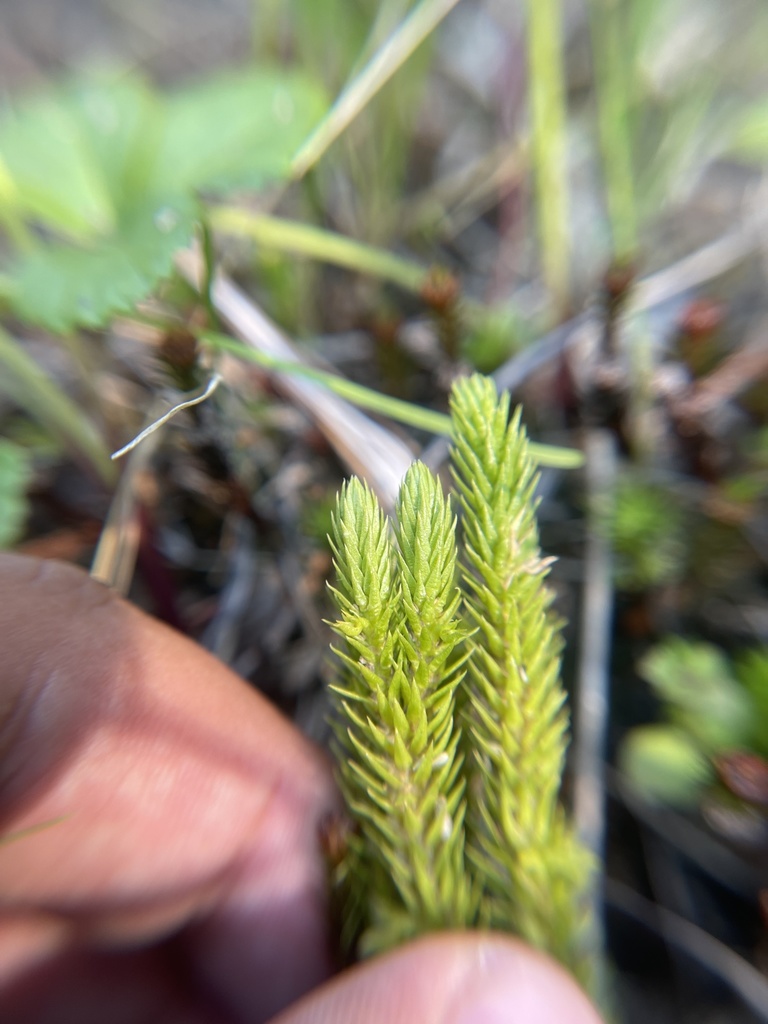
Leaves are small, narrow and lance-shaped, about ⅛ to ¼ inch long, with smooth or very faintly toothed edges and no stalk. They are yellow-green to green and are crowded all around the stem. In fir clubmoss they typically spread outward or angle upward, giving the shoot a slightly bristly look, rather than pressing flat against the stem.
Spores & Gemmae
Kidney-shaped spore cases (sporangia) are borne in the axils of ordinary leaves in bands along the upper part of the shoots; there are no separate cones. Near the shoot tips, the plant also produces gemmae: small, flat, leafy buds that break off and fall to the ground, where they can root and grow into new plants. In fir clubmoss the gemmae form in a single band at the end of each annual growth zone.
How the Species Was Split
Older manuals called all North American firmosses of this type Huperzia selago (or Lycopodium selago). Studies in the 1980s and 1990s, summarized in the Flora of North America, separated several species: H. selago in the strict sense, a lowland plant of boreal forests and shores; H. appressa, the mountain or Appalachian firmoss of alpine summits and arctic tundra, with shorter shoots and leaves pressed against the stem; and H. continentalis, a western plant of Alaska and the Pacific Northwest, which some sources now include in H. miyoshiana. These species also hybridize with each other and with shining clubmoss, so intermediate plants are common, and even experts sometimes disagree on individual specimens.
Quick Facts
| Scientific Name | Huperzia selago |
| Family | Lycopodiaceae (clubmoss family) |
| Plant Type | Evergreen clump-forming lycophyte (clubmoss) |
| Mature Height | 3–6 in |
| Mature Spread | 2–6 in per clump |
| Growth Rate | Very slow |
| Sun Exposure | Part shade to full sun in cool sites |
| Water Needs | Medium to high; consistently moist |
| Soil Type | Moist, acidic sand, gravel, peat or humus |
| Soil pH | About 4.0–6.0 |
| Bloom Time | None; spores mature in late summer |
| Flower Color | None (spore-bearing plant) |
| Fall Color | Evergreen |
| Fruit | None; spores and gemmae |
| Deer Resistant | Yes; rarely browsed |
| USDA Hardiness Zones | 1–5 |
Native Range
In the United States, USDA PLANTS records fir clubmoss as native in Minnesota, Wisconsin, Michigan, New York, Vermont, New Hampshire, Maine, Massachusetts and Connecticut. It is most frequent in the northern parts of the Great Lakes states and northern New England, and becomes rare toward the southern edge of its range in southern New England. It extends across Canada from Newfoundland and Labrador to British Columbia and the Yukon and Northwest Territories, and also grows in Greenland and across northern Europe and Asia.
Because older records lumped several species together, range maps for “Huperzia selago” vary from source to source. Alpine and arctic plants on mountain summits, including those in the southern Appalachians, are now usually treated as mountain firmoss (H. appressa), and western plants from Alaska to Washington as H. continentalis or H. miyoshiana. The map here shows the USDA range for H. selago in the narrow sense.
Fir clubmoss favors cool, moist, acidic, open or lightly shaded ground: sandy and gravelly lake and river shores, ditches and road edges, bog margins, open conifer swamps and moist conifer woods, and rocky outcrops near water.
📋 Regional plant lists featuring Fir Clubmoss: New York, Pennsylvania & Northern New Jersey · Michigan, Wisconsin & Eastern Minnesota · Connecticut, Massachusetts & Rhode Island · New Hampshire, Maine & Vermont
Can You Grow It?
Practically, no. Fir clubmoss is not sold by nurseries, and it should never be dug from the wild. Like other clubmosses, it depends on soil fungi, grows extremely slowly, and almost always dies after transplanting. It is uncommon to rare at the southern edge of its range, where some states track it as a plant of conservation concern. The best way to enjoy it is to find it in the field and leave it in place.
Light
In the wild it grows in open to partly shaded sites. Very deep shade and hot sun both limit it.
Soil & Water
It needs cool, constantly moist, acidic, low-nutrient soil, such as sand, gravel or peat, often near water. These conditions, plus its fungal partners, are very hard to reproduce in a garden.
Planting Tips
If you own land where it grows, protect it rather than moving it: keep foot traffic, fill and herbicides away from shoreline and ditch colonies, and avoid changing drainage.
Pruning & Maintenance
None. Do not pick shoots for wreaths or decorations; colonies recover very slowly.
Propagation
In nature it spreads mainly by gemmae, which drop near the parent plant and root. Spores grow into tiny underground gametophytes that live with fungi for years before producing a new plant. Botanical researchers have grown firmosses from gemmae, but this is not practical for home gardeners.
Where to See It
- Northern lakeshores: look on sandy and gravelly shores and in damp road ditches in northern Minnesota, Wisconsin and Michigan
- Boreal and conifer forests: open, moist spruce, fir and cedar woods in the Adirondacks and northern New England
- Bog edges: the drier margins of bogs and fens across its range
- Canadian parks: common in parks of the boreal forest, such as those around Lake Superior and in Algonquin Provincial Park
- Field botany: a good species to learn alongside shining clubmoss and mountain firmoss
Wildlife & Ecological Value
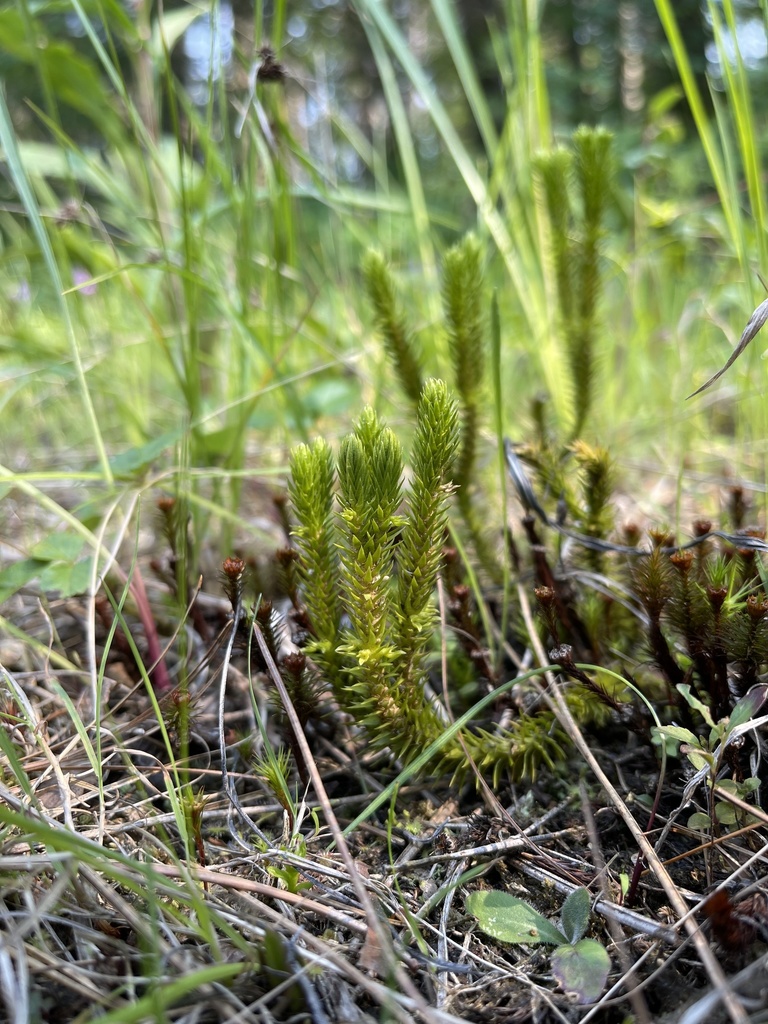
Fir clubmoss is small, but it is part of the long-lived ground layer of northern forests and shores.
For Pollinators
None. It reproduces by spores and gemmae, not flowers, and has no nectar or pollen.
For Birds
Its evergreen tufts add a little cover to the forest floor. It is not an important bird food.
For Mammals
Clubmosses contain bitter alkaloids and are rarely eaten by deer, moose or small mammals.
Ecosystem Role
Its gametophytes live underground for years in partnership with mycorrhizal fungi, which supply them with nutrients before the green plant appears. Its evergreen clumps help hold moist sand and gravel on shores and in ditches. It also shows how lycophytes, a lineage that once included tree-sized plants, persist today as small plants of the forest floor.
Cultural & Historical Uses
Fir clubmoss and its relatives contain lycopodium alkaloids, including huperzine A, a compound first isolated from toothed clubmoss (Huperzia serrata), a firmoss long used in Chinese medicine. Huperzine A inhibits the enzyme acetylcholinesterase and has been studied for memory disorders. Safety note: the plant itself is poisonous. In Europe, fir clubmoss was used in folk medicine as a strong purgative and emetic and against lice, and poisonings were recorded. Do not eat it or prepare it as a remedy.
Linnaeus named the plant Lycopodium selago in 1753, using an old name that Pliny the Elder had applied to a plant gathered by the Druids with special rituals. It was later moved to Huperzia, a genus named for the German fern specialist Johann Peter Huperz.
Clubmoss spores were once collected in great quantity as “lycopodium powder,” used in fireworks, early flash photography and pharmacy, though mostly from the running clubmosses, which produce spores in cones. Today the North American firmosses are more valued as a subject of botanical study, because their hybridization and the 20th-century splitting of H. selago are a classic example of how plant species are recognized.
Frequently Asked Questions
Is fir clubmoss a moss?
No. It is a lycophyte, a vascular plant with roots, stems and leaves that reproduces by spores. True mosses lack internal water-conducting tissue.
What is the difference between fir clubmoss and mountain firmoss?
Fir clubmoss (H. selago in the narrow sense) grows in lowland forests and on shores and has spreading leaves. Mountain firmoss (H. appressa) grows on alpine summits and tundra and has shorter shoots with leaves pressed close to the stem. Older books call both H. selago.
Can I dig up fir clubmoss for my garden?
No. It rarely survives transplanting, is not sold by nurseries, and is uncommon in parts of its range. Leave it where it grows.
Is fir clubmoss poisonous?
Yes. It contains lycopodium alkaloids, including huperzine A, and has caused poisoning when used as a folk remedy. Do not eat it.
How does fir clubmoss reproduce?
By spores borne at the bases of its leaves and, more often, by gemmae: small leafy buds near the shoot tips that fall off and grow into new plants.

Looking for a nursery that carries Fir Clubmoss?
Browse our native plant nursery directory: Connecticut · Maine, Massachusetts, Michigan & Minnesota · New Hampshire & New York · Vermont · Wisconsin

