
Bigleaf Witch-hazel (Hamamelis ovalis)
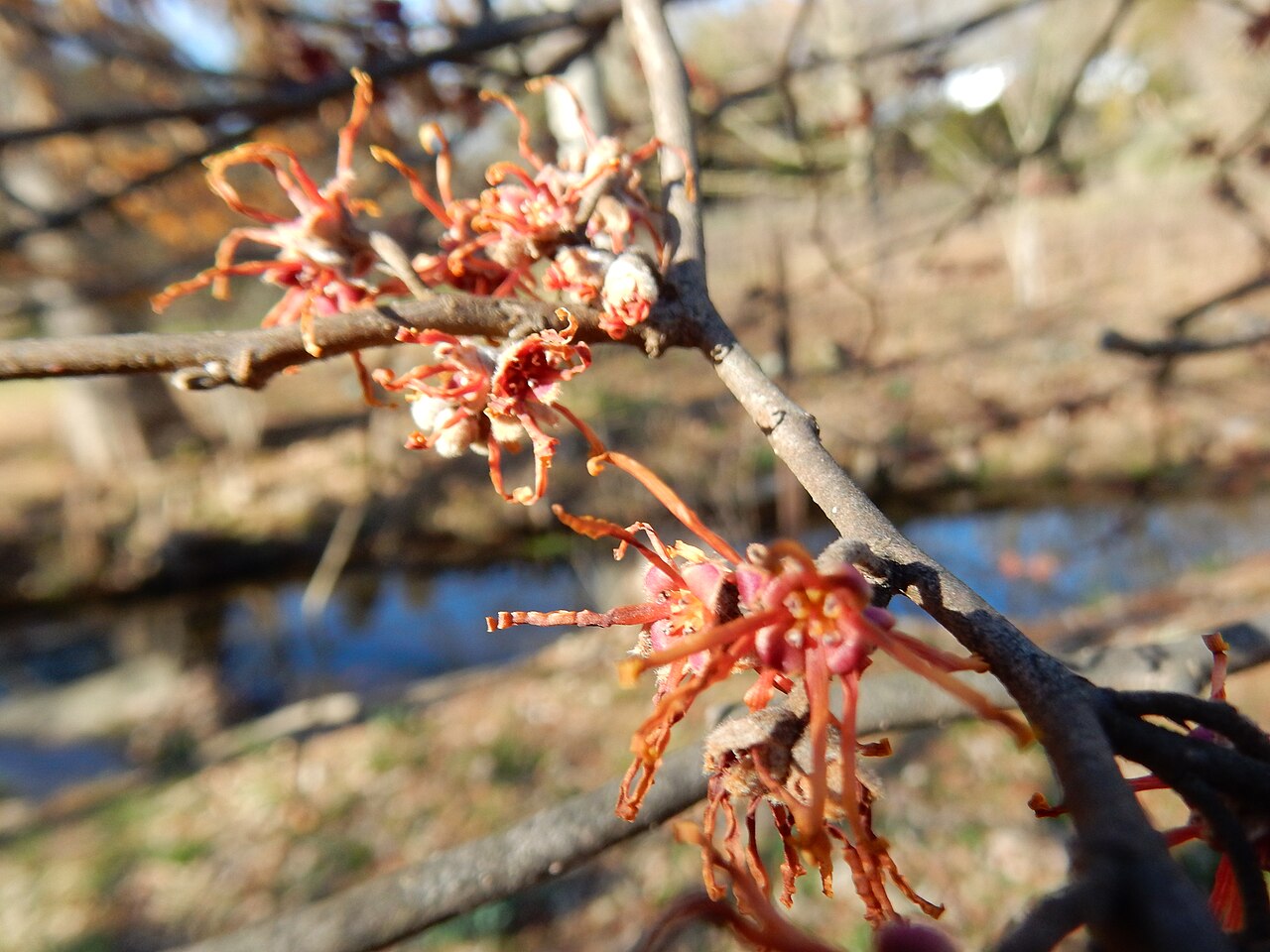
Hamamelis ovalis, the Bigleaf Witch-hazel, also called Leonard’s witch hazel (the USDA PLANTS name), running witch-hazel or southern witch-hazel, is a rare native shrub of pine and pine-hardwood forests on the Gulf Coastal Plain. It blooms in the depth of winter, usually from December to February, with spidery red to maroon flowers on bare branches. Its leaves are noticeably larger and rounder than those of other witch hazels.
It is one of the newest native shrubs described in the eastern United States. Botanist S. W. Leonard found it in Perry County, Mississippi, in 2004 and described it as a new species in 2006, believing it to be endemic to southern Mississippi. It has since been found in Alabama and, according to NatureServe, at a few sites in the western Florida Panhandle, southeastern Georgia and far eastern Texas. NatureServe ranks it globally imperiled to vulnerable (G2G3).
A note on taxonomy: USDA PLANTS and NatureServe accept Hamamelis ovalis as a species, but some botanists sink it into Common Witch Hazel (H. virginiana) as a large-leaved, red-flowered form. For an overview of all the native species, see our guide to Native Witch Hazels.
Identification
Bigleaf witch-hazel shares the classic witch hazel features: zigzag twigs, lopsided leaves with wavy teeth, spidery four-petaled flowers and woody seed capsules that shoot out their seeds. Its large leaves, red winter flowers and colonial habit separate it from the other native species.
Growth Habit
Bigleaf witch-hazel is a deciduous, multi-stemmed shrub that spreads by underground runners to form loose colonies of many stems, which is why it is sometimes called running witch-hazel. Most plants are well under tree size, often roughly 3 to 10 feet tall, and grow in the understory beneath pines and hardwoods.
Leaves
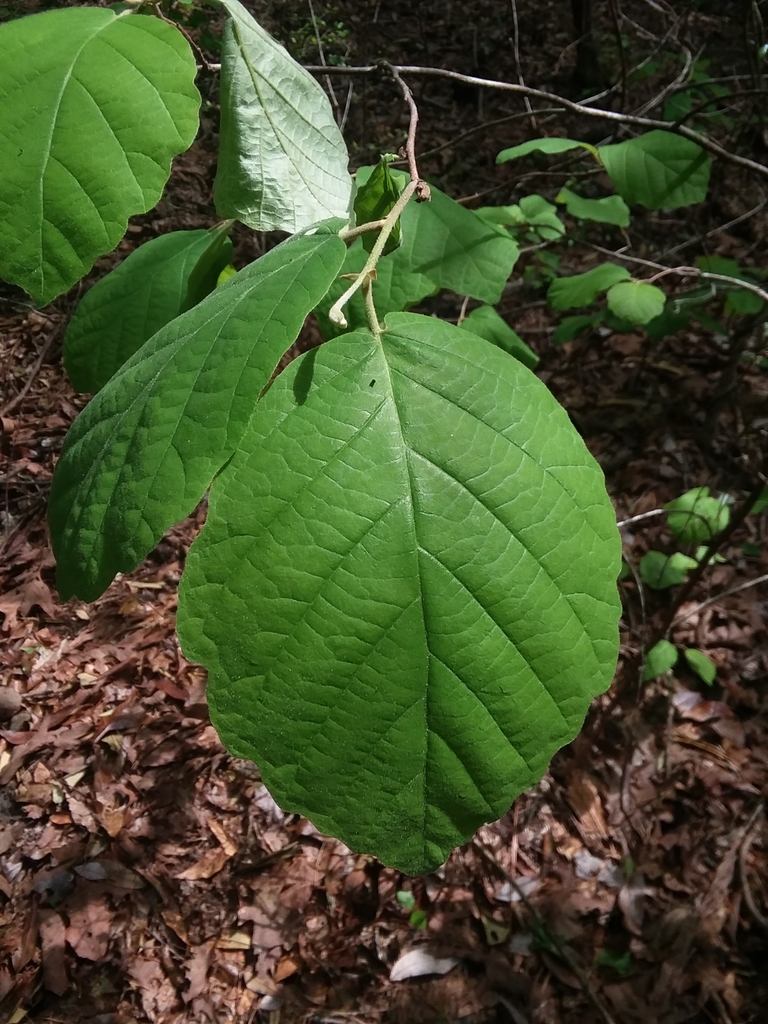
The leaves are alternate, broadly oval to nearly round, with an uneven base and wavy or scalloped teeth. They are much larger than those of common witch hazel, which is the main feature that NatureServe and the original description use to separate the species. The undersides are paler and often softly hairy. The leaves resemble those of a hazelnut.
Flowers
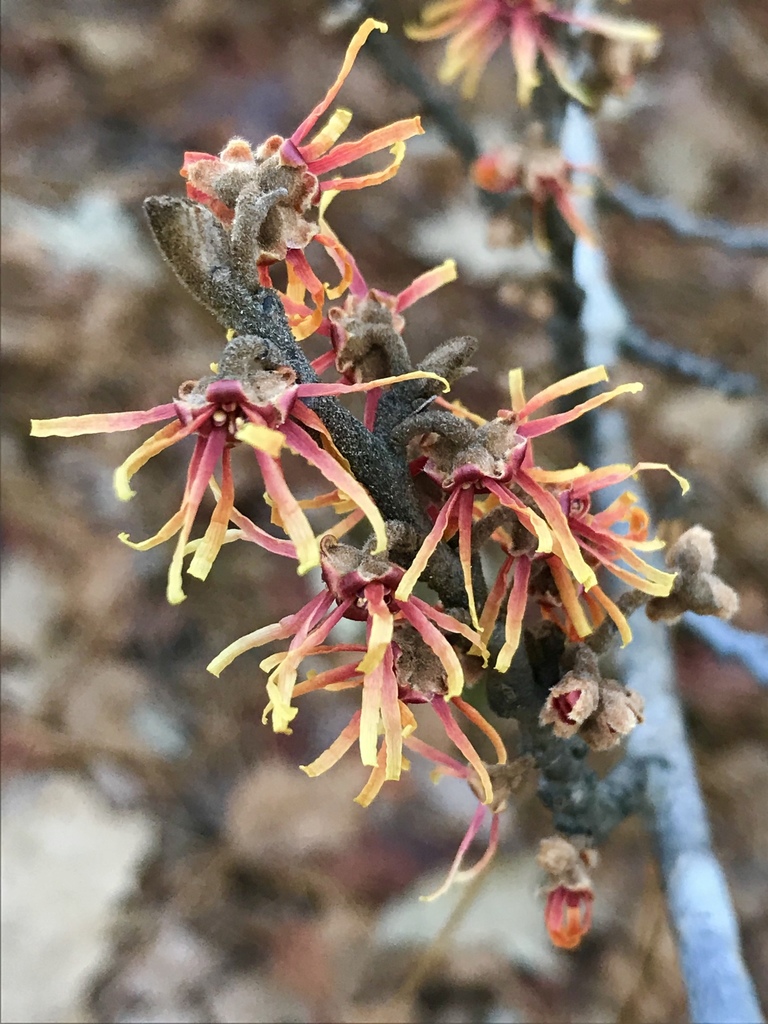
Flowering is in winter, mostly December to February. The flowers grow in small clusters along the bare twigs. Each has four narrow, crinkled, strap-like petals, about 1/2 inch to nearly 1 inch long, that are red to maroon, sometimes paler or yellow toward the tips.
Fruit
Like other witch hazels, it produces small, woody, two-parted capsules that ripen the following fall. When dry, the capsules split and forcibly eject their shiny black seeds several feet from the plant.
Similar Species
Common witch hazel (H. virginiana) is usually a taller shrub or small tree, has smaller leaves and yellow flowers in fall, and does not usually form spreading colonies. Ozark Witch Hazel (H. vernalis) also blooms in winter with yellow to red flowers, but it is native to the Ozarks and Ouachitas, has smaller leaves and grows mainly along rocky streams.
Quick Facts
| Scientific Name | Hamamelis ovalis S.W. Leonard |
| Family | Hamamelidaceae (witch-hazel family) |
| Plant Type | Deciduous shrub; colonial, spreading by rhizomes |
| Mature Height | About 3–10 ft |
| Mature Spread | Forms colonies several feet to many feet wide |
| Growth Rate | Slow to moderate |
| Sun Exposure | Part shade to light shade |
| Water Needs | Medium; well-drained soil |
| Soil Type | Acidic loamy or sandy loam soils in pine-hardwood forests |
| Soil pH | About 4.5–6.5 |
| Bloom Time | December–February |
| Flower Color | Red to maroon, sometimes yellow-tipped |
| Fall Color | Yellow |
| Fruit | Woody two-parted capsule that ejects black seeds |
| Deer Resistant | Moderate |
| USDA Hardiness Zones | 7–9 |
Native Range
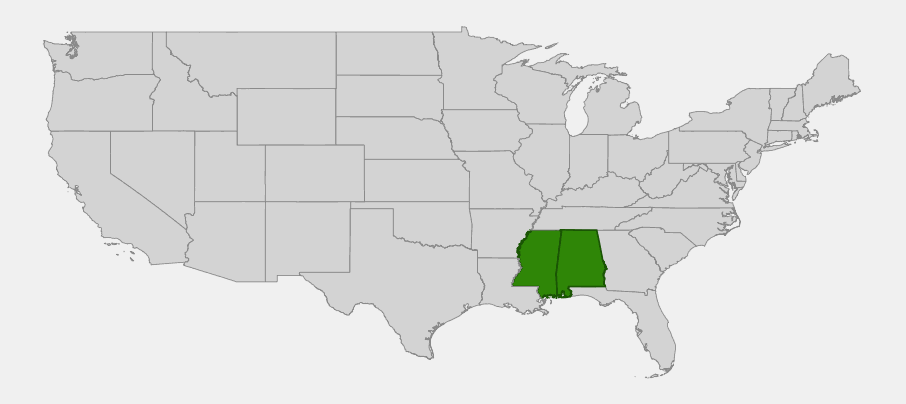
USDA PLANTS lists bigleaf witch-hazel as native in Alabama and Mississippi, which are the states shown on the map. It was first known only from Perry County in southern Mississippi, where it grows in scattered small colonies. NatureServe reports that most known occurrences are now in Alabama, where it is known from about nine counties.
NatureServe also lists a handful of newer records outside those two states: Escambia and Santa Rosa Counties in the Florida Panhandle, Tattnall County in Georgia, and Newton County in far eastern Texas. Observers on iNaturalist have documented plants in eastern Texas as well. Because these records are recent and few, USDA PLANTS does not yet show the species in those states. Botanists expect more populations to be found as they search suitable habitat.
It grows beneath pines and mixed hardwoods, in second-growth forests of longleaf and loblolly pine, on ravine bottoms, low slopes, upper slopes and ridge crests. Associated plants recorded at Mississippi sites include loblolly and longleaf pine, mockernut hickory, blackgum, southern red oak, bigleaf magnolia, flowering dogwood, sassafras, yaupon, American holly, sparkleberry and beautyberry.
📋 Regional plant lists featuring Bigleaf Witch-hazel: Alabama, Georgia & Mississippi
Growing & Care Guide
Bigleaf witch-hazel is rare in the wild and only occasionally available from specialty nurseries and arboretum plant sales. It is a fine shrub for a woodland garden in the Deep South, valued for its red winter flowers and bold summer foliage. Buy only nursery-propagated plants, and never dig it from the wild.
Light
Grow it in part shade or light, filtered shade, as it grows in the wild under a pine and hardwood canopy. It tolerates more sun in moist soil, which may improve flowering.
Soil & Water
Plant it in well-drained, acidic, loamy or sandy loam soil with plenty of organic matter. Water regularly during its first year and during long summer droughts. Avoid soggy soil.
Planting Tips
Plant in fall or winter in the Deep South. Give it room to spread by runners, or plant it where a small colony would be welcome, such as a woodland edge or naturalized slope. Site it near a path or window where you can enjoy the winter flowers.
Pruning & Maintenance
Little pruning is needed. Remove dead wood after flowering, and remove or transplant suckers if you want to keep it compact. Witch hazels are generally free of serious pests.
Propagation
Seeds ripen in fall and should be collected just before the capsules split. They have a deep double dormancy and usually need a warm period followed by a cold period, so they may take two years to germinate. Rooted suckers from nursery-grown plants can be separated in winter.
Landscape Uses
- Winter interest: red flowers on bare branches in the coldest months
- Woodland gardens: a colonial understory shrub for pine and hardwood shade
- Conservation plantings: a way to grow a rare Gulf Coast native from nursery-propagated stock
- Naturalized slopes: spreading colonies help cover shaded banks
- Collector gardens: a distinctive witch hazel to grow alongside common and Ozark witch hazels
Wildlife & Ecological Value
Little has been published about the wildlife that uses bigleaf witch-hazel, but its life history is similar to other native witch hazels.
For Pollinators
Winter-blooming witch hazels are visited on mild days by flies, small bees and other insects that are active in cold weather. Witch hazel leaves are also food for the caterpillars of many moths.
For Birds
Native witch hazel seeds are eaten by some birds, such as wild turkeys and bobwhite quail, and the shrubs provide cover in the forest understory.
For Mammals
Squirrels and other small mammals eat witch hazel seeds. Deer browse the twigs and leaves to some extent.
Ecosystem Role
Bigleaf witch-hazel is part of the understory of Gulf Coastal Plain pine-hardwood forests. Because it was only recognized in the 2000s and is known from few sites, conservation agencies are still surveying for new populations and assessing threats. One Texas site is threatened by reservoir development.
Cultural & Historical Uses
The genus name Hamamelis comes from Greek words often translated as “together with fruit,” because witch hazels carry flowers and the previous year’s fruit on the branches at the same time. The species name ovalis refers to its broadly oval leaves. USDA PLANTS calls it Leonard’s witch hazel, after the botanist who described it.
The discovery of an unrecognized shrub species in the southeastern United States in the 21st century surprised many botanists. When it was described in 2006, it was thought to grow only in southern Mississippi. Later surveys found it in Alabama, Florida, Georgia and Texas, showing how much remains to be learned about the plants of the Gulf Coastal Plain.
Witch hazel extract, used as a skin astringent, is made from the bark and leaves of common witch hazel. Bigleaf witch-hazel is far too rare to be harvested for that purpose.
Frequently Asked Questions
Is bigleaf witch-hazel a separate species?
USDA PLANTS and NatureServe treat Hamamelis ovalis as a separate species, separated mainly by its large leaves, red winter flowers and colonial growth. Some botanists consider it a form of common witch hazel (H. virginiana).
When does bigleaf witch-hazel bloom?
It blooms in winter, usually from December to February, with red to maroon flowers on bare branches.
Where does bigleaf witch-hazel grow?
It grows in pine and pine-hardwood forests of the Gulf Coastal Plain. USDA PLANTS lists it in Alabama and Mississippi, and NatureServe reports a few newer records in the Florida Panhandle, southeastern Georgia and eastern Texas.
Is bigleaf witch-hazel rare?
Yes. NatureServe ranks it globally imperiled to vulnerable (G2G3), with fewer than about 20 confirmed occurrences known in 2018.
Can I grow bigleaf witch-hazel?
Yes, in zones 7 to 9 in part shade and well-drained acidic soil, if you can find nursery-propagated plants. Never dig it from the wild.

Looking for a nursery that carries Bigleaf Witch-hazel?
Browse our native plant nursery directory: Alabama · Mississippi

