
Native Witch Hazels (Hamamelis)
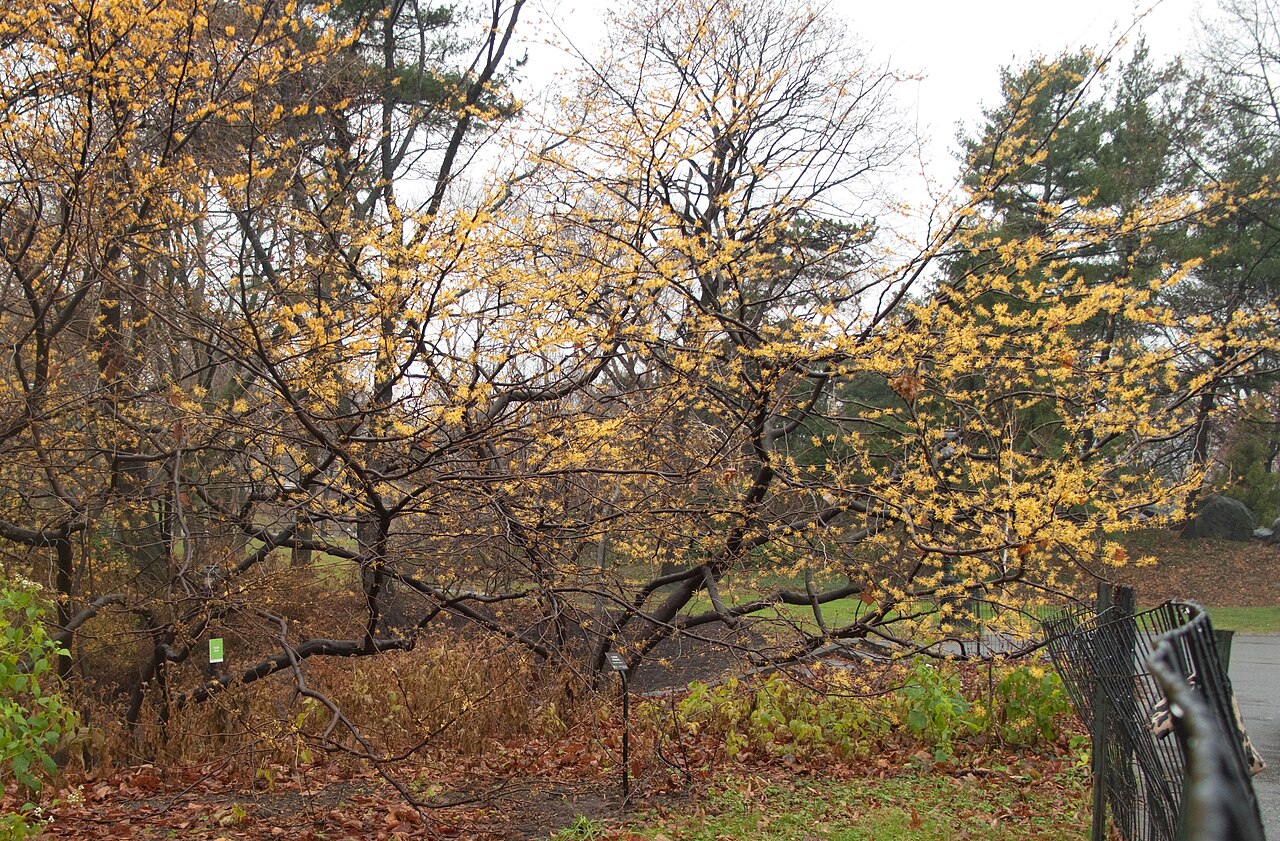
Witch hazels (genus Hamamelis) are large shrubs and small trees famous for flowering when almost nothing else does. Their spidery, ribbon-petaled yellow, orange or red flowers appear in fall or in the depths of winter, on bare branches or among falling leaves, and give off a light, spicy scent on mild days. The genus is small, with only about five or six species, and is split between eastern North America and eastern Asia.
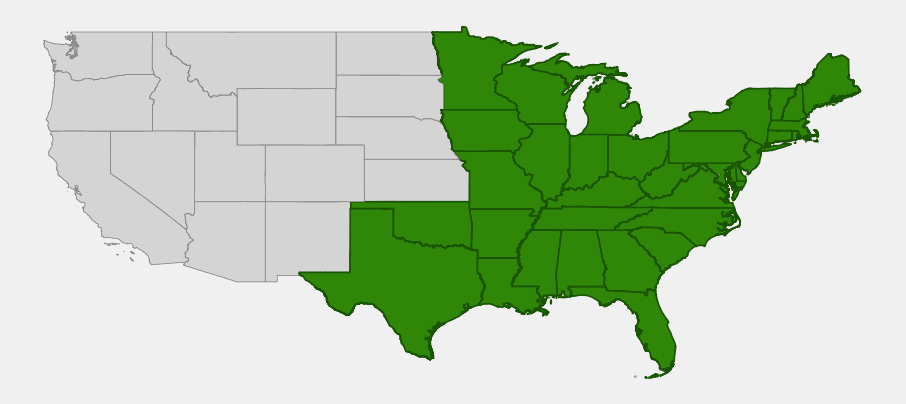
Two witch hazels are native to the United States. Common witch hazel (H. virginiana) grows in woods across the eastern half of the country, from Maine and Minnesota to Florida and east Texas, and blooms in October, November and sometimes into December. Ozark witch hazel (H. vernalis) grows along gravelly streams in the Ozark and Ouachita Mountains and blooms from January to March. Both are tough, long-lived, deer-tolerant shrubs that fit woodland edges, shady borders and naturalistic plantings.
Many of the showiest witch hazels in garden centers, the ones that light up late winter with large yellow, orange or coppery flowers, are not native. They are Asian species and hybrids, especially Hamamelis × intermedia cultivars such as ‘Arnold Promise’ and ‘Jelena’. Those plants are handsome and not invasive, but if you want the native species, which support far more native insects, this guide will help you tell them apart and grow them well.
Identification
Witch hazels have several features found on few other eastern shrubs: zigzag twigs with fuzzy, naked buds, lopsided leaves, ribbon-like flowers and woody seed capsules that shoot their seeds.
Bark & Stems
Witch hazels usually grow as multi-stemmed shrubs or small trees, 10 to 20 feet tall (common witch hazel occasionally to 30 feet), with a broad, open, vase-shaped crown. The bark is smooth and gray to light brown, often mottled, becoming slightly scaly on old stems. Twigs zigzag from bud to bud. The leaf buds are “naked,” with no protective scales, and are covered in fine, tan, velvety hairs; flower buds are small, round and stalked.
Leaves
Leaves are alternate, broadly oval, 3 to 6 inches long, with wavy, scalloped edges and an uneven, lopsided base. The veins are straight and parallel, running to the edge of the leaf. In fall, common witch hazel turns clear yellow, often while it is blooming. Ozark witch hazel turns yellow to orange-red, and its brown leaves often cling to the branches through winter, partly hiding the flowers.
Flowers
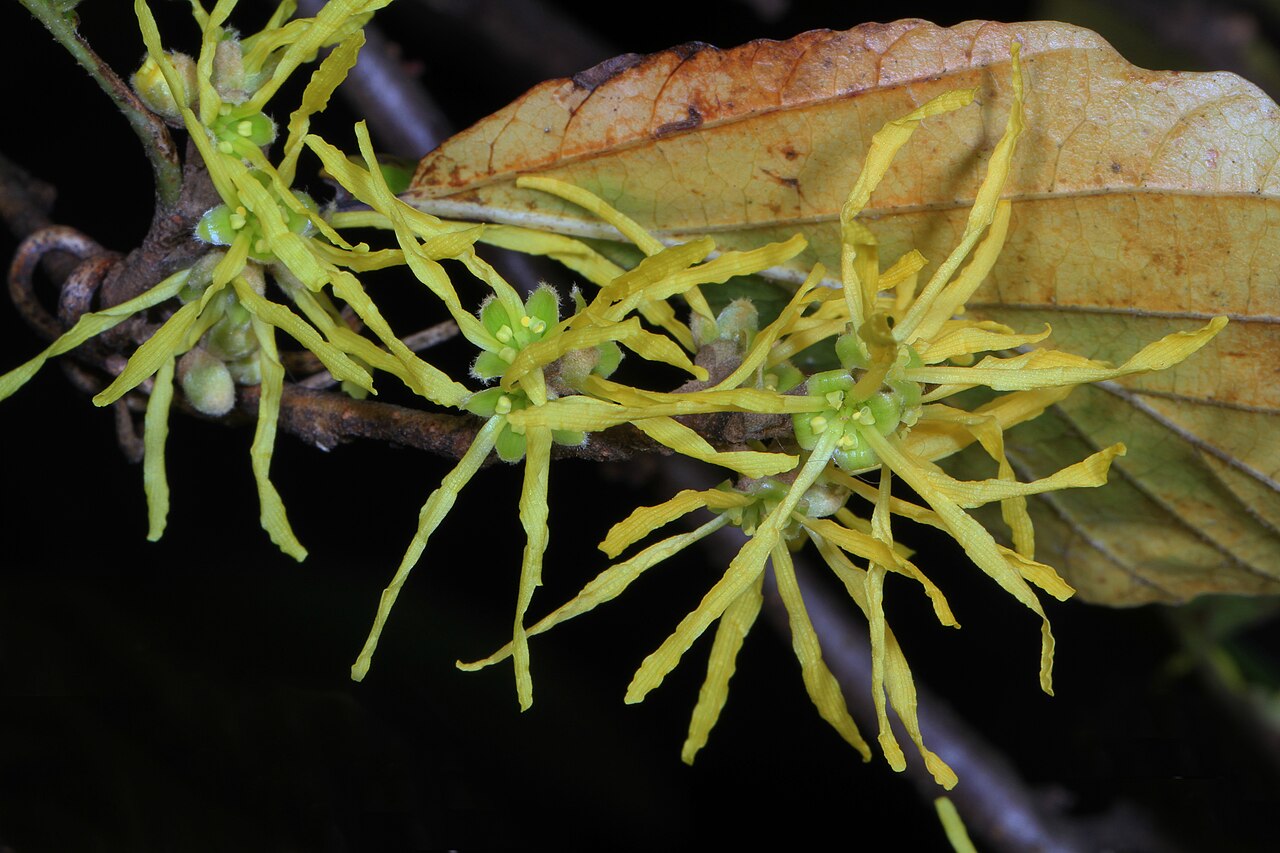
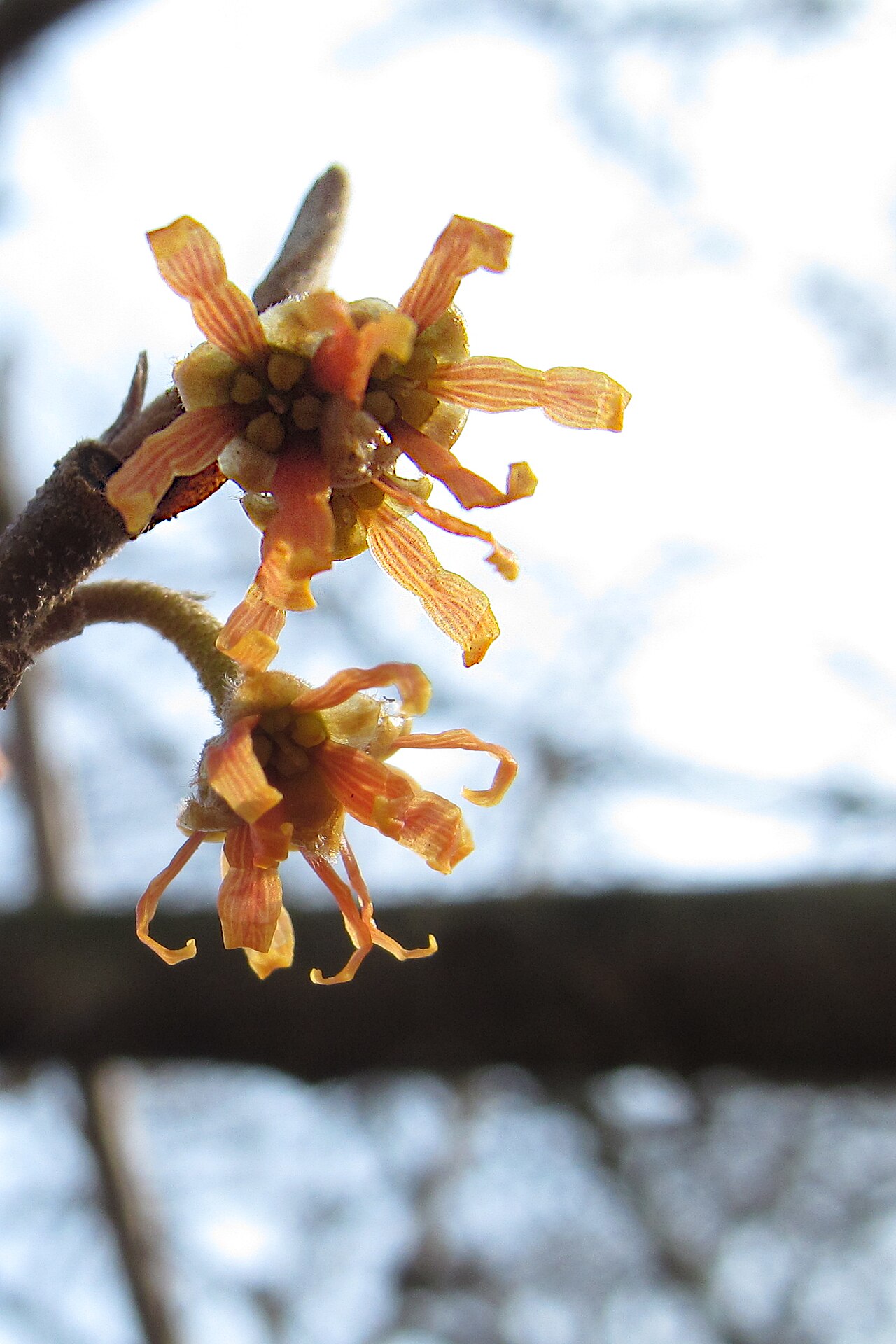
Each flower has four narrow, crinkled, strap-shaped petals about ½ to ¾ inch long, held in small clusters along the twigs. On cold days the petals curl up tightly, then unroll again when it warms. Common witch hazel flowers are lemon yellow and bloom from October into December. Ozark witch hazel flowers are smaller, yellow to orange or reddish, and bloom from January to March, with a stronger, slightly pungent scent.
Fruit & Seeds
The fruit is a woody, two-beaked capsule about ½ inch long that takes nearly a year to ripen. In late summer or fall the capsule splits and squeezes out its two shiny black seeds with enough force to throw them 20 feet or more, sometimes with an audible snap. On common witch hazel, ripe capsules, new flowers and old empty husks can all be on the branches at the same time.
Quick Facts
| Scientific Name | Hamamelis (2 species native to the US: H. virginiana and H. vernalis) |
| Family | Hamamelidaceae (Witch hazel family) |
| Plant Type | Deciduous, multi-stemmed shrubs or small trees |
| Mature Height | 10–20 ft (common witch hazel occasionally to 30 ft; Ozark witch hazel usually 6–10 ft) |
| Mature Spread | 10–20 ft |
| Growth Rate | Slow to moderate |
| Sun Exposure | Full sun to part shade (tolerates fairly deep shade with fewer flowers) |
| Water Needs | Average to moist; tolerates brief drought once established |
| Soil Type | Moist, well-drained loam; Ozark witch hazel also gravel bars and clay |
| Soil pH | Acidic to near neutral (about 5.0–7.0); Ozark witch hazel tolerates slightly alkaline soil |
| Bloom Time | October – December (common); January – March (Ozark) |
| Flower Color | Yellow (common); yellow, orange or red (Ozark) |
| Fall Color | Yellow (common); yellow to orange-red (Ozark) |
| Fruit | Woody capsules that shoot out black seeds about a year after flowering |
| Deer Resistant | Moderately; occasionally browsed |
| USDA Hardiness Zones | 3–8 (common); 4–8 (Ozark) |
Native Range
Common witch hazel is one of the most widespread shrubs of the eastern forest. It is native from Nova Scotia and southern Ontario through all of New England and the Great Lakes states to northern Florida and the Gulf Coast, and west to Minnesota, Iowa, Missouri, eastern Oklahoma and east Texas. It grows in the understory of oak, maple, beech and hemlock forests, along stream banks and ravines and at the edges of woods, from sea level to about 5,000 feet in the southern Appalachians. Southern plants with larger, often hairier leaves are sometimes separated as variety macrophylla.
Ozark witch hazel has a much smaller range. It grows on gravel bars and rocky stream banks, where floods scour the ground, in the Ozark Plateau and Ouachita Mountains of Missouri, Arkansas and eastern Oklahoma, with outlying populations in Louisiana and Texas. Many gardeners elsewhere grow it for its winter flowers, but wild plants are limited to this region.
No witch hazel is native west of the Great Plains. A third North American species, H. mexicana, grows in the mountains of Mexico, and a large-leaved witch hazel described from southern Mississippi and Alabama (H. ovalis) is treated by some botanists as a separate species and by others as a form of common witch hazel.
📋 Regional plant lists with native witch hazel: New Hampshire, Maine & Vermont · Connecticut, Massachusetts & Rhode Island · New York, Pennsylvania & Northern New Jersey · Delaware, Southern New Jersey & Long Island · Maryland, Virginia & West Virginia · North Carolina & South Carolina · Georgia, Alabama & Mississippi · Kentucky & Tennessee · Ohio & Indiana · Illinois, Iowa & Missouri · Michigan, Wisconsin & Eastern Minnesota · Arkansas, Louisiana, Eastern Oklahoma & Eastern Texas
Native Species
Witch hazel is a small genus, and only two species are native to the United States. Each links to our full growing guide.
Common witch hazel (Hamamelis virginiana) is the witch hazel of eastern woods: a large, open shrub or small tree 15 to 20 feet tall with scalloped leaves and lemon-yellow flowers in fall, often while the leaves are still turning yellow. It is hardy to zone 3, takes shade, and is the source of the witch hazel extract sold in drugstores. It is the best choice for a native fall-blooming shrub almost anywhere in the East and Midwest.
Ozark witch hazel (Hamamelis vernalis), also called vernal witch hazel, is a smaller, suckering shrub, usually 6 to 10 feet tall, native to rocky stream banks in Missouri, Arkansas and Oklahoma. It blooms in late winter, from January to March, with small yellow, orange or red flowers that have a strong, spicy scent. It tolerates wetter, heavier and more alkaline soils than common witch hazel and is a native alternative to the Asian winter-blooming witch hazels. Cultivars include the red-flowered ‘Kohankie Red’ and the yellow-flowered ‘Sandra’, which has purple new leaves.
Some references also list bigleaf witch hazel (H. ovalis) from a few counties in southern Mississippi and Alabama, with large leaves and reddish winter flowers. Its status is debated, and many references include it in common witch hazel.
Gardeners looking for more native shrubs with similar seasons can pair witch hazels with their native relatives large fothergilla and dwarf fothergilla, which belong to the same family and bloom with white bottlebrush flowers in spring, or with spicebush, which covers its bare branches in small yellow flowers in early spring.
Non-Native Look-Alikes
Most winter- and early-spring-blooming witch hazels sold in nurseries are Asian. They are good garden plants and are not invasive, but they are not native and support fewer native insects.
- Chinese witch hazel (Hamamelis mollis): Blooms from January to March with large, very fragrant golden-yellow flowers. Its leaves are rounder and densely fuzzy beneath, and old brown leaves often hang on through bloom.
- Japanese witch hazel (Hamamelis japonica): Blooms in late winter with yellow flowers that often have a red or purple center, and has little scent. It is less common in gardens than the hybrids.
- Hybrid witch hazels (Hamamelis × intermedia): Crosses of Chinese and Japanese witch hazel, with the largest flowers in the genus, in yellow, orange, copper or red, from January to March. Popular cultivars include ‘Arnold Promise’ (bright yellow, from Boston’s Arnold Arboretum), ‘Jelena’ (coppery orange) and ‘Diane’ (red). Many are grafted onto common witch hazel roots, so suckers from below the graft will be native witch hazel.
- Winter hazels (Corylopsis): Asian shrubs in the same family with drooping chains of pale yellow, bell-shaped flowers in early spring. Their flowers are not ribbon-like.
- Forsythia and cornelian cherry (Forsythia, Cornus mas): Popular yellow-flowering shrubs of early spring, from Asia and Europe. Forsythia has bell-shaped flowers on arching stems; cornelian cherry has puffs of tiny yellow flowers. Native spicebush is a good substitute for either.
A simple rule: a witch hazel blooming in October or November in the eastern US is almost certainly native common witch hazel. One blooming in late winter is either Ozark witch hazel or an Asian species or hybrid; check the plant tag, flower size and color.
Growing & Care Guide
Witch hazels are easy, low-maintenance shrubs with few pests. Their main needs are moisture while young and a spot where their unusual bloom time can be enjoyed.
Light
Both native species grow in full sun to part shade. In the wild, common witch hazel is an understory shrub and tolerates fairly heavy shade, but it flowers more heavily and keeps a denser shape with at least a few hours of sun. Ozark witch hazel prefers sun to light shade.
Soil & Water
Plant in moist, well-drained, humus-rich soil. Common witch hazel prefers slightly acidic conditions and does well in typical woodland soil; it tolerates clay but not prolonged waterlogging. Ozark witch hazel is more adaptable, handling heavier soil, occasional flooding and pH up to slightly alkaline. Water regularly through the first two summers, and during long dry spells after that. A layer of leaf mulch keeps roots cool and moist.
Planting Tips
Plant container-grown or balled-and-burlapped shrubs in spring or early fall. Allow 10 to 15 feet for common witch hazel to spread. Site plants where you will see the flowers from a window or path, ideally against a dark background such as evergreens or a wall, so the small blooms stand out, and close enough to catch the scent. Witch hazels are slow to establish and may take a few years to bloom heavily.
Pruning & Maintenance
Little pruning is needed. Remove dead, crossing or rubbing branches in late winter or right after spring growth begins. Ozark witch hazel and grafted hybrids sucker from the base; dig or cut suckers if you want to keep a single clump. Leaf galls made by tiny aphids often appear as small cones or spiky bumps on common witch hazel leaves; they are harmless and need no treatment.
Propagation
Collect capsules in late summer just before they split, and keep them in a closed paper bag so the seeds don’t fly away. Seeds have a double dormancy: sow them outdoors in fall and expect most to germinate in the second spring, or give them several months of warm, then cold, moist stratification. Softwood cuttings and layering also work, but slowly.
Landscape Uses
- Woodland gardens and shady borders, with mountain laurel, pagoda dogwood and ferns
- Four-season interest: summer foliage, yellow fall color and flowers when little else blooms
- Informal hedges and screens along property lines
- Stream banks and rain gardens, especially Ozark witch hazel
- Winter interest plantings with winterberry holly and red maple
- Small specimen trees near patios and entrances
Wildlife & Ecological Value
Witch hazels feed insects at seasons when few other flowers are open and support a large community of caterpillars and other insects in summer.
For Pollinators
Few bees fly in November or February, so witch hazel flowers are pollinated mainly by moths, especially owlet moths that are active on mild winter nights, and by flies and the occasional bee on sunny days. These late-season flowers are an important nectar source for those insects.
Caterpillars & Other Insects
Common witch hazel is a host plant for dozens of moth caterpillars, including the witch hazel dagger moth, as well as two native aphids that form harmless galls on the leaves. The leaves are an important part of the insect food web in eastern forests.
For Birds & Mammals
Ruffed grouse, wild turkeys and northern bobwhite eat the seeds and buds, and squirrels and chipmunks eat the seeds. Birds that feed caterpillars to their young benefit from the insects the leaves support. Deer browse young twigs and leaves in some areas, though witch hazel is less favored than many shrubs.
Ecosystem Role
As a long-lived understory shrub, common witch hazel fills the layer between the forest floor and the canopy, adding structure and cover. Ozark witch hazel’s dense, suckering roots help hold gravel bars and stream banks against floods.
Cultural & Historical Uses
The “witch” in witch hazel does not refer to witches. It comes from an Old English word meaning pliant or bendable, the same root as in wych elm. The flexible forked branches were long used for water dowsing, or “water witching,” in which a person walks with a forked stick that is said to dip toward underground water.
Several Native American peoples, including the Haudenosaunee and Mohegan, used witch hazel bark and leaves, and European settlers adopted those uses. In the 1800s, distilled extracts of common witch hazel twigs and bark became a commercial product, and witch hazel distilling became a local industry in Connecticut. Today witch hazel extract is still sold as a skin toner and astringent. It is for external use only and should not be taken by mouth.
In gardens, common witch hazel has been grown since the 1700s, but it was the Asian species and hybrids, introduced in the 1800s and 1900s, that made witch hazels popular winter-blooming shrubs. Native species are now increasingly planted for their wildlife value and their remarkable fall and winter flowers.
Frequently Asked Questions
When does witch hazel bloom?
It depends on the species. Native common witch hazel blooms in fall, from October to December. Native Ozark witch hazel and the Asian and hybrid witch hazels bloom in late winter and early spring, from January to March. So a witch hazel described as blooming “in late winter or early spring” is either Ozark witch hazel or a non-native hybrid.
How tall does witch hazel get?
Common witch hazel usually grows 15 to 20 feet tall and wide and occasionally reaches 30 feet as a small tree. Ozark witch hazel is smaller, usually 6 to 10 feet. Both can be kept smaller with occasional pruning.
Are ‘Arnold Promise’ and ‘Jelena’ native?
No. Both are cultivars of Hamamelis × intermedia, a hybrid of Chinese and Japanese witch hazels. They are attractive, non-invasive garden shrubs, but for a native plant choose common witch hazel or Ozark witch hazel.
Is the witch hazel in drugstores made from the native plant?
Yes. Commercial witch hazel extract is distilled from the twigs and bark of native common witch hazel, mostly harvested in the northeastern US. It is meant for use on the skin only.
Is witch hazel deer resistant?
Moderately. Deer occasionally browse the twigs and leaves, especially of young plants, but mature witch hazels are rarely badly damaged. Protect new plantings with fencing for their first few years where deer pressure is heavy.

Looking for a nursery that carries Native Witch Hazels?
Browse our native plant nursery directory: Alabama & Arkansas · Connecticut, Delaware, Florida & Georgia · Illinois, Indiana & Iowa · Kentucky, Louisiana, Maine, Maryland, Massachusetts, Michigan, Minnesota, Mississippi & Missouri · New Hampshire, New Jersey, New York, North Carolina, Ohio & Oklahoma · Pennsylvania, Rhode Island, South Carolina, Tennessee, Texas, Vermont & Virginia · West Virginia & Wisconsin

