
Native Yuccas (Yucca)
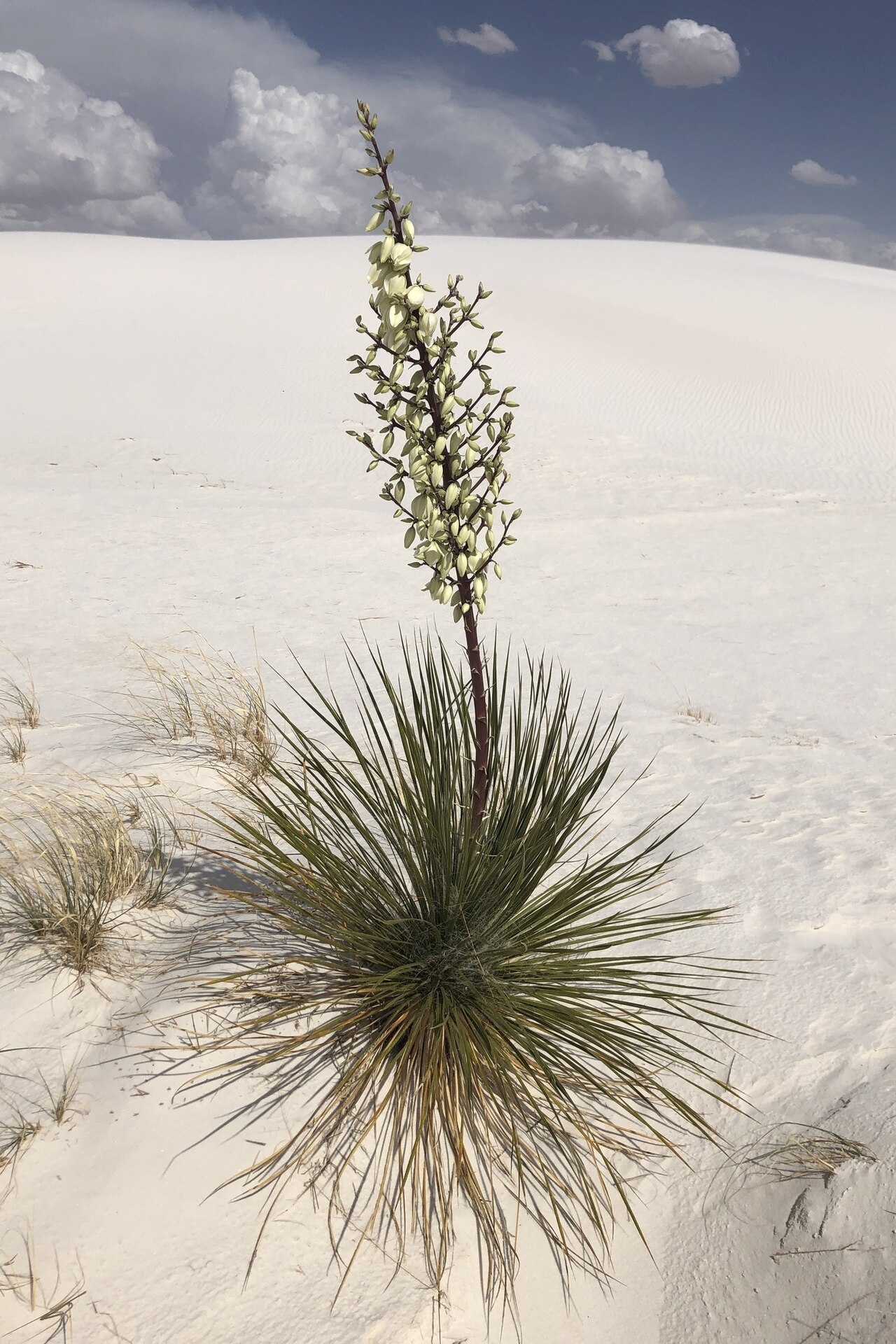
Yuccas (genus Yucca) are the spiky, sword-leaved plants that define so many American landscapes, from the white dunes of New Mexico and the Joshua tree forests of the Mojave to the sandy pinelands of the Carolinas and the shortgrass prairie of the Great Plains. The genus is found only in the Americas, and roughly 30 of its species are native to the United States. Every one of them grows as a rosette of stiff, narrow leaves that sends up a tall stalk of creamy white, bell-shaped flowers, usually in late spring or early summer.
Yuccas range from knee-high, stemless clumps such as Adam’s needle and soapweed to branched, tree-sized plants such as the Joshua tree, which can top 30 feet. Most live in hot, dry, sunny places with fast-draining soil, and once established they need almost no water. That toughness, together with their bold, architectural shape, is why yuccas are favorites for xeriscapes, rock gardens and desert landscaping across the South and West, as well as one of the very few evergreen “desert-look” plants that are truly hardy in the Plains and the East.
Not every plant sold as a “yucca” is a native one, and a few are not yuccas at all. The giant yucca sold as a houseplant comes from Mexico and Central America, red yucca is a different genus, and the cordylines and New Zealand flax often planted beside yuccas come from the other side of the Pacific. This guide covers the yuccas that are native to the US, how to tell the main species apart, and how to grow them well, with links to our full profiles of each species.
Identification
All yuccas share a family look: a rosette of tough, pointed, evergreen leaves, and a single upright flower stalk (inflorescence) rising from its center. Yuccas belong to the asparagus family (Asparagaceae), in the same subfamily as agaves, and are often confused with agaves, sotols, beargrass and red yucca. The details below separate yuccas from those look-alikes and the main yucca groups from one another.
Growth Form
Some yuccas are stemless or nearly so: the rosette sits on the ground and slowly forms a clump of offsets, as in Adam’s needle (Y. filamentosa), soapweed (Y. glauca) and twistleaf yucca (Y. rupicola). Others build a trunk, sometimes branched, covered in a skirt of old dead leaves, as in the Joshua tree, soaptree yucca, beaked yucca, Faxon yucca and Spanish bayonet. Trunked species can take decades to reach full height.
Leaves
Yucca leaves are long, narrow and stiff, ending in a sharp, hard spine. Many species have white or tan threads that peel off the leaf edges and curl like loose hairs, the “filaments” behind the name of Adam’s needle and soaptree yucca. Others, such as beaked yucca and Spanish bayonet, have thin, finely toothed or smooth yellowish margins without threads. Unlike agave leaves, yucca leaves are fairly thin and never armed with hooked teeth along the edges, and the rosette does not die after flowering. Leaf color runs from dark green to the striking powder blue of beaked yucca.
Flowers
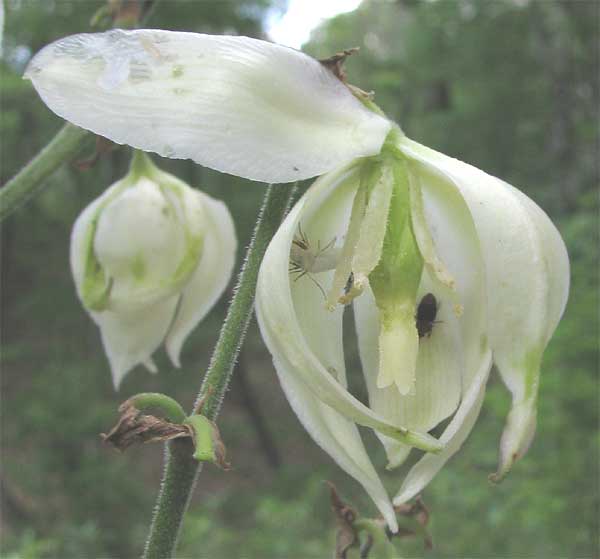
The flowers are bell-shaped or globe-shaped, waxy, and usually creamy white, sometimes tinged green, pink or purple on the outside. They hang or nod from a branched or unbranched stalk that may be held just above the leaves (banana yucca) or lifted 10 feet or more into the air (soaptree yucca). Many are fragrant at night, when their pollinators, the yucca moths, are active. Yuccas flower from early spring in the low deserts to midsummer in the north, and a few, such as moundlily yucca, bloom again in late summer or fall.
Fruit
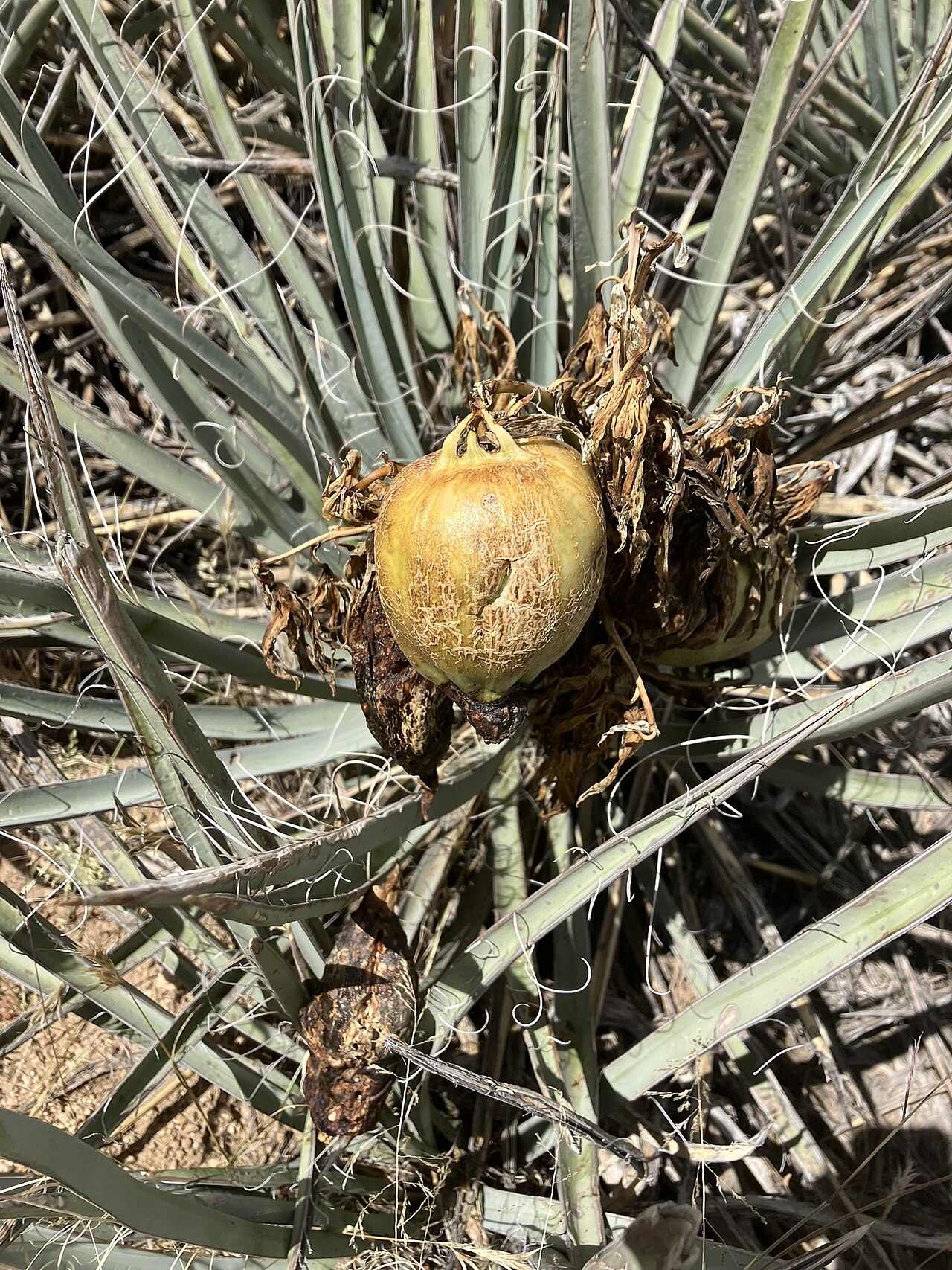
Fruit type splits the genus in two. Many yuccas, including soapweed, Adam’s needle and soaptree yucca, have dry capsules that split open in late summer to release flat black seeds. Others, such as banana yucca, Mojave yucca, Spanish dagger and Spanish bayonet, have fleshy, banana-shaped fruits that do not split open and are eaten by wildlife. The Joshua tree’s fruit is in between, a spongy pod that dries without opening.
Quick Facts
| Scientific Name | Yucca (about 30 species native to the US) |
| Family | Asparagaceae (Asparagus family; subfamily Agavoideae) |
| Plant Type | Evergreen perennials, shrubs and small trees with rosettes of sword-shaped leaves |
| Mature Height | Leaves 1–4 ft on stemless species; trunked species 6–15 ft (Joshua tree to 30 ft or more); flower stalks 3–15 ft |
| Mature Spread | 2–6 ft for most clumps; large tree yuccas wider |
| Growth Rate | Slow to moderate |
| Sun Exposure | Full sun (Adam’s needle and a few others tolerate part shade) |
| Water Needs | Low; drought tolerant once established |
| Soil Type | Sandy, gravelly or rocky soil with fast drainage |
| Soil pH | Acidic to alkaline, depending on species (about 5.5–8.5) |
| Bloom Time | March – August, varying by species and region |
| Flower Color | Creamy white, sometimes tinged green, pink or purple |
| Fall Color | None (evergreen) |
| Fruit | Dry, splitting capsules or fleshy, banana-shaped pods, by species |
| Deer Resistant | Leaves yes; flower stalks are often browsed |
| USDA Hardiness Zones | About 3–11 across the genus (soapweed to zone 3; most desert species 6/7–10) |
Native Range
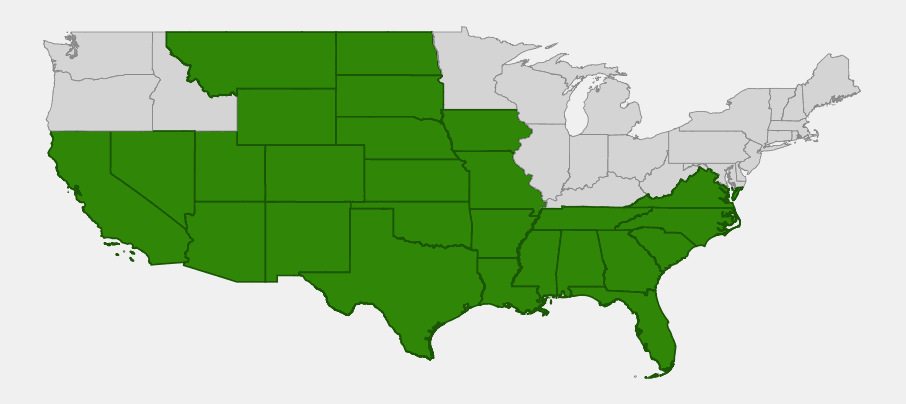
Yuccas are native from the Great Plains and the Southeast to the Pacific Coast, with the greatest number of species in the Southwest and northern Mexico. Texas alone has more native yuccas than any other state, from the twistleaf yucca of the Edwards Plateau and pale yucca of the Blackland Prairie to the giant Faxon yucca and Torrey yucca of the Trans-Pecos. Arizona, New Mexico, Utah, Nevada and southern California add soaptree yucca, banana yucca, Mojave yucca, narrowleaf yucca and the Joshua tree.
On the Great Plains, soapweed yucca (Y. glauca) is native north to Montana and North Dakota and east into the Loess Hills of western Iowa and northwestern Missouri, while Arkansas yucca grows from Kansas and Missouri south to Texas and Arkansas. In the Southeast, Adam’s needle and its close relatives grow in sandhills, old fields, dunes and open woods from Virginia and Tennessee south to Florida and west to Louisiana and Arkansas, and the coastal Spanish bayonet and moundlily yucca line beaches and dunes from North Carolina around the Gulf.
Adam’s needle has been planted for centuries and now grows wild well north of its native range, in the Ohio Valley, the Great Lakes states and New England. Those populations are escapes from gardens, not native stands, so the map shows only states where at least one yucca species is native. No yucca is native to Oregon, Washington, Idaho, Minnesota or the Northeast.
📋 Regional plant lists with native yuccas: South & West Texas · Arizona & New Mexico · California & Nevada · Utah & Western Colorado · Nebraska, Kansas & Eastern Colorado · Montana & Wyoming · North Dakota, South Dakota & Western Minnesota · Illinois, Iowa & Missouri · Arkansas, Louisiana, Eastern Oklahoma & Eastern Texas · Georgia, Alabama & Mississippi · North Carolina & South Carolina · Kentucky & Tennessee · Maryland, Virginia & West Virginia
Native Species
These are the US-native yuccas gardeners are most likely to meet, roughly from east to west. Each name links to our full growing guide.
Adam’s needle (Yucca filamentosa) is the native yucca of the Southeast and the most widely grown yucca in the US. It forms stemless clumps of 2½-foot, flexible, dark green leaves with curly white threads along the edges, and sends up 5- to 8-foot stalks of white bells in early summer. It is hardy to about zone 4, tolerates part shade and average garden soil, and is the yucca named in many garden articles alongside beaked yucca. Inland plants with softer, drooping leaves are often treated as a separate species, weakleaf yucca (Y. flaccida).
Moundlily yucca (Yucca gloriosa) grows on coastal dunes and barrier islands from North Carolina to northern Florida. It builds a short trunk with stiff to softly arching blue-green leaves and often flowers in late summer or fall. Soft-leaved forms, sold as Y. recurvifolia or Y. gloriosa var. recurvifolia, are among the friendlier yuccas to plant near paths.
Spanish bayonet (Yucca aloifolia) is a trunked, often branching coastal yucca of the Southeast and Gulf Coast with stiff, dagger-pointed leaves that live up to its name. It forms dense thickets on dunes and shell mounds and has fleshy purple-black fruit. Some botanists think it may have been carried to the US coast from Mexico long ago, but it is generally treated as native. Keep it well away from walkways.
Arkansas yucca (Yucca arkansana) is a small, stemless yucca of rocky prairies and glades from Kansas and Missouri to Texas and Arkansas, with soft, narrow leaves edged in threads and greenish-white flowers on 2- to 4-foot stalks.
Soapweed or narrowleaf yucca (Yucca glauca) is the yucca of the Great Plains, native from Montana and the Dakotas to Texas and New Mexico. Its narrow, stiff, gray-green leaves with white edges form 2- to 3-foot clumps, and its greenish-white flowers sit on a mostly unbranched 3- to 4-foot spike. It is the hardiest yucca, surviving winters to zone 3.
Pale yucca (Yucca pallida) is a small, stemless Texas endemic of the Blackland Prairie and nearby limestone hills, with flat, powdery blue-green leaves and white flowers on 3- to 5-foot stalks. It is a fine choice for small gardens in north-central Texas.
Twistleaf yucca (Yucca rupicola) grows on limestone ledges of the Edwards Plateau in central Texas. Its wide, bright green leaves twist as they mature, giving the low rosette a loose, relaxed look, and it takes some afternoon shade.
Beaked yucca (Yucca rostrata) is the showpiece of the group: a single, slowly rising trunk 6 to 12 feet tall, topped by a perfect sphere of thin, powder-blue leaves. Native to the Big Bend region of Texas and adjacent Mexico, it is hardy to about zone 5 in dry soil and is one of the most popular yuccas in western landscaping.
Spanish dagger (Yucca treculeana) is a large, trunked yucca of the south Texas brush country with very stiff, broad, sharp leaves and big clusters of white flowers in early spring, followed by fleshy fruit.
Faxon yucca (Yucca faxoniana), sometimes called giant dagger, is one of the largest US yuccas, a trunked plant up to 15 feet or more from the Trans-Pecos of Texas and southern New Mexico, with huge spring flower clusters.
Soaptree yucca (Yucca elata) is the tall, slender, often branched yucca of the Chihuahuan Desert grasslands in New Mexico, Arizona and west Texas. Its grassy, thread-edged leaves form a shaggy head, and its flower stalk can reach 10 feet or more. Its flower is New Mexico’s state flower, and its roots and trunk contain soapy saponins.
Banana yucca (Yucca baccata) is a low, clumping yucca with broad, stiff blue-green leaves, native across the Southwest from California and Nevada to Colorado and west Texas. Its flowers, often tinged reddish-purple outside, sit low among the leaves and are followed by fat, fleshy fruit.
Harriman’s yucca (Yucca harrimaniae) is a small, tidy yucca of the Colorado Plateau in Utah, Colorado and New Mexico, with short, stiff leaves edged in curly threads. It fits rock gardens and troughs where larger yuccas would overwhelm.
Mojave yucca (Yucca schidigera) grows across the Mojave and Colorado deserts of California, Nevada and Arizona. It forms trunks 5 to 15 feet tall with stiff, yellow-green leaves edged in coarse threads, and has fleshy fruit.
Joshua tree (Yucca brevifolia) is the tree yucca of the Mojave Desert in California, Nevada, Arizona and Utah, with short, stiff leaves on branched arms that may reach 30 feet or more. Some botanists split the eastern populations as Y. jaegeriana. In California the western Joshua tree is protected by state law, and removing one requires a permit.
More native yucca profiles: narrowleaf yucca (Y. angustissima) · New Mexico yucca (Y. harrimaniae var. neomexicana) · Torrey yucca (Y. torreyi) · Buckley’s yucca (Y. constricta) · Thompson’s yucca (Y. thompsoniana)
California’s chaparral yucca, or Our Lord’s candle (Hesperoyucca whipplei), was long called Yucca whipplei and looks like a yucca, but it is now placed in its own genus. Unlike true yuccas, each rosette dies after its single spectacular bloom.
Non-Native Look-Alikes
Several spiky plants sold as yuccas, or planted with them, are not native to the US. None of the ones below is a serious invasive, but it helps to know what you are buying.
- Giant yucca or spineless yucca (Yucca gigantea, long sold as Y. elephantipes): The common houseplant “yucca cane,” native to Mexico and Central America. It is a true yucca, with softer, spineless leaves, but it is not native to the US and is only hardy outdoors in frost-free areas such as south Florida and coastal southern California.
- Cordylines (Cordyline australis and C. fruticosa): The cabbage tree from New Zealand and the ti plant of the Pacific islands. Their leaves are softer and often red, purple or striped, with no sharp tip. Ti was brought to Hawaii by Polynesian settlers and is not native there either.
- New Zealand flax (Phormium): Fans of long, leathery, often bronze or striped leaves that grow from the base like an iris, not as a rosette on a stem. It is a different family entirely and is grown mainly in mild coastal climates.
- Red yucca (Hesperaloe parviflora): Not a yucca and not a look-alike import: it is a native of Texas with grass-like leaves and coral-red flowers loved by hummingbirds. It is a good native choice, just a different genus.
- Agaves, sotols and beargrass: Native relatives often mistaken for yuccas. Agaves have thick, fleshy leaves with hooked teeth, and most die after flowering. Sotols such as desert spoon have narrow leaves edged in small hooked teeth, and beargrass has grassy, toothless leaves and tiny flowers.
- Yuca (cassava, Manihot esculenta): The starchy root vegetable is spelled with one “c” and is unrelated to yuccas.
Growing & Care Guide
Native yuccas are among the lowest-maintenance plants you can grow, as long as you match the species to your climate and give it sun and sharp drainage. More yuccas are killed by kindness, through rich soil and too much water, than by neglect.
Light
Give yuccas full sun, at least six hours a day. In shade they stretch, flower poorly and are more prone to rot. Adam’s needle, twistleaf yucca and pale yucca tolerate light afternoon shade, which can be helpful in hot Texas and southeastern summers.
Soil & Water
Drainage matters more than fertility. Plant in sandy, gravelly or rocky soil, or build a raised mound or berm of gritty mix in heavy clay. Most species tolerate alkaline soil, and Adam’s needle grows happily in acidic southeastern sands. Water new plants every week or two through their first summer, then taper off; established yuccas in their native region rarely need supplemental water. Winter wetness is the main killer of desert species planted outside their range, so in rainy climates choose eastern or Plains species, or give western yuccas a slope and a gravel mulch.
Planting Tips
Plant container-grown yuccas in spring or early fall, setting the base of the rosette at or slightly above soil level. Do not bury the trunk. Wear long sleeves, gloves and eye protection, because the leaf tips are sharp enough to puncture skin and eyes. Place yuccas at least 3 to 6 feet from paths, play areas and doors, and allow for the full width of mature clumps. Large trunked yuccas transplant poorly when dug from the wild; buy nursery-grown plants, and in many states it is illegal to dig wild yuccas without permission.
Pruning & Maintenance
Cut the spent flower stalk at its base after bloom or after the seed pods ripen. Pull or cut off dead lower leaves if you prefer a clean look, though on trunked species the “skirt” of old leaves protects the trunk and shelters wildlife. Stemless species spread slowly by offsets; dig and replant pups to control spread. Yuccas need no fertilizer. Watch for the yucca plant bug and agave snout weevil, and remember that root rot from wet soil is the most common problem.
Propagation
Remove offsets (pups) from the base of clumping species in spring with a sharp spade, let the cut end dry for a few days, and replant in dry, gritty soil. Many yuccas also regrow from root pieces, so a plant you dig out may come back. Seed is easy if you can get it: sow fresh, flat black seed shallowly in a gritty mix in warm weather. Seed-grown trunked species take many years to reach size.
Landscape Uses
- Xeriscapes and desert gardens as bold focal points among agaves, cacti and native bunchgrasses
- Prairie and Plains gardens with soapweed or Arkansas yucca among little bluestem and coneflowers
- Coastal and sandhill gardens in the Southeast with Adam’s needle or moundlily yucca
- Rock gardens and slopes, where sharp drainage keeps roots healthy and roots help hold gravelly soil
- Barrier and security plantings of stiff-leaved species such as Spanish bayonet, well away from paths
- Night gardens, where the white flowers glow and give off their fragrance after dark
Wildlife & Ecological Value
Yuccas are a textbook case of plants and animals that depend on each other, and they support a surprising range of desert and grassland wildlife.
For Pollinators
Yuccas are pollinated by yucca moths (Tegeticula and Parategeticula), small white moths that live only on yuccas. A female moth gathers pollen with special mouthparts, flies to another flower, lays eggs in its ovary and then deliberately packs pollen onto the stigma. Her caterpillars eat some of the developing seeds, but plenty are left to ripen. Neither partner can reproduce without the other, which is why yuccas planted far outside their range often flower but rarely set seed. Bees and other insects visit the flowers too but are not effective pollinators.
For Birds
Scott’s orioles nest in yuccas and Joshua trees and weave yucca fibers into their nests, and cactus wrens, ladder-backed woodpeckers and many other desert birds nest or perch in tree yuccas. Fleshy-fruited species feed birds and mammals, and hummingbirds and orioles visit the flowers.
For Mammals
Deer, pronghorn and livestock eat yucca flower stalks, and rabbits, packrats and other rodents eat the fleshy fruits and seeds. Woodrats use the dead leaves and shelter under the clumps. Leaves of established plants are rarely browsed because they are so tough and sharp.
Ecosystem Role
Yuccas are host plants for the yucca giant-skipper and its relatives, whose caterpillars bore into the roots and trunks. Their deep roots and long-lived rosettes stabilize dunes, sandhills and eroding slopes, and large yucca stands provide shade and cover in otherwise open country.
Cultural & Historical Uses
Yuccas were among the most useful plants of the Native peoples of the Southwest and Plains. Leaf fibers were twisted into cord and rope and woven into sandals, mats, baskets and nets; sandals of yucca fiber thousands of years old have been found in dry caves of the Colorado Plateau. Leaves were split into strips and used as brushes for painting pottery.
The roots and trunks of soaptree yucca, soapweed and other species are rich in saponins, which foam in water. They were pounded and used as soap and shampoo, which is the source of names such as soapweed, soaptree and the Spanish amole. Historically, the fleshy fruits of banana yucca and the flowers and young stalks of several species were cooked and eaten by Native peoples, and yucca flowers are still cooked in parts of Mexico. Because yuccas contain saponins and are easily misidentified, this guide does not recommend eating them.
The soaptree yucca flower became New Mexico’s state flower in 1927, and the Joshua tree, named, according to tradition, by Mormon settlers who saw its raised arms as the prophet Joshua, became a symbol of the Mojave and the name of a national park. Adam’s needle was taken to European gardens by the late 1600s and has been grown in American gardens since colonial times.
Frequently Asked Questions
Which yucca is native to my area?
In the Southeast, look for Adam’s needle, moundlily yucca or Spanish bayonet. On the Great Plains, soapweed and Arkansas yucca. In Texas, choose from twistleaf, pale, beaked, Buckley’s, Torrey or Faxon yucca depending on region. In the Southwest and California, try banana, soaptree, Harriman’s, Mojave yucca or the Joshua tree. No yucca is native to the Pacific Northwest, the Great Lakes states or New England, though Adam’s needle grows well in gardens there.
Are yuccas poisonous to pets?
Yuccas contain saponins, which can cause vomiting and drooling if dogs, cats or other pets chew on them in quantity. The bigger hazard is physical: the sharp leaf tips can injure eyes and skin, so keep stiff-leaved species away from play areas and paths.
Why didn’t my yucca make seed pods?
Yuccas need their specific yucca moth for pollination. If the right moth does not live where you garden, the plant will flower but produce few or no seeds. That is normal, and it does not harm the plant.
Does a yucca die after it blooms?
No. Unlike agaves and Our Lord’s candle, true yuccas keep living after flowering. On clumping species the rosette that bloomed may slow down while new offsets grow around it, but the plant carries on for many years.
Is the houseplant yucca a native plant?
The common indoor “yucca cane” is giant yucca (Yucca gigantea), native to Mexico and Central America, not the US. If you want a native yucca outdoors, pick a species from your own region from the list above.

Looking for a nursery that carries Native Yuccas?
Browse our native plant nursery directory: Alabama, Arizona & Arkansas · California · Colorado, Florida & Georgia · Iowa & Kansas · Louisiana, Mississippi, Missouri & Montana · Nebraska, Nevada, New Mexico, North Carolina, North Dakota & Oklahoma · South Carolina, South Dakota, Tennessee, Texas, Utah & Virginia · Wyoming

