
Spanish Bayonet (Yucca aloifolia)
Spanish Bayonet (Yucca aloifolia), also called aloe yucca (the USDA PLANTS common name), Spanish dagger and dagger plant, is a tall, trunk-forming yucca of coastal dunes, shell mounds and sandy scrub along the Atlantic and Gulf coasts of the southeastern United States. It is the type species of the genus Yucca, described by Linnaeus in 1753, and it belongs to the asparagus family (Asparagaceae, subfamily Agavoideae; older references place it in the agave family, Agavaceae).
It earns its name. The stiff, dark green leaves are about 2 feet long and end in a hard, needle-sharp point, and their edges carry fine, saw-like teeth. Brushing against the plant can cause painful puncture wounds, and the points are at eye level for children and pets. That makes Spanish bayonet a plant for the back of a dune garden or a barrier planting, never beside a walkway, pool, driveway or play area. In early summer it rewards careful placement with tall spikes of nodding, creamy white flowers, sometimes tinged purple, followed by fleshy purple-black fruit.
Spanish bayonet is very tolerant of salt spray, heat, drought and poor sand, so it is a classic plant for beach landscapes. This guide explains how to identify it, where it grows, how to place and grow it safely, and its unusual relationship with yucca moths.
Identification
Spanish bayonet is the tallest and stiffest of the eastern yuccas. It is easy to tell from the low, stemless Adam’s Needle and from mound-lily yucca once you look at its trunk, leaf edges and fruit.
Trunk & Habit
Plants have an erect trunk 3 to 5 inches thick that usually reaches 6 to 12 feet and occasionally about 20 feet. Tall trunks often become top-heavy and lean or topple, and the tip then turns upward and keeps growing. New shoots also sprout from the base and from the rhizomes, so older plants form dense, spiky clumps or thickets. Old leaves die and hang down the trunk like a brown skirt.
Leaves
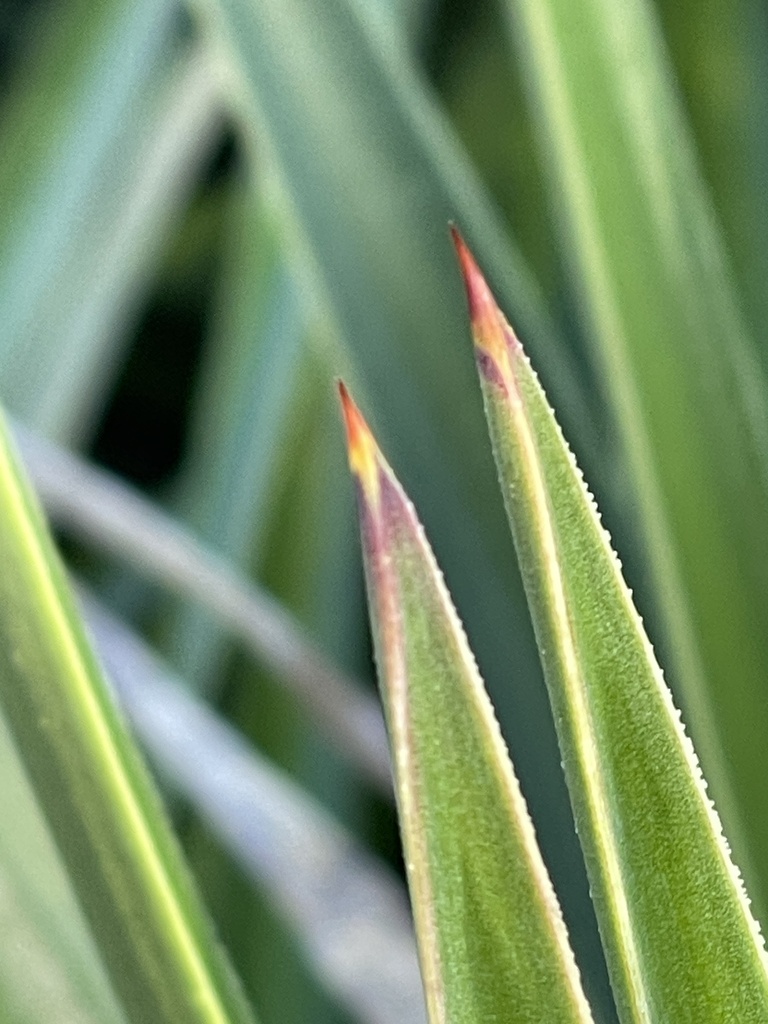
The leaves are stiff, thick, dark green and sword-shaped, about 1 to 2½ feet long and 1½ to 2½ inches wide, crowded in a dense rosette at the top of each trunk. The youngest stand upright, older ones spread or bend downward. Each ends in a sharp, hard, brownish to reddish spine, and the margins are finely toothed (serrulate), a key difference from Adam’s needle, which has curling threads on its leaf edges.
Flowers
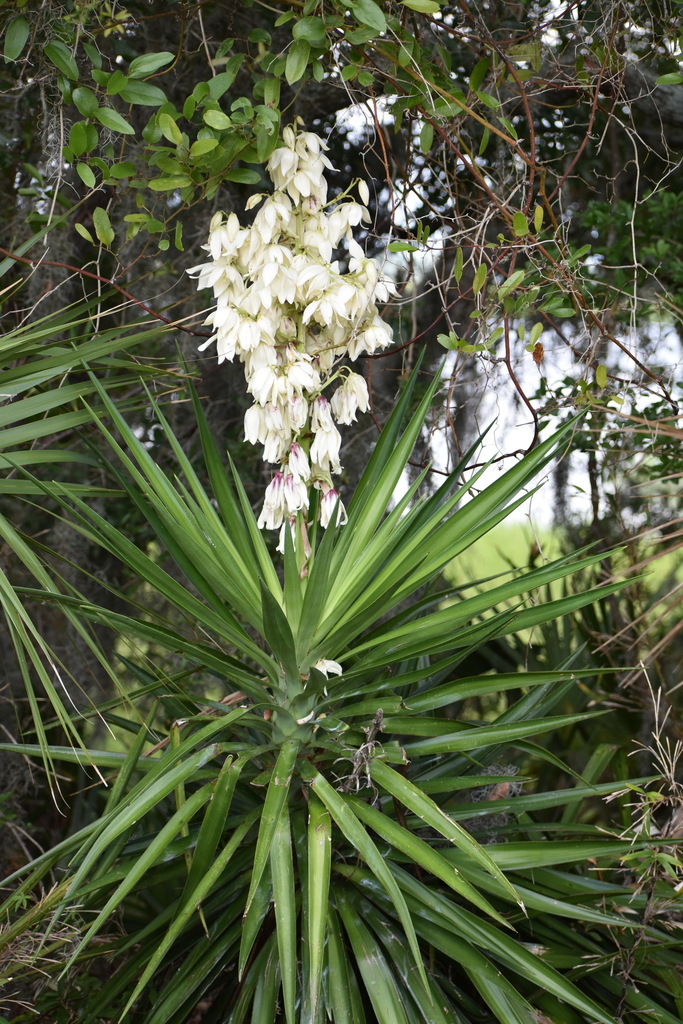
Flowering stalks rise about 1 to 2 feet above the leaves from the tip of the trunk, carrying dense clusters of nodding, bell-shaped flowers 2 to 4 inches across. They are creamy white, often with a purple tinge on the outside, and have six thick tepals. The Lady Bird Johnson Wildflower Center gives June and July as the main bloom time. After flowering, that trunk stops growing at the tip and new growth continues from side buds.
Fruit
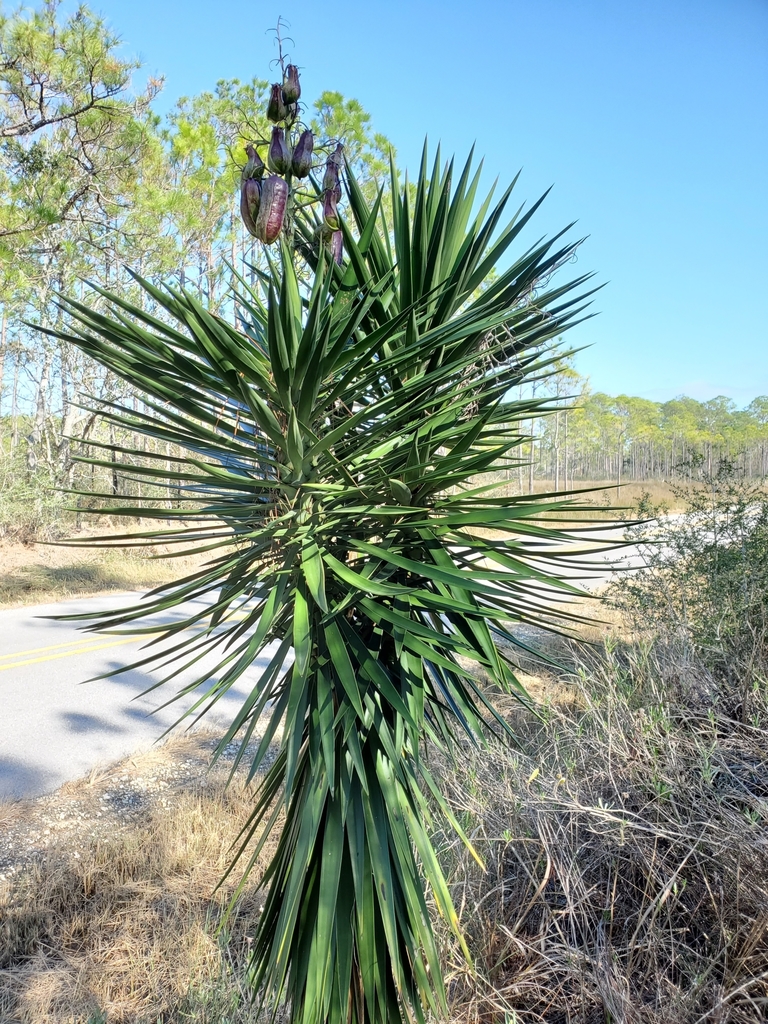
Unlike many yuccas, which have dry capsules, Spanish bayonet produces fleshy, elongated, berry-like fruits up to about 2 inches long. They turn from green to dark purple-black and hang in heavy clusters. Many plants set little or no fruit in a given year, and much of the spread of the species is by offsets and rhizomes rather than seed.
Quick Facts
| Scientific Name | Yucca aloifolia |
| Family | Asparagaceae (asparagus family; formerly Agavaceae) |
| Plant Type | Evergreen trunk-forming shrub or small tree |
| Mature Height | 6–12 ft (occasionally to about 20 ft) |
| Mature Spread | 3–6 ft per trunk; clumps spread wider over time |
| Growth Rate | Slow to moderate |
| Sun Exposure | Full sun |
| Water Needs | Low; very drought tolerant |
| Soil Type | Well-drained sand, shell or sandy loam |
| Soil pH | Acidic to alkaline (about 5.5–8.0) |
| Bloom Time | Mainly June–July |
| Flower Color | Creamy white, often tinged purple |
| Fall Color | None; evergreen |
| Fruit | Fleshy, purple-black, berry-like fruit up to about 2 in long |
| Deer Resistant | Yes |
| USDA Hardiness Zones | 7b–11 |
Native Range
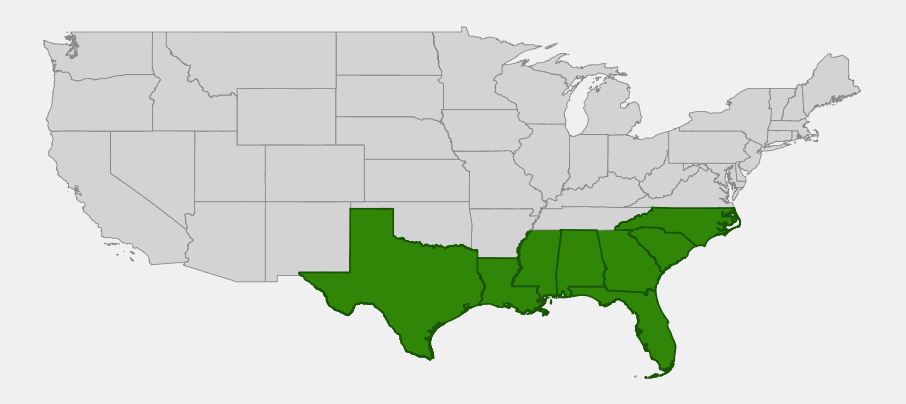
USDA PLANTS lists Spanish bayonet as native to the lower 48 states, with records in North Carolina, South Carolina, Georgia, Florida, Alabama, Mississippi, Louisiana and Texas; it is listed as introduced in Puerto Rico and the U.S. Virgin Islands. The Lady Bird Johnson Wildflower Center describes its native range as the Coastal Plain from North Carolina to Florida and Louisiana, and it extends west along the Gulf Coast into Texas. Outside the United States it also grows in Bermuda, parts of the Caribbean and on the Yucatán coast of Mexico.
Its natural habitats are coastal: back dunes and stabilized dunes, shell middens and shell ridges, maritime scrub and the edges of brackish and salt marshes. It is widely planted in beach communities and around old homesites, and it often persists and spreads there, so it is common well outside natural habitats.
There is a long-standing debate over its origin in the Southeast. Some botanists, beginning with William Trelease in 1902, have suggested that it was brought from Mexico or the Caribbean by early Spanish colonists, which would help explain its weak dependence on yucca moths for pollination. USDA PLANTS, the Atlas of Florida Plants and most state floras treat it as native, which is the basis for its inclusion here.
📋 Regional plant lists featuring Spanish Bayonet: North & South Florida · Alabama, Georgia & Mississippi · North & South Carolina · Arkansas, Louisiana, Eastern Oklahoma & Eastern Texas
Growing & Care Guide
Spanish bayonet is one of the toughest plants for a sunny coastal yard: it handles salt spray, sand, heat and drought with no care at all. The challenge is not keeping it alive but putting it in a place where its needle-tipped leaves will not hurt anyone. The Lady Bird Johnson Wildflower Center notes that its placement should be carefully considered because the sharp-pointed leaves can be dangerous.
Light
Full sun. It tolerates light shade but becomes leggy and flowers less.
Soil & Water
Plant it in fast-draining sand, shell or sandy loam. It tolerates acidic to alkaline soils and salt spray, but not soggy ground. Water a few times while it establishes; after that, it rarely needs irrigation. Do not fertilize.
Planting Tips
Choose the location first. Keep Spanish bayonet at least 6 to 8 feet from walkways, patios, pools, driveways, doors and anywhere children or pets play, and away from windows you need to clean or plants you need to reach. It works best at the back of a border, on a dune or berm, or as a deliberate barrier hedge below windows or along a property line. Wear thick gloves, long sleeves and eye protection when planting or handling it. Young plants are easy to move; large, established trunks and clumps are heavy and dangerous to handle, so plan carefully.
Pruning & Maintenance
Remove spent flower stalks and dead lower leaves if you want a tidier trunk, using long-handled loppers and eye protection. Some gardeners clip the sharp tips off leaves that hang near a path, but it is safer to move the plant or the path. Offsets will appear at the base; remove unwanted ones while small, and dig out any rhizome pieces, which can regrow. Pests are few.
Propagation
It is easy to propagate from stem cuttings, which root readily after the cut end dries for a few days, and from offsets dug from the base of established plants. Fresh seed also germinates well, best at about 60 to 70°F, according to the Wildflower Center. Even small leaf-bearing pieces of trunk left on the ground can root, which is how it spreads on disturbed dunes.
Landscape Uses
- Coastal and dune landscapes: salt- and wind-tolerant structure for beachfront yards
- Barrier and security plantings: an effective deterrent below windows or along property lines, well away from paths
- Xeriscapes and dry gardens: bold, architectural form with no irrigation once established
- Wildlife gardens: flowers for yucca moths and other insects, fruit for birds and mammals, and protected nest sites
- Erosion control: clumps and rhizomes help hold stabilized dune sand
Wildlife & Ecological Value
Spanish bayonet looks forbidding, but its flowers, fruit and spiny cover all serve wildlife in coastal habitats.
For Pollinators
Like all yuccas, it is linked with yucca moths (Tegeticula), small white moths whose females gather pollen, lay eggs in the flower’s ovary and then pack pollen onto the stigma, so that a few of the developing seeds feed their larvae. Spanish bayonet is less dependent on this partnership than most yuccas: studies by Jim Leebens-Mack and colleagues found it can be pollinated by the yucca moth Tegeticula yuccasella and also by honeybees. Its flowering season overlaps only briefly with that of Adam’s needle, and only in some years, but the two have hybridized: mound-lily yucca (Yucca gloriosa) is a stabilized hybrid between them.
For Birds
The dense, spiny rosettes and thickets give small birds cover that predators find hard to reach. Birds also eat the soft fruit when it ripens.
For Mammals
Mammals may eat fallen fruit. Deer generally avoid the stiff, spiny foliage.
Ecosystem Role
On dunes and shell mounds, Spanish bayonet thickets trap blowing sand and shelter smaller plants and animals. Because it spreads by rhizomes and rooted fragments, it recovers well after storms bury or break plants.
Cultural & Historical Uses
Spanish bayonet holds a special place in botany: it was the first yucca Linnaeus named in 1753, so it is the type species of the genus Yucca, and the name aloifolia means “with leaves like an aloe.” The common names bayonet and dagger plant need no explanation to anyone who has backed into one.
Like other yuccas, its roots contain soapy compounds (saponins) and have been used as a soap and shampoo, and the flowers and fruit have been eaten. Its value as a living barrier has made it a common planting in coastal towns, and it often persists around old homesites long after the buildings are gone.
Its origin remains a subject of research. Some botanists have argued that it was carried from Mexico or the Caribbean by Spanish colonists, while USDA PLANTS and Southeastern floras treat it as native. Whatever its early history, it has been part of the coastal landscape of the Southeast for centuries and is now a common sight on dunes from the Carolinas to Texas.
Frequently Asked Questions
Is Spanish bayonet dangerous?
Yes, in the wrong place. Every leaf ends in a hard, needle-sharp tip that can cause painful puncture wounds, including eye injuries. Plant it well away from walkways, pools, play areas and doors, and wear gloves, long sleeves and eye protection when working near it.
What is the difference between Spanish bayonet and Adam’s needle?
Spanish bayonet forms an upright trunk and has very stiff, finely toothed leaves with sharp spines. Adam’s needle (Yucca filamentosa) is usually stemless, with softer leaves edged in curling white threads, and it grows much farther north and inland.
Is Spanish bayonet native?
USDA PLANTS lists it as native to the southeastern U.S. (and introduced in Puerto Rico and the Virgin Islands), and Florida’s plant atlas treats it as native. Some researchers have suggested it was brought to the region by Spanish colonists, but it has grown wild on Southeastern coasts for centuries.
Will it tolerate salt spray?
Yes. It is one of the most salt-tolerant plants for front-line coastal landscapes, and it grows naturally on back dunes and shell mounds.
How do I remove an unwanted Spanish bayonet?
Wear heavy gloves, long sleeves and eye protection. Cut the trunk in sections with loppers or a saw, then dig out the base and as much of the rhizome as possible, since remaining pieces can resprout. Bag or dispose of cut pieces rather than leaving them on the ground, where they may root.

Looking for a nursery that carries Spanish Bayonet?
Browse our native plant nursery directory: Alabama · Florida & Georgia · Louisiana & Mississippi · North Carolina · South Carolina & Texas