
Gulf Croton (Croton punctatus)
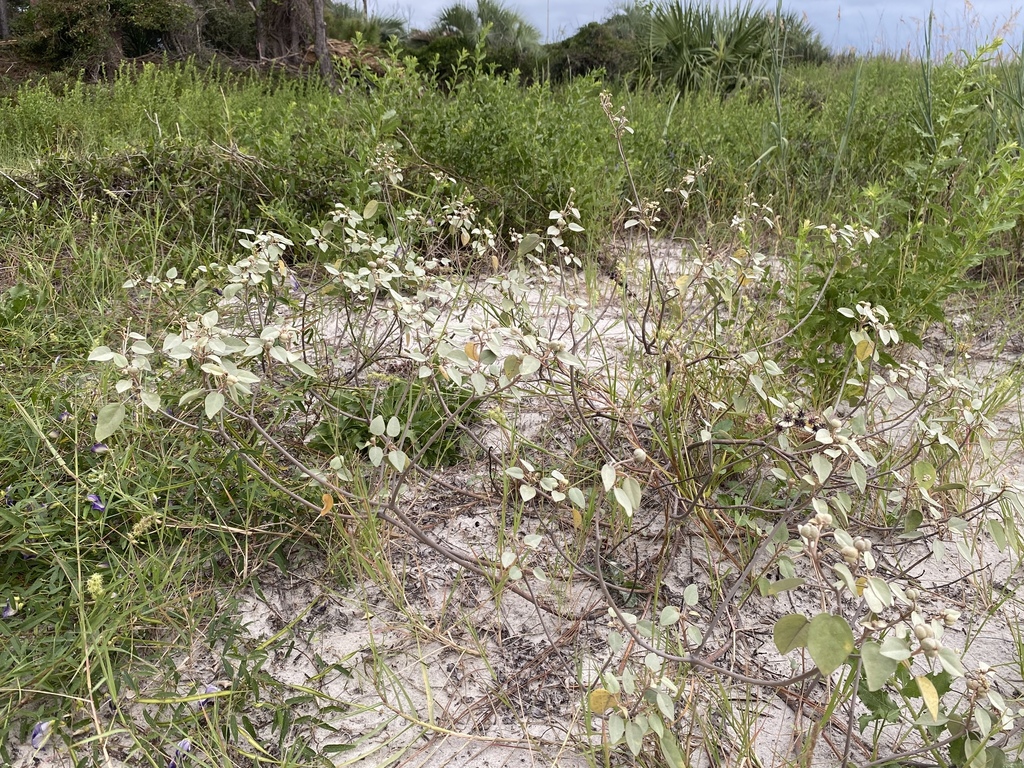
Croton punctatus, the Gulf Croton, is a silvery, low, bushy perennial of beaches and sand dunes along the Atlantic and Gulf coasts of the southern United States. It is also called beach tea and seaside croton. From a distance a patch of gulf croton looks almost frosted: every leaf and stem is covered in tiny scales that give the plant a soft gray-green to silver color, flecked with rusty brown dots. Those dots give the species its name, since punctatus means “spotted” or “dotted.”
Gulf croton is one of the true pioneers of the dune system. It grows on the upper beach, on foredunes and in the open, shifting sand behind them, where salt spray, blowing sand, heat and drought keep most plants out. Its branching stems catch windblown sand, and its deep roots help hold it, so it plays a small but real part in building and stabilizing dunes alongside sea oats and coastal panic grass.
If you came here from a Florida plant list that called “seaside croton” Codiaeum variegatum, you have found the right plant, but with the wrong name attached. Codiaeum variegatum is the colorful garden croton, a tropical shrub from Southeast Asia and the western Pacific with bold red, orange, yellow and green leaves. It is not native to Florida or anywhere else in the United States. The native seaside croton of Florida’s beaches is Croton punctatus, a much smaller and plainer plant with silvery leaves and tiny whitish flowers. Both belong to the spurge family, but they are different genera, and they look nothing alike. The differences are explained in detail further down this page.
Identification
Gulf croton grows as a rounded to sprawling, much-branched clump, usually 1 to 3 feet tall and often wider than tall. The lower stems become somewhat woody with age, so botanists describe it as an herb or subshrub. In frost-free areas it stays leafy all year; farther north along the Carolina and upper Gulf coasts, frost can knock it back, and it regrows from the base in spring. The overall color, a dull silvery green speckled with rust, is the quickest way to pick it out among dune plants.
Stems
The stems are slender, branching and covered with the same tight layer of scales as the leaves. Young stems look tan, pinkish-tan or rusty because of the many brown dots scattered over them. Older stems near the base turn gray and woody and can be partly buried by drifting sand, which the plant tolerates well.
Leaves
The leaves are alternate and stalked, oval to egg-shaped or broadly elliptic, with smooth edges and blunt to rounded tips. Most are roughly 1 to 2½ inches long. Both surfaces are covered with tiny, flat, star-shaped scales that make the leaf feel slightly rough and give it its silvery cast. The upper side is gray-green; the underside is paler and more silvery. Look closely and you will see the small rusty-brown dots, especially on the leaf stalks, the leaf undersides and the margins, which often have a thin brown rim. Crushed leaves have a faint, resinous smell, like many crotons.
Flowers
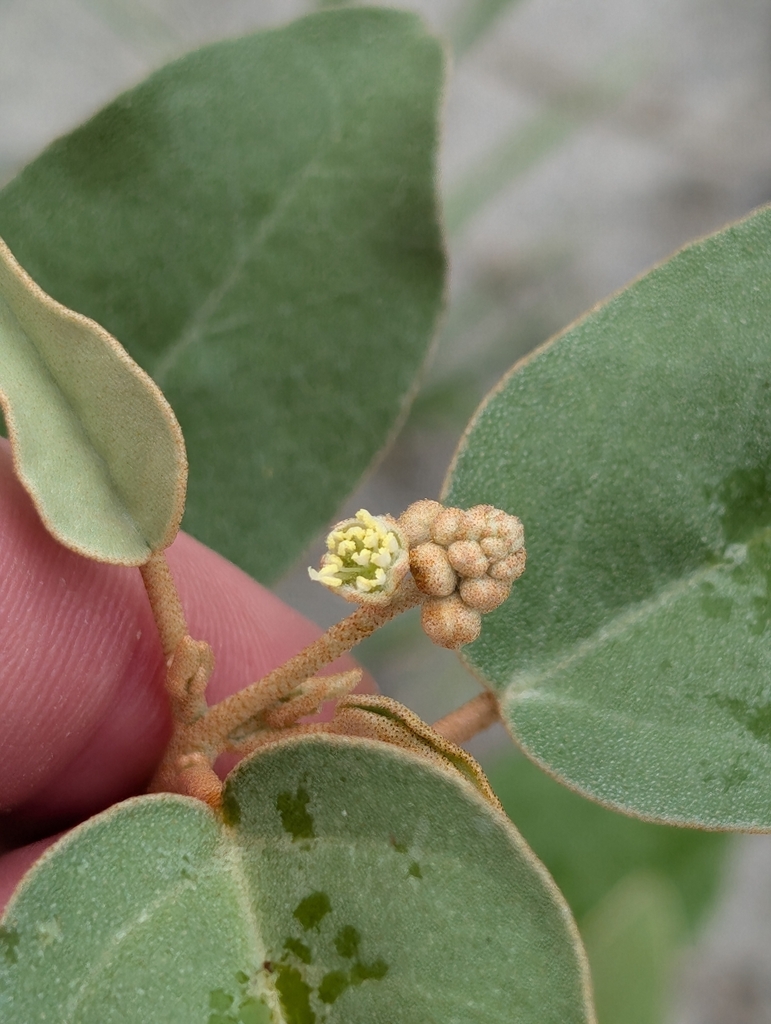
Gulf croton bears separate male and female flowers on the same plant. They are tiny, about ⅛ inch across, and grouped in short spikes (racemes) at the stem tips and in the upper leaf axils. The top of each spike holds a tight cluster of round, scaly male flower buds that open to show a little burst of pale yellow stamens. One to a few female flowers sit at the base of the spike; they have no showy petals, just a scaly cup and short, branched styles. The flowers are cream to whitish green and easy to overlook. In Florida and South Texas the plant can bloom through much of the year; farther north it flowers from late spring into fall.
Fruit & Seeds
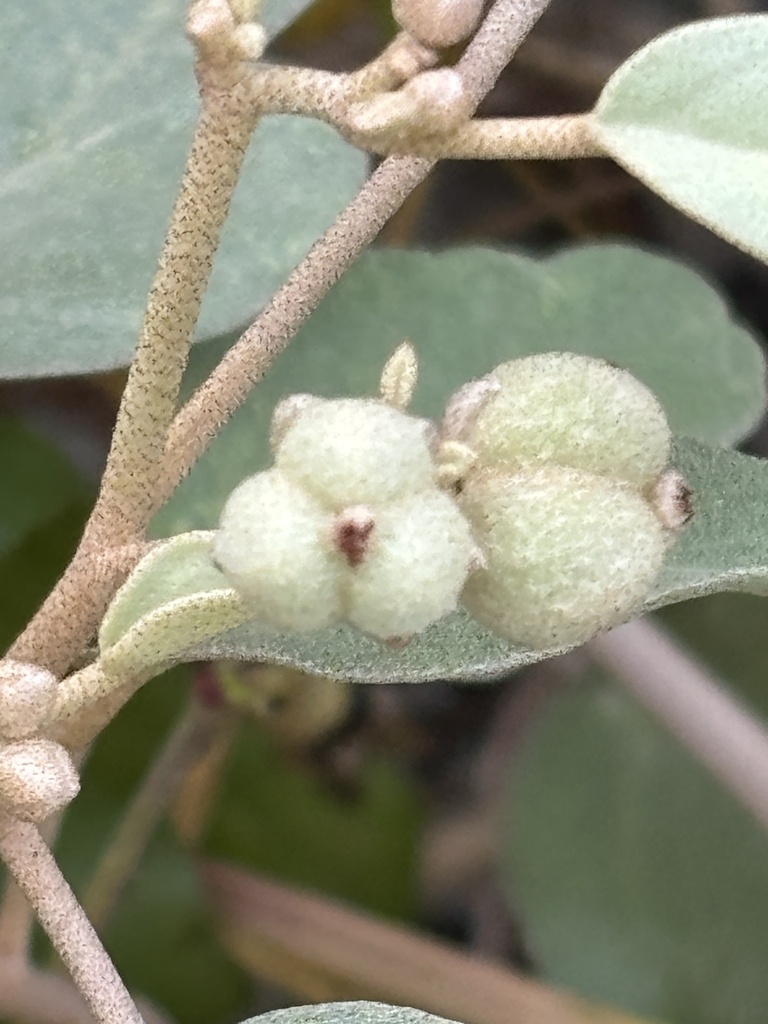
The female flowers develop into rounded, three-lobed capsules about ¼ inch across, covered in the same silvery-tan scales as the rest of the plant. Each lobe holds a single smooth, shiny brown seed. When the capsules dry, they split open and release the seeds, which drop into the sand near the parent or are moved by wind, water and animals.
Quick Facts
| Scientific Name | Croton punctatus |
| Other Common Names | Beach tea, seaside croton, silverleaf croton |
| Family | Euphorbiaceae (Spurge) |
| Plant Type | Perennial herb to subshrub, woody at the base |
| Mature Height | 1–3 ft |
| Mature Spread | 2–4 ft (sprawling clumps) |
| Growth Rate | Moderate to fast |
| Sun Exposure | Full Sun |
| Water Needs | Dry; highly drought tolerant once established |
| Soil Type | Loose, sharply drained beach and dune sand |
| Soil pH | Near neutral to alkaline (shelly sand) |
| Salt Tolerance | High (salt spray and salty sand) |
| Bloom Time | Late spring – fall; much of the year in Florida and South Texas |
| Flower Color | Cream to greenish white, tiny |
| Fall Color | None; silvery foliage year-round where frost-free |
| Fruit | Scaly, three-lobed capsule about ¼ in, with 3 brown seeds |
| Toxicity | Spurge family; treat leaves and seeds as unsafe to eat |
| USDA Hardiness Zones | 8–11 |
Native Range
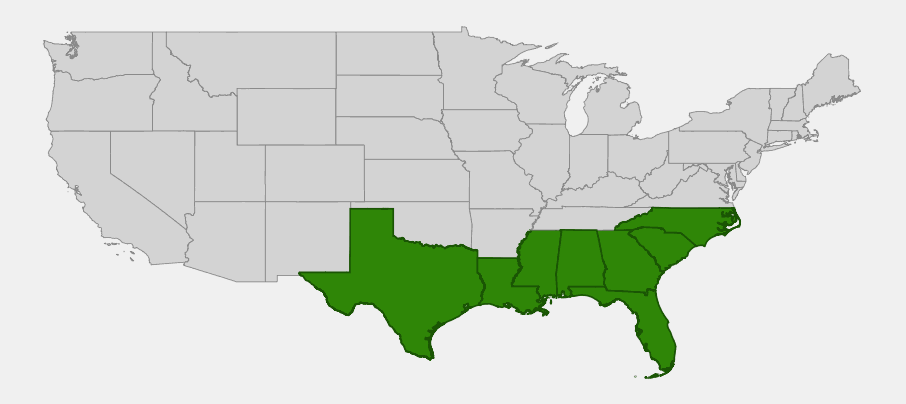
Gulf croton is a strictly coastal plant in the United States. It grows on barrier islands and mainland beaches from southeastern North Carolina south along the Atlantic coast through South Carolina and Georgia to Florida, then west along the Gulf of Mexico through Alabama, Mississippi and Louisiana to the southern tip of Texas. In Florida it occurs on beaches of both the Atlantic and Gulf coasts. Inland, away from beach sand, it essentially disappears. Beyond the United States it continues around the Gulf coast of Mexico and through the Caribbean, Bermuda and Central America to the northern coast of South America.
Its home is the dune system: the upper beach above normal high tide, the windward faces and crests of foredunes, overwash flats, and the open, sunny sand of back dunes and swales. It often appears in places that storms have recently reshaped, where it can be one of the first perennials to move back in. It shares this hard environment with sea oats, bitter panic grass, beach morning glory, beach sunflower, seacoast marsh elder and seashore dropseed, and on the Atlantic coast often grows just seaward of saw palmetto and wax myrtle thickets.
Some references list Pennsylvania for this species. That record is an old, non-native occurrence, most likely from ship ballast dumped near a port, and the plant does not grow wild there today. Gulf croton is native only to the southern coastal states shown on the map.
📋 Regional plant lists covering Gulf Croton’s range: North Carolina & South Carolina · Georgia, Alabama & Mississippi · Arkansas, Louisiana, Eastern Oklahoma & Eastern Texas · South & West Texas · Florida flowering natives
Growing & Care Guide
Gulf croton is a specialist. In the right place, a sunny, sandy, salty coastal yard, it is close to indestructible and needs almost nothing from you. Away from the coast, or in rich, watered garden beds, it tends to sulk, flop or rot. Think of it as a plant for oceanfront and near-beach landscapes, dune restoration and very dry, sandy sites in coastal counties.
Light
Give gulf croton full sun. On the beach it grows in completely open sand with no shade at all, and in gardens it stays dense and silvery only with at least six to eight hours of direct sun. In shade the stems stretch, the plant opens up and the leaves lose much of their silver.
Soil & Water
Plant it in pure sand or very sandy, fast-draining soil; shelly, alkaline beach sand is ideal. Avoid clay, heavy loam, rich garden soil and anywhere water stands after rain. Water new plants every few days for the first month and then taper off; once rooted, gulf croton survives on rainfall alone in coastal areas and is one of the most drought tolerant plants in the dune community. Salt spray and occasional salty overwash do not bother it. Overwatering and fertilizer are the most common ways gardeners lose it.
Planting Tips
Plant from small containers in spring or early summer, when warm sand and regular rain help roots settle. Space plants 2 to 3 feet apart for a loose groundcover effect. On a dune, plant among sea oats and other dune grasses rather than in a single row, and work only where you have permission: in most coastal communities dunes are protected, and dune planting or restoration may require a permit and the use of specified native species. Never dig plants from the wild; use nursery-grown stock.
Pruning & Maintenance
Little care is needed. If plants become leggy or are damaged by frost in the northern part of the range, cut the old stems back by about half in late winter, and new growth will fill in from the base. Do not mulch heavily around it; open sand around the crown is closer to what it gets in nature. Gulf croton has few pest problems. When handling it, wear gloves and avoid getting sap in your eyes, as with other plants in the spurge family.
Propagation
Gulf croton is usually grown from seed. Collect capsules as they turn tan and begin to dry, and keep them in a paper bag, because they split open on their own and scatter the seeds. Sow the seeds shallowly in a sandy mix and keep them warm; germination can be slow and uneven. Semi-woody stem cuttings taken in late spring or summer can also be rooted in clean sand with bottom heat. Because demand is low, gulf croton is found mainly at native-plant nurseries in Florida, Texas and the Carolinas and at nurseries that grow plants for dune restoration.
Landscape Uses
- Dune restoration and stabilization with sea oats, coastal panic grass and saltmeadow cordgrass
- Oceanfront gardens paired with beach sunflower, Indian blanket and Spanish bayonet
- Silver foliage accent to contrast with the deep green of railroad vine and largeleaf pennywort
- Low, salt-proof cover for beach-access paths, parking edges and sandy medians near the shore
- Wildlife-friendly coastal yards, where its seeds feed ground-foraging birds
Wildlife & Ecological Value
Gulf croton is modest-looking, but on a bare beach every plant that holds sand and produces seed matters.
For Pollinators
The tiny flowers are visited by small bees, wasps, flies and other small insects that collect pollen and nectar. Because gulf croton blooms over a long season, especially in Florida and South Texas, it provides a steady, if small, food source on dunes where flowers can be scarce. Several other native crotons are caterpillar host plants for the goatweed leafwing and Florida leafwing butterflies; gulf croton’s role as a host is less well documented.
For Birds
Croton seeds are a well-known food of ground-feeding birds, especially doves and quail, and many crotons go by the name “doveweed” for that reason. On beaches, mourning doves, common ground doves and other seed-eaters forage under the plants for fallen seeds. The low, shrubby clumps also give small animals a little shade and cover on otherwise open sand.
For Mammals
Small rodents of the dunes, including the beach mice of the Gulf and Atlantic coasts, depend on a mix of seed-producing dune plants and low cover, and gulf croton is part of that plant community. Larger mammals and deer seldom feed on it; the rough, scaly, resinous foliage is not a favored browse.
Ecosystem Role
Gulf croton is a dune builder in a small way. Its branching stems slow the wind at ground level, so sand drops out around the plant, and its roots and buried stems help bind that sand in place. As one of the first perennials to colonize fresh sand after storms, it helps start the process by which bare overwash slowly becomes vegetated dune again.
Cultural & Historical Uses
The name “beach tea” suggests that people along the southern coasts once steeped the leaves as a tea, and several crotons were used in traditional folk remedies in the Caribbean and Latin America. That is history, not a recommendation. Gulf croton belongs to the spurge family, many of whose members, including other Croton species, contain irritating and purgative compounds, and its safety as a drink has not been established. Do not brew or eat any part of it.
The plant’s name has caused much more confusion than any use. Gardeners in Florida grow the tropical garden croton, Codiaeum variegatum, everywhere as a hedge and houseplant, and the shared word “croton” means the two are often mixed up in plant lists and articles. The old botanical name Croton variegatum, used by Linnaeus for the garden croton before it was moved to Codiaeum, is the reason that tropical shrub is still called “croton” today.
Today gulf croton’s value is practical. Coastal managers, restoration nurseries and beach communities from the Carolinas to Texas use it with sea oats and other dune plants to rebuild protective dunes after hurricanes, and its silver foliage has found a small following among gardeners who want a truly native, salt-proof plant for an oceanfront yard.
Gulf Croton vs. Garden Croton (Codiaeum variegatum)
The two “seaside crotons” are easy to tell apart once you know what to look for:
- Origin: Gulf croton is native to US beaches from North Carolina to Texas. Garden croton is native to Indonesia, Malaysia, northern Australia and the western Pacific islands, and is grown in the US only as an ornamental.
- Leaves: Gulf croton has small (about 1 to 2½ inch), dull, silvery gray-green, scaly leaves with rusty dots. Garden croton has large (often 4 to 12 inch), thick, glossy, leathery leaves in loud combinations of green, yellow, orange, red, pink and purple, often spotted, veined or twisted.
- Size and habit: Gulf croton is a sprawling plant 1 to 3 feet tall. Garden croton is an upright shrub that can reach 6 to 10 feet in frost-free gardens.
- Flowers: Gulf croton has tiny cream to greenish-white flowers in short spikes. Garden croton has long, thin sprays of small white and yellowish flowers that are rarely noticed; it is grown for leaves, not flowers. Neither has red flowers.
- Habitat and hardiness: Gulf croton grows in dry, salty dune sand and survives light frosts. Garden croton wants rich, moist soil and some shelter, is damaged by frost, and grows outdoors only in about zones 10–12 (South Florida, the Keys and South Texas), or as a houseplant.
- Safety: Garden croton has milky sap that irritates skin, and all parts are toxic to people and pets if eaten. Treat gulf croton with the same caution.
If you want a native “seaside croton” for a Florida coastal yard, look for Croton punctatus at a native nursery. If you already grow garden croton, it is not considered invasive, but it adds nothing for native wildlife.
Frequently Asked Questions
Is seaside croton the same as Codiaeum variegatum?
No. The native seaside croton or gulf croton is Croton punctatus, a small silvery dune plant. Codiaeum variegatum is the non-native garden croton, a tropical shrub with large, multicolored leaves. Some plant lists mix them up because both are called “croton.”
Is gulf croton an annual or a perennial?
It is a perennial. The base of the plant becomes woody, and in frost-free areas it stays leafy all year. Along the northern edge of its range, frost can kill the tops back, but the plant regrows from the base in spring.
Can I grow gulf croton away from the beach?
Sometimes, in very sandy, fast-draining soil and full sun within the coastal plain. It does poorly in clay, rich garden beds and irrigated lawns, where it tends to rot or flop. It is best used in coastal yards and dune plantings.
Is gulf croton poisonous?
Treat it as unsafe to eat. It belongs to the spurge family, and many crotons contain irritating and purgative compounds. Despite the name “beach tea,” do not brew it. Wear gloves if you are sensitive to plant sap.
Can I plant gulf croton on my beachfront dune?
Usually yes, but check local and state rules first. Many coastal states and towns protect dunes, and planting or altering them may need a permit and approved native species. Gulf croton is commonly used with sea oats in permitted dune restorations from the Carolinas to Texas.

Looking for a nursery that carries Gulf Croton?
Browse our native plant nursery directory: Florida & Georgia · Alabama · Louisiana & Mississippi · North Carolina · South Carolina & Texas

