
Native Lilies (Lilium)
True lilies, the genus Lilium, are not only florist flowers from Asia. North America has its own lilies, and roughly two dozen species are native to the United States, from the Turk’s cap lilies of Appalachian meadows and the Canada lilies of New England roadsides to the wood lilies of the northern prairies and the extraordinary leopard, Humboldt and Washington lilies of the Pacific states. They are among the showiest wildflowers on the continent, with nodding or upturned flowers up to several inches across on stems that can stand taller than a person.
If you arrived here from an article about what pink, yellow or orange lilies mean, this page shows the native side of that story. Most lilies sold in bouquets and garden centers are Asian species and hybrids: Easter lilies, Asiatic lilies, Oriental lilies such as ‘Stargazer’, and the Asian tiger lily. America’s native lilies come mainly in shades of orange, red-orange and scarlet, with a few genuine yellows (the yellow form of Canada lily and the lemon lily of the Southwest) and a handful of white western lilies that blush pink to purple as they age. The color guide below sorts them out.
Native lilies are not the easiest plants to grow, and many are now uncommon in the wild because of habitat loss, deer browsing and bulb digging. But several species, especially Turk’s cap, Michigan, Canada, Carolina and leopard lilies, can thrive in a garden with the right soil and some protection from deer. Grown from nursery stock, they bring a wild, regional character that no hybrid can match, and they feed swallowtail butterflies, hummingbirds and night-flying moths.
Identification
All lilies in the genus Lilium grow from scaly bulbs and send up a single unbranched stem each year, with leaves along its length and one to many large flowers at the top. That combination separates true lilies from the many other plants called “lily.”
Bulbs
Lily bulbs are made of loose, fleshy, overlapping scales, a little like a small artichoke, with no papery outer skin. Some western species, such as leopard lily, have bulbs that branch sideways into rhizome-like chains and form clumps over time. In the wild the bulbs sit several inches deep in cool, moist soil.
Stems & Leaves
The stem is upright and leafy. Leaves are narrow to lance-shaped, smooth-edged, with parallel veins, and are arranged either in whorls (rings of several leaves around the stem, typical of Turk’s cap, Michigan, Canada and Columbia lilies) or scattered singly up the stem (typical of pine lily and the prairie form of wood lily). This leafy stem is one of the quickest ways to tell a true lily from a daylily, whose leaves all rise from the ground.
Flowers
Each flower has six petal-like tepals, six long stamens with large anthers that swing freely on their filaments, and a long style with a three-lobed stigma. Native lilies show three main flower shapes:
- Turk’s cap (recurved): nodding flowers with tepals rolled sharply backward so the stamens hang well below, as in Turk’s cap, Michigan, Carolina, Columbia, leopard and Humboldt lilies.
- Bell or trumpet: nodding to horizontal flowers with tepals that flare only at the tips, as in Canada, Gray’s, Sierra tiger, lemon and Washington lilies.
- Upright cup: flowers facing the sky, as in wood lily and pine lily, whose tepals narrow to slender stalks (claws) at the base, leaving gaps between them.
Most native lilies have dark purple to maroon spots inside the flower, especially toward the throat. Bloom time is mainly June through August, with pine lily continuing into fall.
Fruit & Seeds
After flowering, lilies form upright, three-chambered capsules 1 to 2 inches long that dry and split at the top in fall. Inside are neat stacks of thin, flat, papery brown seeds that drift on the wind. Seed-grown native lilies typically take three to five years or more to reach flowering size.
Quick Facts
| Scientific Name | Lilium (genus) |
| Family | Liliaceae (Lily) |
| US-Native Species | About 20–24, depending on how species are divided; most in the Pacific states and the East |
| Plant Type | Perennial bulbs with a single leafy stem |
| Mature Height | 1–8 ft depending on species (most 2–5 ft) |
| Mature Spread | About 1 ft per stem; some species form wider clumps |
| Sun Exposure | Full Sun to Part Shade (cool, shaded roots) |
| Water Needs | Most need steady moisture; a few (wood, Carolina, Humboldt, Washington) take drier soil |
| Soil Type | Humus-rich, moist but well-drained loam or sandy loam |
| Soil pH | Mostly acidic to near neutral |
| Bloom Time | June – August (pine lily into October) |
| Flower Color | Mostly orange to red, often spotted; some yellow; a few white aging pink to purple |
| Fruit | Upright 3-chambered capsule with flat, papery seeds |
| Wildlife Value | Swallowtail butterflies, hummingbirds, hawkmoths, bumblebees |
| Deer Resistant | No (heavily browsed) |
| Toxicity | All parts, including pollen, are highly toxic to cats |
| USDA Hardiness Zones | 2–10 across the genus; each species has a narrower range |
Native Range
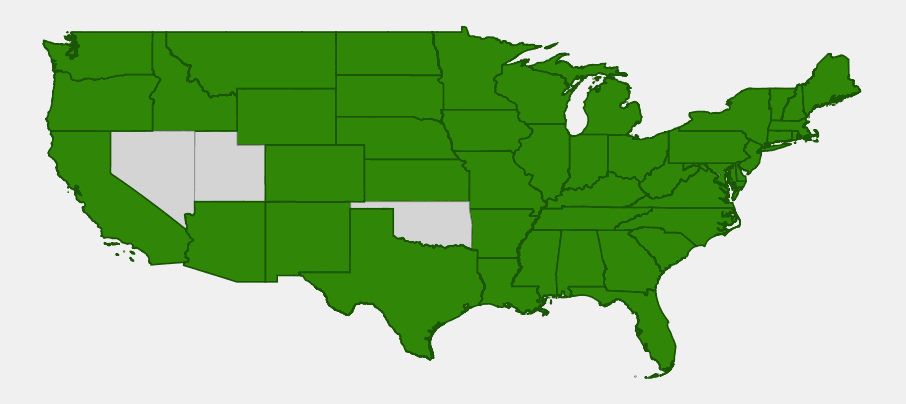
Native lilies grow in most of the lower 48 states. The East has the most familiar species: Turk’s cap, Canada, Carolina and Gray’s lilies in the Appalachians and the Atlantic states, Michigan lily across the Midwest, and pine and panhandle lilies on the southern Coastal Plain. Wood lily covers the widest range of any American lily, from Maine and the Great Lakes across the northern prairies to Montana and south along the Rockies to Colorado and New Mexico, although it has become scarce in many eastern states.
The West Coast is the real center of lily diversity. California and Oregon together hold about half of the country’s native species, including leopard, Humboldt, Sierra tiger, Washington, Kellogg’s, coast and western lilies, many of them found nowhere else. Columbia lily extends north through Washington and Idaho, and the lemon lily reaches the mountains of southeastern Arizona. In much of the arid interior West native lilies are absent, and this guide’s map leaves out Utah, Nevada and Oklahoma, where we could not confirm native wild populations. Alaska and Hawaii have no native Lilium.
Lilies favor places with cool, moist soil and summer sun on their upper leaves: wet meadows, bogs, stream banks, seeps, damp roadside ditches, open woods, pine savannas and mountain meadows. Because the bulbs are long-lived, a colony may persist for decades if the habitat stays open and moist, and many old roadside populations survive along mowed ditches.
📋 Regional plant lists covering native lily ranges: New Hampshire, Maine & Vermont · Connecticut, Massachusetts & Rhode Island · New York, Pennsylvania & Northern New Jersey · Delaware, Southern New Jersey & Long Island · Maryland, Virginia & West Virginia · North & South Carolina · Georgia, Alabama & Mississippi · Kentucky & Tennessee · Ohio & Indiana · Michigan, Wisconsin & Eastern Minnesota · Illinois, Iowa & Missouri · Arkansas, Louisiana & Eastern Texas · Dakotas & Western Minnesota · Nebraska, Kansas & Eastern Colorado · Montana & Wyoming · Arizona & New Mexico · Idaho, Eastern Oregon & Eastern Washington · Western Oregon & Western Washington · California & Nevada
Native Species
These are the native lilies gardeners and hikers are most likely to meet, grouped by region. Thirteen of them have full profiles on Plant Native, linked below.
Eastern & Midwestern Lilies
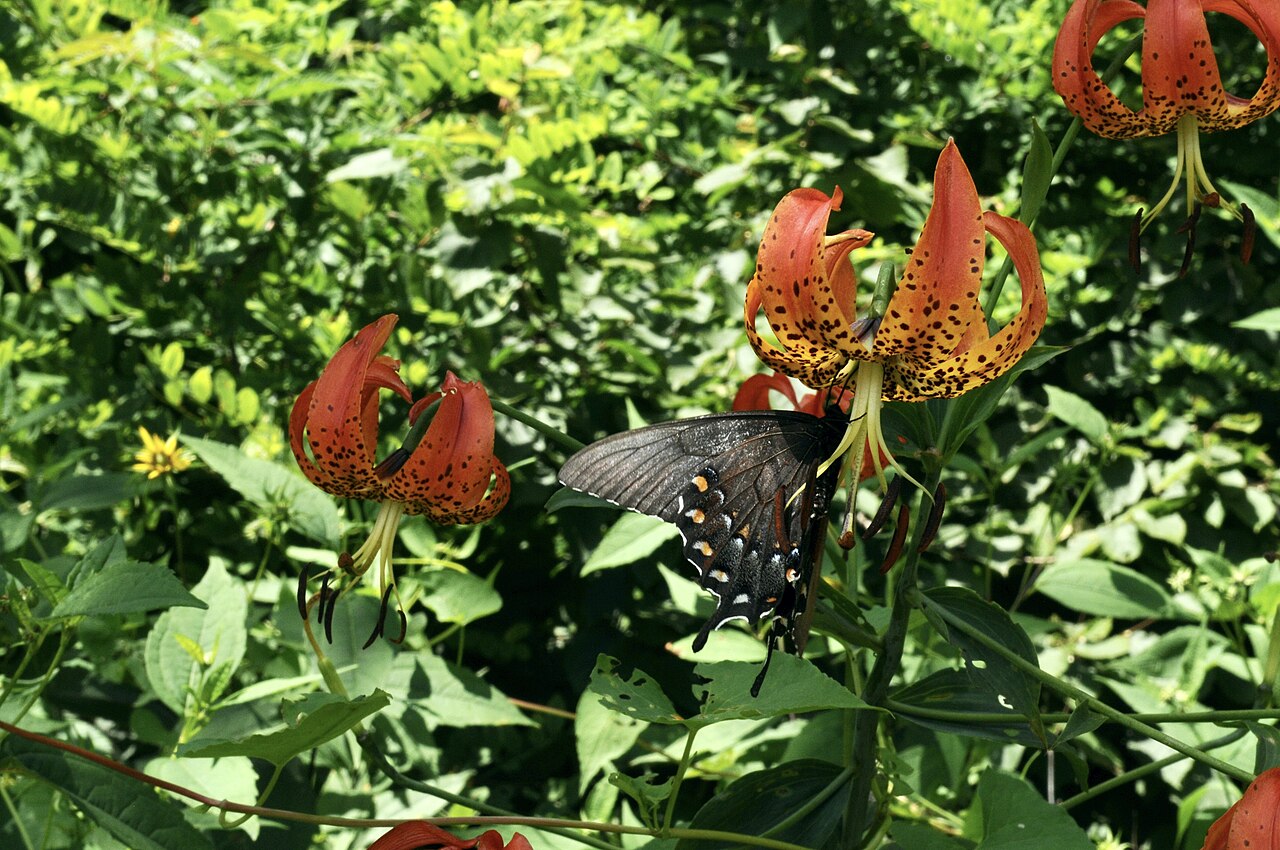
Turk’s cap lily (Lilium superbum) is the giant of eastern lilies, often 4 to 7 feet tall and occasionally taller, with whorled leaves and, on a strong plant, a candelabra of a dozen or more nodding, strongly recurved orange flowers spotted with maroon. Look for a green star at the center of each flower, which separates it from Michigan lily. It grows in wet meadows, stream banks and moist woods from southern New England and New York south through the Appalachians to the Florida Panhandle and Alabama, blooming in July and August.
Michigan lily (Lilium michiganense), also sold as Turk’s cap lily, is the Midwestern counterpart: 2 to 5 feet tall with recurved orange to red-orange spotted flowers that lack the green star. It grows in wet prairies, moist woods and ditches from Minnesota, Wisconsin and Michigan south to Missouri, Kansas, Kentucky and Tennessee, and is one of the best lilies for rain gardens and wet prairie plantings.
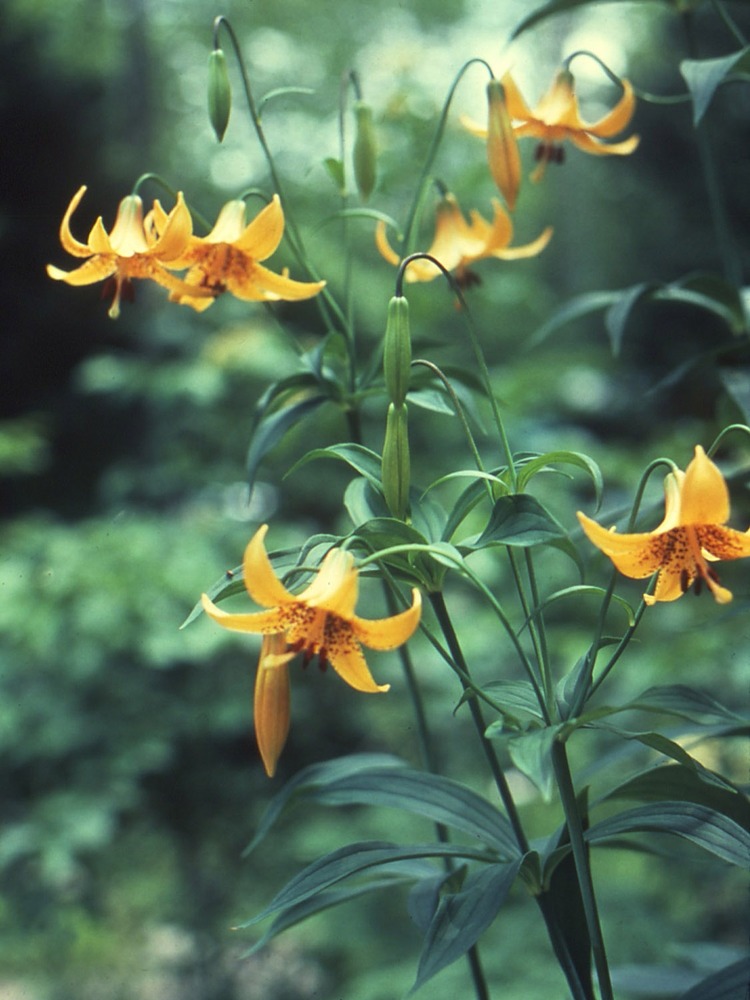
Canada lily (Lilium canadense) carries nodding, bell-shaped flowers whose tepals flare outward but do not roll back fully. It comes in clear yellow, orange and red forms, all freckled inside. Native from Maine and the Great Lakes south through the Appalachians, it grows 2 to 5 feet tall in wet meadows, damp roadsides and moist woods and is a favorite of ruby-throated hummingbirds.
Wood lily (Lilium philadelphicum) is the only widespread native lily whose flowers face straight up: one to a few orange-red cups, 1 to 3 feet tall, with yellow, maroon-spotted throats and gaps between the narrow-based tepals. It grows in dry open woods, sandy barrens, meadows and prairies from New England across the Great Lakes and northern plains to the Rockies. It has declined sharply in many eastern states and is considered rare or protected in several.
Southeastern Lilies
Carolina lily (Lilium michauxii) is the state wildflower of North Carolina. It looks like a small Turk’s cap, 1 to 4 feet tall with one to a few nodding, recurved orange-red flowers, but it has broad, slightly fleshy leaves that are widest toward the tip, and its flowers are fragrant. It grows in drier upland woods than most lilies, from Virginia south to Florida and west to Louisiana and eastern Texas, which makes it a good choice for southern gardens.
Pine lily (Lilium catesbaei) holds a single upward-facing scarlet to orange flower with a yellow, spotted center and wavy tepals that taper to long, slender claws. Only 1 to 2 feet tall, it blooms in late summer and fall in wet pine flatwoods, savannas and bogs of the southeastern Coastal Plain from the Carolinas to Florida and Louisiana. It is listed as threatened in Florida.
Gray’s lily (Lilium grayi) is a rare lily of high-elevation meadows, bogs and balds in the southern Appalachians of Virginia, North Carolina and Tennessee. Its nodding, deep red-orange flowers stay narrowly bell-shaped, with only the tips flaring. It is protected or tracked as rare across its small range.
Panhandle lily (Lilium iridollae) grows in seepage bogs and wet stream edges of the western Florida Panhandle and southern Alabama. Its nodding, recurved flowers are a warm yellow-orange to golden orange with brown spots. It is rare and protected in Florida; do not disturb wild plants.
Western Lilies
Columbia lily (Lilium columbianum) is the native “tiger lily” of the Pacific Northwest: 2 to 4 feet tall with nodding, recurved, orange flowers covered in dark spots. It grows in open woods, meadows and coastal bluffs from British Columbia through Washington, Oregon and Idaho to northern California. It is a different species from the Asian tiger lily, described below.
Leopard lily (Lilium pardalinum) forms clumps from branching bulbs along streams and seeps in Oregon and California, sending up stems 3 to 8 feet tall with recurved flowers that are orange at the center and red toward the tips, boldly spotted. It is one of the easiest western lilies to grow in moist soil. One subspecies, the Pitkin Marsh lily, is federally endangered.
Humboldt lily (Lilium humboldtii) is a California endemic of open, dry woods and chaparral edges in the Sierra Nevada foothills and southern California mountains. Its 3- to 6-foot stems carry large, recurved, golden-orange flowers with big maroon spots. It tolerates drier summer conditions than most lilies.
Sierra tiger lily (Lilium parvum), also called alpine lily, has small, bell-shaped, outward-facing orange to red flowers with yellow, spotted throats. It grows 2 to 5 feet tall along streams and in wet meadows of the Sierra Nevada and southern Cascades in California and Oregon, and is pollinated mainly by hummingbirds.
Lemon lily (Lilium parryi) has fragrant, clear lemon-yellow trumpet flowers held horizontally on 2- to 5-foot stems. It grows along shaded mountain streams in southern California and southeastern Arizona, is pollinated largely by hawkmoths at dusk, and is rare and declining across its range.
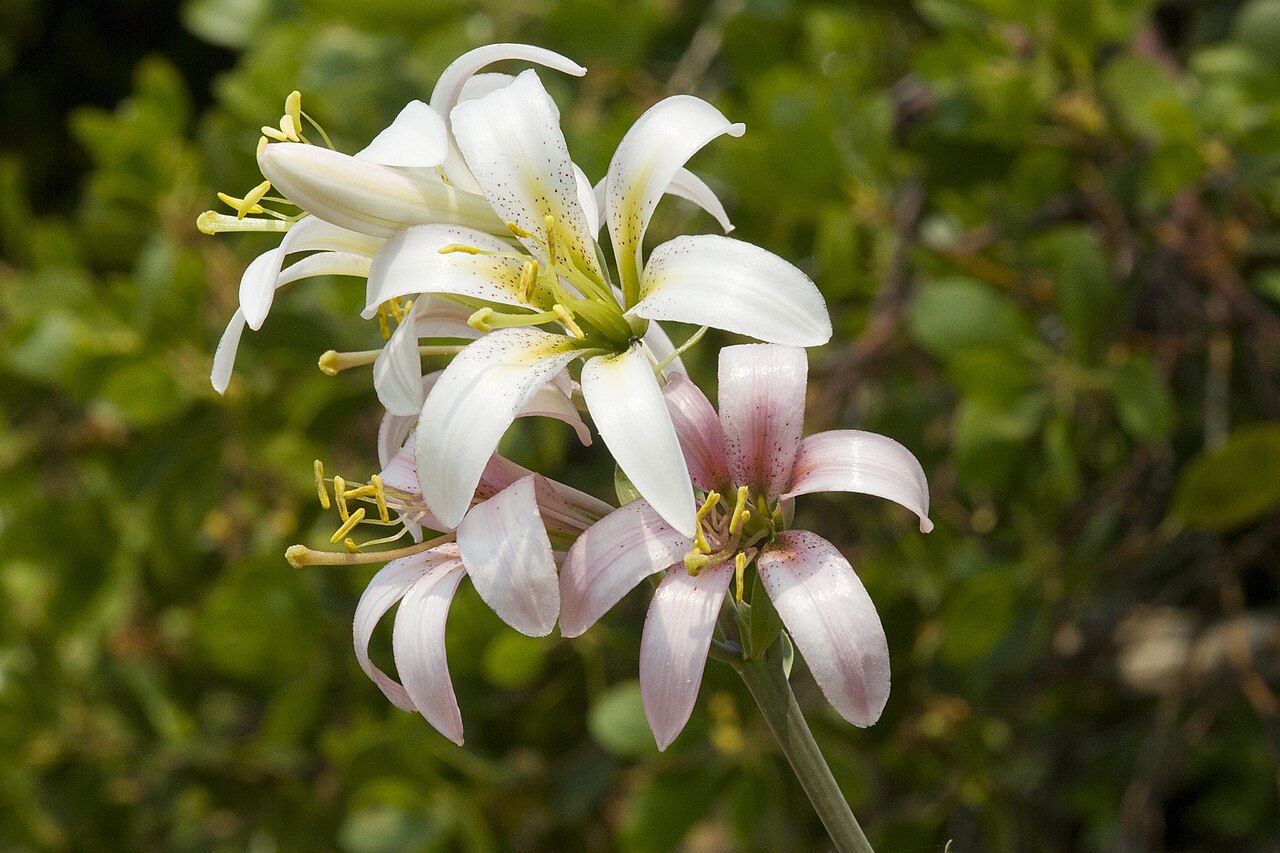
Washington lily (Lilium washingtonianum), also called Shasta lily or Mount Hood lily, has large, very fragrant, white trumpet flowers that age to pink and purple. It grows 2 to 6 feet tall in open conifer forest and brushy slopes of the Sierra Nevada, Klamath Mountains and Oregon Cascades.
Western lily (Lilium occidentale) has nodding crimson flowers with an orange to greenish center and grows only in coastal bogs and wet prairies of southern Oregon and northern California. It is listed as federally endangered.
Other US natives include Kellogg’s lily (L. kelloggii), with fragrant pink-lavender flowers, and chaparral lily (L. rubescens), whose white flowers age to rose-purple, both of northern California and southern Oregon; Kelley’s lily (L. kelleyanum), coast lily (L. maritimum) and Bolander’s lily (L. bolanderi) in California and Oregon; and the rare sandhills lily (L. pyrophilum) of Virginia and the Carolinas.
Native Lilies by Flower Color
Orange lilies. Orange is the signature color of American lilies. Turk’s cap, Michigan, Carolina, Columbia, Humboldt and leopard lilies are all orange to red-orange with dark spots, and wood lily and pine lily add upright orange to scarlet cups. If you want orange lilies with native roots, choose the species from your own region.
Yellow lilies. The best-known yellow native is the yellow form of Canada lily, pictured above. Lemon lily of southern California and Arizona is pure lemon yellow, Kelley’s lily is yellow to yellow-orange, and panhandle lily is golden orange. Wood lily and Sierra tiger lily occasionally produce yellow-flowered plants. Most bright-yellow lilies sold as cut flowers are Asiatic hybrids.
Pink lilies. No eastern native lily is pink. In the West, Washington lily and chaparral lily open white and blush pink to purple as they age, and Kellogg’s lily is pinkish lavender from the start. The large pink lilies of florists’ bouquets, such as ‘Stargazer’, are Oriental hybrids bred from Japanese species.
Growing & Care Guide
Native lilies reward patience. Give them the cool, moist root zone they have in the wild, protect them from deer and pests, and established bulbs can bloom for many years.
Light
Most species bloom best with sun on their leaves and flowers for at least half the day, while their roots stay shaded by low companion plants or mulch. Turk’s cap, Canada and Michigan lilies grow well in full sun to light shade. Wood lily and pine lily need full sun. Lemon, leopard and Columbia lilies tolerate more shade, especially in hot inland areas.
Soil & Water
Plant lilies in deep, humus-rich soil that holds moisture but never stays waterlogged in winter, when sitting bulbs can rot. Moist meadow species, such as Turk’s cap, Michigan, Canada, leopard and Sierra tiger lilies, need regular water through summer. Wood lily, Carolina lily, Humboldt lily and Washington lily prefer sharper drainage and drier summers once established. Most native lilies like acidic to near-neutral soil. A few inches of leaf mulch keeps roots cool.
Planting Tips
Buy bulbs or potted plants from native-plant nurseries that propagate their stock; never dig lilies from the wild. Plant bulbs in fall or early spring, setting them 4 to 6 inches deep (about two to three times the bulb’s height), and handle them gently because the loose scales bruise and dry out quickly. Plant them among low grasses, sedges or perennials that shade the soil, and group three or more bulbs together for a better display.
Pruning & Maintenance
Leave the stems and leaves standing until they yellow in late summer or fall, because the foliage feeds the bulb for next year. Remove spent flowers if you do not want seed. Deer, rabbits and voles eat lily shoots, buds and bulbs, so use fencing, repellents or wire cages where they are a problem. In the Northeast and parts of the Midwest, watch for the introduced red lily leaf beetle, whose larvae can strip native lilies as well as garden hybrids; hand-pick adults and larvae.
Propagation
Lilies can be grown from seed sown in fall or after a cold-moist period, but they are slow, often taking three to five years to bloom. Faster methods use the bulb itself: individual scales snapped off in late summer and kept in moist medium will form small bulblets, and clump-forming species such as leopard and Michigan lilies can be divided in fall.
Landscape Uses
- Wet meadows and rain gardens with Michigan, Turk’s cap and Canada lilies
- Prairie and meadow plantings, where wood lily and Michigan lily rise above native grasses
- Woodland edges and shade gardens with Carolina, Columbia and leopard lilies among ferns
- Hummingbird and butterfly gardens paired with bee balm and cardinal flower
- Bog gardens in the Southeast for pine lily, with pitcher plants and native grasses
- Fragrance gardens in the West for Washington and lemon lilies, near a path where evening scent can be enjoyed
Non-Native Look-Alikes
Most lilies you see in stores and gardens are not native to North America. None of the true lilies below is a serious invader of natural areas, but several matter to anyone who grows native lilies.
Asian tiger lily (Lilium lancifolium). This orange, black-spotted, recurved lily from China, Korea and Japan has been grown in American gardens for over a century and has escaped around old homesteads and roadsides in many eastern states. Tell it from native lilies by the small, dark, shiny bulbils that form in the leaf axils along the stem; no native lily has them. It often carries lily viruses without showing symptoms, and aphids can spread those viruses to native lilies, so keep tiger lilies well away from native plantings. Many people call Columbia lily or even Turk’s cap lily “tiger lily,” but the plant sold as tiger lily is this Asian species.
Easter lily (Lilium longiflorum). The pure white, fragrant, trumpet-shaped Easter lily is native to the Ryukyu Islands of southern Japan and Taiwan. It is a potted holiday plant and a white-lily symbol in flower-meaning guides, but it has no wild American relatives with the same look, except the western Washington lily, which is fragrant and white but ages pink.
Asiatic and Oriental hybrid lilies. The upward-facing, usually unscented Asiatic hybrids come in yellow, orange, red, pink and white and are the lilies most often sold as cut flowers. Oriental hybrids, such as the pink, spotted ‘Stargazer’, have very large, fragrant flowers. Both groups are bred from Asian species. Other non-native garden lilies include the Madonna lily (L. candidum) from the eastern Mediterranean and the regal lily (L. regale) from China. They are fine garden plants, but they support fewer native insects than local species and can share viruses and the lily leaf beetle with native lilies.
Daylilies (Hemerocallis) are not true lilies. The orange daylily (Hemerocallis fulva), the “ditch lily” of roadsides, comes from Asia and belongs to a different family. Its leaves are long, arching straps that all rise from the base, its flower stalks are bare, and each flower lasts only one day. It spreads by thick roots into dense colonies and has naturalized in much of the eastern and central US, where it crowds out native plants in meadows, woodland edges and ditches; many land managers and state invasive-plant councils treat it as invasive. Native lilies, in contrast, have leaves all along the stem, each flower lasts several days, and they do not form solid mats.
Other “lilies.” Calla lily, peace lily, Peruvian lily (Alstroemeria) and the European lily of the valley are not true lilies either. North America also has many native wildflowers called lily that are not Lilium, such as trout lily, bluebead lily, mariposa lily, chocolate lily and woodland spiderlily.
Wildlife & Ecological Value
For Pollinators
The big orange and red recurved lilies of the East are pollinated mainly by large swallowtail butterflies. As an eastern tiger swallowtail, spicebush swallowtail or (in the South) palamedes swallowtail clings to the flower and probes for nectar, its fluttering wings brush the dangling anthers and stigma and carry pollen from flower to flower. Bumblebees also gather the abundant pollen.
For Birds
Ruby-throated hummingbirds visit Canada lily and Turk’s cap lily in the East, and in the West hummingbirds are the main pollinators of red and orange bell-shaped lilies such as Sierra tiger lily and coast lily. The fragrant white and yellow western trumpets, Washington lily and lemon lily, open their scent in the evening for hawkmoths with long tongues.
For Mammals
Deer, elk, rabbits, groundhogs and rodents relish lily shoots, buds and bulbs. In many eastern woods, heavy deer browsing is a major reason lilies seldom flower any more. Lilies are not a significant food source for mammals compared with grasses and shrubs, but that browsing pressure strongly affects lily populations.
Ecosystem Role
Native lilies are indicators of healthy, open, moist habitats: wet meadows, fens, seeps, pine savannas and prairies maintained by fire or grazing. When those habitats are drained, plowed or allowed to grow up into thicket, lilies are among the first plants to disappear. Several species, including western lily, Pitkin Marsh lily, panhandle lily, Gray’s lily and lemon lily, are rare enough to be listed or tracked for conservation.
Cultural & Historical Uses
Several Native American peoples historically dug the bulbs of native lilies, including Columbia lily in the Northwest and wood lily and Canada lily in the East, and cooked them as a starchy food. That is history, not a suggestion: wild lilies are now uncommon, some are protected by law, and digging them destroys the plant. Do not harvest wild lilies.
American lilies fascinated European gardeners from the 1600s on. Canada lily was one of the first North American plants grown in Europe, and Turk’s cap and Carolina lilies were painted by early naturalists. In the 1800s, plant collectors sent western species such as leopard, Humboldt and Washington lilies to Europe, and these became parents of many hybrids. Leopard lily, for example, is a parent of the Bellingham hybrids.
Lilies are also rich in symbolism. In flower-meaning traditions, white lilies stand for purity, orange lilies for energy and confidence, yellow for happiness and pink for love and admiration, and the Easter lily is a Christian symbol of the resurrection. Native lilies carry their own regional meanings: Carolina lily is North Carolina’s state wildflower, and the wood lily is the floral emblem of Saskatchewan.
Frequently Asked Questions
Are lilies native to the United States?
Yes. About two dozen Lilium species are native to the United States, found in every lower-48 region except much of the dry interior West. Most lilies sold by florists and garden centers, however, are Asian species and hybrids.
Are there native pink, yellow or orange lilies?
Orange is by far the most common native color. Native yellow lilies include the yellow form of Canada lily and the lemon lily. Pink appears only in a few western species, such as Kellogg’s lily and the aging flowers of Washington and chaparral lilies.
Is the tiger lily native?
The plant sold as tiger lily, Lilium lancifolium, is native to East Asia and has escaped in parts of the eastern US. It has small black bulbils in the leaf axils. The Columbia lily of the Northwest is often called tiger lily too, and it is native.
Are lilies poisonous to cats?
Yes. All true lilies, including native species, and daylilies can cause life-threatening kidney failure in cats, even from chewing a leaf, licking pollen from their fur or drinking vase water. Keep lilies away from cats, and call a veterinarian at once if a cat may have eaten any part of one.
Is a daylily a true lily?
No. Daylilies (Hemerocallis) belong to a different family. They have strap-shaped leaves rising from the base, bare flower stalks and flowers that last one day. The orange daylily is a non-native that has spread widely along roadsides and into natural areas.

Looking for a nursery that carries native lilies?
Browse our native plant nursery directory: Alabama, Arizona & Arkansas · California · Colorado, Connecticut, Delaware, Florida & Georgia · Idaho, Illinois, Indiana, Iowa & Kansas · Kentucky, Louisiana, Maine, Maryland, Massachusetts, Michigan, Minnesota, Mississippi, Missouri & Montana · Nebraska, New Hampshire, New Jersey, New Mexico, New York, North Carolina, North Dakota & Ohio · Oregon · Pennsylvania, Rhode Island, South Carolina, South Dakota, Tennessee, Texas, Vermont & Virginia · Washington · West Virginia, Wisconsin & Wyoming

