A Narrow Native Garden Between a Fence and a Path: Measure Before Planting
Last updated: November 6, 2026
The strip between a fence and a path is one of the most common small spaces in a yard. It is also one of the easiest to overplant. A nursery pot looks tiny next to a fence, and three years later the plant is spilling over the walk or pressing against the boards.
The fix is not a special plant list. It is a tape measure. Once you know the real usable width, the light the fence casts, and how much room you need for access, the plant choices almost make themselves.
This guide walks through measuring the strip, then matching each plant’s mature width to it. The sample palette uses natives of the eastern and central U.S.; regional alternates are noted, and you should confirm every plant is native where you live.
Plan at a Glance
| Site | A strip bed between a fence and a walkway, patio edge or driveway |
| Size | Usable widths of 18 inches to 4 feet; the sample plan is a 3 × 24-foot strip |
| Sun | Varies by which side of the fence you are on; measure before choosing plants |
| Soil | Average, well-drained soil; edges by paving are often compacted and dry |
| Maintenance | Low to moderate: one vine to train, a spring cutback, edge trimming |
| Best regions | Eastern and central U.S. for the plants named here; regional alternates below |
Step 1: Measure the Real Planting Width
Start at the fence face, not the fence posts or the property line. Measure straight across to the edge of the path at several points along the strip, because fences and walks are rarely perfectly parallel. Write down the narrowest figure; that is the width your plants have to live in.
Then subtract what the plants cannot have. Most fences need occasional repairs, staining or post replacement, so leave a narrow stepping strip against the boards. A strip of mulch or a few flat stones is enough, as long as you can stand there without crushing anything.
Next, subtract the path edge. A plant whose leaves lean a few inches over a walkway gets brushed by every passer, wet with dew and stepped on by dogs. Keep the outer edge of each mature plant just inside the paving, not over it.
What is left is your true planting width. In many yards a “three-foot bed” turns out to have about two feet of real growing room once access and the path edge are accounted for.
Measure height limits, too
Note anything above the strip: windows on a nearby wall, a gate that swings across the bed, an overhanging eave that keeps rain off, or a hose bib you need to reach. A gate swing in particular rules out tall plants in that section of the strip.
Check what is under the soil
Fence lines and walk edges often hide footings, buried gravel and utility lines. Dig a few test holes with a hand trowel before you plan large planting holes. Before digging deep in the U.S., call 811 or use your state’s utility-locating service.
Step 2: Read the Fence’s Shadow and Rain Shadow
A solid fence changes the light in a narrow bed more than almost anything else. On the north side of a tall privacy fence, a strip may get little direct sun for much of the day. On the south side, the same fence can reflect heat and dry the soil quickly.
East- and west-facing strips split the difference, with sun in one half of the day. Watch the bed at mid-morning, noon and late afternoon in summer, then count the hours of direct sun. Six or more hours means sun plants; fewer means part-shade choices.
Rain behaves oddly here too. Wind-driven rain can miss the base of a solid fence, while runoff from the path may soak the outer edge. It is common for the fence side of the strip to be noticeably drier than the path side.
Use that pattern. Put the most drought-tolerant plants against the fence and the plants that like a bit more moisture nearer the paving, as long as the paving does not shed water from a downspout into the bed.
Step 3: Size Every Plant by Its Mature Width
Here is the rule that keeps a narrow bed working: no plant’s mature width should exceed the planting width you measured. Plant centers then go at half the mature width in from the edge they face.
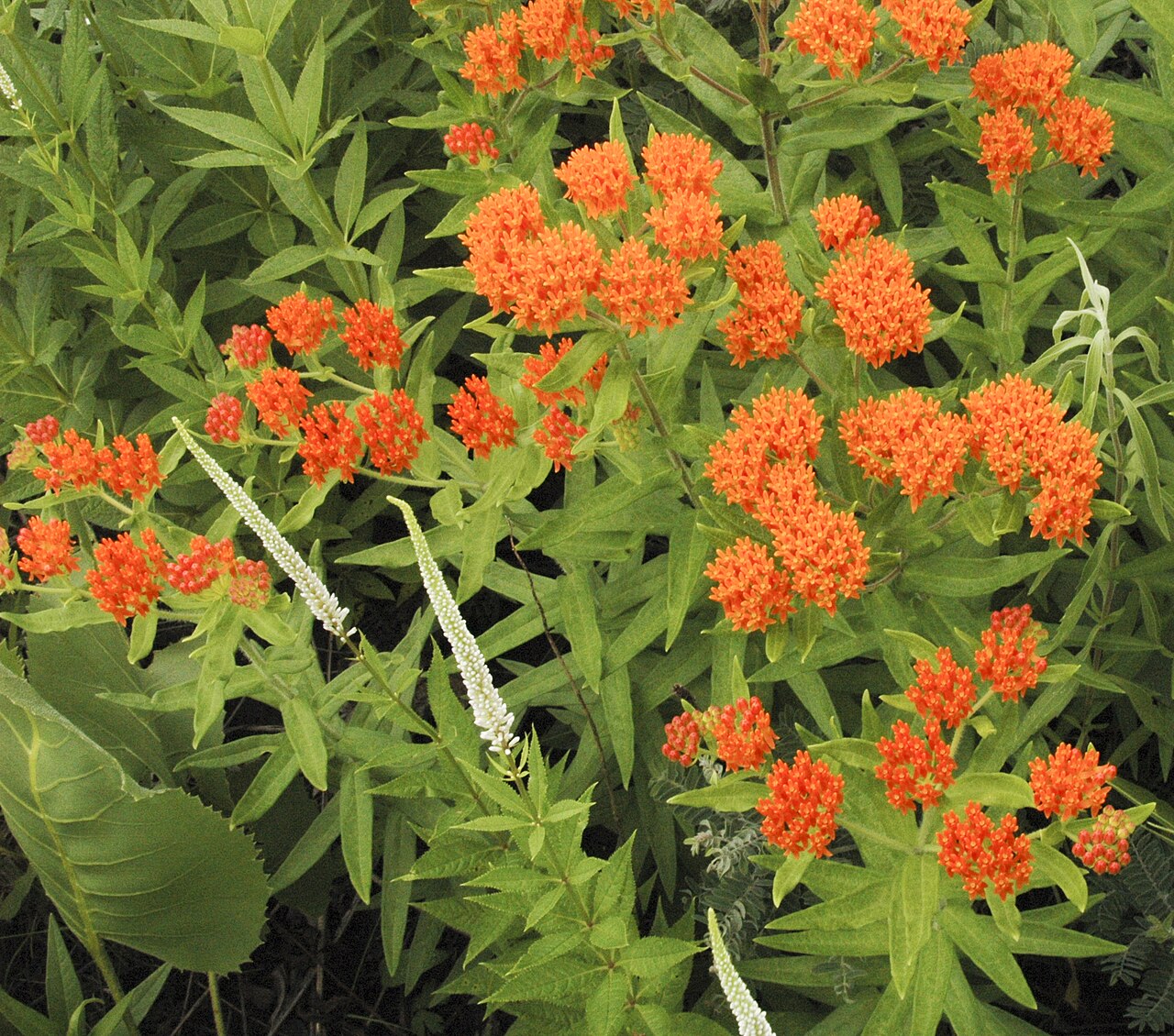
For example, N.C. State’s plant toolbox lists butterfly weed at 1 to 1.5 feet wide. Set it about 9 inches in from the path, and it should fill to the edge without spilling over. Prairie dropseed, at 2 to 3 feet wide in the same database, needs a strip at least that wide or it will push onto the walk.
Widths in plant databases are ranges, and plants in rich, irrigated soil tend toward the top of the range. In a tight strip, plan for the upper figure.
Width tiers for a fence-and-path strip
- Under 2 feet of planting width: one row of narrow plants, a low edging plant, and a vine on the fence. Skip grasses that form wide fountains.
- 2 to 3 feet: two loose rows, with upright plants toward the fence and low ones at the path.
- 3 to 4 feet: room for a few wider clumps such as prairie dropseed or aromatic aster, used sparingly.
Step 4: Lay Out the Strip in Three Bands
Think of a narrow strip as three bands running its full length: the fence, the middle, and the path edge. Each band has its own job.
The fence band: go vertical
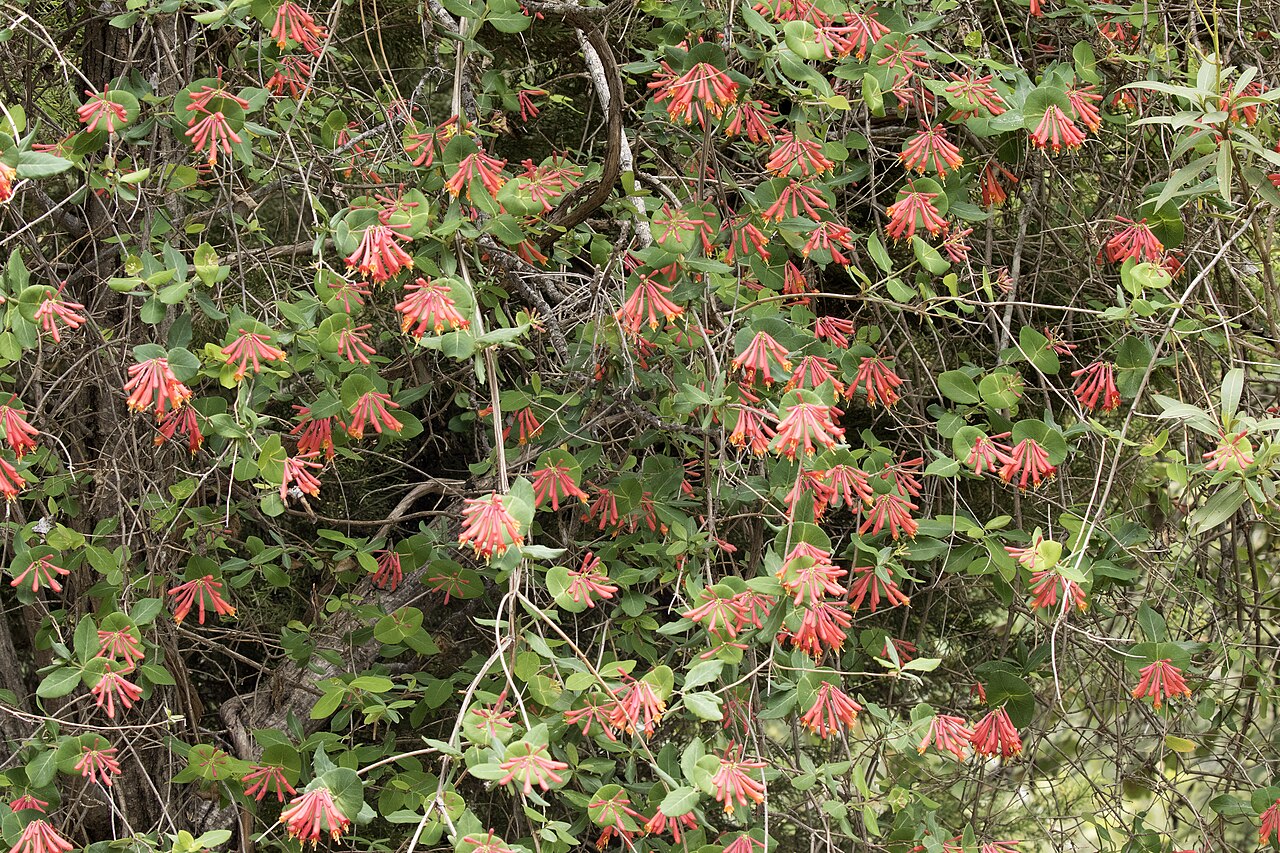
A vine is the best way to add height without using ground space. Coral honeysuckle is a strong choice across much of the East. The Lady Bird Johnson Wildflower Center describes it as a slender, not-too-aggressive climber with stems up to about 20 feet long, native from southern Maine to Florida and east Texas.
Coral honeysuckle climbs by twining. University of Maryland Extension explains that twining vines wrap their stems around a support, so give it a trellis panel or wires rather than expecting it to cling to flat boards. Mounting the support a few inches off the fence keeps stems off the wood and leaves room to stain or repair the fence.
The Wildflower Center notes that coral honeysuckle needs light, good air circulation and adequate drainage to avoid powdery mildew. A support set slightly away from the fence helps with airflow, too. Place one vine per 6 to 8 feet of fence at most; N.C. State lists its width at 3 to 6 feet.
The middle band: upright plants
Choose plants that grow up more than out. On the sunny side, foxglove beardtongue sends up white flower stalks 2 to 4 feet tall from a clump N.C. State lists at 1.5 to 2 feet wide. Butterfly weed adds orange in summer.
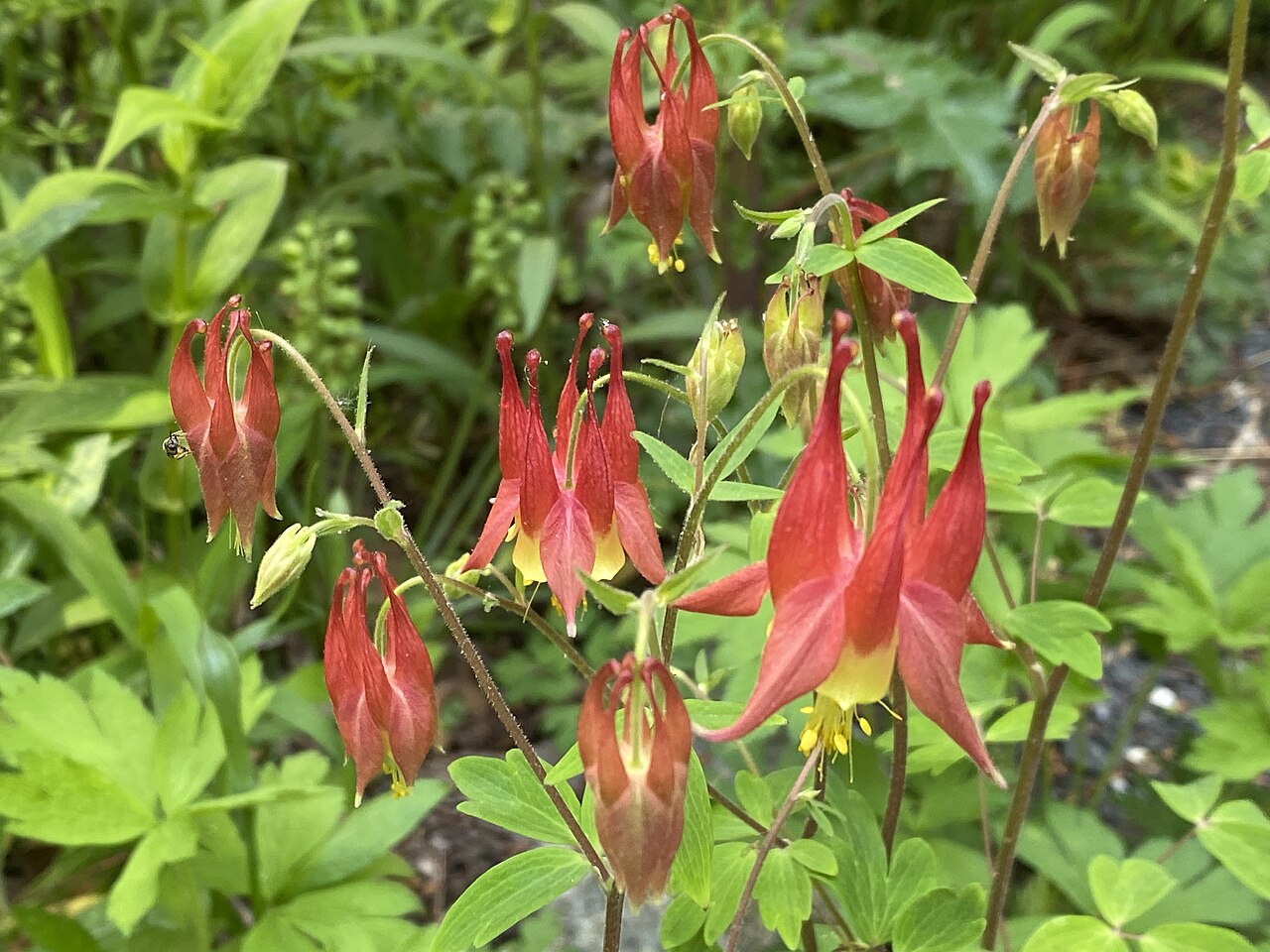
On the shady side, wild columbine is about as narrow as perennials get: 1 to 1.5 feet wide in N.C. State’s listing. The Wildflower Center notes that rich soil makes it rank and short-lived, while thin, well-drained soil keeps it compact, which suits a lean fence-line strip.
The path band: low and tidy
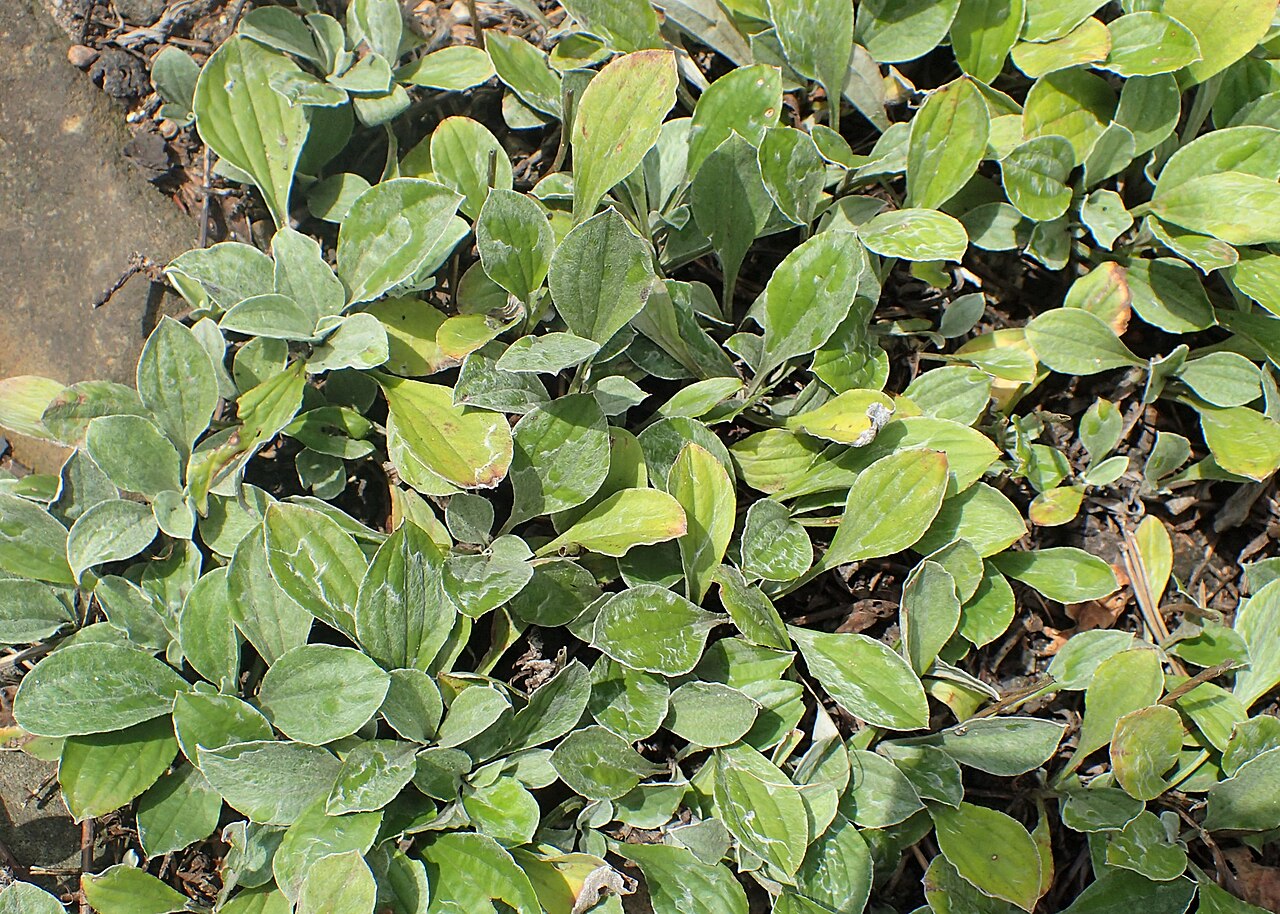
The edge plant should stay well below knee height and not flop. Pussytoes forms a mat; the Wildflower Center gives its foliage as about 2 inches high, with flowers to about 10 inches. It suits dry, sunny to part-shaded edges.
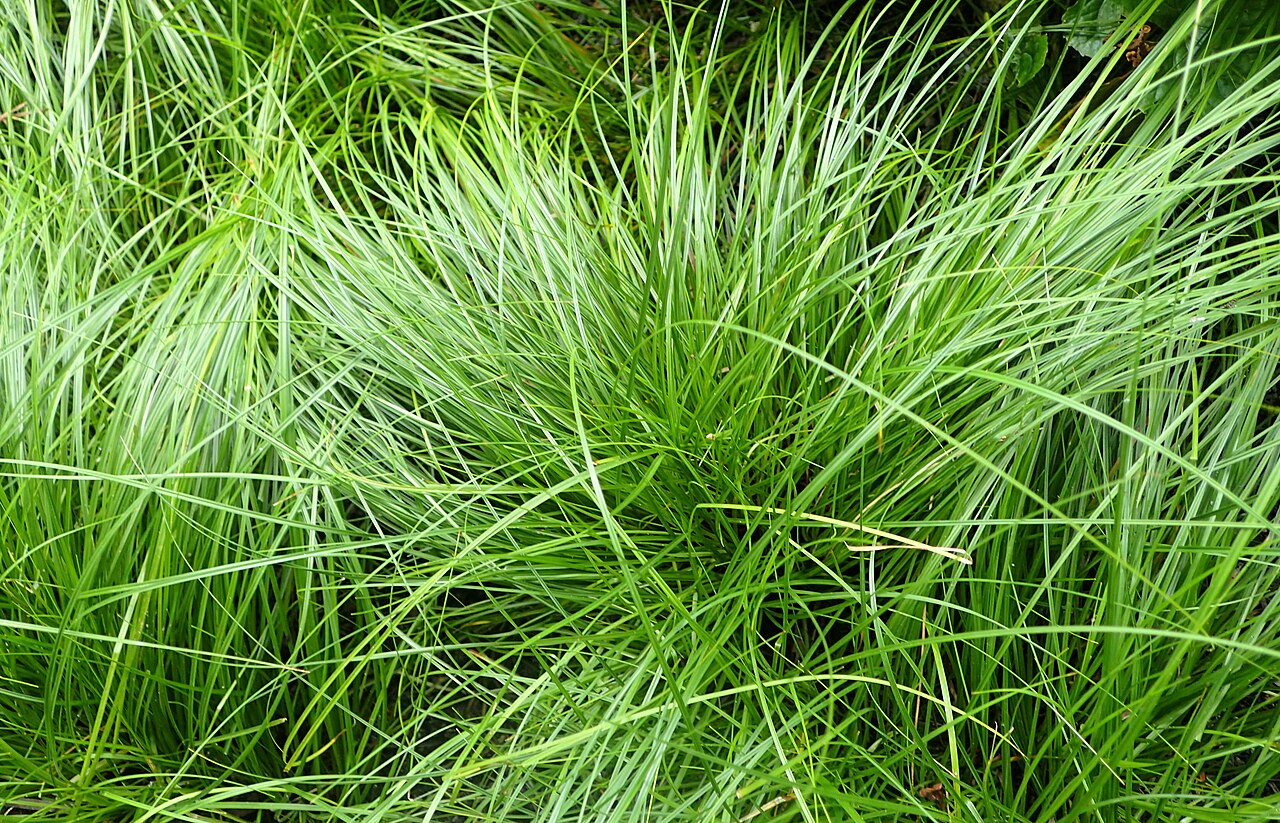
In shade, Pennsylvania sedge makes a fine-textured green edge. The Wildflower Center calls it a fine ground cover that spreads by rhizomes, so expect it to fill the band rather than stay in neat dots.
Plant Palette
Heights and widths are from N.C. State Extension’s plant toolbox; light, moisture and native range from the Lady Bird Johnson Wildflower Center. Confirm each plant is native to your state.
| Plant | Role | Height × width | Sun / moisture | Native range |
|---|---|---|---|---|
| Coral honeysuckle (Lonicera sempervirens) | Fence vine | Stems to ~20 ft; 3–6 ft wide | Sun–part shade; moist, well-drained | S. ME to FL & e. TX; scattered inland to IL |
| Foxglove beardtongue (Penstemon digitalis) | Upright, sun | 2–4 ft × 1.5–2 ft | Sun–part shade; dry to wet | ME to MI & SD, s. to VA, AL & e. TX |
| Butterfly weed (Asclepias tuberosa) | Upright, sun | 1–2 ft × 1–1.5 ft | Sun; dry to moist | Much of the East and central U.S. |
| Wild columbine (Aquilegia canadensis) | Upright, shade | 1–3 ft × 1–1.5 ft | Part shade–shade; well-drained | N. America east of the Rockies |
| Aromatic aster (Symphyotrichum oblongifolium) | Fall clump (3-ft+ strips) | 1–3 ft × 1–3 ft | Sun–part shade; dry to moist | PA to NC, w. to WY & TX |
| Prairie dropseed (Sporobolus heterolepis) | Grass clump (3-ft+ strips) | 2–3 ft × 2–3 ft | Sun; dry | Que. to Sask., locally s. to NC, KY, e. TX & CO |
| Pussytoes (Antennaria plantaginifolia) | Path edge, sun | Leaves ~2 in; flowers to ~10 in; 1–2 ft wide | Sun–part shade; dry | ME & Que. to FL, west to LA, north to MN |
| Pennsylvania sedge (Carex pensylvanica) | Path edge, shade | Up to ~8 in; spreads | Sun–shade; dry | S. Que. to ND & MT, s. to GA, AR & WY |
Regional alternates
- Southeast, long sturdy fence: crossvine is native from Florida to east Texas and north to Maryland and the Ohio Valley. The Wildflower Center notes it can climb 36 to 50 feet, so reserve it for a long, strong fence, not a short run.
- Northern Plains and Upper Midwest path edge: prairie smoke grows up to about 18 inches and, per the Wildflower Center, mature plants often form dense mats.
- West and Southwest: the eastern plants above are mostly out of range. Use the same measuring method with low, narrow natives from your state’s list.
Sample Plan: 3 × 24-Foot Sunny Strip
Assumes a south-facing strip with about 2 feet of planting width after a 1-foot access strip along the fence.
- Fence: 3 coral honeysuckle on trellis panels, about 8 feet apart.
- Middle band: 5 foxglove beardtongue and 4 butterfly weed, alternating, about 2.5 to 3 feet apart.
- Path band: about 16 pussytoes, roughly 18 inches apart and about 9 inches in from the paving; they knit into a mat.
- Total: about 28 plants. A 3-foot planting width could swap two beardtongues for prairie dropseed.
Installation Steps
- Mark the bands. Run string lines for the access strip and the path edge, then mark plant centers with flags or flour.
- Install supports first. Put up trellis panels or wire before planting, so you are not trampling new plants later.
- Clear existing turf and weeds. University of Minnesota Extension stresses removing existing vegetation before planting a prairie garden, because new plants cannot establish while competing with it. A narrow strip is small enough to do by hand.
- Loosen compacted edges. Soil beside paving is often packed hard. Loosen it with a fork in the planting zone without undermining the path.
- Plant and water. Set each plant at the depth it grew in the pot, water deeply, and mulch lightly, keeping mulch off crowns and stems.
- Start the vine. The Wildflower Center notes coral honeysuckle may need help to begin climbing. Loosely tie or weave the first stems onto the support.
The First Three Years
- Year 1: Water during dry spells, especially on the fence side. Weed often; Minnesota Extension calls weed control in the first two years essential for prairie plantings. Guide new vine shoots onto the support.
- Year 2: Check the path edge. Anything leaning onto the walk was placed too close; move it in fall or early spring. Fill gaps with extra edge plants.
- Year 3: Cut back dead stems in late winter or early spring. Thin the vine if it shades the strip or reaches past the fence top. Divide edge plants that have spread past their band.
Mistakes to Avoid
- Measuring from the property line. Measure from the fence face to the paving edge, then subtract access room.
- Planting the vine on the boards. Twining vines need a support they can wrap around, and you need room to maintain the fence.
- Using wide grasses in a tight strip. A 3-foot-wide clump in a 2-foot strip will lean onto the walk every summer.
- Ignoring the fence’s shadow. A sun palette on the north side of a privacy fence will stretch and flower poorly.
- Enriching the soil. Many of these plants prefer lean, well-drained conditions; the Wildflower Center warns that rich soil makes wild columbine floppy and short-lived.
- Forgetting toxicity. The Wildflower Center lists butterfly weed’s roots and sap as poisonous if eaten. Keep that in mind beside a path used by small children or pets.
For a sunnier strip built around grasses, see our narrow blazing star and grass border plan. If your strip runs along the house, our guide to a native grass border that keeps windows and walkways clear covers height limits in more detail.
📋 Find plants for your region: start with the profiles linked above, then see our native plant lists for Connecticut, Massachusetts & Rhode Island, Kentucky & Tennessee and Michigan, Wisconsin & Eastern Minnesota, or the list for your own state.
Frequently Asked Questions
How wide should a garden bed between a fence and a path be?
Any width can work if the plants fit it. Measure from the fence face to the paving, subtract an access strip and a few inches at the path, and choose plants whose mature width is no more than what is left.
Can I plant a vine directly against a wooden fence?
It is better to use a trellis or wires. University of Maryland Extension notes that clinging vines can damage wood surfaces unless trained to a separate trellis, and twining vines like coral honeysuckle need something to wrap around anyway.
What grows in a narrow bed on the shady side of a fence?
In much of the East and Midwest, wild columbine and Pennsylvania sedge are good starting points. Both appear in the Wildflower Center database for part shade to shade.
How far from a path should I plant?
Set each plant’s center at about half its mature width in from the paving. A plant listed at 18 inches wide goes about 9 inches in.
Will coral honeysuckle take over the fence?
The Wildflower Center describes it as not too aggressive. Its stems can reach about 20 feet, so space plants generously and thin or shorten stems after flowering if they outgrow the support.
Sources
- Lady Bird Johnson Wildflower Center plant database, coral honeysuckle, wild columbine, foxglove beardtongue, butterfly weed, aromatic aster, prairie dropseed, pussytoes, Pennsylvania sedge, crossvine and prairie smoke: native range, light, moisture, size notes, growth habit and warnings.
- N.C. State Extension Gardener Plant Toolbox, coral honeysuckle, wild columbine, foxglove beardtongue, butterfly weed, aromatic aster, prairie dropseed, pussytoes, Pennsylvania sedge: mature height and width ranges.
- University of Maryland Extension, Vines: climbing methods, supports, clinging vines and wood surfaces.
- University of Minnesota Extension, Planting and maintaining a prairie garden: removing existing vegetation and early weed control.